Episode 35: Sue Grabowski's Take On Why Your Nephew Should Not Run Your Ads
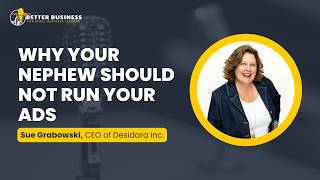
In this interview, Sue Grabowski recounts her journey from a C‑student and music major to founding her own communications agency in 1997 after a bold exit from Progressive Insurance, which became her first client. She describes the agency’s transformation from traditional print production (key‑lining machines) to a tech‑enabled, product‑focused firm that builds tools for articulating specifications, process documentation, and AI‑augmented content creation. Grabowski stresses that sloppy articulation leads to rework and that clear, documented processes—mirroring manufacturing standards—are essential for effective marketing and sales. She warns against chasing tools without a solid audience‑first plan, advocating an "understand‑plan‑execute" framework and long‑term ad commitments. The conversation shifts to crisis communications, where she outlines the need for a pre‑written, accessible plan covering roles, decision‑making, and rapid response, especially in the age of social media and ransomware. Grabowski also shares her extensive community involvement, nonprofit board service, and recent election as a township trustee, linking her Christian‑driven service ethic to her business philosophy. She rejects the notion of retirement, viewing continued public service and AI‑driven change as her next season, while delegating more operational responsibility to her team. Finally, she offers a practical 1 % improvement habit—keeping her kitchen sink empty each night—to create mental clarity and peace of mind that positively impacts her business.
Chapters
I went to Progressive Insurance to get big company experience and quit cold turkey to start my own firm in 1997. Told my boss at Progressive, I'm giving you a month's notice because I'm just going home. I'm not, I'm not going to another job. And 2 weeks into my notice, she came in and said, could we be your first client?
Today's guest has spent nearly 30 years helping people and organizations communicate more clearly, but what really sets her apart is how she leads with clarity, connection, and conviction. Sue Grabowski, thank you for being on the podcast today.
Thank you for having me. I'm really excited.
I'm excited too. Can you tell the listeners a little bit about you, your entrepreneurial journey, and your organization?
Sure. So, uh, long story short is, uh, it's a very long story, but Uh, I was— I have to go back to high school. I'm the first in my family to go to college, uh, and to graduate from college and to, to go. My parents weren't really into it, um, and I really was a C student, wallflower high school person. So I went in as a music major. I took 12 years of piano and went to Malone University, really wanted to go there but didn't know what to major in. And, uh, first semester, Intro to Communications, my— it's a required class for all freshmen. The professor pulled me aside and said the following words. Dr. Kim Phipps, she said, would you take a journalism course? I see some promise in your writing.
Oh wow.
Those words changed my life. Took one journalism course, never went back to music. Do you still have a piano? Okay, very rusty, but love music, just didn't go back to it. Uh, and it transformed me. I went from, you know, C student to A student. President of— I mean, vice president of the student body, editor of the school paper. It, it, it just propelled me forward. I found what I loved. So, um, left there, went to— wanted to work in government. Okay. Applied at the Ohio Statehouse for a postgraduate internship. 25 positions, 300 applicants. You are talking to number 26. Wow. First runner-up in the beauty contest. Nobody— I was the alternate. And so my doors closed in Columbus, and I ended up going down the business route. So I went into— worked at a magazine, worked at a small ad agency, which is where I got the bug to own my own place. And I was 22 and I'm like, I could, I could own my own place. I worked for a woman named Marie Covington, who's very popular in Akron, very well known. And she was really a fire starter in those days. Not many female agency owners. And I got to see everything that the agency did because it was very small. It was her, the office manager, and me. And so, a few years after that, I went to Progressive Insurance to get big company experience and quit cold turkey to start my own firm in 1997. Told my boss at Progressive, "I'm giving you a month's notice because I'm just going home. I'm not going to another job." And 2 weeks into my notice, she came in and said, "Could we be your first client?" It's like a movie. It was crazy. So, Progressive Insurance was my first client. I took about half my job. Home with me. And then the Timken Company, which I did work for, for Marie, I never contacted them because I never wanted to impinge on her. They found out I was on my own and they, they called me and said, would you start working for us doing some speechwriting for the CEO? And it was their centennial celebration. And so I started being on site there and that led to, well, since you're here, could you start, could you do these things too? And the agency took off. So that was a long time ago, almost 3 decades, and I have had shifts up and down through those years, but still love what I do every day.
Yeah. So you've led the organization for nearly 30 years and now it's evolving into something new. So what's been that mindset shift for you as, as you move forward from that traditional agency to tech and consulting? Tell us a little bit about now what you're working on and kind of what the future looks like.
Awesome. Thank you. So in 30 years, I mean, when I look back at the technology, when I started out of college, I worked at a magazine. I literally was using a keylining machine, which people wouldn't even know what that is today.
I don't know what that is.
I would type my articles into a machine that would produce out long galley strips like a newspaper strip.
Okay.
Of the article. And those would be waxed onto paper that I would sit at my desk and lay out into pages of a magazine.
Wow.
From that to these pocket computers that we wear on our wrist or we carry in our pockets in terms of a phone where we can literally talk to AI now. So that transformation is stark. Where I think, um, agency life is going is that the, the production, the, the things that we used to be our bread and butter, we used to make the money on, people don't need us for anymore. I mean, do you need me to make you a logo?
No.
You, you know, you— people even say they don't need us to write. Hmm, questionable. I think they need us to edit, but we— but they definitely can get so much farther down that line than they used to. Where I think we come in as a communications firm and as a tech firm is the articulation of plans and articulation of specifications. The, the clearer your specification, whether you're doing a project or a full marketing plan, or you're just trying to build out processes, the clearer your articulation, the easier it is to get the final outcome you desire, whether that be through AI or through human effort. And what I find is sloppy articulation is what causes the most rework and causes the most problems. And people just think they can just spit into AI and get something out that, that's going to be useful to them. So I think that my years of articulation and message development and clarity now combined with AI— and when I say we're a tech company, we now have products in-house that can help us do that, help us build refinement, help us bring together outside sources and inside insights Okay. Into documentation that then could be handed to a person to go produce or to a computer to go produce or AI to produce. And so I work with— I bought out technology Squawker Mobile Media in 2015. My now business partner had shown me easy ways to present content in mobile devices. At that time we said we're calling it Squawker with a QR. And I was called crazy by folks because QR codes are passé. QR codes aren't going to be used.
No one's ever going to use them. Yep.
Here we are, pandemic later, nobody touches anything, right? So, uh, we're trying to look ahead and say, what does the future of communication look like? Not just marketing, and then building tech to support that. And so we've got Several products, like I said, that we're using right now to help our clients better articulate specifications, build out processes for communications, which is generally not a process-driven function within an organization. Yeah, we're just a bunch of jazz hands people.
No, that's not true. Where do you think most people miss the mark in internal or external communications? Because that's, that's your sweet spot. Where do I know that a lot of times business owners think, oh, we've got our communications figured out. We don't. Where do they miss the mark?
So a couple of things. One is is they don't treat it like other segments in their business. So let's talk about manufacturing, for example. In a manufacturing facility, processes must be followed or people get injured or products are not put together properly. And so you've got, you've got liability, right? But when it comes to sales and marketing, it's just like whatever we feel like doing, you know, one, one person handles sales a certain way and they've got their own je ne sais quoi and they've got their own way of doing it. And then that person leaves. And you lose that. I think documenting processes related to marketing is one of the biggest problems that organizations face, small businesses and large, because it's, it's the roles that are squishy and are not managed properly in terms of what are our outcomes, defining our, our objectives, and make sure that— making sure that our tactics align with objectives instead of trying to throw things against the wall, hoping that they stick, and then complaining either about the agency or the idea that they had when it didn't work. So that same articulation that would go into building out a manufacturing facility or a manufacturing line needs to be applied to marketing and sales. And unfortunately, that doesn't happen because it's a, it's a feely segment of the business. And I think we bring— at least we try to bring a more objective approach to it. And we— it forces us to get out of the— it doesn't— it does not restrict the creativity. It just focuses creativity on the outcomes that you want rather than we just need to increase sales.
No, I love what you're saying in that you can— it's about intentionality, being intentional and having the focus to be able to do the fun, creative things that may get individuals' attention. But there's got to be strategy and intention behind it.
Right now, the other issue I see is people chasing tools. Mm-hmm.
Tell me more about that.
So there's a tool a minute coming up that we're going to get you in front of more people, or we're going to make it easier for you to get things on multiple platforms, or we're— those things are great. But if you don't even understand the basis of who your audience is, taking a step back and saying, who are we actually trying to meet with? Who are we trying to connect to? That's problematic because what if your audience is best reached through snail mail? What if they're best reached through, you know, person one-to-one-on-one phone calls? Those things are not completely dead, but we invest in tools thinking we're gonna— it's gonna be the silver bullet. And again, we get frustrated when we don't get the results that we think we're going to get, and then we blame the tool and we go on to the next tool. So I am a big proponent of taking the step back and planning first. So we operate from an understand, plan, execute model at my firm because we got to understand where you want to go first and who you're trying to reach and what your, what your deliverables are going to be. Building a plan out to match that and then execute. And right now in marketing and sales, it's a lot of execute first. Yeah. And then go back and go, well, that didn't work, so maybe I should plan now. And you lose time, you lose momentum, and it gets really frustrating.
What is your, your thought or your expertise around, you know, patience? I know for, for me in the insurance space, in the HR space, a lot of times it's business owners are not willing to commit for a season. They want to commit for a moment. Is that— do you find that similar in marketing? Like, do they commit long enough, or do we have just too short of an attention span? Oh, there's another tool here, I'm going— is, is part of the issue also? Being willing to commit and give the time for something to grow.
It is a game changer. So I— we do, um, social media advertising, for example. I currently will not engage with a client for less than a year, and that probably sounds like, what? Well, here's what happens. We can make something happen right away, and you can get a little uptick, whether that's in engagement with your pages or traffic to your website. But the minute that you stop that, and it's— you basically start from ground zero all over again. Secondly, there is this long tail effect that has great benefit because you build your audience first, find out what they like to interact with, A/B test ads, everything from colored backgrounds to headline changes and content changes. You find out what's working with the audience, then you can build on that and you can grow that initial audience through retargeting and other things. And then you can approach like-minded folks in that same way. But that takes time. And the other thing is people will invest in— well, my, my nephew's kind of techie, so I'll have them buy my social media ads. You know, we have actual social media ad buyers who expertise, who understand that. But again, that takes time and experimentation. People want quick fixes. And the other challenge is, what if that's not the problem with your sales? You know, What happened? We only control— marketing drives leads to sales. That's, that's our desire is to drive leads to sales. I don't control your sales team. I'd like to. I don't know how they answer the phone. I don't know how they respond in email to inquiries. I don't know what their diligence is. I don't know what their tone is. I don't know what your operations are like. I don't know what your customer service is like.
Can they close? It doesn't matter how many doors you open if no one can close them.
Often people are like, we have trouble with sales, we need more sales. What if the sales aren't the problem? What if the operations are the problem? And then you call a marketing firm to fix your operations and then again, you get frustrated at the marketing firm for not, yeah, not driving the sales that you want. So that's why I think you need a strong plan and you need defined objectives. What are you really trying to do? And it can't just be as simple as we just wanna grow, we wanna grow sales. It doesn't everybody.
Yeah. Good point. So while we're talking about communication, you know, building patience, executing on a strategy. Let's talk about the other end in crisis communications. And so how should a business communicate during crisis, and what's the— what's one thing that they should have prepared before anything goes wrong? As a communications expert, I'm excited to hear what you have to say.
Thank you. This is a great topic. So, uh, I teach crisis communications planning to, uh, folks in the UAE government.
Oh wow.
And been to do Dubai a couple times, and they really care about preparing for crises. And these are government folks that are in a variety of roles and a variety of ministries within the government. And I can tell you that most small businesses do not have a crisis communications plan at the ready. And today more than ever they need to because social media can be the devil and a single bad post Yeah, I've had local clients have a post made about them from an average person, not an influencer. This is not a media thing and spool out of control before they even know what's hit them. So we got to plan for when, not if, a crisis occurs. And with ransomware, I've had two clients face ransomware problems where It's terrifying. Whole operations shut down.
Yep.
So, you need a thorough plan that maps out what you think might be your risks. You know, dream up the scenarios. Everything from my building burns down to an employee commits a heinous crime. And it's kind of fun to brainstorm those because you're like, that would never happen.
That would never happen.
That would never happen. It does happen. So everyone needs a crisis plan and you need to have a plan that covers who's on your team. You literally have minutes now. Back in the not so distant future, in my early days in communications, 2 decades ago, maybe even a decade ago, you could have a crisis plan in place and it was in that file drawer. And when something would go bad and maybe the media would hit, you'd have about 24 hours to formulate What are we going to do? You don't have that time now. So being able to reach for something that says, okay, in this kind of scenario, we need this group, we need legal, we need a subject matter expert, we need a spokesperson who's going to be the person that's liaison with the media. We need copy editors who are going to read everything that goes out, fact checkers. And here's how we structure our decision making regarding how severe is this. So I will say just some tips. If there's ever an injury or a loss of life, you are at DEF CON 10 and you need to be able to respond with compassion and competency at those times. And the only way you're going to do that is to be able to calmly speak from facts. And when we don't have a plan, we will speak from emotion and we will say the wrong thing online, on camera. To other people. And we need to start with our employees really first, because employees are your greatest advocates, your greatest ambassadors. And sometimes we don't even keep them in the loop first. So the number one thing is to have a plan. I don't care if it's even just a rough one. We build out comprehensive ones, but you don't— you want to go to sleep at night knowing that your leadership team has something they can reach for. And when I say reach for, outside the firewall, because you could get ransomware attacked and all your systems are compromised, where all of your key leaders can get to it and somebody can take the lead. It really does bring peace of mind. And I'm all about bringing business owners peace of mind. They don't need to be thinking about these things at night. They have enough on their plates.
No, I completely agree with you. So let's shift a little bit from crisis. So let's talk about community impact and public service. So you've served on a lot of different nonprofit boards. And now you're in public office as a township trustee. Congratulations on your win.
Thank you.
Why has community leadership always been a non-negotiable part of your business and your life? I feel like we share some of this, so I would— I'd love to hear your answer.
So there's really two, several things that influence that. One, um, I, I am a Christian. I believe that we're to serve other people. That's what we're here to do on this planet. So there's that. But I don't think I am well-designed for all of the, the service that needs to be done. I think I would make a really not so great nurse. Uh, I would make a not so good medical— things would not be good. I don't think I'd be a great foster mom. And I'm just amazed at the people who raise their hands to do so many different volunteer things. So, uh, what I can do is help them from a board perspective. I can help raise money. I can help raise awareness. I can help them with decision-making as they're doing their jobs. I come in and help, you know, make some, some key decisions. So I've always thought that that's important. I really see the government work— well, I'll say where I've served in the past is Pathway Caring for Children, which is a nonprofit that is a foster care and mental health agency. Blown away by what, what they do and agencies like them do. I worked at Mobile Meals in Akron. Again, um, just delivering food and being that human contact to people who maybe never— don't have human contact. That's just gigantic. Um, but I also believe in the business community, so I'm on the board of the— of the Canton Regional Chamber of Commerce. I'm a— um, I really value helping grow businesses, helping entrepreneurs. When I started, I don't know how you felt when you started, I didn't know who to go to. No, I didn't talk to anybody. I made so many gigantic mistakes. And just winged it. So let's work with organizations that help us not go down that path. Um, so I, I just continue to, to be part of that. I'm on the board at Malone University, which I feel such an honor because that place changed my life so much. Um, but I— the public service part of it is really, I think, the ultimate outworking of that, because in those groups I'm representing kind of affinities You know, are, are you caring for kids? You're caring for businesses? Are you caring for students? As a public official, I'm caring for 30,000 people. Uh, and they may or may not agree with me on all the decisions I have to make, but I have to try to think in their best interest. Uh, so to me that's the natural kind of outworking and it's taking me right back to my roots from 35 years ago, which is, is crazy. So I just put my hat in the ring. I'm, I'm finalizing my my signatures to run for state representative for the 48th District.
Wow.
And, um, so gotta win in the primary. We'll see what happens. And I feel like if the voters want me to stay at the local level, I'll stay at the local level and serve. If they think I can do more at the state level, which I believe I can, because a lot of local issues can't be solved locally, then I'll do that. But I'm really geeked about it, and I'm doing this really for me, it's something I would like to do now. My business is mature, the business is changing, but I've got a great team that's serving our clients. And I think now's the time.
Yeah, so that leads me into a question. You know, I've heard you say you don't believe in retirement, you do believe in restructuring your life. So what does this season of leadership look like for you as you're looking at, you know, moving into a different space? But also how you've worked to develop your team. So what does the future look like for you, Sue?
How I spend my time is going to be, you know, different. It is right now. You know, I'm spending time on township things.
And I think—
so I don't, again, I don't really believe in retirement. I don't see it biblically. I just don't. I also, I had a dad who lived to be 90. And a grandmother who lived to be 101.
Wow.
And my dad sold his mechanics garage. He had a repair shop in North Canton at age 65, and then he went to work at Stark State in the auto lab till he was 80, and he retired again. And at 82, he's telling me I should never have retired because I think there needs to be something that gets you up in the morning. So at my age of 57, almost 57, I'm, I'm like, What do I want that to be? What's that path next? I think public service is that path. I think it would get me up in the morning. The business still gets me up every day. I love what I do and I will keep that going. But I think, um, in the coming days, I think my team will take more and more responsibility for day-to-day stuff. They already do, but you know, I think, and I think they're welcoming that too. I, you know, I micro, I, I'm like, if I can micromanage like any crazy entrepreneur does. Yeah, absolutely. We can be completely off in our own world and then we come back and we're like, yeah, but what about this thing? And they're like, I've got that handled, man. Just chill. Um, I think that I'm giving freedom to the next, you know, generation to, to potentially take over my firm in the future. And then also I will spend my day out with people. I love to be with people. And I think spending time listening to the constituents, listening to residents, solving problems locally or at the state level, and moving the needle. I mean, I just think we need to move faster in everything, business and government, because I don't think we understand how fast AI and AGI is coming.
Yeah, very good point.
And I think we're like, it's out there. It's not out there.
No, it's here.
It's right here. And it's going to dramatically shift our way of life. And I don't want to be in the back seat for that. I want to be in a driver's seat for that. So I think I'm making some moves right now because I feel the pressure to— I need to move. Okay, now, or, uh, if I wait, opportunities will pass me by. And as an opportunity junkie, I'm not willing to let that happen.
No, I appreciate that. I like— I share your your love of opportunity.
Yeah, most entrepreneurs do. We do.
And we get, I mean, sometimes we get bored and sometimes we get called to bigger things. So congratulations on, you know, acknowledging that retirement's not an option for you. You're going to reimagine.
We'll see. I mean, I do like to play golf. I'd like to play more golf, but I don't think I want to play golf every day.
All day?
No.
No, I don't think that's a good idea.
It's not my thing.
So as we start to wrap up, we have one question that we always ask all of our all of our guests, and that is, you know, what is the one thing that you would tell a business owner to do to get 1% better in their business every day?
So this is a strange answer, but I think in their business, I think as entrepreneurs, we understand that if things are not right at home personally with us, our business suffers and vice versa. If things aren't going well at the business, we drag it home. What I've found is peace of mind drives a lot of benefit in business. And one thing that I've done in the past year is I don't have any dishes in my sink. Uh, this sounds really strange.
Oh no, I love this. Tell me more.
So I, I tend to work in piles, not files anyway. I always kind of have been that. My, my college roommates would tell you, like, I don't like, uh, clutter around the house so much, but my desk is always There's piles and I know exactly what's in the piles, but it looks like chaos.
Mm-hmm.
And I know other entrepreneurs that operate that way. But I would also at night, you know, look, I, we finish up dinner and the dishes would be in the sink. And then the morning I come out and we work remotely since COVID even before COVID we were working remotely. I come out in the morning to make my coffee and there's those dishes.
Mm-hmm.
And there's a study that shows that actually clutter with really affects women chemically. Mentally, even more than men. And that's how you're starting your day. You're starting your day with something that you have to do. There's no, there's no clean way to start your day. And most of us start our day with a cup of coffee or a breakfast or something. And so you have to wash those before you go make your egg, or you have to wash those before you get that coffee cup. So started making it so that at night there is nothing on my sink and nothing, nothing in the sink, nothing on my counters. And when I come out in the morning, it's this breath of fresh air. When you talk about 1%, it changes. I come out with a smile on my face instead of that humped-shouldered big sigh. And it's changed a lot for me. And I wonder how many of us in business, before we ever get to the business.
Yeah.
What, what are we starting our morning with in terms of clarity and peace that could actually affect how we treat our employees, how we approach that first task on our list. And so I've— that's what I do.
I've—
I don't have dishes in my sink anymore.
So I love that. Thank you. It's so practical.
1% practical. It seems like such— it's really changed things for me.
Yeah. How can people connect with you?
Uh, you can connect with— so all of my social media is public. If you go to Sue Grabowski, it's Sue Dorschuk Grabowski, but, uh, you can go there on Facebook, LinkedIn, uh, Instagram. They're all public. You can connect with me there. Uh, you can go to desidar.com. Uh, and my cell phone is like out there, so, um, hey, you know, 330-608-1651 is my cell. Um, during the campaign, people are like, how do I connect with you? And they're like, wait a minute, I found you. Just, just call me. Uh, and yeah, I still get a lot of spam calls, but so if I don't answer and you leave me a message, I'm going to call you back. It's wonderful. Um, would love to connect with The people want to talk.
Sue, thank you for your time today. Thank you for sharing.
For the opportunity. Opportunity junkie. Absolutely. Thanks.










