Episode 36: How Jim Barlett Broke The $3M Ceiling With Forward-Looking Finance
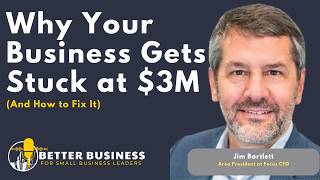
In this episode of the podcast, host Chrissy Myers interviews Jim Bartlett, Area President at Focus CFO, about the challenges small businesses face when they reach the $2‑3 million revenue inflection point and how forward‑looking financial practices can help them break through that ceiling. Jim shares his personal journey from Navy mission commander to e‑commerce entrepreneur and eventually to a fractional CFO role. He explains why many owners become stuck—owner‑dependency, lack of strategic financial analysis, and reactive cash‑flow management—and introduces the core tools Focus CFO uses: a 13‑week cash‑flow forecast and a “DNA” model that maps key business metrics. The conversation delves into the unique value of operationally experienced fractional CFOs versus traditional consultants, the importance of building trust (the “Sherpa” analogy), and how CFOs act as liaisons with banks to translate founder vision into financing language. Jim also discusses cash‑flow crunch mitigation, the role of coachability and self‑awareness in evaluating new ventures, and how Focus CFO tailors engagement models (flexible fractional days) to fit businesses of different sizes. The episode closes with practical advice for daily discipline—blocking time on the calendar for outreach—and contact information for listeners who want to connect with Jim.
Chapters
Smaller businesses tend to be owner-dependent.
Yeah.
And so the owner entrepreneur, you know, they had a great idea, they're a real good salesperson, you know, whatever that skill is that they have, they use it and they have great success growing a business. But there comes this point and it can be different depending on the business, but there's this point where they just can't do it all.
Our guest today My guest today is someone who has flown missions over the ocean and scaled e-commerce brands from the ground up. Jim Bartlett is an area president of Focus CFO, where he helps founders move on from reactive to strategic using forward-thinking financial systems. Jim, thank you for coming on the podcast today.
Oh, thank you, Chrissy. I'm glad to be here.
So before Focus CFO, I mean, I know you were at Staples, before Staples, before Vineyard Fresh, which I know is another organization. You were a Navy mission commander and then an entrepreneur. So what was your first real step into entrepreneurship And what pulled you in?
This is back in 2004. I had done the military thing for a while and then the corporate thing for a while. When my fourth daughter was born, fourth child was born, my wife and I at the time were like, "OK, what's next?" I decided at that time I wanted to do something different. I wanted to do something on my own. In 2004, I started up an e-commerce retail business in the sporting goods space. That's where it began. I had that business for about 12 years.
Wow. And you exited?
I did. I went through the— Replay the tape. 2004, there was this thing called Google AdWords. That's what I used to grow the business. 12 years later, this thing called Amazon had really become dominant in that space. In 2016, decided to exit the business and sold it to a larger distributor.
What moved you to Focus?
So this is about a year ago now.
Okay.
And, uh, I'd had two other entrepreneurial experiences in between those two, and the last one was this Vineyard Fresh that you had mentioned. And, uh, that's a whole separate story. We can go down that road. But I decided to, uh, with my partner and I, to shut that down. And I was like, okay, well, I've done the military thing, I've done the corporate thing, I've done entrepreneurial thing. Like, what's next for me?
Yes.
I'm at a point in my life, got some gray hair, and I was like, "I don't know if I want to go back to the entrepreneurial. I feel like that chapter of my life is closed." I thought about, "Well, how can I help entrepreneurs?" Because I love stories about small businesses and what they do. I ended up having this conversation with a gentleman in Columbus named Brad Martin. Brad's the founder of Focus CFO. He founded the business in 2001. I'm having a conversation with Brad. "Hey, is there a way that I can help your clients?" He said, "Well, you know what? We have this role called area president and somebody with your background in entrepreneurial space would be terrific because the role is to go out and meet business owners, talk to them, see what challenges they're having, what pains they have, and see if we can help solve them." That's what began the conversation. I had no idea a year ago that I'd be sitting here as an area president with Focus CFO.
And now you're in the, the consulting space where you're helping businesses figure out, you know, how to continue to move forward. So I've heard you say a common mistake business owners make is driving while looking in the rearview mirror, checking numbers only at tax time. So what's the very first forward-looking financial habit you encourage those founders that you work with to build?
Yeah, I mean, I think it's, you know, job one for our CFOs when they begin is to, you know, like you said, start looking forward. Cash flow forecast is probably the number one thing. So developing a 13-week cash forecast and then what we call a DNA model. So how does the business operate? What metrics are there and how do they relate to each other so that you can understand the business? Those two things, I think, help the owner kind of get their head up. And instead of looking at a financial statement of last month's performance, Thinking, okay, you know, I have a potential cash issue 8 weeks from now, 12 weeks from now. What can I do about it so that it doesn't become something that's real serious? So just getting that head up and looking forward.
Now, and you work with, with organizations between like $3 million to $30 million, helping with strategic focus around specifically financials, financial management, the things that they need to make, make good decisions to grow their business. What is it about that $3 million mark in revenue that causes so many businesses to get stuck?
Yeah. I can relate personally. My e-commerce business, our top was $2.5 million. And so I think I saw what happened, and I see this happen every day with people I'm talking to. Smaller businesses tend to be owner-dependent. And so the owner-entrepreneur, they had a great idea. They're a real good salesperson. Whatever that skill is that they have, They use it and they have great success growing a business. But there comes this point, and it can be different depending on the business, but there's this point where they just can't do it all. And that's this inflection point where kind of, well, one of three things happen. One is that it goes south. The other is it just kind of goes sideways. And the third is if the owner can begin to do things to delegate, to develop the organization, get themselves back out of everything that goes on in the business. That's when they have time to refocus back on growth, what got them there, what they're good at. Those are the types of things at that $2 to $3 million point where a lot of owners get stuck and they need help getting out of that.
A lot of business owners think, "I've got a bookkeeper. I've got the CPA. I'm covered." It seems like the main small business mentality. But you say there's still a gap. What does fractional CFO work? What does Focus CFO? How do they play and do the things that others can't. Tell us why it's important.
A business has got to have some sort of an accounting function to pay their bills and/or collect money from customers and just do general accounting work. That exists. They also have to comply with tax codes and tax laws, so they have a CPA that helps them do that. The gap that I see comes in when, you know, who is doing the real strategic level, forward-looking financial analysis, strategic analysis? And more often than not, that's the owner themselves. And so, you know, you've got the owner who has certain capabilities and there's this huge gap down to kind of the administrative level of the organization. And so, you know, the owner is the one who has to do it. And one of two things happens. Either, you know, they do it, in which case they're spending a lot of their time and energy in that space as opposed to growing revenue. Mm-hmm. Or it doesn't get done at all. And more often than not, it just doesn't get done at all. So the react— their, their reality ends up being that the owner is, you know, it's involved in the day-to-day firefighting, you know, working real hard and nobody's doing the forward-looking strategic level. Thought. So in a fractional space, you know, fractional CFO can play that role. So they can fill that gap between the owner and the rest of the organization. And it does two things: it frees up a bunch of time that the owner can then do what they do best. And in some cases where that work isn't being done at all, now all of a sudden there is work being done in a real thoughtful and strategic way, and that allows the business to go forward.
So Jim, you're unique in the fractional CFO space because you've got a lot of entrepreneurial and operational experience. And so how does a CFO with operations experience shift that conversation, and why does it matter when it comes to building a real strategy for an organization?
Well, I think this is one of the things that, you know, one of Brad Martin's insights was that we want CFOs that are part of our organization to have experience as CFOs inside operating companies. So what you won't see within our group of CFOs are consultants or CPAs. What they are, are they're operating company CFOs. So they have 10, 20, 30 years of experience inside the business dealing with these things, whether it's the shop floor or a service business. And we look for that. And that's part of our core values is we look for CFOs that can talk to the board and create a board presentation, but then later that afternoon be walking on the floor and talking nuts and bolts and boxes with the folks on the floor. So that's just a— it's a crucial part of what we offer.
Nice. Let's talk about cash flow crunch. So I know as an entrepreneur there have been times where I've experienced cash flow crunch. I don't know if you as an entrepreneur have ever experienced that either, um, but it happens. And, you know, growing revenue doesn't always mean having cash in the bank. So how do you teach founders— how do you business leaders to manage that gap so they can grow and hopefully sleep at night.
Yeah. Yeah. I mean, I, you know, I remember very distinctly growing 30% a year and wondering how I'm going to make payroll next week. I mean, it's just like really kind of ironic situation, but it's, it's fairly common.
Yeah, but we don't always talk about it either.
No, because it's, it almost feels a little embarrassing, right? You know, I'm growing so fast and that's really sexy and all that stuff, but Cash is king. Cash is what goes to payroll. And that's a different story. And so for us, the key is, again, back to this kind of cash flow forecast. So let's get in there. Let's start building. And a lot of times, this just simply does not exist. So we go in there and we build this forecast. And it looks at things like inventory. It looks like AR, AP, that cash conversion cycle. What is the business doing with the cash? Where is it going?
Yeah.
And a lot of times, you know, the owner, they may have a bit of an instinctual sense, but they don't necessarily have the facts of where it's going. And specifically, you know, let's say it's an AR. What's the process that they have? How are they managing it? How are they collecting, you know, these kinds of blocking and tackling? And, you know, there's a big pile of inventory out back that's not turning. These things, that's all cash sitting there. So, you know, our guys, They go in, they'll develop that forecast, they'll look at the plan and go, oh my gosh, you know, we've got an issue over here. You know, how we're managing AR needs work and we need to be more diligent. We need to have different processes on it. And so we look for those opportunities to get the cash back in the business.
You know, let's talk about another undervalued role of CFO, and that is, you know, banking relationships, relationships that you have with bankers. How do you translate founder's vision, small business leader into the kind of risk language that banks trust and fund? Because I think a lot of times business owners can be afraid of communicating with the bank.
Well, again, I think it's scary, right? Yeah. This is people that are loaning you money. So it's all, it's kind of scary and they talk a whole different language. So, you know, the role of the CFO is this liaison, right? And so, you know, we develop this trusted relationship with the owner. So the CFO, he or she will understand where the business is going, what it's trying to do. But they also understand, you know, what's the language of a commercial banker and what are they looking for? You know, whether it's the accuracy and timeliness of the report, you know, the, the substance of the package, risk identification, mitigation strategies, these things that the CFO can then, you know, sit with a business owner, learn, and then turn around and say, okay, well, I know the banker's going to want to hear it in this kind of language, and let me develop the package for the bank that kind of sets them up for success so that it can get through underwriting and ultimately a yes or, you know, a better rate.
I like what you're talking about because it's giving the perspective of you have the expertise, but you're walking the business owner through the process, making it less scary, helping them understand. And it's going from just, you know, explaining the finances and this is how it works to building relationships and truly leading them through their organization. Organization. So let's talk a little bit about leadership if you're, you're okay with that. All right.
So before we do that though, so one of our core values, we call it, we want to be Sherpas.
Yes.
If you think of the term Sherpa, right, it's, you know, we want to be the ones carrying the burden, the heavy load, right, of financial analysis, financial planning, reporting. Uh, but we're not, you know, up at the top of the mountain taking a selfie, right? We're helping the client climb the mountain and we're back there kind of carrying the load. And that's one of our core values. Important to us.
I love it. So let's go back to your time in the Navy because I feel like some of your conversation around, you know, being the Sherpa probably comes a little bit from your experience in the Navy. You've had to make high-stakes decisions with incomplete information in your life in the past. So how does that mindset show up in part as you're being a Sherpa, but then also as you're helping business owners manage risk that they may not understand or may not see?
Yeah. So I think that, you know, the reality is like The information is never going to be complete. You're never going to know the whole story. And even if you do know the whole story, it's the story of today or yesterday or the day before. It's not the story of tomorrow. So there's always risk. There's always uncertainty that you're dealing with. And then I think the— I mentioned earlier this DNA model. And this is a— I think of this big honking Excel with all sorts of inputs that are attempting to describe how does the business function. And this is, you know, it's invaluable information for the owner because it gives the owner knowledge about, okay, you know what, if I do X, the consequence is going to be Y. And so they're able to link these decisions to outcomes, and that helps, you know. Yes, okay, I, I may not be able to predict interest rates 6 months into the future, but I know that if they do this Here's a result that's going to be, you know, my cash position. And if they do that, it's going to be a different cash position. Well, what can I do in the next month, next 2 months to prepare for that?
Yeah.
Yeah.
So you've taken some big swings in different things that you've done within your career from, you know, action sports gear. I know you did some wine preservation systems. When you're evaluating new business opportunities, whether it's for you or for your clients, what's your go-to filter for deciding whether a niche is worth pursuing?
Yeah, yeah. So, uh, part of this is a little mea culpa on my part, right? So, you know, I think I've learned— I had 3 entrepreneurial journeys. One of them was pretty successful, one was meh, and one was not successful. And the last one was not particularly successful. And I think, you know, when I look back on it, I was like, oh, what happened? What, you know, what didn't I do? And this gets back to your question. I think there's two things that I think about and I look for. And one is, is the entrepreneur self-aware? Right? Because if they're not self-aware, that's a problem. So do they have good self-awareness? And somewhat related, can they be brutally honest with themselves? That's hard. And I think back to my experience that didn't go so well. The signs were there. I was not honest with myself. And so I said, I can deny all the signs, keep working this thing. And finally, after a couple of years, you just can't deny it anymore. So when I look at, you know, whether it's a client or even kind of with myself, you know, what do I look for? You know, are you aware of what your strengths are and what your blind spots are? And can you be really honest with yourself? And sometimes that may not be, I just could look in the mirror and be honest with myself. You may reach out to a trusted advisor. Ask them for perspective and they come back and say, hey, you know, Jim, this isn't such a good idea. You got to be willing to listen to that, right?
Yeah.
And say, okay, I, you know, something's not right here. Somebody's telling me this may not be a great idea and I need to listen to that.
Yeah, we talk about that at Clarity when we're talking about, you know, when we vet HR clients, we want them to be coachable and open to change. And as business owners, sometimes it's hard. Oh yeah, it'd be really hard. Really? Because I am, I am the person that handles all the things. You're going to tell me I have to be coachable? And sometimes it's really hard to look in the mirror and And admit that you're doing it wrong.
And kind of you've earned a little bit of that, right? 'Cause I mean, obviously you're owning a successful business. So that comes with a lot of credibility, right? And your own kind of, you know, hey, look, my instincts were good here. But to have somebody else tell you that, eh, something's not right. It takes a lot to, you know, step back and say, you know what, I need to rethink this.
Yeah, so, you know, a lot of business owners, you know, they know they need more strategic help, but they don't always want to admit it. So they hesitate. What would you say to someone, to a business leader that thinks they're not big enough or ready for some of that strategic help, especially as it relates to a CFO? What do you tell them when they're like, I'm not big enough, I don't need a CFO?
Well, so, you know, as part of our initial conversations, right, it's really heavy into kind of qualifying, right? And you mentioned earlier, you know, one of your qualifications is coachability. Same, right? Yeah. So part of my challenge is, all right, I'm hearing this from a prospective client, right? And part of it is, are they just struggling with it? Like, they're just not quite sure? Or are they like belligerent with it? And, you know, if they're not coachable, then, you know, we just have to walk away. But if I get a sense that, you know, they're just kind of struggling with whether this is the right thing to do or not, then we can have a conversation. And that conversation can span from, you know, legitimately you may be too small. Like if it's a half million dollar business and, you know, we're not for everybody, right? So we're an expensive resource even on a fractional basis. Sometimes it just doesn't— the economics don't make sense.
Okay.
But if you're in this kind of $2 to $3 million range and you're like, you know, I think I'm a little bit too small, it's just a great opportunity for us to have this conversation of what is a fractional model? What does that mean? "How do you get access to this resource?" And similar, I'm sure, to your business, we can flex up and flex down depending on the circumstance. Right? And sometimes you don't need somebody. I mean, typically our most common engagement is 1 day a week. That's what, you know, the vast majority of our engagement. Sometimes they don't need that much. So maybe it's a half day a week or 2 days a month, and sometimes maybe even 1 day a month. I mean, we can flex that. So we try to make the economics make sense to the business owner. But sometimes the solution simply isn't us. We're just not right. And it might be, hey, you know, you really need an accounting manager or maybe a part-time controller. And so, you know, our job as being Sherpas is to, hey, look, we want to solve your problem. That may not be me. And if it's not me, you know, I have people in my network that I think I can introduce you to that are just a better solution for where you're at.
Yeah, I love that because I think especially as, you know, as consultants and advisors, and I love how you put it as Sherpas, it's really important to have, you know, strength of network, being able to, you know, connect a business owner to the right resource and knowing that we're not always going to be the right fit. And sometimes that's because it's budget, sometimes it's personality, and that's okay because no one— I don't think anybody wants to be a hostage in an engagement in dealing with, with a situation. So we want to be able to work together and provide value.
Well, and I think it, you know, it just makes sense, right? We're not in the contract CFO business where we're looking for 2-month engagements. You know, we want to be an embedded trusted advisor for years. And so, you know, you have to go into it for the right reasons. And if, you know, if I try to oversell or I make promises that aren't realistic, 2 months down the road, 3 months down the road, the business owner's going to look at us and go, well, you know, what am I paying you for?
Yes.
Right. And I don't want to be there and I don't want to put a CFO there and I don't want the business owner to do that. So you just have to be, you know, honest. No.
And I think it is a mistake that often if we don't educate well in the fractional space, but also if the, if the, the business owner doesn't understand, like our goal is to be within the organization and stay for a while. We're not there for like 90 days and then we exit. It's, you know, you're— the expectation is that we're in your accountability chart or we're in your org chart and we're We're a value and extension of your leadership team. We're a part of your leadership team, similar to what, what you're doing. I mean, I think that that's something that is often undervalued in fractional expertise is that, you know, while we may be there for only a short period of time during the week, we're really there to carry a lot more weight and have value of expertise and continue to be with the organization while they grow. Because that's the goal is that we're here to help you grow too.
And I, and you know, that trusted advisor. Language is spot on, right? Because that's, you know, that's our goal. We want to be trusted advisor. And obviously in the HR space, you're dealing with highly confidential stuff. In the financial space, we're dealing with highly confidential stuff. Yes. I mean, these aren't, you know, they're not parts of the business that people take lightly.
No.
And so you have to earn that trust. And, you know, it takes time. You know, I— we don't expect to go in on day one and, and to have really hard conversations about why certain things are hitting the, the, you know, P&L.
No, you gotta learn for a few months.
Yes, you gotta understand, you know, what's the owner's communication style, what are they sensitive to, what's important to them. Can we build that trust over a period of months?
Yes.
Then this wonderful thing happens, right? Is that all of a sudden the owner is like, all right, where's Jim? You know, I've got an issue. I need a conversation. Where's Jim? And, you know, that's a great situation to be in. And that's where we want to be, right? And we— you're absolutely right. And we may only be in there on Wednesdays, but we have this relationship with the owner that's built on that trust. And one of the things I love about the fractional space is, you know, we're embedded in the client. You know, we want them to succeed. But there's just enough emotional separation that you can speak truth.
Yes.
And so, you know, although we work for the owner, we kind of don't work for the owner. All right. And so we understand that our job is to speak truth and we have enough of that emotional distance to speak truth. And it's really a cool space to be in because, you know, our CFOs just love it. 'Cause they can have really, really tough conversations with the owner that, you know, if you reported to them and they were doing your performance review and, you know, you had to worry about your merit increase, just might not quite be as honest or open about it. So it's a really cool space to be in.
We talk about that too in the HR space and that, you know, we are here, we're here for the organization. We're not always here, we want to keep our job, Yeah, our job is also to, to make the hard calls and to give the information that sometimes isn't going to be warm and fuzzy. Like, there may be times where we have to look at an organization owner and say, you are the problem in your culture, and if you want people to stay, these are the things we need you to do. And similar to you, I mean, often a, a general W-2 employee is going to be fearful of their job, and that's why we, we're here for you. We want to keep you as a client, but we also know that we don't need you as a client to be able to feed our families because we clients that we work with. So there's integrity, solid integrity in really how we do our work and we can move the business forward or say these are the things that we think will really help you move your business forward. You get to choose, but we get to have a little bit, we get to be a little more brave in some of our decision-making and our conversations. That's another, yeah, I agree with you. That's why I love fractional.
I know. I don't know if, I'm sure you've had these circumstances, right? Where it's like this moment of truth, right? You've got a real heavy decision. And you present it to the owner and you're not sure which way it's going to go. And, you know, you hope you've built enough credibility and trust to influence them.
Yes.
But sometimes that's the first moment you realize, I thought they were coachable, but maybe they're not.
Maybe they're not.
And they're not willing to change. Yeah. And that's okay. You know, they can do what they want. And then there's a decision back to us, which is, okay, well, We understand now what the limit is and we make a conscious decision. Do we continue to, you know, do this or does it not make sense to do this? Are they really coachable? Because everybody says they're coachable, right?
Yes.
You go through the, you know, discovery and are you coachable?
Of course I am.
It's like interviewing, right?
Yes.
But when the real meat hits, then you find out. And then sometimes it's great.
Yeah.
And it's so rewarding. And then other times it's tough.
Yeah. And I think that's a good question to ask yourself as a business leader, especially when you're, when you're the owner, when you're the driver, is, you know, how do I take feedback not just from my team members? Like, am I willing to take feedback from my employees? But then when I, when I'm paying for coaching, I'm paying for consulting, I'm paying for someone to occupy a seat that has more experience and depth and breadth. Am I coachable? And do I listen? It doesn't mean that I'm always going to do everything that they say, but am I even willing to listen and to take some of those hard lessons or that hard advice in. So I would, I encourage you if that's something that's been a challenge for you as a business leader, that you would, you know, kind of ask yourself that question, think about it. And when someone like Jim or I is having a conversation with you and are you coachable as we're talking about fractional services, you really think about, you know, what is the real answer? Because yeah, just like what you said, just like in an interview, everybody says they're coachable.
Well, and I would say even if you're a small business owner out there now, And you don't know who that person is that's going to ask you those questions and really kind of force you to evaluate, to self-assess. You don't have that person. Find them.
Yes.
Right? And it doesn't have to be us. It doesn't have to be a fractional. Nope. Certainly that's part of our role, but it might be, you know, just a friend, a peer, an advisor of some sort, somebody that challenges you. Because if nobody's challenging you, Uh, you might be perfect, but you know, you're probably not, and you're just not getting challenged when you should. Yeah.
So Jim, as we're wrapping up the podcast, we ask the same question to all of our guests that are here, and it is, you know, what is one thing that a business owner can do to get 1% better in their business every day?
Well, so this is something I've learned in the last year.
Okay.
And I was challenged, you know, we, uh, we use Sandler for our sales coaching methods. And one of his challenges was put on your calendar— because I'm a slave to my calendar, right? Put on your calendar every day, block out time to, in our case, cold call, you know, or email or whatever, LinkedIn. Put it on your calendar. And to me, that's been, I think, a significant behavioral change for me because I typically— I'm like, ah, you know, I'll get to it, I'll get to it. You don't. It's Friday afternoon, you're like, I'm tired. I want a glass of wine. So literally every day on my calendar, I have a 30-minute block and I flex that block if I need to, but it's in front of me every day. That alone has helped me commit to it. So it's just a small behavioral tool that keeps me, you know, on task.
How can people connect with you, Jim?
Ah, well, great. LinkedIn.
Okay.
So Jim Bartlett @focusCFO. You can also go to focusCFO.com and I have my own personalized landing page if you want to go see my background. Or email me at j.bartlett@focuscfo.com.
Jim, thank you for your time today. Thank you for sharing what Focus CFO does and the role that a fractional advisor can, can have in a business. Thank you for your time.
Oh, thank you for having me. I enjoyed it.










