Episode 39: Stephanie Smith Talks About Your Best Opportunities Come From People You Trust
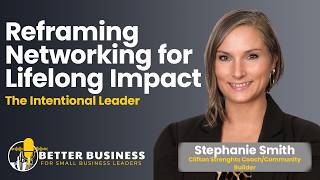
Stephanie Smith, a Gallup Strengths coach at Leadership Akron, explains why your best opportunities come from people you trust, not formal plans. She breaks down CliftonStrengths as a map of how you work, shares her top five themes, and offers one concrete move: reach out to someone who mattered to you with a lunch or note.
Chapters
How do you know you're leveraging your relationships and living in your strengths? We're gonna talk about that today. Stay tuned. Today we're talking about something that doesn't always show up on a balance sheet, but can absolutely shape the trajectory of your career and your business. And that is relationships. Because if you talk to enough leaders and you start to realize something pretty quickly, most of the biggest opportunities that you have and most of the biggest opportunities that they had in their lives didn't come from perfectly written strategic plan. They came from people, um, from conversations, from introductions, from relationships that were built over time through curiosity, service, and willingness to connect. And when you combine those relationships with a deeper understanding of your own strengths, that's where leadership really starts to take shape. So joining me today is Stephanie Smith, Director of Engagement and Impact at Leadership Akron and a certified Gallup Strength Coach, which is just So awesome. Stephanie, you spent much of your career helping leaders understand how to leverage their strengths. Thank you for coming on the podcast today.
Thank you for inviting me. I'm excited to be here.
Well, I'm excited too. So before we even talk about strengths, I'd love to start with your career journey. So you've moved through different roles and organizations over time. I have loved getting to know you over the last, oh my gosh, it's probably been a decade. We won't talk about how long it's been. And networking has played a really big part in that. So how have relationships really shaped your career path?
Yeah, well, I like to think of it as really a two-sided piece to that, right? Because it's not just about what you give, but it's about what you get, right? So when you start building relationships, you know, people are helping you, they're giving you feedback, they're giving you connections, they're giving you advice, they're giving you— and then as these relationships grow, you realize that you are contributing back to those as well. So you're building your own credibility and trust and respect with them as well. And I think what's been helpful for me is as I've been getting things from people, I've been able to give back. And then, you know, that really leads to a compounded relationship that is building on trust and respect. And so you're going to get more opportunities and you're going to, you know, be asked to contribute in more ways.
Was there ever a moment when a relationship opened a door for you that you didn't expect?
So yes. Uh, and I'm going to put a little spin on this because I'm not going to put it on myself. I'm going to put it on my kid. Nice. So, uh, over, um, I was looking at ways to connect my kids with career opportunities, like half-day shadowing opportunities or little lunches with, with individuals. And, um, one of my kids had an interest in the forensics and I was telling the story of how I was trying to connect my kids. And I had a friend who said, I know somebody who's in at the medical examiner's office. And I ended up getting my child a half-day shadowing opportunity in 7th grade going into 8th with the medical examiner of Summit County. So I feel like that's something I couldn't— maybe I could have done on my own, but the fact that very quickly someone said, I can help you. Yeah. I hear what you need. And, and that was, that was really awesome for me. I still talk about that.
It's amazing. Yeah. Just the connections that we can build.
Mm-hmm.
And the connections that can continue to ripple, especially for our families.
Yeah.
So a lot of people hear the word networking and they, they cringe. They get a little upset. They picture awkward cocktail hours, you know, handing out business cards or throwing business cards at people without having to talk to them. But the leaders I know who do it well, and you are one of them, approach it very differently. So what does effective networking actually look like?
I always like to start with asking people, what is networking? Right. And so networking is the act of consistently building establishing, maintaining mutual trust and respect with your peers. And you'll notice I didn't talk about any activity there. No, because it's different for everyone else. So how would you continue to build trust? You have an authentic conversation, you go out to coffee, you send a follow-up note, you comment on social media. So there are so many ways that networking, which isn't viewed as networking, but if we stop talking about networking because we think that's the act and start thinking about relationship building. Yeah. And how might you contribute value to this relationship? I think it really changes the way that we perceive what it could be.
Oh, absolutely. What do you feel is the difference between that transactional networking and really what makes it relationship building?
I think transactional is more about what can I get out of this? Mm-hmm. And, you know, we'll, we'll often find that in times where there are people who are constantly asking and asking and asking, they get what they need and and we don't hear from 'em again until they have another need. Yeah. That I feel is more of the transactional. I'm just, you know, we might think of that pushy salesman approach or whomever that might be where they're just trying to land the sale and you won't hear from 'em again until it's time to renew or re-up. And I think relational, relational, relational. Yeah. Uh, networking is more about what can I give?
Yeah.
And less about what can I get? Because we really should be thinking about ways to give before we ever need anything back.
So for someone who's listening that feels uncomfortable with the networking part, how can you— what would you like to tell them about how they can start, how they can start instead of networking, but really relationship building?
I would say start on the surface level. Start with someone you know, maybe you've interacted with a few times but didn't really go too deep on that and follow up, invite them out for coffee, go to lunch with them. And I think that's really the hardest part is I think people might feel that there might be rejection in that, you know? And I, not to sound weird, but sometimes it feels like dating.
Yeah.
Right. You're trying to connect with somebody that you may or may not have a spark with, and you're trying to get to know them a little bit better. And we feel that we're going to be turned down or they're going to say no, or they don't have time. That's okay.
Yeah.
Ask someone else. Absolutely. And I think you will eventually find someone like-minded enough who will be interested to want to get to know you a little better. So start small.
Yeah, I agree with you. And I think that so much oftentimes I think a lot of times when people are talking about networking, they forget about the time investment. It's really not about how many people can I meet, it's how many intentional relationships can I build. And sometimes all you need is one or two really deep relationships to be able to help you connect even further. So something that I love doing when I'm starting to get to know someone is asking them, being curious, what do you do? How do you do it? And then how can I help you? Because I would love to connect you to other people. If I have a great conversation with you, I think that giving the gift of your time to someone else is really important and impactful. So that's something that you've taught me is just to go into situations when sometimes you may feel uncomfortable and just be curious.
Curiosity is— and that's really, I think, an easier way because we often feel like we are responsible for just providing information. You know, I don't know what to say about myself. I don't know. Well, then, you know, switch the script a little bit and ask about them. Tell me about your job and what you do.
And yeah, and don't be afraid to follow up. Connect with them on LinkedIn, connect in another way. I mean, I know for me, there are times where it can take 2 or 3 times to get to, to meet someone before we're in that space where I can feel like we can— yeah, we can talk and I get to know them a little bit more. I mean, just, it's, it's again, like you said, sometimes it feels like dating, but it's really about being intentional in how you're, you're moving forward. Yeah. So I think another thing that makes you and your work really interesting is that you help leaders not only build relationships, but then also understand themselves through strengths-based leadership. So, um, For those leaders who may not be familiar with Gallup Strengths, I mean, I absolutely love them. I love that you are a certified professional in this space. What does it mean to lead through your strengths? You wanna tell us about, you know, strengths in general and then some of the things that you do with it?
Sure. So our CliftonStrengths don't tell us what we do. It tells us how we do things, how we build relationships, how we can help inspire others, how we think about things and how we get things done. And so what strengths helps us is it provides us with a language to help us better understand ourselves of how we naturally think, feel, and behave. And what I love about that is oftentimes when people will ask you, what are you good at?
Yeah.
We will immediately switch to a tangible, tangible competency, right? Yes. I'm good at spreadsheets. I'm good at, um, I'm very detail-oriented, or I'm very— and so strengths gives us a different language to understand exactly how and not the what. Yeah. So it's not the things I do, it's how how I get things done. Well, I'm great at my job because I'm able to look at the big picture, weed out all the different scenarios, and figure out the best way to get there. I'm great at my job because I know how to inspire a team to help us get it all done, right? So it gives us a different way to think about it. And what it also does is it really creates that reservoir of energy in us because we now know how we get things done. And so we're able to build and capitalize on that to have more successful, productive moments. Nice.
So how many strengths are there for CliftonStrengths?
There are 34 broad categories of talent. And when you take— most people, when they take the report, you can get— you're ranked from your most intense talent all the way down to your least intense talent. So it helps you to kind of manage the things you're great at and maybe the things you're not so great at.
So we use CliftonStrengths in our organization. So I think it's important anyone coming into the organization, it's important that they know what their strengths are. That we know what their strengths are because we always wanna make sure that we're putting them in positions where they're not going to be miserable.
Yeah.
So, because there are some strengths, like if you are relationship building and the only thing that you're going to do is see four walls of a cubicle, that's probably not the right position or the right type of thing for you. So tell me about your strengths, Stephanie.
Wow. So my top 5 are Strategic, which really gives me the ability to see the big picture. Yeah. And navigate how I'm gonna get there the best way. Individualization helps me to see all the unique qualities about an individual. Um, so I'm kind of like a detail collector of individuals. I'm a good gift giver. Um, yes, you are. Responsibility is psychological ownership of everything that I say that I will do. So I'm, I can be counted on and I never miss a deadline. Analytical, uh, is my number 4. So that's really the problem solver. Uh, but I can do it in a way that really presents facts without emotion. Yeah. Which can go both ways sometimes. And then my number 5 is communication. So it's that storytelling. Storyteller. Uh, but, and then, you know, when you think about pairing, when it comes to individuals, sometimes I can also come up with the words for others.
Yeah.
In those instances. So it's, it's really interesting how they all work together.
Yeah. Do you know what your bottom one is?
Mm, I do.
Okay.
Um, so my, uh, my bottom is includer.
Okay.
Which is interesting because, uh, it's not that I don't know how to include, it's just that it, I get there differently. Yeah. So it takes a lot more effort. It takes a lot more. Um, and then competition and empathy.
Okay.
Wow.
I love it.
So it's, it's interesting because there, it doesn't mean that I can't or I don't. It just means that there, I have to get there through other talents. So I just do it differently than someone who knows how to naturally invite someone in where I might give it a go and then give up because I'm on a mission to go do something else where someone else would just spend more time to be encouraging. And so again, that, that's really the differences are what set us apart and why we oftentimes look to the things we're bad at 'cause we think we need to be better when we should be leaning into the things we're best at.
Yeah.
And let others help fill in those gaps for us.
Yeah.
So there's a, the way that I phrase it is that we should be sharp as an individual, but well-rounded as a team.
Ooh, I like that.
Yeah. Nice.
So I found when we did, we've done strengths for a number of years and there was one team member that we just, we got along really well, but there would be times times when we would work in projects where it just didn't seem to gel. And so when I pulled up our strengths, I pulled up mine as they were to hers, and I realized that my top 5 were her bottom 5, and her bottom 5 were my top— like, they were vice versa, they were switched. And so, um, it was really helpful in knowing that that's how she was wired versus how I was wired and how we could continue to work together. So I'd love if you could tell us too how some teams can benefit from knowing each other's strengths. That's how it worked in our organization, but how have you seen it work with some of the individuals and the teams that you work with?
Yeah, so again, with it being this self-awareness journey, you are able to understand yourself, what you need and how you get things done. And once you have that awareness and understanding of it, when you start having conversations with others about their talents and their strengths, and it really is a conversation. We can't just rely on, oh, these are your top 5, so I know who you are. Right? We need to be able to articulate, um, uh, what makes us different and how we get things done. But when you're able to see what others need from you, I think that's really where the change happens because, um, just because they have a talent doesn't mean that they are wired a certain way.
Absolutely.
So understanding how other team players show up, uh, what they need from us and the the support that we need to give them to show up at their best every day is really where the magic happens.
Wow. You know, for our business leaders, you know, running a business can feel all-consuming, and sometimes professional development gets pushed aside. And I classify some of the things at CliftonStrengths as professional development, even though I feel like they are, they're more than that. They're integral to how an organization can be run. But I know that the best leaders never stop learning. So how should leaders think about investing in their development? As someone who's a Certified Strengths Coach, What should make them think about that?
I think part of it is figure out how it should be part of your everyday. It's not just a task. It really should be embedded in your leadership journey. And oftentimes we think about learning as I have to read a book, I have to go to a— I have to be an expert, if you will. And I think if we started looking at learning in micro segments, Small little things that can be done that fit within your ability. For example, I struggle reading books. It's, it's just a very long effort. I'd rather say, did you read that book? Can we go grab lunch and you just gimme the bullet points? Like, let me know what happened. I'm more of that, like, you know, gimme the digested version, top 10 bullet points because I have Achiever and I'm kind of on a mission and I just wanna learn and go. Mm-hmm. Um, So I don't always love the journey, or I feel like I don't have time for that full journey. So I think looking at small things— so if you don't want to read the book, maybe there's an article you can read. Maybe there's a documentary if you're a visual learner, or maybe there are other ways that you can look to, uh, digesting the information that you're looking to get, uh, whether it's about a topic or leadership development or your own strengths. Set the time. I think that's the hardest part is, you know, having that time to put aside when you are a busy business leader and a professional and, you know, your, your time is money. So yeah, investing in the best way that you can.
Well, I was gonna ask you what habits do strong leaders have around learning? I think you've answered it. They make the time. Any other thoughts about that?
They're intentional.
Okay.
I think that's a big piece is you have to want it.
Mm-hmm.
You have to wanna learn and wanna grow and wanna be better. Every day. And that really does take some self-discovery and some learning about yourself and understanding what do I need to get better at this? Uh, so I think there's some intentionality behind that.
Yeah. How do you build intentionality in your learning? What do you do? Do you pick a theme for the year? Do you have like a list of things that you wanna learn? How do you do that?
Uh, so my, my intentionality usually is more in the moment. Okay. So it's something that I might learn or hear or pick up, and then I'll decide that I wanna dive I've a little bit deeper in this, or I wanna know a little bit more. So it can be a little bit, I don't know that I plan for the whole year. Futuristic isn't as high for me, but, um, I don't know that I plan for the whole year that far out, but I will, uh, pick topics as they go, as they grow. I'm new to the nonprofit space.
Okay.
So I have been focusing a little bit more on some of the nonprofit topics that I've never had to learn before. And those are just coming in micro segments, a, a quick workshop. Okay. Or a little, you know, 1-hour webinar. Webinar that I'm sitting in through, or smaller little bits and pieces, because that aligns with the way that I like to learn.
Yeah. So one thing that has, has been helpful for me is community-based learning. So I know that for me, I love to learn from other leaders, and I feel like leadership growth often happens in community with others. What do you think?
I think you're absolutely right. Um, there's something about having that that group effort, if you will, because you are doing it together. Yeah. Is part of it. But it's also, you are getting those diverse perspectives along the way. So it's not just what you are learning and how you are taking it in. You can also gain that feedback to what others think about it. Mm-hmm. And so I think that's really where we learn to grow best because people develop in response to one another. Right. We are contributing in ways and thinking in ways, um, that are feeding other people. And maybe we get that back and start thinking about things a little differently.
Yeah. And I would say when we go back to what we first talked about with relationships, sometimes in those learning communities and in those environments, some of the, the most significant relationships that I have in community and my business leadership have been forged there. I think about the relationship that we have that started when we were in a learning cohort together.
Yeah.
So, so as we kind of think about that, so we've got the, the continuation of always wanting to be curious. So continuing lifelong learning, you know, Can your strengths change over time? It's always a question that I think people ask me, and I'm— as, as a certified expert, I would like to know your opinion.
Yes, I actually get that question a lot. Or, I've taken the test, should I take it again? It's been 6 months or a year, uh, or it's been a few years. So strengths, strengths can change based on state or trait. Okay, state being state of mind, the state of mind you're in. So there was the— I think it's the Myers-Briggs. I had taken the assessment and then I didn't love the responses. And I immediately took it right again and it changed. And then I took it one more time and it changed again. So I'm like, I don't really understand how that worked. Now it can happen because what's the state of mind that you're in when you're taking it? And now that you know, are you changing your responses to some of those? So the state of mind we're in, but it can also, it can also reflect any maybe psychological trauma or things that might have changed over time in your life. So that is also kind of the state of mind, like maybe I I took it when I was, you know, a single parent and now, you know, my kids are grown and old and I have a different lifestyle now.
Yeah.
So they're more apt to change. However, most of the time when we take it, especially in more of a shorter period of time, we're more likely to see just your top 10 reshuffle.
Okay.
And we're not really pulling stuff all the way from the bottom up. Yeah. Um, but then back to the two ways. So state and then trait. Trait is really the job that we're in. Okay. So if our job changes and now we are focusing on different things, That will likely maybe push up some new talents that we hadn't seen before because we're honing them a little bit more. But overall, I think I hear from a lot of people who, once they go deep enough down the strengths lane, if you will, they often don't want to take them again. Because they get to a point to where they feel, "I know who I am." You can give me some new results. I might see something new in there, but at the end of the day, I know who I am.
Okay. So Stephanie, if somebody wants to connect with you, what's the easiest way to do that? Is it LinkedIn? Is it email? What's— they're like, hey, I want to learn more about strengths.
Yes.
I want to talk to you.
Absolutely. Yeah. So I think LinkedIn is always the easiest way to get a hold of me. And then they're welcome to reach out via email as well.
Okay. I would say if they always— they can always drop a line into the podcast chat and we can send them information too. We're happy to connect them to you.
Wonderful.
So we close every episode the same way at Better Business because we always want to make sure that our leaders are getting better with every day. So, Stephanie, what is one thing that a business leader can do to get 1% better in their business this week?
So I will stay on the topic of relationship building.
Okay.
And I will say to make the extra effort, make the extra effort to invite someone to lunch or send that follow-up note to someone who made an impact on you. Or to schedule a lunch, to ask the question you want to ask, to dig a little deeper. I think that would be my suggestion.
Well, that's wonderful. Thank you for your time, Stephanie. I've enjoyed speaking with you today, and I'm going to be back to wrap things up in a minute.
Thanks so much, Chrissy Myers.
I want to take a moment to reflect on some of the things that I talked about with Stephanie today, because there were some powerful reminders in the conversation. First, First, I would say that relationships matter more than we sometimes realize. Stephanie shared how networking and connections helped open doors for her, and that's something I see over and over again in the business world. Opportunities often come through people who know you, trust you, and believe in what you bring to the table. And then second, I would say networking isn't about collecting business cards or just showing up to an event with a sales pitch. The most meaningful networks are built through authentic relationships, curiosity, and a genuine interest. And others. So when you approach connections in that way, the impact can ripple out in ways you never expected. And third, you know, understanding your strengths can change how you lead. Instead of spending all your time trying to fix weaknesses, strengths-based leadership encourages you to lean into what you naturally do well and help your team do the same. So when leaders understand their own strengths in those, in those terms, and they understand the strengths of their teams, collaboration Collaboration becomes stronger and work becomes more energizing. And finally, leadership growth doesn't happen by accident. It happens when leaders intentionally invest in their development through learning, through community, through programs that bring people together to help serve, live, and learn about each other. So if there's one thing I'd encourage you to take away from today's conversation, it's this: build relationships, know your strengths, and keep growing as a leader. Stephanie, I really appreciate you for being here with us today. Thank you for sharing your story on how to be intentional in relationships and leveraging your strengths.










