Episode 42: CJ Meager on How Proactive Legal Strategy Helps You Catch Risk Early
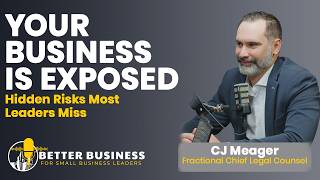
In this episode, host Chrissy Myers interviews attorney CJ Meagher, a partner at Brennan, Manna & Diamond who provides fractional chief legal counsel services to growing businesses. The conversation explores the shift from reactive to proactive legal strategies, explaining how early legal involvement can prevent costly litigation and protect a company as it scales. CJ describes the fractional counsel model—offering flexible, blended-rate, flat-fee, or retainer arrangements—and how it differs from traditional one‑off attorney engagements. They discuss common legal blind spots for scaling firms, such as weak corporate governance, outdated employee handbooks, succession planning, and the pitfalls of relying on DIY services like LegalZoom. CJ highlights emerging risks, especially the misuse of AI tools that can generate inaccurate legal content, and stresses the need for governance around AI usage. The interview also covers how a fractional counsel integrates into a client’s team, attends board or planning meetings, and acts as a holistic business advisor, not just a lawyer. CJ emphasizes the importance of delegating non‑core tasks, building a capable team, and adopting a mindset shift to enable exponential growth. The episode concludes with practical advice: identify one legal area that’s a bottleneck, bring in fractional expertise, and aim for incremental (1%) improvements to drive larger gains.
Chapters
Have you ever made a decision in your business thinking this is going to be great and then realized that you created a risk that you didn't see? We're going to talk about that today and how to avoid it. Stay tuned. Our conversation today is for business owners who are past that early stage. So you've got a team, you're making bigger decisions, and the margin for error is a little smaller because at this stage it's it's not just about growth. It's about protecting what you've built while you grow. So today, I'm joined by CJ Meagher, an attorney with Brennan, Manna Diamond, who is also working with businesses as a fractional chief legal counsel. And what I appreciate about CJ's approach is that he's not just helping businesses react to legal issues, he's also helping them see around corners before those issues really pop up. So before we jump in though, I want to say this quickly because it's important. This conversation is meant to give you perspective and help you think differently about how you're running your business. But it's not legal advice. If you want legal advice, you need to call an attorney. Every business is different. Every situation is different. So if something you hear today applies to you, make sure that you're getting guidance specific to your situation. All right. We're going to jump into it. CJ, thank you for being here today.
Thank you, Chrissy Myers. Absolute pleasure to be here. I enjoy talking with you and to see ways we can provide value to our clients.
Yeah. So before we get started, just why don't you tell us a little bit about the types of businesses that you typically work with and what's happening in those businesses when they're bringing you in?
Sure. Absolutely. So the type of businesses I typically encounter in my practice are ones that see a need for a relationship outside the one-off projects. So there's people who want to take a more global approach to their legal services and not necessarily be more reactive to situations. So that's the first type of business. Second one is situations in which they're a little bit more cost-conscious, so they don't have a budget or a need for a full-time in-house counsel. So what they do is they look for a fractional services type counsel situation, and because I'm a member of my firm, equity partner, I'm able to provide them with a variety of fee options. So whether it be a blended reduced rate where you pay— no matter what partner in my firm you work with, you pay a reduced rate— associates, paralegals, etc. And then I'm also able to do flat fee arrangements, whether it be, you know, a monthly retainer or, uh, just by project specificity. But, um, yeah, it's been a good, uh, opening for me to get some different types of clients.
All right, so when you're working with a company in that fractional chief legal space, you know, how is that different from that traditional call an attorney when something breaks approach?
Yeah, I think it goes back to being more proactive versus reactive. So I'm sure a lot of business owners out there realize that once it gets to litigation, it can get very expensive. So the approach I take is being more proactive, reviewing contracts, employment handbooks, policies, et cetera, to kind of get you out of those situations before they even arise. So those are the types of clients that— and it takes some trust, right? Yeah. It takes a while, but I think they— it's a value-add proposition, and they definitely see there's value in having that early contact or early touchpoints with attorneys.
So bringing you in as they're starting to scale scale, that maybe they have a strategic plan, wanting you to kind of look at things and say, are there things that maybe we should be looking at? And you're telling them even before they think about it.
Exactly. And then also being able to anticipate their needs. So when I'm involved in the company early on, I can anticipate, uh, I know their, their plan 1 year out, 5 years out, 10 years out. We can start anticipating what we need to do along those lines. Also, because of the size of my firm, uh, we're on the forefront of a lot of, uh, emerging business issues, whether it be healthcare, corporate, changes in policies, laws, regulations. So in those circumstances, we can actually provide memos free of charge because it's also something we prepare internally and they get access to that as part of my clients.
Oh, wow. So as businesses start to scale quickly, I know you work in those organizations that tend to rocket forward. What changes from a legal standpoint that business owners don't always anticipate?
Good question. I think as a As they start to scale, what I see is the owners of the business tend to wear too many hats. Okay. Right? And I see that as maybe they're more of a creative type. Yeah. But they're doing a lot of the more back office operationals, and it kind of stagnates their growth, or at least detracts them from what could really give the business the next step in growth. So in my experience, it's building a team around those folks and finding what they're good at keep them in that seat and then building a team around them.
Yeah. One thing that I learned when I was in Goldman Sachs 10,000 Small Businesses is they said, you know, think about what the business could look like when you're no longer in it. Is that something that you help business owners kind of think through too?
Yes. And that's another thing, you know, when you talk about a 5-year, 10-year plan, we look at succession planning. You know, great, you build this beautiful thing, your business, right? And, and it's, it's like, what is the next step? A lot of these smaller clients of mine, you know, you know, privately held not publicly traded. They're like, hey, how do I exit? They built something, it was a great living for them, but how do they exit, retire? So when I kind of advise them, we kind of plan for that next step. So make sure the corporate documents are in place, make sure you get key people around you that can take over the business and be attractive to whether it be entrepreneurs, other business owners, or even private equity, family office, etc. Nice.
There's a common phrase in business like, we don't know what we don't know. So what are some of those common legal blind spots that you see in those growing businesses that you support?
So I think for the small— my smaller clients, I think it's just very simple corporate governance stuff. A lot of times people come to me and say, hey, I have this issue. I said, give me your corporate docs, review it. They think they own something they only own. There's some other aspects to it. They don't have the ability to make decisions on certain aspects when they need other approvals, you know, voting controls and stuff like that. So kind of explaining them the corporate structure and then maintain that corporate structure. It does a lot of things for them and explain that for my much larger clients. Their blind spots are more or less institutional. They've been trained over time that they have to hire the large, expensive firms. And I think what you see a shift in the legal community now is people are looking more for value. And those big clients now are, you know, not necessarily driven by cost, but they start looking around because the costs have gotten so excessive.
Yeah, I see a lot of times you see that leaders outgrow their systems. We have that commonly on the HR side. They'll have an issue pop up and we're like, well, what does your handbook say? And they're like, well, we haven't updated our handbook since like 1995. We're like, oh, Oh, that's a problem. So kind of helping them, not just their documents, but then also how they make decisions. So let's talk a little bit about the idea of fractional chief legal counsel, because when we first met and you started talking about how you do this work, I was absolutely fascinated. So what does that actually look like inside a business? How do you walk a customer through being a fractional chief legal counsel?
So it's a full game. And through my career, I've been practicing for 13+ years, I've done this type of fractional service where I go into the office a couple days a week or completely remote. And it's been across industries. Industries, whether it be manufacturing, healthcare, just small industrial businesses, or just, you know, sales providers or professional services providers. And, you know, it's all about flexibility, what they need and what they want. And what I find is when you have that connection, there's not that fear to pick up the phone and call you. Yeah, a lot of times when people do one-off projects with legal counsel, they have the phone call, 30 minutes of it talking about just catching up, and they get that bill for that. And I tell my clients is, you know, if you have a question, call me. If I can answer on the phone or it's a quick email, I'm not going to charge you for that. But when you do those little touch points throughout time, it does save them money in the long run. It doesn't seem like it at first, but, you know, one mistake or failing to call a lawyer with a big issue and then eventually it leads to litigation or something much more expensive or even equally expensive, I think clients can appreciate over time the cost-value savings that they get with that.
No, and I appreciate that. I think that you make a really good point about the relationship that you're building. I know there have been times when I've been in organizations where if I've had to call the attorney I have the list of questions and I'm saying, okay, this is my first question. Okay, you've answered that. Now I have this. But when you have a relationship and you're able to have dialog, I feel like there's just— there's the ability for the person that you're working with, the legal guidance that you're getting to help you see around corners more, and even the ability for you to pick up the phone and call the client and say, hey, I've been thinking about this with you. When you're in that fractional space, is that— it provides you more dialog?
Yes. And you don't have the blinders on. So if you just get the phone call, hey, I need a contract review or a handbook. When they come to me and they have a contract review and I have the intimate knowledge of their business, I pick up on key issues. I mean, my areas of expertise are corporate, business, real estate, and mergers and acquisitions. Okay. But when I'm talking to a client, they want to do a contract and an issue comes up, maybe their name, it's like, well, do you have that USPTO protection? Do you have that trademark protection? Is there somebody going to rip you off or try to infringe upon your, uh, likeness of your, your company? Yeah. So I'm able to pick stuff like that up. So it may not be my area of expertise, but I have a deep bench. So when I do, am I able to pick up those issues? I could bring somebody in and help consult. So when you don't have blinders on, you can really do like a holistic approach to legal counsel. And I think my clients appreciate that because it's like you have 100+ attorney in-house counsel team. Yeah. You know, we have, you know, across several states, we have, we're licensed in 20+ states. I'm the lead contact person. The buck stops with me, but I'm able to pick up those cues because I've worked with these people servicing our clients in this type of way.
Yeah. Where do you think business owners think they're protected, but they're actually exposed? I know there are times where I think everything's great and until it's not. So can you kind of explain that a little bit?
Yeah, so I think I also separate this in some of my smaller clients versus larger clients. I mean, my smaller clients, it goes back to the basics. They just, they don't have a basic understanding of corporate governance.
Yeah.
And, you know, you can do everything, do all the legal gymnastics, but you don't follow the corporate requirements, you can definitely open yourself up to liability, whether it be personal or otherwise. So just making them understand that and make sure they follow proper corporate governance. For my bigger clients, I think their biggest exposure is they've been kind of trained that, you know, they have to pay the high fees. I have good examples in which clients of mine I got from being burned from larger firms and, you know, they start to see that, hey, you know, I can get the same quality, high, sophisticated legal counsel here in the Midwest with— and pay Midwest fees, as opposed to going to some of the larger firms, AMLaw 50, AMLaw 100. So I think, you know, once they kind of get in that cadence, they're more than happy to switch the work over. And that's, that's been kind of my, um, you know, how I built my practice over the years.
Yeah. So how do you think business owners should start thinking about legal differently as they scale? I know that when I was a small business owner and startup, it was like, oh, we don't want to call the attorney. How can we like make sure that we avoid all of the things? So I have a feeling you have a different perspective.
Yeah, I think it's just kind of retraining how you think of it. When you have trusted advisors, I think, you know, you always rely upon them to provide advice. If you were always worried to call the attorney because of whatever the billing, or, you know, maybe you don't like them.
Yeah.
Or just, just afraid that what the answer is going to be, you know, it does set you up for failure. And I think The way that I would tell people to kind of train us is think of us as like your business advisors, not just your legal counsel.
Yeah.
And I tell clients all the time, you know, if it's not even a legal question, if you have a question with insurance, you know, your healthcare, your benefits, you know, call me. I've built a Rolodex of providers over my years, and these are people that are going to treat my client as if I would treat them because they know I send them a lot of work and they have to stay in my good graces. So I have clients, you know, I can't get a hold of so-and-so at XYZ Company. Well, let me reach out to them. And typically they're like, hey CJ, I didn't know it was your client, you know, we're just busy, whatever, but we'll give them a call back. So sometimes just having that team around you, thinking of us as a team and not necessarily just your lawyer, think of us as your business counselor.
No, I love that. And I think that, you know, dealing in the HR space, similar, we're not lawyers, but like we deal with the fear of, I don't want to have to call HR, I don't want to be wrong. And I think that you do a good job in kind of building relationship with your clients so that they know that they can pick up the phone anytime. There isn't necessarily a wrong answer. It's better to call us sooner than to call us later. So as you're, you're doing that advisory work for your clients, are there times, do you sit in some of their leadership team meetings? Do you sit in like quarterly planning meetings? Like what does that look like for, you know, some for, I know it's different for everyone, but how do you like to kind of approach that work? How do you like to be in the visibility space so you can help them see around corners?
Yeah, it is dictated by the client. Some of my larger clients, you know, have boards, shareholders and stuff that they have to answer to. So I'll just appear at board meetings for my piece.
Okay.
Some of my smaller clients, they like me to be in the room for the planning, you know, some other aspects of it. So it's really client specific. But I do give them the flexibility. You know, I charge, you know, if I charge you a reduced blended rate for my services, any partner shows up. So if you need somebody to show up to a municipal hearing on your variance or something like that for your business, you know, you get that team, they'll go and do that for you. But it is really whatever the client needs. And that's the thing I have. I have a deep bench and we can fill holes as you need them. So it's not always going to be me, but I'm going to be the leader. I'm going to be the person you contact at all times. And then we find the right person that can handle your specific issue.
So in taking care of the business, oftentimes you're also taking care of the business owner. So is that— can your firm support some of the business owner work that can sometimes be adjacent to the actual business?
Sure. It gets a little bit more difficult with conflict issues as an attorney, but let's say it's a sole proprietor or a managing member of a business. You know, we do tend to have them help them with personal matters because you do become like a friend and a business advisor. So they do tend to reach out to you. And then we have to explain to them, say, listen, if a conflict does arise, we have to have a conflict waiver if it's a waivable conflict. But we do try to just, you know, take care of them holistically. So a lot of times that does involve doing some side project with, with business owners. But we just have to be careful to make sure that, hey, you know, you understand that we are legal counsel for the company as well. And if there's ever a time in which your interests conflict with the business interest, then there's a conflict and we'll have to get a waiver from the business and you, okay, to be able to represent somebody. A lot of times that's not waivable, which causes problems. So we do explain that upfront.
Okay.
But a lot of times you can get around that because it's a sole proprietor or a single-member business. In this ownership situation.
And I would think that if you've got some issues that you can also give recommendations or say, you know, let's move in a different direction.
Yeah, I tell people I work well with others. I mean, I, I'm always type of person that, you know, I want competent legal counsel on the other side of every transaction that I do because it makes my job easier. Even though you might think, well, it's going to be more hard, difficult, but I find that we can get to a middle ground and have a win-win for everybody versus somebody that's not willing to entertain a discussion. They just don't understand the issue. So I've built a pretty good Rolodex of people I can refer stuff to and people I trust because I've dealt with them on transactions. So that's the thing. I, I, I will never hesitate if there's a conflict with my firm to send you some other firm or some other attorney that I know can handle your issue.
Yeah, I appreciate that. And I remember a while back when we were doing our transition at AUI, I mean, we're a third-generation family business, and I had the, the corporate accountant and the corporate attorney, and they're sitting across from me and they're like, Chrissy, we just need to remind you that like we don't work for you, we work for the business. So you're going to have to— as we were going through the transition and the negotiation of everything, you're going to need to go find other legal counsel. But it was really helpful. They said the same thing. We work well with others too. So, yeah, it's, um, I would say especially in complex family business situations, understanding and having good, good legal counsel and people that can work together in a team is really important. So I want to go back to what I talked about at the very beginning of the podcast where, you know, we have this great idea and we may create unintentional risk within our business. Where do you see leaders right now unintentionally creating risk in how they should lead or operate their business? Is there any hot topic right now that you're like, ooh, So let's pay attention to that.
Yeah, I mean, the short answer is AI. So I see that a lot. You know, clients are, I'm not going to call my attorney, I typed into ChatGPT or whatever, got a response.
Oh no.
Yeah. And just last month, AMLaw, I think 220-firm, Wall Street, very prestigious firm. Wow. You know, of lawyers, very, you know, sophisticated attorneys just got hit. I don't know if they got sanctioned yet, but they filed a court filing in which it had what they call AI hallucinations.
Yes.
So AI actually created fake cases, cited those cases, they included their court filing. Oh no. So this is, this is, this is a huge firm, um, and they got past the eyes of lawyers. So I have so many times clients will say, hey, I, I did this based on AI and it didn't work, right? And I'm like, I wish you would reached out to me because, you know, my firm does leverage AI and we use it, but this AI tool that we use pulls from trusted legal sources, whether it's Westlaw, Lexis, or whatever. And even that, I catch stuff that's not necessarily correct, and you have to make sure that you understand it. You know, I've been trained, you know, Yeah, you know, law school plus, you know, 13+ years of practice. I know how to spot things. I know how to check things to make sure they're correct. And I think clients who rely on those do end up getting burned in the long run because they, they, I'm afraid to call my attorney. I'm going to use ChatGPT or whatever AI tool that they have. Um, I'm not saying you can't use AI, but make sure the AI is pulling from the right sources. You know, garbage in, garbage out. So, you know, if it's not pulling from right sources, you tend to get the wrong answer.
But I would say too, being able to have governance documents around, you know, AI usage are those things too that you're seeing and helping with organizations with?
Yeah, I, I mean, even past AI, I mean, people who set their companies in, in LegalZoom, I mean, the actual base documents you get are not bad, but a lot of people don't need base documents. They need something more customizable to what they want to do. And that's kind of where I come to play. Like, if you're just setting up a single-member operator, you're not going to bring in any other investors or any other members, you know, you could probably use LegalZoom. But it tends that if you rely on that document and it comes time to do that investment or whatever sale, that's when I have to come in and have to fix things. And it tends not to too much more expensive, but it does take time. It slows things down. So I tell people, if you're going beyond, you know, just the basic setup, you definitely need to have somebody in your corner to be able to fill in holes that you don't know.
Yeah.
So if you don't know what you don't know, you don't know how to address that issue. So I tell my clients, you know, just call me, we can talk through it. A lot of times I provide free consultations and say, you don't need to use me for this. And I've turned away a lot of work. I'm like, you don't want to pay me for this. I'm too expensive for what you want to do. Because what you're doing, you could do through this. And I kind of point them in a direction. And they do appreciate it, and they come back to me.
But that makes you valuable as a fractional chief legal counsel because you're able to provide all of that value and direction. So I'm sure they see it and have a lot of appreciation around that. I know I would. So there is a phrase about, you know, what got you to this level won't get you to the next. And so as you're watching businesses scale, I have a question around, you know, mindset. Is there a mindset shift that you think has to happen for someone to really lead from one level to the next? And if so, what is that?
Yeah, so I see that when, when there's certain growth and you're stagnated, you plateau, it's because you're not building a team around you. So a lot of times they kind of stick, hey, I'm going to do all these different things. It might not be what they want to do, but they feel like they have to do it all because the buck stops with them. And I tell you, at some point you run out of hours of the day to do what you need to do, call who you need to call, meet with who you need to meet with. So what are you good at, right? And then sit down and do ROI. In my day, what am I doing? That gets me the best return on my investment. So if you're not the finance person, you're spending all this time doing invoices and finances and AR and stuff like that, you know, hire somebody even on a fractional basis and that frees you up to do more. So then you can exponentially grow your business by building that team at the same time. So I think it takes— it's very difficult. I've dealt with clients before, is this— they don't want to give up that or delegate those responsibilities. But I think once you do that and you build that team it's— the growth is exponential. Yeah.
So last question. I have a feeling I'm going to know some of the answer because we've had such a great conversation. So it's the question that we end with every episode. And so someone's listening today and they want to get 1% better in their business. What advice would you tell them?
I think build a team. I think, you know, if you just want to start at 1%, find something that you don't like doing in your business that's holding you back from doing what you're good at and hire somebody fractionally otherwise to do that. And I think what you'll see is it's going to go beyond 1%. Freeing yourself up, you know, a couple hours a week and really open you up to other opportunities that you didn't otherwise have.
Thank you. Well, CJ, thank you for your time today. We're going to connect all of your information in the show notes so that the audience knows how to reach out to you if they're interested in, you know, learning more about what fractional legal counsel looks like. And I will be back to wrap up in just a moment.
Thank you, Chrissy Myers.
Here's what I want you to take away from today. As your business grows, risk doesn't just increase, It changes. And what you— what got you here, what got you to your business and the success that you're at right now doesn't necessarily protect you at the next level. And the businesses that scale well are not the ones that avoid risk. They're the ones that can see it early, understand it, and make better decisions because of it. So don't wait for something to break. Pick one area, whether it's contracts, employment structure, where you know you've been operating on assumptions. And I encourage you to get clarity. Because clarity is what allows you to grow with confidence. And if this episode has helped you, I want you to share it with another business owner who's building something and wants to protect it the right way as well. And as always, let's keep working on getting 1% better in our businesses each day.










