Episode 48: Don Fischbach Shares How to Build Clarity Without More Complexity
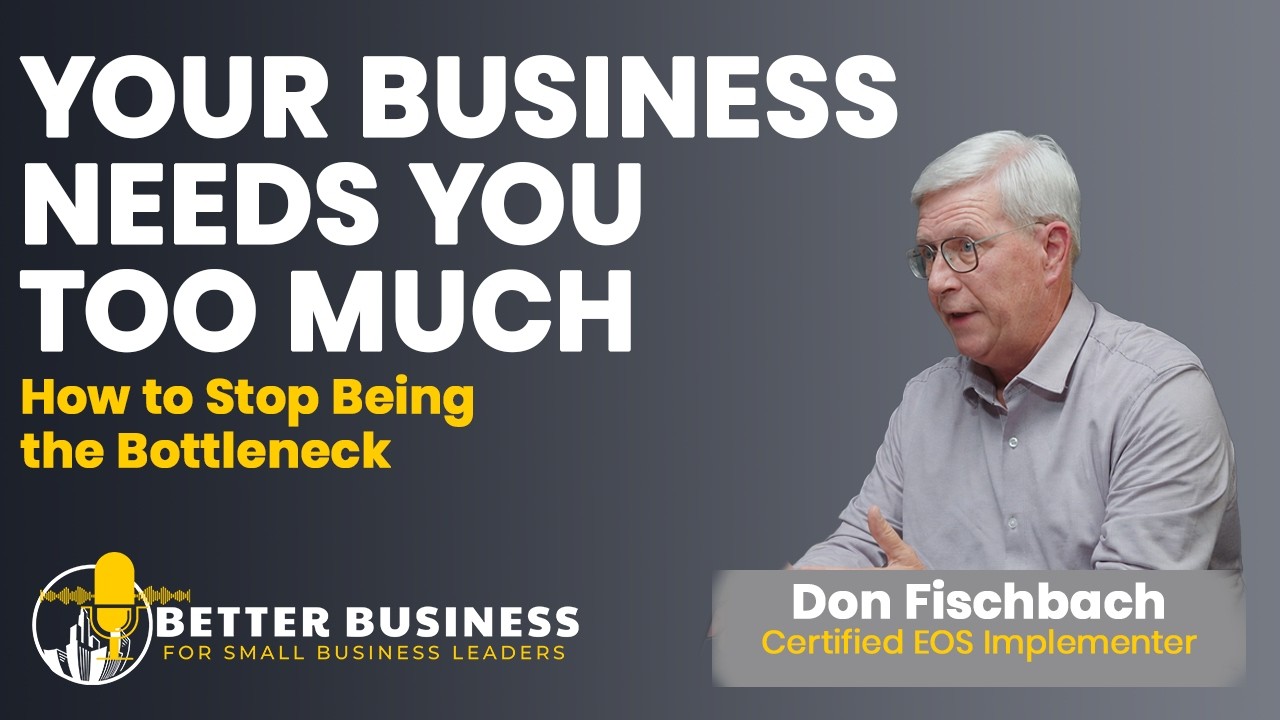
In this episode of the AUI & Clarity HR podcast, host Chrissy Myers interviews Don Fischbach, a certified EOS implementer and founder of Sterling Traction Partners. Don shares how his discovery of the Entrepreneurial Operating System (EOS) transformed his own career and how he now helps entrepreneurs move from chaotic, founder‑centric operations to disciplined, team‑driven businesses. The conversation covers why many owners lose sight of their desired outcomes, the warning signs that a business is running the owner instead of the other way around, and the importance of articulating a shared vision and a short‑term (90‑day) priority list. Don emphasizes that trust—both personal vulnerability and the willingness of leaders to be vulnerable with each other—is the foundation of a healthy leadership team, enabling constructive conflict and better decision‑making. He outlines a simple execution rhythm based on weekly L10 meetings that focus on problem‑solving rather than status reporting, and stresses that consistency and top‑down modeling keep any system from becoming a forgotten “90‑day” experiment. The episode concludes with a practical takeaway: get leadership to agree on three top priorities and align around them, a small step that can drive 1 % weekly improvement. Throughout, Don positions EOS as a low‑complexity framework that delivers clarity, accountability, and scalable growth without adding unnecessary bureaucracy.
Chapters
Have you ever built a business that technically works, but it feels a lot harder than it should? We're going to talk about how to fix that. Stay tuned. Today's guest is someone who has had a front row seat to a lot of entrepreneurial journeys, including ours at AUI and Clarity HR. I'm joined today by Don Fischbach, a certified EOS implementer and founder of Sterling Traction Partners, Don works with entrepreneurs and leadership teams to help them get clearer on where they're going, build more discipline around execution, and become healthier as a team. But what I appreciate most about Don's perspective is that he doesn't approach business as theory. His career has included law, business ownership, corporate leadership, and working alongside entrepreneurs with real skin in the game. It's really easy to learn from Don because Don has actually been there, and he has seen what shapes, um, and sees what happens when businesses grow without clarity. And he also has seen what happens when leaders slow down long enough to build the right structure. So today, we're going to talk about what it really takes to get what you want from your business without getting buried in jargon, tools, or another binder that sits on the shelf. So, Don, welcome to the podcast today.
Well, thank you very much. And gosh, you put it that way, it looks like I've got a number of chapters in my background.
Yes.
So I guess that's a good thing. Currently, I've got to tell you that EOS hit me like a ton of bricks one night.
Tell me about it.
When I picked up a book for light reading before I went to bed, and I realized in about 4 or 5 pages that whoever the author was, was explaining in some detail the last chapter of my career that I had recently left or exited. And the point was, is that The more I read, the more I realized every page was a, I've been there, done that.
Yeah.
If I had only known, if I had only known. Well, so that got me on the trek of tracking down this guy by the name of Gino Wickman. And what I realized was that he was explaining in some detail everything that had taken us from literally a small regional operation into industry-leading, world-class, $30 billion organization, and it was a wild ride. But pairing up with that entrepreneur was really kind of like everything fitting together once I read and got to know Gino and his theories. So it was an interesting evolution that just kind of happened.
Yeah. So you've worked in both corporate and entrepreneurial environments. What did that teach you about how businesses get things done?
Well, the point is, is when you get into business, it's somewhat illusionary when you realize that the way you've always done it doesn't work anymore.
Yeah.
And recognizing that change is needed or some type of evolution is required is really the catalyst on making a lifestyle into a real business and starting the evolutionary requirements that take you from a guy that does everything into really having a business that can scale, can grow, and can literally project much larger than any individual component.
Yeah, I think that perspective matters a lot, especially in business, because we get the book, and then we're like, oh, this isn't exactly what I thought. It's not what the book said was going to happen. It's really different. It's different when payroll's due. It's different when people are looking for answers, and the owner is really carrying the risk. Let's talk a little bit about like getting what you want from the business. You know, one of the phrases that's connected to your work is helping entrepreneurs get what they want from their business. And I think it sounds simple, but it's a really big question. So why do so many business owners lose sight of what they want from the business they've built?
Because they get bogged down.
Okay.
I mean, in regards to getting what you want, it's surprising how many leaders that I work with have never taken the moment or the time to really think about what that endpoint is or what it looks like. And even those that have, far fewer of those have actually tried to verbalize it and share it with their leaders. And as a result, you have people that are really hardworking, really talented. Mm-hmm. They've got a general idea on where we're going. But they've all got their own version of it. And solidifying exactly what that objective looks like is the way you coordinate and execute on that pursuit.
Yeah, Gino has that tagline around, like, is the business running you or are you running the business? What are some of the warning signs that you see that the business is running the owner instead of the owner leading that business?
Frustration, number one. And it comes in a lot of different forms. But the real indicator is that founder, that fearless leader, as I call them, becomes the bottleneck because everything needs to come through him. He is— every day is an urgency.
Okay.
Okay. Everything's a fire. Every decision that seems to be needed has to come through him and get his input. And then the execution is something that he has to monitor. And from my standpoint, what we're looking at there is the failure to recognize what structure is needed by the business so that proper delegation and responsibility assumption can occur.
Nice. How does a leadership team get clear on what they're really trying to build? You know, we talk about the owner being the bottleneck. They often have leaders that are kind of, I would say, confused. So how do you help in that space?
Well, it really takes 2 parallel tracks.
Okay.
One is a shared vision. Okay, like I said, very rarely do people take the time to write, you know, where are we going? What is our general plan? And rarely does the leadership team take the time to really dive into that And come together and say, yes, that's it. The flip side of that, or the ancillary path, is understanding what the priorities are and saying, okay, these are the 3 to 7 things that we need to focus on, on the next 90 days. And if you go into a leadership team and you ask them to write on a piece of paper, what are the 3 priorities that you have?
Yes.
If you have 3 people, you'll probably have 7 different priorities.
Yep.
And the point there is that we're working, we're exercising what we can do, but we're all channeling differently. And that's where the shared vision, understanding who we are and where we're going, along with clear priorities and objectives for that rhythm that we establish within the organization, is really key because That's how you harness your talent and your skill set is to get everyone working in the same direction toward the shared objectives.
So how do you get everyone working in the same direction, Don? Because I know you work with leadership teams on this, including you've worked with ours.
So, well, as you will recall, as a lawyer for almost 40 years, I've always advocated for a client. As an advocate for a client, you learn in the practice of law that there are some questions that aren't easy to ask but need to be asked. It's the elephant in the room.
Yes.
The point is, is that I have become used to being the south end of a northbound horse in the practice of law. Now my client is the business. And as a result, sometimes that makes you a rock star. Sometimes that makes you Do better speech. But it's all part of the process. And if we truly are sharing that same objective, those clear and candid conversations is how we grow, how we evolve, not only individually, but also collectively. Yeah.
So I think it's really one of the biggest lessons that we have to learn for small business that accountability without clarity just turns into that irritation. We can't hit targets we can't see, so getting everyone on the same page is really important. So let's talk about the leadership team as the business grows. You know, as the business grows, we know the leadership team has to evolve too. I mean, you've made a comment to me about your culture changes every time you add one person to your team. It's always going to be there. Let's talk a little bit about, you know, what changes when a business moves from being founder-led to needing a real leadership team, and then I'd love to get your perspective too around, where founders struggle most in that transition?
Answers to both of those questions are very related because the evolution of the leadership team is really determined by the perspective of the fearless leader. And because in a very general sense, there are great businesses out there that are lifestyle businesses.
Absolutely.
They are meant to take care of the family, and they're doing a fabulous job for it. And that's perfect. That's perfect. But if you want more, one of the real characteristics that enables the scalability of that organization is the fearless leader to recognize that, to a certain extent, he has become his own ceiling. In that he's always done it. He's always been able to do all of it. And now I'm out of time.
Yeah.
And if I'm really going to evolve this business, I've got to be able to delegate things into other people that I trust and rely on. And the ability to let go of those vines, to elevate themselves into doing what they're really grade A world class at, is part of the evolution of the business. Not everyone can do that. Not everybody wants to do that. But that is part of the equation, is having the mindset of, how do I build the team? First question is, what do I need in my team?
Yeah.
And that's another recognition point, that when you get the fearless leaders together and they collectively say, this is the structure that we need moving forward, then we can start identifying what skill sets are really required to deliver. on those positions. And that's part of it, is that ability to trust others, bring in talent, and let them go once you bring them in. Because everyone needs to be accountable for what they're responsible for, but that doesn't mean you micromanage it.
Yeah. So as a follow-up, we've got the team built. What makes that leadership team healthy enough to have honest conversations? Because I know that we've had conversations in your office as we're going through our quarterly meetings that aren't always comfortable. But we do it and we manage it and we come through better for it. But from your background, what makes a leadership team healthy enough to have those honest conversations?
I'm going to start with a trite answer.
Okay.
And that is trust.
Okay.
Okay? Trust is something that we all talk about, right? But there's a qualifier on that. In a leadership room, in a leadership team, the trust that I'm talking about is the ability to, one, be vulnerable with yourself. I'm not perfect. I know I didn't do the Smith account justice last month. That's being internally vulnerable to the mirror. But the other side of that is creating the willingness of your leaders to be vulnerable in front of others. That's another step.
Yeah.
But the development of that Trust that allows everyone in the room to be vulnerable with each other and themselves allows you to have constructive conflict. And this is something that it's rare in some entrepreneurial organizations, and it's part of the evolution. And sometimes, in all candor, I'll plant the seed of argument just to see.
Yes.
And just to understand how strong are you on that opinion.
Mm-hmm.
Because the point there is that for the team to really work toward the best interest of the business, which is what we're all after in the room, we've got to be able to express opinions that are not the stated standard, and that constructive conflict on debate, discuss, and analyze normally allows the room to generate their best interest and to execute on it. Because again, you have to understand where you're going before you can travel to get there.
Yeah, so wrapping that up, so I think that when we go from founder to leadership team transition, it's one of those hardest things and the hardest parts of growth for a business. And you go from, I know everything because I touch everything, to I need to trust other people to own the work, and that is not always comfortable. So building that trust is really important. So I want to talk a little bit about, you know, how we execute and get to that space without overcomplicating things. So, you know, a lot of small business owners, including myself, are allergic to complicated systems.
Mm-hmm.
And I understand why. I mean, it, we don't need more noise in our businesses. We don't, we need something that will actually help us execute. So what does simple, consistent execution look like for a small business leadership team?
Clarity. We're using that word again.
Yes, thank you for using the word.
In the priorities, in understanding what those priorities are, a regular rhythm where we're all checking in. And I'm not talking about a meeting where we just get in together and everybody gives us a status report of what they did in the last year. I'm talking about something that is really productive. And in my world and my experience, You will change the dynamic of the momentum of the business if you establish a rhythm pulse that actually problem solves.
Yes.
Because when you problem solve in a meeting, now we've got movement. We've got clarity of thought. We've got clarity of direction. And now we've got a plan to get it resolved and to move the needle further. So I think clarity of priorities, Clarity of responsibilities, and that rhythm where we're checking in periodically. You know as well as I do that we use weekly.
Yes, we do.
We love the weekly. But it's just that internal accountability and sometimes tension that says, this is what we need to do. What are our obstacles? How do we get over the obstacles? How do we solve the problem?
What makes meetings useful instead of painful? 'Cause I mean, death by meeting, meeting for the sake of meetings. I love our weekly, we have weekly L10 meetings, 'cause again, we run on EOS. But what do you find, 'cause you deal with more businesses than I do, especially in this space, what makes meetings useful instead of painful?
I think it gets to what I just said, and that is problem solving. Because the death knell of a meeting Yeah. Is when you sit down, you have a tentative agenda, but you never really follow it. And someone sits down and the first question is, how'd we do on the Smith account last week? And then somebody has to tell you everything that happened. The autopsy, yes. You know, my neighbor's dog got in the backyard and I couldn't get to work on time, so I didn't meet the meet Smith in his office. And as a result, we were 2 days late. OK, I don't need to know all that. Bottom line is we've got a problem. Put it on the list. We'll deal with it.
OK.
And the way you deal with it— and it's that problem solving as opposed to reporting that gives the meeting a different dynamic. And that's the key. If you're in a meeting, do what you need to do to understand the status of the business. Are we hitting our numbers? Are our priorities being met? But then let's get down to it and let's solve problems. And let's solve problems for as much of that time frame as we can. That's what gives the meeting value because now I know who's doing what, when it's being done, and what I can rely on.
How do you keep a system from becoming one more thing that people stop using after 90 days?
Leadership from the top.
Hey, that's good.
Exactly, exactly. Because the consistency and then the following of the rules. The 3rd rule of that was that handful of rules, be prepared to repeat yourself often, and then walk the talk.
Nice.
If the leadership team has the rules, talks about them all the time, and then does something differently, you're creating chaos and nobody's going to take you seriously. So the point there is from the top, the company will mirror the image that's being portrayed. So as that fearless leader goes, he needs to stay engaged with it. He needs to be the lead cheerleader for the system because the system is allowing him to reallocate some time and to free himself up.
Yeah, at AUI and Clarity, we call that modeling what you mandate. I really appreciate the system that we have because it keeps us organized, it keeps us on track, it enables us to stay in the problem-solving space. And I mean, I always think the best system is a system that people will use. So, appreciate the structure. So, Don, I have one more question. It's the question we end with, with all individuals that come on the podcast. So, and that is, if someone listening today just wants to get 1% better in their business this week, What is the one thing they can do?
I would say, make sure that your decision makers have the same priorities. Sit them down tomorrow, say, OK, give me your 3 priorities for the business. What are they? They'll be similar, if I had to guess. They won't be the same. Get those leaders on the same page. There's not a switch we can flip. It is a journey. But if we can progress day by day at your 1% level, everything's going to work out because it all compounds. But I think it starts with understanding and getting on the same page with your leadership team what the true priorities of the business are.
Oh, I love that. Don, thank you for your time today and for being on the podcast. And I'll be back to wrap up in just a moment. Here's what I hope you take away from my conversation with Don today. First, clarity comes before accountability. If your team is frustrated, scattered, or constantly missing expectations, the first question is not always, why aren't they doing it? Sometimes the better question is, have we made the target clear enough? Second, growth requires the leadership team to evolve. The habits that get a business started are not always the habits that help it scale, and at some point, the owner has to move from being the center of every decision, or the bottleneck to building the team that can think, solve, and lead without them. And third, simple execution beats complicated planning. You do not need a perfect system. You need a clear direction, honest conversations, and a rhythm that keeps the right things moving forward. Don's perspective is such a good reminder that the goal is not to make the business more complicated. And if you're looking for an operating system for your business, EOS, Might be the one. So the goal is to build a business that is clearer, healthier, and more capable of giving the owner and the team what they actually want from the organization. So if you're listening today, start small. Clarify one priority, have one honest conversation, and fix one meeting, because that is how businesses get better. Not all at once, but one disciplined step at a time. And if this episode helped you think differently about your business, And how your business is operating, I want you to share it with another small business owner who's ready for more clarity and less chaos. And as always, keep working to get 1% better in your business every day.
Ooh.










