From Struggle to Success: Meredith Farrow's Journey in the CBD Industry
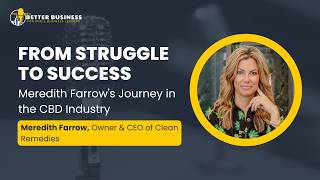
Podcast interview with Meredith Farrow, CEO of Clean Remedies, describing her company's operations (manufacturing lab and retail in Avon, Ohio), focus on 100% USDA organic CBD/THC products, and motivations rooted in her own experience with postpartum depression and dependence on prescription medications. Discussion covers the importance of organic hemp due to bioaccumulation risks, regulatory/compliance challenges (state and federal), consumer education on product quality (full spectrum vs isolate, potency), marketing tactics (Facebook ads, retargeting, print, billboards), strategic pivots toward THC products and planned diversification into non-cannabis supplements (functional mushrooms, nootropics). Emphasis on flexibility, advocacy (lobbyists, legal counsel), and mission-driven values.
Chapters
So you really have to be able to be flexible and pivot and pivot quickly. If you sit on the sideline too long, you're going to miss your opportunity.
So today on the podcast, we have Meredith Farrow, the CEO of Clean Remedies. Thank you for your time today, Meredith.
Thanks for having me, Chrissy.
So can you tell me a little bit about what your business does?
We are a cannabis manufacturer. We specialize in hemp based products. So CBD and thc and we do everything except to grow the hemp. So we have a manufacturing lab in Avon, Ohio, where we make all of our goodies, we ship everything out. We even have a retail store there. Customer service, sales, everything's in Avon. Wow.
So tell me what sparked your interest in the hemp industry? Is there anything specific that that led you to start Clean Remedies?
Yes. So I have two children. I had pretty severe postpartum depression with both of them. Was put on not only antidepressants, but benzos as well. At the time, I had no idea how addictive some of these benzos were. Just took them to try to feel better, tried to get off of them and could not. So I realized very quickly I was dependent on some of these medications. I was on them for probably almost a decade, tried to get off of them for about seven years. When I realized that my memory was being affected by this and that, I just, I could not go to sleep or I could not function during the day without it. And I thought to myself, there has to be more natural alternative to Big Pharma. There has to be something out there that's a little bit safer and still effective. And so I was introduced to CBD and thought, this is it. This is, this is better than anything that you could get your hands on through the pharmacy.
Wow. So you're one of a few 100% USDA certified organic CBD companies. So if you're going to do it, you do it really well. So what led you to prioritize organic certification for your product line and how does that impact your business?
So hemp is a bioaccumulator, which means it sucks up all the heavy metals, toxins, pesticides, anything that's in the soil. And a lot of times farmers use that to cleanse their soil before they plant a new crop. And so, so if you are getting your hemp from, let's just say a field in Kentucky that used to grow tobacco or somewhere out west that maybe they're spraying a farm close by, and that spray is definitely going to travel into the hemp crops. You're ingesting that. And most people are taking our product because they have some type of a health ailment. So organic just made sense to me. The fact that you are trying to either help with your pain or your anxiety or whatever the ailment is, you don't want to add more to it by having nasties in your product. So organic to me was just a very obvious route to go.
Okay. So, Meredith, I had this thought in my head as to what someone who manufactured CBD products look like, maybe what they did, how they ran their business. You do not appear like that person at all. How, how have you had to kind of work through, you know, what misconceptions people have about CBD and about the.
Products that you sell? I get that all the time. I, you know, people think that I'm going to be some stoner with dreadlocks, hippie, dippy. You know, I'm a business person first. And I found, I found a business that I was passionate about while I use our products and I consume our products. It's. I'm not your typical pot smoker that you would think the biggest difference between CBD and THC is that CBD does not get you high where THC does get you high. So people that use our products are not living in mom's basement stoned out of their mind all day. They are you and me, everyday white collar people that get up and go to a job 9 to 5, Monday through Friday, drive their kids to soccer practice after work, go to church on Sunday. It's. It is people just like us that are using our products.
Wow. So you're in an interesting industry in that you have a lot of regulations, not just with state, but also with federal. So you've got evolving challenges happening all the time. How do you navigate some of those challenges and advocate for your business within that industry?
Yeah, it's tough. Not gonna lie. It is hard. We are very regulated and staying on top of the laws or the could be laws that are always, you know, looming out there is tough. I used to have a chief totally blanked out on what her name, what her chief. It's in there. What is it in there? Can you bloop this out? I'll find a way.
You have chief communications officer.
Are you a chief?
I don't have your. I just have the questions. Legal.
Chief compliance. Compliance officer. Gosh, I only had one cup of coffee this morning. I used to have a chief compliance officer and she really helped me in the beginning to stand the straight and narrow. She really helped me to learn the law. Knowledge is power. I have a great attorney, and I have actually hired some lobbyists to help because Ohio, there's a lot of rumblings about Ohio changing the law in this industry. And so I have hired a lobbyist group to help me as well.
Okay. For those small businesses that maybe don't have to deal with the level of regulations that you do, but potentially could have something shift in their industry. For example, we dealt with a major shift in the insurance industry and the Affordable Care Act. What advice would you give to small business owners about paying attention and kind of like being aware of what could potentially shift within the legalities of how they do business? And then at the same time, how do they take care of compliance? What's some advice you could give just anyone?
Well, you have to absolutely be up and up on the laws. For me, it's all 50 states, so it's not just Ohio. So, you know, different states have different laws. There are certain products that we can't sell our products into. So you absolutely have to be educated and have some knowledge. You need to have a good legal representation for if you have any questions. And you have to really be flexible, especially in this industry. I mean, I would have been out of business years ago if I hadn't shifted and gone more towards THC products, because that seemed. Seems to be what more people are wanting now to get the faster results. So you really have to be able to be flexible and pivot and pivot quickly. If you sit on the sideline too long, you're going to miss your opportunity.
Okay, so you talked a lot about education for yourself and knowing what's going on in your industry. Let's talk about how you educate consumers, too. So how do you educate your consumers about the differences in hemp quality and especially the importance of choosing organic, because that's something that you specialize in.
Right? So we like to tell people that they're. You know, you can get CBD now anywhere. You know, you can go to your local gas station, you can go to your local convenience store down on the corner, and you're going to be able to get it anywhere. But you can't compare apples to oranges. So you have to look at a. Is it. What. What are the milligrams? What is the potency that you're buying? Is it a full spectrum versus an isolate versus thc? There's, you know, different levels. Does it have artificial colors, flavors? Does it. Is it organic? Is it not? You Know, there's so much that goes into it, and there's a lot of brands out there that just don't care about quality. They just want to mass produce it, stick it on the shelf and charge as little as they can. But they, you know, they want mass volume. So we try to tell people that it really matters where you're getting it. We specialize in selling wholesale into medical offices, and so we have to be top notch. If we're selling into doctor's offices and chiropractic offices and whatnot, we have to be on the up and up with everything. So just knowing that you can get it anywhere, but just like anything, there is quality and there's crap out there. So trying to educate people on that, trying to tell them that if they think it didn't work the first time, digging in and asking some of these questions like, well, what was the potency you had? What was the brand? Was it full specific spectrum? Was it a CBD isolate? Which a lot of people don't even know the difference between those things. So it is, it's hard to educate them when people aren't aware of all the differences that they can get. But I think that when people have tried a crap product and then they try our product, they know the difference right away.
Okay, so let's talk about shifting from education. So you have to educate your customers. At the same time you, you talked at the beginning of the podcast about how your customer isn't necessarily who we would think is consuming a CBD or a THC product. What I would love to know now, especially with you working in a regulated industry, also having to educate your customers, what are some of the key marketing strategies that you are using to reach your target audience, who may or may not have been the person that everybody thought would consume this type of product? How do you reach them?
Marketing has been tough in this highly regulated industry because for the longest time we couldn't do Google Ads, we couldn't do Facebook ads. We couldn't even have normal banking relationships. I mean, it was really, really hard in the beginning. Things have started to loosen up a bit. And so we have, we have thrown a lot of stuff at the wall to see what sticks. Some stuck, some hasn't. But I would say that our most successful would be our Facebook ads. We pause them throughout the year though, at times because we find that like summer months, they don't do as well as more in the fall and the winter and spring. So I would say Facebook ads, retargeting people that are coming onto our website, because we do have a website. We use print ads, we do billboards. So we're trying to do one of two things. We're trying to raise awareness in the Cleveland area with local publishers, local billboards, but then on a more national scale, we're targeting for Facebook ads. We did Google Ads, they didn't do well, so we stopped our Google Ads. But that might be something we might do in the future as well.
So is a lot of what you're doing, is it kind of trial and error trying to do that?
A lot of it is trial and error. So a lot of money wasted trying to figure out what's best.
How do you maintain your patience with some of these things? I would think that having to dealing with a lot of trial and error, dealing with a lot of changes in regulation, not always knowing where someone's going to move, move your cheese. I mean, you're constantly looking for the direction. How do you maintain your energy and your drive? As a business owner, I have a mission.
I didn't start this company to make a buck. I started this company because I had a real passion to help people. And so that's the first and foremost front of my mind, is if I can help one more person not become dependent or addicted onto medication. If I can help one more person get out of bed today because of their anxiety or their depression, or get a better night's sleep and be a better mother, father, spouse, whatever that may look like, that's on the forefront of my mind is helping people. And so I'm always remembering that on the hard days, I don't have a lot of patience. I'm someone that moves quickly and don't have a lot of patience. But I would say that there are times throughout my business journey that I have stopped everything and just did a reset. And I've stopped, you know, all marketing, all sales. I've stopped everything and just on a reset. And I think sometimes that's important to do. Just because you can get overwhelmed in this industry. You can get frustrated, you can get where you just want to throw the towel in and just burn it all down. But you've got to kind of take a step back. And I keep saying to myself, why did I get into this industry?
Okay. Wow. So, looking ahead, what are your goals for clean remedies? Are there any specific product lines, marketing segments you plan to expand to? What's your goal besides world domination of the cannabis industry?
My goal is two things. One, education. You know, there's still a lack of education out There where people think, think, oh, I would never touch that. That's, you know, that's, that's bad. That's a drug. And so trying to get people to understand why you would use this versus suffering or taking a pharmaceutical drug. So definitely education is still, we've got a long, long ways to go. But secondly, I want to diversify a bit out of cannabis as well. You know, I'm interested in supplements or things that are going to help people. Like for instance, functional mushrooms. That's something that we'll be launching soon. That will not be a cannabis product. Nootropics. That's also something that fascinates me that we would do without cannabis. So try to diversify a bit. And I think that that goes back to your last question, is diversifying a bit out of cannabis is going to help when these laws and rules and regulations change and we have to pivot again, having some diversification in products will definitely help that.
Okay, so I'm hearing a lot of resilience in your story. Continuing to pivot, continuing to try new things at the same time being passionate about helping individuals, whether it's with their mental health care, with their physical well being. So that's one of the reasons, one of the primary reasons that drove you into the industry that you're in. I want to know what are some of your personal values at this point that guide the business decisions that you're making? How do you incorporate them even more into Clean Remedies and kind of continue to think about what you want to do? Moving on.
So my personal values absolutely drive the ship at Clean Remedies. First and foremost, life is short and we are never guaranteed tomorrow. And so I really believe wholeheartedly in, in taking a leap forward, doing something against the grid, doing something. You know, when I first started in this industry, I joke around, people thought I was like Breaking Bad in my basement, the show Breaking Bad, you know, because it's like you're doing what you're. Are you growing marijuana in your basement? Like no one really knew.
You're a mom from Avon, right?
Very taboo.
Yeah.
It was like. And I'm thinking, no, I'm not doing that. But it's like I had two heads up my shoulder. But taking that leap and being the first to kind of get into an industry in the Cleveland area. I didn't know anyone else that was in this industry at the time. So I do think I was one of the first in actually probably the state of Ohio, but definitely in Cleveland. But taking that leap and believing in your gut and in your heart that what you're doing is for the right reason. If I was doing it for the wrong reason, I don't think I could have kept going, but I felt that I was doing it for the right reason. So always doing things for the right reason.
Love it. So one thing that we like to do on this podcast is give our small business owners one usable thing. From your experience as a business owner, if there is one thing that you would want to leave as a lesson from what you have experienced in your small business life that another small business owner could take into their business, what would that be?
You have to be flexible and willing to pivot. And when you think you have a plan, throw it away, because you're gonna have to have another plan and another plan and another plan. So you just, you have to be flexible. You have to pivot and know that. That things change, people change, businesses change. And if you're not willing to change with it, you're gonna be left behind. Wonderful.
Well, Meredith, thank you for your time today. Thank you for sharing about clean remedies, talking about being flexible, and continuing to be nimble in an industry that is constantly changing.
Thank you. Chrissy. Sam.










