Small Starts, Strong Bonds: Why Mutually Beneficial Partnerships Win According to Chris Canova
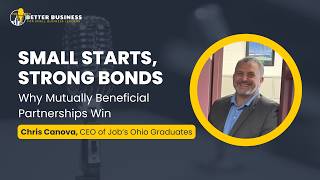
Chris Canova runs Jobs for Ohio's Graduates, which placed 14-24 year-olds into work across 10 counties. He grew the nonprofit from 8-9 founders to 70 full-time staff by building partnerships with 400+ local businesses. His formula: start small, meet face-to-face, be clear about what each side gets, and check in regularly.
Chapters
You have to prove your worth too. Right. You know, what is your value to the people that you're working with? Whether it's your clients, whether it's your business partners, you need to prove it every day.
So one of the biggest myths in business is that you have to do everything all by yourself. And so today I am talking with Chris Canova from and Jobs for Ohio's Graduates and he is going to be having a conversation with me about collaboration. So Chris, thank you for being on the show today.
I am so happy to be here. Thanks for asking.
So you are someone who kind of leads with clarity. You kind of, you build intention and you understand how to build good teams across not just your organization but with other organizations as well. So you know, you've led JOG through a lot of change and growth. I'd like you to kind of talk a little bit about what JOG does and then I kind of like you to talk about how collaboration has shown up as a non negotiable part of your organization.
Well, you're absolutely right. Collaboration is the key to our one of the keys to our success jobs for Ohio graduates is operating in 10 counties. Now we help young people 14 to 24 to graduate from high school, create a career path and get them into a positive situation after graduation, either employment or additional training or college. Of late we've gotten into serving specialized population adjudicated youth as well as adult populations that are more targeted towards manufacturing career sector and our business sector. And this next year we'll be getting into the polymer sector as well. So we're excited about what's happening within the organization with respect to collaboration. Oh man, that's a big topic. And I'll probably say this more than just this once today, but collaboration is a word that's often used but seldom put into play in a meaningful way.
Agree.
So I'm looking forward to talking about that with you today.
Yeah. So JOG works at that intersection of education, workforce and business. So how do you balance those moving parts while keeping your organization mission focused?
Right. I think it's first of all you have to mission needs to be first and you know, what do we need as an organization to serve our clients and that has to lead the way for us. Given that knowing your partners, knowing the people in business, knowing the people in education, et cetera, it's really important. It's critical. And what I would say is it's a two way street. We need to know what their needs are. If we're not addressing their needs to begin with then it is very difficult to build a relationship. It has to be mutual. One sided relationships, as you well know, don't work for very long. So building that relationship with them, identifying what their needs are, and then I don't treat them differently because we're mission driven and we're there for our clients. Now we have different programs and those programs might have different priorities. But saying that we're very fortunate that our education partners have been with us for over 30 years of late, especially since COVID our business relationships have really taken off. We have over 400, you know, what I would consider partners in the business community just in Summit county and more than that beyond. So really excited for what I guess the future has in hold for jog.
When you start thinking about the partnerships that you have that work, whether it is a business relationship, an education relationship, what are those common threads? What makes collaboration actually productive for you as an organization and as a leader?
That's a really good question. I think that there are three elements that kind of drive how I operate. One is the, you know, the ability and willingness to engage. Again, because we're seeking that collaboration, oftentimes they're not. We have to engage them where they're at. We need to, you know, through that engagement. The more often you're willing to engage, the better you are at making that happen. That sounds simple, right? Just meeting somebody is not altogether that easy. Or going to the facility, fitting them in your schedule. Once you're able to engage them, you can build that relationship. And once you have the relationship, then you can establish collaborations, partnerships, meaningful pathways for their students or their clients. And it needs to be mutually. Mutually beneficial. Yeah. So I think that's what I'm always seeking. What is the mutual. The mutual path to success.
Yeah. So on the flip side, what tends to get in the way of effective partnerships for nonprofits and the business community, besides sometimes personality?
Well, I've been around the non profit arena for quite some time now, as you well know. And I would say from a non profit's perspective, treating your business on a day to day basis as a charity doesn't often work. When trying to build relationships with those education and business partners, you need to be in it for each other. And if you're not willing to do so, those relationships aren't going to happen. And they're certainly not going to be long term. That's what I would say the biggest pitfall is. You have to operate as a business, whether it's personnel, whether it's growing your business, whether it's your finances. You need to make sure that your business plan is what you're working.
Yeah. So you've worked in a lot of different funding streams, a lot of different types of projects. They have tons of different names and they change over time. So you've got to think how you, you collaborate with different individuals in the business community. But let's talk about internally, so how you lead your team to think collaboratively. So how do you, you do that across departments, with outside partners, with the youth you serve, how do you foster collaboration within your organization? Because you're rapidly growing as well. So I feel like.
I want to ask you that question.
No, I want to ask you.
We can talk about it. Yeah. It's one of the most challenging things that I do. And I don't think anybody, whether it's our organization, whether it's an individual professional. When you operate in a silo, it's hard to get things done. And in this day and age where budgets might be more constricted or, or you're being asked to do more with less, you need others to be successful. And then when you talk about departments, they tend to be insular and reaching across the three foot hallway is. Might as well be a mile sometimes. So again, putting them in the same, same place. And, you know, I think it starts with me starting the discussion and then asking them for, you know, certain outcomes that I expect. And I know that those outcomes that I place upon them are going to require both of them to be involved. So that's how I start the conversation internally. When we're talking about external relationships, I think it really varies on, you know, where we're at, what our intentions are with our clients, what do our clients need because they drive those relationships and those collaborations. I would say this. Don't be in a rush to build collaborations or to build partnerships. Summit county is a good example. Slim County, Job and Family Services. Great leadership. You know, from the top down, whether it's Eileen at the executive level or Terry running job and family services and her whole team, you need to start again with building the relationship from the perspective of what do they need and expect from you. And sometimes that takes a long time.
Yeah.
What I've seen happen to a number of nonprofits or businesses who have bit into these kind of relationships with the county is that they are so internally focused that they lose sight of the overarching goals the county might have that really should be mutual goals. Right. Putting people in positive positions to be successful. So that's what I would say about that.
Yeah. One thing that I've learned from you in that collaboration is often a long game, but also it's about alignment and finding the alignment. There isn't always a straight line to alignment. And so when I look at your organization, how you foster collaboration across departments and teams, I mean, you've got departments in. You've got finance, you've got programs, you've got all of these business development, business engagement. And then you've got other teams that are dealing with divided counties. So Summit County, Medina County, Trumbull county, all. All of those things have the potential to be siloed. But then you bring everyone together. I mean, you just did this a couple weeks ago, pulling together your organization, having strategic visioning sessions, having everybody in the same room sharing ideas. I think that part of collaboration within your organization, whether you are a small team of five or you're a growing team of 500, it's figuring out how to get everyone in the room to have those conversations. And then also at the leadership level, really making sure that they understand that collaboration can come in a lot of different ways.
So, Yeah, I agree 100%. Making the effort to put people together. And that's not easy. I mean, you have a busy schedule. Getting on your calendar sometimes is not altogether easy.
Likewise, yours is the same.
Right, Exactly. And we're just individuals. Right. Multiply that times 70 for us. And if you don't make it a priority, it's never gonna happen. So whether it's more of a business type of a gathering or strategic or sometimes just fun. And I saw that you took your group to for an outing recently.
Yeah, we went to an alpaca farm.
Thank you. Right. And I've heard, like, nothing but positive things about that from your people. So similar kind of thought process, putting people in environments where they need to communicate to one another. And again, back to relationships. If they don't have a relationship, they're just not going to talk to one another. They're not going to work together. So I think it's part of our responsibility to make sure that we're doing those things.
Yeah. Another thing that I think you do well as it relates to collaboration is being in a space where you're top of mind for organizations. Because being in workforce, working with the business community, there are going to be some organizations that always need your services, always need help with, with internships, with helping develop additional workforce resources. And then there are going to be some that it's all about timing. And so I think that as a leader, you've Done a very good job of positioning people to be top of mind and be in front of people and available for when the need arises. So to kind of talk a little bit more about that, you know, a lot of small businesses want to be a part of the workforce solution. We keep talking about like winning the war for talent as generations continue to rise up within, within the world. How do we engage that work? So how can small businesses be a part of that workforce solution even when they don't know where to start? So what's the first step locally that they can take besides just knowing who jog is?
Well, I mean, I think being transparent with their needs and being realistic given the current economy, job market, etc. Most businesses come to us because they need or want employees. Most education institutions, school districts, et cetera, come to us because they want our services. We need to know what their need is. And then we, it's, you know, our responsibility. To your point you just made, sometimes it's a long play. It's not like, okay, we realize you need employers, however, everybody needs employers. And let's talk about what your wage is, let's talk about what the hours of availability are, how much access do our clients have to your business? And I'm not asking those questions because I'm begging for what we need, but just making them aware of the market. Right. So starting with those conversations and then putting in, in play what we see the relationship looking like on a given timeline. Yeah, that's what I would, that's, that's pretty much what I would say.
Yeah. So collaboration sometimes goes well, sometimes it doesn't. What's a lesson that you've learned the hard way about collaboration? Either something that didn't go as planned or I mean, maybe it went really well, reshaped how you lead.
I mentioned earlier the, you know, collaboration is a word often used but not really utilized a lot in the nonprofit arena. And I think people are protective of their space, protective of their resources, budgets, et cetera. And on the opposite end of the spectrum, maybe it could be a cash grab, things of those nature. Of that nature. And I think it's part of my responsibility to just see what they're looking for, what they're asking for and what the relationship, how it could be mutually beneficial to one another. To answer your question directly, I've been burnt more than once. We've been burnt more than one time in that the relationship ended up being self serving to the other organization. I'm not saying we're perfect. I'm sure we've been in that, that spot here and there, I suppose. But we, we really need to be front end work with the people that you want to be partners with is as important as actually the engagement and implementing whatever product or program that you want to do with them. Know your partners because we've had programs taken, we've had resources that have shifted from, you know, our pot to their pot. Yeah, I just think you need to be weary, not, not so much weary. Just know your partner so you have explicit expectations when you enter into these agreements.
One thing I've learned from you too as building collaboration, creating partnerships is it can start small. I think oftentimes as small business leaders, we think it's got to be, it's got to be something big. And you've really shared with me that, that often the success that you have that has been on a larger scale is because you started really small. And we're willing to say, you know what, we don't need 90% of the project. Can we take 10% of the project? And looking at, you know, those are things that we don't do well. And you really advocating to be able to be at the table for the things that you do a good job at pulling other individuals or organizations in, in collaboration of, you know, we can do this section and then maybe this other organization can do another section. I remember you telling me, you know, sometimes it's as simple as just, you know, carrying the banner for the organization. Whether it's something that you would normally do or not. If helps build the relationship to get you to the next step, it's worth it. So that's my feedback and appreciation for the things that you've taught me. So thank you.
I think literally the story that I told you about that I was literally carrying a banner. You were carrying a banner for the organization, ironically. But you know, I couldn't agree more. You know, our story is one that didn't happen overnight. I've been the director for, I've lost track for how many years?
A long time.
A long time. More than a minute. And you know, I think we had eight, nine people when I started. We now have 70 full time people. But again, over many years. And you have to prove your worth too. Right. You know, what is your value to the people that you're working with? Whether it's your clients, whether it's your business partners, you need to prove it every day. And when it's not happening, when it's not going well, you need to be honest about that too.
Yeah.
And you would think that is, you know, is commonplace.
Yeah.
What I've learned is it's not. Transparent conversations are not always the easiest to have. But I think you and I excel in the transparent conversation mode so.
Well, and it's that question about how long does it take you to become an overnight success? Decades.
You're right.
I mean people say you're, you're everywhere. You've done all these things, you. And with jog, like jog is, is continuing to grow and they like. How long have you been successful? Well, we've been successful for a minute, but it's taken us a long time to really perfect where we are.
Well, I, I think much like, much like you and your business or businesses, I should say, you know, we started in, in at one point over here and the bandwidth really has expanded, has widened and that happened because of the relationships and the success we were having at our core business. Right. So we were humming along and at the same time, you know, it's not just about what we're doing now, what are we going to be doing tomorrow or five years from now, and having the foresight or I should say the willingness to entertain thoughts that are outside the box.
Yeah.
And listening to your clients. Not clients, I'm sorry, but clients as well. But, but businesses that you're working with or partners.
Yeah.
And saying, huh, they have a need. We don't do that currently, but we have the capacity, we have the professional expertise. And is that something that we can entertain? Because we already have the relationship. Now it's about putting the work in to make sure that maybe you're even interjecting the, you know, what that next project would be. It's happened a lot for us. I mentioned before that, you know, our core business is 16 to 24 year olds and helping those young people be successful, whether that's education or workforce. The reality now is most of our growth is in the adult arena. How do we get there? We got there because these business partners, these government entities, these education environments saw our results. Hey, listen, if you can do this with 18 year olds, why can't you do it with 30 year olds? And at first I'm like, huh, I'm not sure.
You didn't just say, no, that's not your core.
So we thought about it and we worked on it. And I think that's been our biggest growth sector in the last two or three years. We didn't have any Department of Labor grants or resources. Now it's upwards of maybe two or three million dollars a year.
So let's zoom out for a second. Okay, so what do you think the next five years looks like for business and workforce partnerships? As you're seeing your work going into older adults, dealing with a more mature workforce, what needs to shift? What's going to happen without panic?
Okay, so I think there, I think there's, there's a couple things in play here. And you never know about tomorrow till it gets here. Right?
Yeah.
However, what I would say is, especially for the young, the younger workforce, thinking about who we are trying to work with and communicate with, engagement is critical. They want to be engaged. They may not know they want to be engaged, but they need to be engaged. It's not happening. It didn't happen for them in school because of the, because of COVID And now we've put them out into the real world and they're not used to building relationships. They're not even used to engaging others. So it sounds very simplistic. But the willingness to engage young people is critical. They see that as investment in them. And when you work with young people and you invest and they see that you're investing in them, they will stay forever. They won't leave. Now the sign of the opposite happening is young people leaving for a nickel an hour raise.
Yeah.
That shows the employer, and this is what I tell employers, you're not doing a very good job of engagement, building relationships. It's just a job. And young people are looking for something more than that nowadays with respect to the general arena, AI is real.
Yeah.
And it's here more than we all know. And we need to embrace it and use it as a tool to make our people more productive. And I think if we're willing to do that, they're going to view that as an investment in them. If we don't do it, they're going to continue or not going to continue. They're going to perceive AI as a potential threat to their job, to their well being. So you might as well embrace it and bring it into the organization that you're involved with and get your people familiar with it and if possible, trained.
So, last question. So for business owners listening, who want to build a better team, better culture, better community, what's the one thing that you challenge them to do this quarter to get better in their business?
I mentioned it earlier, actually, you brought it up, planning time together. And it happens within your department, it happens as a whole organization. It needs to happen. And you're more likely to help somebody, to assist them in their job, to introduce them to somebody. If you know them. If you have a relationship absent that, it's very difficult to be successful long term. So I think that's number one. Our organization has shifted and let me back up. I say that and it sounds very simplistic. We used to, and we still do call it, you know, our staff, the jog family. That being said, going from 10 to.
70, it's a lot.
And maintaining that culture is very difficult. The only way to do that is face to FaceTime. And whether that's small groups or large groups, it needs to be happening.
Chris, thank you for your time. Things I've heard from you today about how to collaborate. First, just get started, start building relationships, make those connections. It can start small. Don't underestimate or undervalue the little things that you're doing to stay engaged with different individuals and build collaborative partnerships. And then in building collaboration within your organization, talk to each other, see each other, spend time with one another so that you can continue to learn and grow. And as it relates to workforce, continuing to educate, staying connected and also, again, being relatable, being approachable. So thank you for your time and all the things that you've shared with us. We'll connect everyone to JOG in our show notes and appreciate you being here.
Well, thank you so much for having me.










