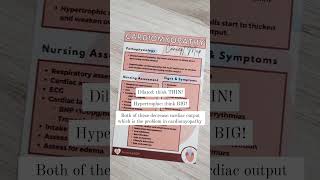
A concept map breaks down two types of cardiomyopathy for nursing students. Dilated cardiomyopathy thins and stretches the heart wall, while hypertrophic cardiomyopathy thickens it. Both reduce cardiac output, causing dyspnea, syncope, fatigue, and dizziness that nursing care must address.
Chapters
Let's talk about cardiomyopathy and give you a concept map for nursing school. So cardiomyopathy, there's two main types. Dilated cardiomyopathy where the heart, the walls of the heart, they start to dilate and it decreases the cardiac output. And then you have hypertrophic cardiomyopathy where the heart walls start to thicken and because they're thicker, they become weaker over time and again decreases the cardiac output. Now, whenever you are learning in nursing school, you want to focus on the pathophysiology and then to the other things of the disorder. You have to know like the signs and symptoms, the nursing assessment and the nursing interventions. Those are so, so important and we want to connect it back to the patho so we know that it's going to decrease cardiac output. So the signs and symptoms make sense. You're going to dyspnea, syncope, fatigue, dizziness. All of those things have to do with a low cardiac output. The nursing assessment and the nursing interventions again will have to do with that cardiac output. So I hope that this concept map helps.