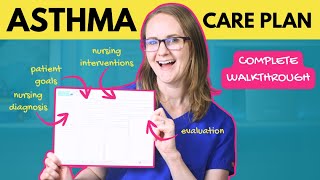
Christina Rafano walks through building an asthma care plan for nursing school. You'll learn how to pick a NANDA diagnosis, write patient-centered SMART goals, and create nursing interventions that match the diagnosis and goals.
Chapters
Hey there, my friend. My name is Christina Rafano from nursingsos.com and in this video, today we are going to write an asthma care plan together. Care plans are a huge deal in nursing school. You're gonna have to write them all the time and they're a big part of your grade. So I hope that this video helps to give you some tips and tricks to help make your care plans better so that you can pass them every time. Let's dive in. So you're gonna write care planes all, all the time in nursing school at clinical. You'll talk about them in lecture class, probably like they are a big, big deal and a big part of your grade. So let's walk through an asthma care plan to help you kind of see how it's structured and how you can write them easier, faster. And I'm going to give you lots of tips and tricks to help you out with that. Now, I am going to use our asthma care plan that I have for you available inside the nursing SOS membership community. I have a whole care plan database and inside the NMC for you. So if you are struggling with care plans and you really just want more examples on how to write them, definitely check that out. I think it's going to be really helpful for you. So I'm going to put the link down below in the description for you to check out the details. So let's walk through it. So the first part of any care plan that you're going to write in nursing school is the nursing diagnosis. This is a big, big deal. The nursing diagnosis. You've got to make sure that you are selecting a specific, specific nursing diagnosis to your patient. Okay? What I often see and hear from with nursing students is that you look at the list of nursing diagnoses that you have and choose something that doesn't really apply to your patient. You do not want to do that. You want to make sure that whatever nursing diagnosis that you use actually applies to your specific patient, that you're actually picking a nursing diagnosis that is specific for them. Now, thankfully, you do not have to make up your own nursing diagnoses. These are actually standardized. So nursing diagnoses are standardized. And I love this book, you guys. If you have been around for a while, you know, I talk about it all the time. The Nursing Diagnosis Handbook by Ackley and Ludwig. This is the book that I recommend for writing care plans. And in the front here, as you will see, there are all the nursing diagnoses that you can choose from. So the thing about nursing diagnoses for for your care plans is that you don't actually make them up. You just select from a list. These are standardized so you do not have to pull them out of thin air or pull them out of your brain. You just pick from a list. So for asthma there are several possible nursing diagnoses that you can use. But some there's three that I picked that could apply to your patients. But of course don't choose one that doesn't apply to your patient. You want to make sure that it's specific for your patient. But possible nurs diagnosis for asthma could be something like impaired gas exchange. That's a good one. Ineffective airway clearance or ineffective breathing pattern. Those are just three possible nursing diagnoses that you could choose for a patient with asthma if it applies to your patient. So that is the first part of your nursing diagnosis is actually the nursing diagnosis part like the NANDA nursing diagnosis. Now the second part is the related to and this is kind of what you would say is the cause or what I like to say is the pathophysiology, what is actually happening in the body that's causing this problem or the nursing diagnosis. So if the patient has impaired gas exchange or ineffective airway clearance or ineffective breathing pattern, why the related to is the why behind that the pathophysiology so possible related to sections or what I call the related two factor could be inflammation in the airway. So for asthma, inflammation in the airway is common, bronchial secretions or obstruction of the airway. Those can all be possible related to sections for your nursing diagnosis for asthma. Now the third section of a nursing diagnosis for your care plan is the as evidenced by now this, you'll see this abbreviated oftentimes as a eb. So don't get confused by this. All it means is the signs and support symptoms. Literally that's all it means is the symptoms. What are the things that you are seeing in your patient that show that the nursing diagnosis that you gave them is appropriate? So what is the evidence for that nursing diagnosis? Does that make sense? So you've got your nursing diagnosis, you've got the why that related to part and then you've got the as evidenced by so it's as evidenced by this list of things which is basically the signs and symptoms. Okay, so for asthma, some possible as evidenced by some possible signs and symptoms could be things like cough, decrease oxygen saturation, increased work of breathing or wob, increased respiratory rate, adventitious breath sounds or abnormal ABG results. So those are some possible signs and symptoms that you might see in a patient with asthma. So when you are putting this whole nursing diagnosis together, this could be a possibility of what it might look like. You would have a NANDO nursing diagnosis of maybe impaired gas exchange related to inflammation in the airway as evidenced by a cough, decrease oxygen saturation or increased work of breathing. So that could be a good nursing diagnosis for a patient with asthma. You've got those three parts. The NANDA nursing diagnosis, the related to, and then the asthma evidenced by. So that is how you would write your nursing diagnosis. Now, I know writing nursing diagnosis can be really tricky because there's all those moving parts, right? I actually have a free cheat sheet for you to help you write nursing diagnoses better. So kind of simplify it out for you. So I'm going to put the link to that free cheat sheet down below in the description for you to check that out if you think that'll be helpful for you. Now, the next section of your nursing care plan is the goals. Patient goals. Now here's the tricky thing about this, is that these are specific to the patient. These are things that the patient will do, not the nurse. All right, that's the next part and we'll get there. But right now, in this patient goals section, this is things that the patient should achieve or that we want them to achieve to help them progress in their plan of care. Their care plan. Huh? So see how that works? So this is patient goals. These can either be long term goals or short term goals. Okay, so for asthma, some possible patient goals, let's just use these as examples. Could be the patient will maintain a patent airway. So an open airway with a decrease in work of breathing and increased aeration in their lungs. Right? So number two, the patient will have improved aeration gas exchange in their lungs. The patient will understand the medications and the rationale for their use. Even when they're feeling well. The patient understands how to identify and avoid potential triggers to maintain their respiratory status. That's a big one for asthma is, is avoiding possible triggers for them. And then five, the patient understands the importance of deep breathing and coughing exercises. So those are just some examples of some patient goals that you could use for a care plan for asthma. No, the thing about patient goals that your school might use is smart goals. You've probably heard of this before. Okay? Specific, measurable, attainable. Let's see. S, M, A, R is realistic and T is time bound. So if your school uses that smart goal framework, you want to make sure that you're Sticking within that framework, specific, measurable, attainable, realistic and time bound. So with these goals here, these would fall under that category. But the thing that you would want to change or add is that time bound piece. So make sure that you're adding like the patient will maintain a patent airway with a decrease in work of breathing and increased duration by this time. Like oh, 700 on this day. You could also, to make it even more specific for that s part, you could put like keep an oxygen saturation above 95%. Right? So that would be more specific. Actually adding a number there would be more specific to whatever patient you're working with. And then, and then that time bound piece, the patient will maintain a oxygen saturation of above a 95% or above for a duration of 6 hours by 0700 on this day. Like that could be a good patient goal for you if your school uses that smart goal framework. But one of the key things to remember for this patient goal section is it is written as the patient will. So the patient will do this, the patient will do that by this time. So make sure it's specific, measurable, attainable, realistic and time bound for your patient. Patient. Okay, so those, this column here is the patient goal and that is written as the patient will. Now the next column is the nursing interventions. And these are written as the nurse will. So that's you, the nurse, the nursing student, the nurse will do this. Now these nursing interventions are meant to help the patient to reach their goal. So whatever goal that you wrote in the previous column under the patient goals, that is what your nursing interventions are going to target. You want to make sure that you're helping, trying to help your patient reach their goal. And then those goals need to relate back to the nursing diagnosis. We, we want to make sure your whole care plan is consistent with each other. Okay? So because this is a care plan for asthma, it's all going to relate back to that asthma nursing diagnosis. Okay? So now here in the nursing interventions column, some possible ones that you might use could be something like the nurse will continue to monitor the respiratory status closely. Now you could say monitoring their oxygen saturation, monitoring their ABGs, if that's what you're doing, things like that, you know, whatever that you've got the patient on, if they're on a peak flow meter or something, you know, you could say the nurse will monitor the, their peak flow. Okay. Number two, the nurse will continue to monitor their vital signs. The nurse will administer medications as ordered. And to make this more specific, you would put Their medications, the nurse will administer oxygen and then say, like at however many liters, the nurse will administer whatever medications that they're on. Okay, so you can be more specific for your patient. Now, number four, the nurse will educate the patient on their medications and the proper use of them. If you wanted to be more specific with this, you could say things like, how are they going to use their oxygen mask? Are they going to use a spacer when they do their inhaler, Are they going to use a nebulizer? You know, educate the patient on their specific medications. And now number five, the nurse will encourage deep breathing exercises or coughing exercises. So these nursing interventions are written as the nurse will. So that's you. So what are you going to do to help get this patient's asthma more under control, Help them to meet those patient goals that we wrote out and then ultimately to meet to help improve that nursing diagnosis? So if our nursing diagnosis here, like we wrote, is impaired gas exchange, we want to help improve their gas exchange, get more oxygen into the body. So those interventions need to need to correlate, correspond back to that nursing diagnosis. Now, the last section of the care plan is the evaluation section. So this is basically just a reassessment all over again. This is your nursing assessment again. So what you will do for the evaluation for your care plan is you will write out if the goal, the patient goal was met or not, and if it was not met, what are you going to change? So those are really the key aspects of this evaluation. And what your nursing instructor is going to be looking for is to really dig deeper to figure out if the goal was not met, what are some good changes that you could do to their plan of care to help your patient meet their goal next time? So if the patient goals were not met, then what are you going to do? What nursing interventions can you do or continue or change to help your patient meet their goal? So that is what this evaluation section is all about, Just kind of evaluating the patient's progress, evaluating how those nursing interventions worked to help your patient and what you're going to do differently next time. So care plans really are a huge deal in nursing school. So click on this video right here and I walk you through my step by step process for how to ace your care plan. So I hope this asthma care plan example will was helpful for you, but that video is going to walk you through the process step by step. And if you loved this video, write love in the comments below, because that is what we do here on my channel. And of course as always, my friend. Go. Become the nurse that God created only you to be. And I will see you over there in that next video.










