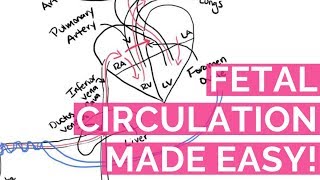
Fetal blood bypasses the lungs and liver through three shunts: the foramen ovale, ductus venosus, and ductus arteriosus. Oxygenated blood from the placenta travels through the umbilical vein and is diverted away from non-functional organs. All three shunts close after birth, switching to adult circulation.
Chapters
What is up, my friend? What is going on? I hope you are having a beautiful day. I could not be having a better day. And that is despite the fact that we found not one but two caterpillars in our salad the other day. How is that even possible? Now I'm afraid to eat salad ever again. Have you ever found a bug in your salad before? Please tell me. Yes. So I feel less alone. But actually part of me doesn't want to know that it happens very often because I never want it to happen again. Ever. Anyway, you're probably wondering why we're sitting in my office here at home and I have a super fun video planned for you today. We are going to talk about fetal circulation, and I'm actually going to draw it out here for you on my computer so that you can actually see it and we can draw out the pathway and everything to make it really come alive for you. So if you are taking OB or maternity in nursing school right now, or if you're heading that direction in nursing school, listen up. This video is for you. You will absolutely be tested on this at some point, and I really want you to do well on your exam. There are some key differences between the blood circulation of an adult and the blood circulation of a baby when it's ins its mama. If you haven't watched the previous video I did on the pathway of blood flow through the heart, be sure to check that one out first and then come back to this video. Because you really need to know what an adult's heart looks like before you can learn what a baby's heart looks like when it's inside its mama. So I'm going to trace this all out for you so you can follow along and you will finally understand it after this video. Let's do it. Now, the first thing you need to know is that there are three key differences in fetal the ductus arteriosus, which is right here the foramen ovale, which is right here, and the ductus venosus, which is right here. The ductus arteriosus is the little hole that connects the pulmonary artery and the aorta, so it diverts blood flow away from the lungs. When the baby is inside its mama, it's not using its lungs, so the ductus arteriosus will help to divert that blood, bypass the lungs, and give more blood to the body. Now, the foramen ovale is another little hole that connects the left and the right atrium. Now, since the baby isn't breathing by itself, it doesn't need to move blood into the pulmonary circulation, to get oxygen, it already comes in oxygenated from the mama. So the foramen ovale here is a little hole that allows blood to pass from the right atrium to the left atrium, which helps to bypass that pulmonary circulation. And finally, we have the ductus venosus, which is the last one that you need to know about. Now, this one is located between the umbilical vein right here. That's the umbilical vein and the liver. So it's between the umbilical vein and the liver. So the baby isn't using its liver either. It's not using its lungs or its liver when it's inside its mama. So the ductus venosus will allow blood to pass from the umbilical vein into the inferior vena cava right here. Now, some blood will still go to the liver, but this opening really allows more blood to go to the rest of the baby's body. So those are the three key differences that you need to know about. Fetal circulation is the ductus arteriosus, the foramen ovale, and the ductus spinosus. So let's draw this out so we can see what it looks like. The pathway of blood flow will start here in the placenta, right here. And then the blood will move through the umbilical vein, and that's oxygenated blood. It travels through the umbilical vein into the liver area. It'll travel through the ductus venosus right here, which allows the blood to bypass the liver and meet the inferior vena cava, like we said. Then the blood is gonna move up here and get dumped into the right atrium. Now, from here, some of the blood goes into the right ventricle and then into the pulmonary artery, and that will go to the lungs. But the majority of it moves to the left atrium right here through that foramen ovale, like we said before. So that foramen ovale connects the right atrium to the left atrium and allows blood to pass through that. So more blood is going to go out to the body rather than going up here through the pulmonary circulation, pulmonary artery into the lungs. Now, the ductus arteriosus is an opening in the pulmonary artery to the aorta to help shunt blood even more away from the lungs. So some of the blood that ended up going down here to the right ventricle and then into the pulmonary artery, it'll flow out from that pulmonary circulation into the aorta. So it's actually going to come up this way and go through that ductus arteriosus into the aorta. And out to the baby's body. Now this just helps get as much blood to the baby's body as possible because the baby isn't using their lungs quite yet and it doesn't need as much blood there right now. So now because blood moved from the right atrium to the left atrium through the foramen ovale, we have blood here in the left atrium. Now the blood from the left atrium, it goes to the left, left ventricle down here and then it goes into the aorta right through there. Now this is now distributed through the baby's body. So it comes all the way over here, meets that little blood there and goes out to the body through the aorta. Now, once the blood has gone through the baby's body and the baby has used up all that oxygen to, you know, keep itself alive and keep itself healthy, keep itself healthy, then all of that blood from the body is going to go all the way back here, all the way back here to the placenta. And now I am actually going to draw two arteries because there are two, two umbilical arteries and one umbilical vein. And the way that I like to describe this to nursing students is that you want to get two A's nursing school, not one. So there's two arteries and one vein. So my friend, that is the pathway of fetal circulation. It's super important to mention that when a baby is born that all of these holes, all of these holes, the ductus venosus, the ductus arteriosus and the foramen ovale, they all close up so then the baby can use its lungs and its liver. I hope this breakdown helped you understand this more for nursing school. And of course, if you need more help with OB or maternity or newborn topics in nursing school, you definitely want to check out the nursing SOS membership community where we have a full maternal newborn course for you inside the community. I get a lot of requests from nursing students for more in depth help with their specific situations in nursing school. And this membership community is the best way that I know how to help you with nursing school. When you join, you'll get access to all of our courses, including these like Med Surg, how to study Pharmacology, Fluids and Electrolytes, how to write care Plans, Critical care course, and of course the the maternal newborn course for you that will walk you through more of this in depth fetal circulation topics and all the other maternal newborn topics that you need to know about in nursing school. You are going to love it. So thank you so much for watching, friend. Now go become the nurse that God created only you to be. And I will catch you in the next video.