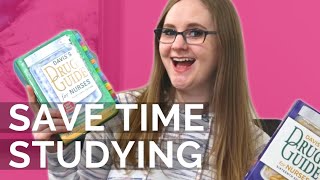
In this instructional video, nursing educator Christina Rafano walks nursing students through her personal system for using Davis's Drug Guide to learn medications efficiently. She emphasizes purchasing the newest edition, explains the three key sections of the guide (front classifications tab, individual medication pages, and the comprehensive index in the back), and demonstrates a three‑step workflow: locate a drug in the index, flip to its individual entry to identify its pharmacologic class, then study that class in the front classification section instead of memorizing each drug separately. Rafano shares her tabbing method—using assorted colored tabs for frequently used meds—and provides a downloadable cheat sheet to help break drugs into classes. She answers a common student query about a master medication list, clarifying that the NCSBN does not publish one, and encourages students to learn drugs through repeated clinical exposure. The video also promotes the Nursing SOS membership, which offers a forthcoming medication database, a pharmacology study course, and announces an upcoming med‑surg video. Throughout, she uses a supportive, enthusiastic tone to motivate students to adopt class‑based learning and leverage the drug guide as a study tool.
Chapters
In this video today we are going to talk about how to use a drug guide in nursing school. I get questions all the time from nursing students asking me how I tab mine and how I use it to learn meds faster. So we are going to go over how I used my drug guide in nursing school to learn meds super fast. So hit that subscribe button and click the notification bell and let's dive in. So first things first, the drug aid that I recommend that you buy for nursing school is called the Davis's Drug Guide. Now this is the older edition. This is the one that I used in nursing school. I still love it. It has all my pretty tabs. I just haven't transferred them over. This is the new edition, so if you are going to purchase it, you really should make sure that you have the newer edition because I mean, I was so surprised when I got that in the mail. It's so much thicker. It's like they added a gazillion meds. So super important that you have the updated version just to make sure that you have, you know, all the updated information, all the updated meds. I will transfer my T over to this new one eventually, but I'm kind of attached to it. So I am going to walk you through most of this video in this drug guide just because it's my favorite. So I just get questions all the time from students asking me what my system was for learning meds in nursing school, how I tab my drug guide, if there's a color coding system and just generally how to use it to learn meds faster. So really there are three main parts to your drug guide that I want to walk you through that I used in nursing school that are super important. The first one is if you get the Davis's drug Guide in the front section here, it has a red tab section that's called classifications. Now this is kind of a mix of therapeutic and pharmacologic class, you'll notice. But this is super duper important. And I walk you through why these drug classes are super important here in this video. So definitely check that out if you haven't already. And I walk you through everything, how to learn your meds faster using this section of the drug guide. Seriously, if you haven't watched that video, friend, I cannot stress it enough. If you are spending all your time learning medications individually, you absolutely need to watch that video and learn them by drug class. I tell you why in that video, seriously save you a ton of time. So that is the first thing that you absolutely have to use in your drug guide. Now the second one is where I have all of my tabs here. These are in individual medications. So all throughout the drug add all these white pages here are just individual meds that you have to know. And then the final section that I want to point out is way in the back. And this is the, it's also tabbed here in red and it's the comprehensive index. So this has all the medications as well and it tells you what page number they're on so that you can find. Flip to whatever page and then find it pretty easily that way. So the first thing let's go over is how I tab this. I often get questions from students asking me if there's a color code system. And the first gal that asked me that, I was like, oh, that would be super cool. But no, there's not a color code system to my dread guide tabs. I just chose whatever color I thought fit the medication the best, I guess. But basically what I have is I've tabbed the most common meds that I used to give in nursing school. So things like aspirin, furosemide, amlodipine, docusate, all these are like tabbed here on the side. Just meds that I gave over and over and over again because I did not want to have to keep looking it up. Friends, I am so bad at the Alphabet. If I have to flip through pages and find where things are in alphabetical order, I always find myself like repeating the Alphabet in my head or even out loud flip. I'm like A, B, C, D, E. Because seriously, I just don't know it apparently as well as I should. So I have tabbed it. It just makes it so much easier for me to find exactly what I need. So here is kind of a three step process that I want you to go through when you are looking up your medications in your drug guide. This is what I did in nursing school. I found it to be really the easiest way to do this. So the first thing is when you see a new medication or if you just have to look a medication up for one of your patients or for your lecture class or something in nursing school, the first thing that I would do is I would come back here to the comprehensive index and I would find the name of the medication. So you just flip through here, find any of the medications that you are studying and need to know about and then it'll tell you the page number and then go to the page number. So step number two is to then find, let's do albuterol. Find the page that that medication is on. And then what you're gonna want to do is look initially at the pharmacologic class of, of that medication. So that is step number two. Go to the individual medication in your drug guide and then find the pharmacologic class. Now, if you remember from that video that I had mentioned earlier, the third step you're going to do is come back here to the front to the classification section, and you're going to learn your meds based on the pharmacologic class that that drug belongs under. I do not want you to memorize medications individually. Friend, Friend. There are so many medications here in these white pages, right? But look at this. There's only a few pharmacologic classes or therapeutic classes. I want you to remember your medications based on pharmacologic class. Here's why. With pharmacologic classes, all of the medications that belong to the same pharmacologic class will have the same or similar mechanism of action. So instead of learning like 10 or 12 medications that belong under one pharmacolog, instead of learning them individually here in these white pages, you can just learn the mechanism of action of the pharmacologic class. Then you'll automatically understand what the mechanism of action is for all those individual drugs. You see what I'm saying? So it's like Instead of memorizing 10 or 12 medications, you're only memorizing one drug class. It just cuts your study time way, way down. So this is how I use my drug guide. Literally. Go from back to front. Start with the comprehensive index. When you get a med that you need to look up, go to the comprehensive index here in the back. Find the page number, then flip to whatever page number it is. There you go. Corticosteroids. Flip to whatever page number it is, and then you're going to look up the pharmacologic class, and then you're going to see if that is listed here in the front under classifications. And that is how you're going learn that. If you've been around for a while, you have probably heard me say this over and over, that I really want you to remember your medications by pharmacologic class, not by individual drug. So thankfully, I do have a cheat sheet for you to help you out with this whole process so you can download it. I'll put the link down below in the description of this video for you to check it out to help you break your medications into drug class so you can study them by class. And not by individual medications. Super cool. Now, I got a super great question from a student earlier this week. It's actually our YouTube comment of the week. But it's such a good question and I wanted to answer it here in this video today. The comment said, is there a trusted inclusive list of all drugs we need to know? My school doesn't provide any. Okay. So I get this question all the time from students. Is there a master list of medications that we need to know for nursing school and the nclex? And unfortunately, the answer is no. The ncsbn, the organization that puts on the NCLEX for nurses to get licensed. Right. The NCLEX is that board exam that you have to take to get licensed as a nurse in the U.S. so unfortunately, the NCSBN does not give us a comprehensive or inclusive list of medications that we have to know. So. So really, it just kind of comes down to learning the medications as you go through nursing school. So here's the thing that I always like to tell students. I know that learning medications can be overwhelming because, friend, look, I mean, there are tons of medications in here. But here's the thing. As you go through nursing school, you will be so surprised at how much you are going to remember the more you take care of your patients. Because oftentimes, especially if you're on at the same clinical site and on the same floor of maybe a hospital or something, you're on the same unit, the medications that you're going to see are going to be pretty repetitive. A lot of your patients are going to be on the same medications or similar medications. Just makes it a lot easier for you to learn them if you're giving them all the time and you're having to look them up all the time. Because of course, you've got to know your medications before you give them, right? So you're looking them up and then you're giving them to your patient after you understand what that medication is. So the more that you have patients with the same or similar medications, the more you have to look it up, the faster you're going to really commit all those meds to memory. So I really, I tell students all the time you are going to be so surprised at just how much you know about your meds when you get to the NCLEX or when you get to your nursing school exam, because you will have given them so many times. So just make sure that you're doing your due diligence following that system. Look up the comprehensive index in the back. Go to the individual medications here. And then please, please, please try the best you can to remember them by drug class. So that is the system that I recommend and that is exactly how I use my Davis Drug guide. Now, if you are a nursing SOS member, I hope you heard the announcement that we made a couple of weeks back that we are releasing a whole medication database for you. So this is going to be game and super amazing because oftentimes students will tell me that they really aren't really understanding their medications by reading a drug guide. Although I still want you to take a look at this. But it'll be nice. If you're a nursing SOS member, you'll be able to come home, pull up a video and it'll just be me explaining to you in very, very simple, easy terms what the medication does, what you have to know about it and everything. So it's gonna be so amazing. If you are a nursing SOS member, stay tuned for that because we are releasing that very, very soon you are going to have a whole medication database to help you learn your meds faster in nursing school. And also inside the nursing SOS membership community, we do have a whole course on how to study pharmacology where I walk you through really my entire process, step by step for how I learned my meds super fast in nursing school. So that is there for you. If you are a nursing SOS member, you can check it out in your dashboard. Now in a couple of weeks I am going to be doing a video here on YouTube all about what makes med surge hard. So if you are struggling in med surg and want some encouragement and some tips to get through, trust me, I'm right with you. That's what I'm here for. Make sure that you have hit the notification bell so you'll get notified when that video goes up and is available for you. Now make sure to like comment, subscribe and share this video with a friend and click on one of these videos right over here so you can keep rocking nursing school and friend as always. Go become the nurse that God created only you to be and I'll see you in the next video. Take care. Bye.