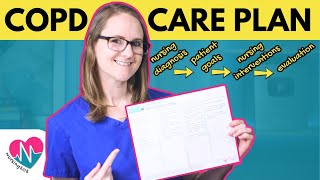
Christina Rafano walks through building a COPD nursing care plan column by column: picking a NANDA diagnosis like ineffective airway clearance, documenting signs like abnormal ABGs, writing goals as "the patient will," and listing interventions like deep-breathing teaching. She emphasizes using patient-specific data and shows how to evaluate whether goals were met.
Chapters
Hey there, my friend. My name is Christina Rafano with nursingsos.com and in this video, we are going to go through a whole care plan for copd. So care plans in nursing school, as you probably know, are a huge deal. You're going to write them all the time. So I really want to bring more care plan videos here on this channel to help walk you through exactly how care plans are laid out and what you might include in them so that you can write your care plans perfectly and get an A on them in nursing school. So let's watch through a COPD care plan. Be sure to subscribe to my channel and click that notification bell. Let's dive in. So, to be honest, I really struggled with writing care plans in the beginning of nursing school. I thought they were super complicated. I remember going through the textbooks and trying to figure out where are the nursing diagnoses and how do I write this thing and what is a patient goal? And I don't even know how to be a nurse, so how in the world would I know what nursing interventions to do? There's a lot that they throw at you with these care plans in nursing school that you have to know somehow in nursing fundamentals. And I just did it like, I, like it did not connect. Nursing care plans took me so long to write, they were so frustrating when I started nursing school. So if that's where you're at, like, I totally get it. So I really am hoping that walking through a lot of these care plan examples are going to help you to kind of connect things together and put, you know, connect the dots for you so that you can understand how to write them and really start writing them faster and easier because they don't have to take so long. Once it clicks for you like it, I hope it clicks for you like it did for me. It's going to be so much easier for you. So. But it takes time, takes practice. So that's why we're going to do all these care plan videos here on this channel to walk you through all of that so that they can become easier for you. Now, before we dive in, I want to make sure that you know about my free pack of nursing care plans. So snag that so you can use them as examples to write your care plans faster and easier in nursing school. I'm going to put the link to that down below in the description for you to check out after this video. So with your nursing care plans, the first step that you're going to do always is the nursing diagnosis. So these are standardized what we call NANDA nursing diagnoses. You don't write them yourself. So this is the first part of your care plan. Actually, this is the book that I always recommend that nursing students get. This is the book that I used in nursing school for writing care plans. It's called the Nursing Diagnosis Handbook by Ackley and Ludwig. And now this one in the front here, right in like the first couple of pages, is the entire list of NANDA nursing diagnoses that you can use when you are writing your care plans. So, so you just choose from the list. So for our nursing care plan for copd, so this could be things like emphysema or chronic bronchitis. Those are mostly the COPD disorders that you might see in nursing school. You could pick a nursing diagnosis, something like ineffective airway clearance, impaired gas exchange, or ineffective breathing pattern. So all of those are inside that care plan book. And then you would just pick that nursing diagnosis. That's it. Have to like pull these things out of your brain. You literally will just open up the book and pick the nursing diagnosis that specifically applies to your patient. So when we're talking about a respiratory disorder like COPD where the patient is, their. Their breathing is compromised, so we want to make sure that we are choosing a nursing diagnosis that applies to that situation. Something like, you know, ineffective airway clearance. Right. And side note by the, these are all inside the nursing SOS membership community. I have my full care plan database for our nursing SOS members. So if you are a member, be sure to download this and all the other care plans that I have in there for you so that you can use it as you write your care plans to make them easier. They're just really, really handy to have as you're writing your own in nursing school. If you're not a nursing SOS member, be sure to click the link down below to join. Make sure that you join and grab these when you do. You'll see it inside our care plan. So that could be super, super handy resource for you as you go through nursing school and write your own care plans. So that's really step number one here is to choose a nursing diagnosis. Make sure that it's specific to your patient. So if your patient is having that ineffective airway clearance or impaired gas exchange for those respiratory disorders, impaired gas exchange is such a good diagnosis to use, or ineffective breathing pattern. But pick the one that most closely is specific to your patient and whatever your patient's experiencing. And now the second part of your nursing diagnosis is what we Call the related to or related to factor. So what I like to tell nursing students is to dive deep into what is actually going on inside your patient's body. So with this related to this is the pathophysiology or like what is that diagnosis related to, what's causing it? So with a diagnosis like ineffective airway clearance, what we have here or in paragus exchange is it could be related to things like bronchospasm, inflammation in the airway or in the lungs, bronchial secretions. If your patient is having that compromised breathing, then it could be because there's increased mucus in the lungs or that those bronchial secretions and then obstruction of the airways there an obstruction, you know, is there airway tightening? Is there. Are those really all that mucus buildup and the secretions, are those things obstructing the patient's airway and compromising it? So those things would be possibilities that you could use for your related to section of your nursing diagnosis. So you've got that NANDA nursing diagnosis, then you've got the related to. Now the third part of this is the one what we call the AEB or as evidenced by. So you'll see it written as aeb it stands for as evidenced by. Now this part is literally just the signs and symptoms that you're seeing with your patient. So anything that you're seeing like a. Well, let's go through the list for this care plane because I think this is a really good example. So what I wrote here is increased work of breathing. So increased W O B persistent cough. Is there like so much gunkiness and mucus in the lungs that they have a persistent cough? It could be productive, it could be non productive. Decreased oxygen saturation, increased respiratory rate, so they're just trying to get more oxygen in their body. Adventitious breath sounds as they're wheezing or crackles, things like that, and then abnormal ABG results. If your patient did have labs drawn, if they did have an ABG done, like are those values out of whack? Now something that I really want to say about this section of the nursing diagnosis, this as evidenced by section is that you really want to make sure that it, it is specific for your patient. Okay? So if your patient did not have their ABGs drawn, if they did not have those lab values done, you wouldn't want to write that in your care plan because they did not have it done. If your patient doesn't have an increased respiratory rate, you wouldn't write that in your Care plan. You want to make sure that you are actually writing down the symptoms that your patient has with this diagnosis. Does that make sense? You're not just going to make things up. That's not how this works. We're not going to lie on our care plan plan. Okay? This is a care plan for your patient. Well, really for your clinical instructor. But we want to make sure that we are writing the things down that are actually happening with your patient. Does that make sense? So only write the signs and symptoms that your patient has. Now, the next section for your nursing care plan is what we call the patient goal section. Now, this section, this part is written as what the patient will do. All right? So patient goals. What do you want the patient to accomplish? What does the patient want to accomplish to help them get better and get well? So here, some things that we have listed here are the patient will maintain a patent or open airway. They'll have a decreased work of breathing and increased aeration in the lungs. So the patient will maintain an open airway. That's what we want. We want their airway to be open. We want them to have a decrease in their work of breathing. Then, number two, the patient will have improved aeration and a respiratory rate within normal limits. That could be a really good patient goal. We want the patient to have a respiratory rate that's within normal for them. Then the patient will demonstrate how to improve airway clearance through active coughing. So if we're going to teach our patient how to do coughing exercises, then that would be a good goal for them, is to show that they can do those things well, that they can demonstrate how to have their improved aeration in their lungs through those active coughing exercises. Number four, the patient will maintain adequate oxygenation of their tissues with ABGs within normal limits. So like we said before, if you're not doing active coughing exercises with your patient or if you're not drawing ABG for them, you're not going to use these things as patient goals. You want to make sure it is specific, specific to your patient. Because my friend, your clinical instructor is there on the floor with you. Right? Like, I remember so many times, like, being in a patient room and my clinical instructors, like, they're stealthy, man. Right? Like, your clinical instructors are going to be, like, right outside that door listening to everything that you're doing. They know. Like, they know if you drew labs or the hospital drew labs from your patient. Like, they know if your patient got ABGs or not. Your clinical instructors are there with you. They know those things. So don't lie to them, okay? That will not end up well for you. Your clinical instructors are there. Please don't lie to them. Not a good thing. Have integrity, okay? That's what this is all about. So if you didn't draw labs for ABGs for your patient, don't write that as a patient goal. If you are not doing active coughing exercises with them, don't write it as a patient goal, okay? Now, number five, the patient understands the importance of deep breathing and coughing exercises. So if you educate them on those coughing exercises, then, yes, you can use that. If not, don't use it, okay? But those are good patient goals to have. The goals that we write for our patients, we want to write those goals to help solve the problem. Our problem is that those secretions in the lungs or the decreased airflow that they have in their lungs that decrease oxygenation. So we want to solve that, and that's why we're writing these patient goals that are going to show that, yes, we're solving that problem. So the patient knows how to do their coughing exercises well. Or the patient's ABGs are getting within a normal range, or their. Their respiratory rate is starting to come down, those kinds of things. Their oxygen saturation is coming back up. You know, we want to keep those things within normal, within normal ranges. So that's how your patient goals are going to be written. We want to write our patient goals for things that we want the patient to do or accomplish to help them be well. Now, the next section is the things that you will do as the nurse or the nursing student. And you'll write these as the nurse will. So this is the third column, Nursing interventions. So you, as the nursing student, you will write these things as the nurse will. So that's you. The nurse will. Some examples we have here. The nurse will continue to monitor the respiratory status closely. Okay? The nurse will continue to monitor vital signs closely. The nurse will administer medications as ordered. You can actually put whatever specific medications that your patients on. So if they're on, you know, a rescue inhaler, if they're on steroids or whatever right there, like what medications they're specifically on, the nurse will administer those as ordered. The nurse will assess for breathlessness symptoms and infection. Big one, okay? Monitoring for infection, pneumonia. The nurse will encourage deep breathing and coughing exercises and even educate the patient on those deep breathing and coughing exercises. And then the nurse will educate the patient on lifestyle modifications such as cessation of smoking or quitting smoking, because those things go a long way with copd. So this column of the nurse will. These are things that you are going to do as the nurse to help the patient accomplish those goals. So these things like monitoring the respiratory status, their vital signs, teaching them on how to do those coughing exercises, or quitting smoking, or giving their medications as prescribed, those are all things to help get more air into their lungs, increase the oxygenation so that they can breathe easier and better. So we ultimately, these nursing interventions are ultimately going to link back to that nursing diagnosis that you did, though these nursing interventions are going to try to help improve that nursing diagnosis so that the patient can be more well. Now, the last column of your care plan, the fourth column here is evaluation. When you are evaluating your patient, basically this is just a reassessment. So you are reassessing your patient to see if they are meeting their patient goals, if these nursing interventions are working, if that nursing diagnosis still applies to them, does or does not. So here's what you're going to write for here. You're going to state whether the goal was met, was your patient goal met or not. All right? If the goal was not met, then what do you need to change in order to help them meet their goal? And what progress did they make in order to help meet that goal? So did they make any progress? Did they not make any progress? And what do you need to change in this care plan, like your nursing interventions? What do you need to change in this care plan to help them meet that goal? And then you'll give your recommendations for changing the care plan in order to improve that patient's outcome. So if you want to change up some nursing interventions, that's what you would want to put here, is like, here are the things that we're going to do differently to help the patient meet their goal. So does that make sense? That's that evaluation column. It's basically just a reassessment where you're saying whether or not the patient met their goal or not, and then what you're going to change in order to help them meet that goal in the future, either that, that shift right then or the next day or whatever, what should be changed in that plan of care or the care plan in order to help the patient meet that goal of increasing that oxygenation to their lungs and decreasing their work of breathing, all that good stuff that you had already written in your care plan. Now, I know that the nursing diagnosis specifically can be a huge hurdle to get past with your care plans there. They can be really tricky to write. This first column here, the nursing diagnosis so be sure to click on this video here. I just did that one a couple weeks ago that walks you through how to write a perfect nursing diagnosis. It's going to help so so much to walk you through the different parts of the nursing diagnosis, how to write them, how to find them and all the things that help you to write a perfect nursing diagnosis for your care plan. So check out that video there and if you love this video write love in the comments below because that is what we here on my channel. I love hearing from you and if you have a care plan topic that you want me to do another care plan video on, let me know in the comments because I'm going to do a whole care plan series to really help you write your care planes faster and easier my friend. As always go become the nurse that God created only you to be and I will see you over there in that next video.










