Nursing School - ASK ME ANYTHING
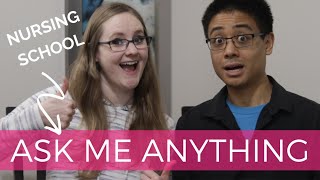
Christina Rafano and her husband Matthew answer nursing school questions from viewers. For pharmacology, learn mechanism of action first using the Davis Drug Guide. They stress practice questions for ATI/HESI exams, a positive mindset, and staying debt-free through scholarships rather than loans.
Chapters
Actually, there we go. How's that?
Waving to people.
If you guys can Hear us in YouTube, go ahead and comment below. I forgot to turn on the mic. My bad. No audio. See Audio now.
Audio now. Are we good?
Maybe. We'll see.
Let's see. Welcome you to.
Sorry about that.
Thank you. A422. All right.
We don't have to worry about that much with your phone.
No, no. Okay. Good morning, Instagram. I see you guys waving at me. You're the best.
Hello, guys.
All right, let's do it again. My name is Christina Rafano. Matthew Rafano.
Hi, I'm Matthew.
We are married. Happily. Super excited. All right, Happy Monday, everybody. I am a nurse here to help you figure out how to pass nursing school. That's what we do here on these AMA shows. I think we're gonna be doing this on the regular because it's just so fun.
We've been doing it on Monday and Wednesdays, so go ahead and comment if that's enough. If that's too much.
If you're like, guys, get off the Internet.
We're open to seeing how it's going times and all that stuff. So frequency. Yeah, it's.
Tell us all the things.
So.
Hello. I see some nursing members.
Oh, hi.
Good morning.
Good morning, guys.
Good morning, family. Okay, let's jump in. Ama. Ask me anything. Post in the chat your questions. We have some questions that were previously submitted for this video. I didn't see anything from members. Do we have anything from members? Because I didn't see anything. Okay, we didn't see. So I'm going to go through. It's kind of blocked. Am I supposed to go through those questions there in the onenote? I don't know, because I kind of have not really seen them. All right, let's do some Instagram first.
Okay.
Getting ready for week eight of nursing concepts. Sweet. Okay. Actually, I don't think. Is that a question? Yeah, that's more like a. Congratulations, you're gonna rock it. All right. What? You got YouTube. Send it to me. Send it my way.
How are you? The first question. Tough question. Tough hitting question. First one. How are you doing?
I am.
How was your weekend? How was everyone's weekend?
It was surviving.
We are in the west, North Pacific Northwest. If you would. The best and the best coast. The best west coast is the best coast.
I had not heard about that until last week when you told me. Pretty good.
And it's been hot.
Caffeinated. Trevor is caffeinated.
Oh, good.
Yes, it is hot. Did I say that? Right, Trevor? Yes.
Okay.
Hello. Good morning, Trevor. Yes. Caffeinated. All of us here. It has been hot.
It has been.
Which is really nice.
Yeah, yeah, we'll see how it goes.
It's a change of pace.
And I think that's the key term is it's a change of pace. It's not always hot like you guys in Texas or the southern areas. Yeah, yeah.
You guys, man. You guys in the south. All y' all my in that heat. All right, you go YouTube.
All right, well, we. We do have a question here about pharmacology. Just basics, ins and outs of pharmacology and how do you remember pharmacology?
How do you remember pharmacology? So again, if you guys were here last week, I may or may not have something coming for you so soon. I may or may not have something. It's more on the may side because it's coming for you soon. So if you are on our email list, you will get it. If you are not on the email list, make sure you join the email list because it may or may not have something to do with pharmacology and may or may not help you with how to study pharmacology and learn your medications faster.
It's a lot of may or may not.
So I would.
I'm guessing it's on the may side.
I may or may not recommend that you get on our email list before, let's say, next week. Wink. So I do have may or may not have something coming for you. So pharmacology, I have a whole step by step process for how to study pharmacology that may or may not be coming for you next week. So make sure to get on the email list. Matthew will put the link in the. Should I just do the checklist one? Yeah, yeah, that's fine.
Okay.
Yep. There you go again on the email list. You'll get a study checklist there. If you're on Instagram, go to my bio and click the link in the bio. So now with pharmacology, they can bless you.
Excuse me.
It's not what you think it is. YouTube doesn't like those words.
There you go.
YouTube doesn't like those words.
I don't want them getting it.
Whatever. All right, friends, you just. You can't sneeze in public anymore.
No, you cannot. You cannot do that.
Cannot. Like, you know. Oh, man. Wow. The world has changed.
You know what? I was. Okay, so necessary for the mornings. I just came back from there and I was standing in line and I felt A sneeze.
And that's the worst.
Yeah, it's the worst. Because what do you do? What do you. You cannot just. You can't.
You can't just do that.
You can't do that. Yeah. So.
Oh, man. Like dragging.
No. So you go like that and you just kind of move it a little bit. Or slow breaths through the mouth. I. I was able to.
You were able to control it?
I was able to control it. But yeah, that. That was. That was intense.
Oh, man. Also, sneezing in your mask is probably not the best experience.
No.
You've ever had.
Not at all.
Oh, man. Friends, I tell you what. Okay. Pharmacology.
Yes.
Make sure that you study the mechanism of action first. That is the biggest deal.
We call that the moa.
We call it the moa.
The very first live that we did.
It's a cooler bit. It's a cooler. It's a cooler. Was that an acronym?
A term? Moa.
Learn the moa mechanism of action. Learn that first. And then you will be able to understand the side effects of the medication and the nursing assessment and the nursing interventions, nursing considerations for that medication. Because everything stems from that. So that is really the best thing that you want to do for studying pharmacology and learning your medications faster. If you, if you learn the moa, the mechanism of action, learn it first. And then that way, learning the side effects, the assessment, nursing considerations, you know, implementation will just be so much easier for you once you actually understand what is the medication doing in the body. There's my answer for that.
Awesome.
And get on our email list.
Wink.
I can't wink. I'm so bad at it. I'm like, this is.
Just do a two eyed wink.
Two eyed wink. All right, that works.
All right, here's one.
Okay, let's do it.
Are willing.
Ask me your questions.
Ask you anything.
Ask me anything.
All right, so any tips on starting the first term? They're in summer course and going to start first year of nursing. First. First course is nursing concepts, but just kind of stressed out in general about starting. And any tips on starting first term?
Stressed out. Okay, so here's what happens when we start nursing school or really just start something new. We psych ourselves out. Like, we really get worked up about it. We tend to. Right. So when you're starting something new, whether it be nursing school or something else in nursing school, it's so easy because the rumor mill is alive and well, friends. Right, Right. Like, how many things did you hear about nursing school before you went to Nursing school. Thousand. I mean, everyone says that it's super hard. You're. Everyone fails. You know, you've heard all these things, right? Like, the tests are super hard, the instructors are super mean. Everyone fails out. You can't pass nursing school. Nursing is the worst. Yada, yada, yada, over and over. And you hear this all the time. Don't listen to it. We're going to go back to last week. Don't do what the world tells you to do, friends. Don't listen to the world. Don't listen to the world. That's really the biggest thing you have to go into nursing school not having any expectations, but not. Don't like, think negatively about it before you start. Like, make your own opinion when you get there, right? Like, when I started nursing school, I was super nervous listening to the rumor mill. Everyone hates it. It's super hard, you know, nobody wants, you know, no one can pass nursing school. That's what you hear all the time, right? But I got there and friends, I got straight A's through nursing school. Like everyone said that are in our school. Our fourth term was said to be the. The most hard, hardest. The hardest, the most difficult, the harderest. I'm really bad at English. Really bad at English. He's my Grammarly, the most difficult fourth term. Then I got to fourth term and I was like, this is awesome. Like, this is my jam, man. That's when we were learning all the really deep, like pathos stuff, med surg stuff, the really advanced things. I thrived on it. I loved it. It was so much fun. So. So make your own opinion. Don't listen to the world out there. Do your own thing. That is really my biggest tip. Because if you go into nursing school, any new term in nursing school, if you've been in nursing school already and you're like coming up on your med surg rotation, you're coming up on critical care or something. Don't go into it thinking that it's going to be hard and that you're going to fail. That does not help you at all, right? Because what's going to happen, it's going to be super hard for you because you're just going to be constantly thinking that it's super hard. That doesn't help you at all. So go into it. Have a positive mindset, you know, be excited about it. Like, man, like we talked about a couple of weeks ago, it's so important that you think back to where you were like three years ago. Like, where were we three years ago, right? And now you're in nursing school. Three years ago you were trying to get into nursing school, like working your way to this place that you are now. So be grateful for where you are now and be like, you know, don't be stressed about it. Nobody got time for that.
So there's two points that I just wanted to touch on there that you're just talking about. Is, is one, that last part, it is really about movement. You are moving, you're going in a positive direction. Just keep going in that direction. Movement matters more than your feelings are, more than, more than that mindset and that you leads into that other thing is really what we've been stressing a lot about. A lot of what Christine talks about is it's really mindset. It is all about mindset, having a positive attitude. And that may sound a little bit woo woo. But definitely that does affect you on how you view your day or view yourself or. And how you show up and how you show up. So yeah, scan a little bit taller, straight, straight back and just take on the world with positive attitude. And it does really affect you. That's not to say that you ignore everything that you, that you hear. You want to still study, you still want to prepare and everything. But definitely mindset is a big part of that. And lastly, what Christina was talking about with us starting anything new, we do psych ourselves out. We do get scared. And that's okay. It's not to say that being scared is bad. Scared is okay. Scared is knowing that you are moving in a direction that is uncomfortable but could be beneficial. So just take that into, into kind of your mindset and use that in psyching yourself self up in that mindset. And I was just remembering a story that I heard about in the quote about doing it scared. Yep, do it scared. And the story is about burning building. And there was a lady that was stuck on the top floor and the fire man, fire lady, fire person, went all the way up, they got her and had to walk her down the stairs. And he kept saying, I can't, I can't, I'm scared, I'm scared. And that's the whole point. If she wasn't scared, that would. There would be a problem there too. That would be a problem.
You're like in a burning building.
It'S okay to be scared. But even though you're scared, you have to have that forward movement. You still need to move. So the quote, do it scared. It's okay if you're scared. Just do it scared. And repeating it Every flight of stairs down until she goes out. So take it one step at a time, do it scared, and just focus on your mindset.
Is that where I've been? Right.
I heard it from Rory Vaden. I don't remember what the story.
What's the exact, like, origin was. Yeah, yeah. John Acuffer.
Rory Vaden.
I don't look him up. They're amazing. Rory Vaden, John Acuff. It's probably one of those two. I also heard it from Christy Wright in business critique.
Oh, awesome.
Yep. The whole do it scared thing. So as long as you're moving forward, like, keep going. Like, no matter what, do not stop, you know, or you will not pass nursing school if you. If you stop, if you quit, you will not pass. So just keep going, do it scared. Absolutely.
Okay. And I like this story, so I'm just going to tell it to you. Sharks do it. Sharks. Funny, funny story.
I like fun stories and fun stories. Tell me about sharks.
It ties back in. I promise. It ties back in sharks. If you did not know, have to keep swimming in order to stay afloat.
What?
As soon as they stop, they sink.
That's crazy.
As soon as they stop swimming, they sink.
There you go. Be a shark.
So be a shark.
Keep going forward, Keep moving, or else you'll sink. So interesting. There's your science lesson for the day. That's awesome. Okay, Instagram, what you got for me. I'm, like, scrolling up and waving at people because you guys are amazing. Okay. Hi. Instagram. Okay. Yeah, yeah, yeah. All right. I think we kind of answered that. Any advice for new nursing students that haven't started yet, and I'm freaking out. Was that kind of.
Yeah, that was kind of it.
Okay, so I hope we answered that. Tips on memorizing the assessment steps. Like the nursing process, I'm assuming, or I guess. Yeah, your assessment steps. Flashcards, you know. Yeah, yeah. Come up with, like, weird little. I don't know. Just, just. I. I don't know. You can come up with, like, songs in your mind or, like, weird little, like, things that you think of, like flashcards for anything. Memorization. Flashcards.
Flashcards. I remember when you were going through nursing school that we were looking into that. Oh, how does. How does memorization work in general? And at that point in time, we were also watching Sherlock. Mm, Great, great show. BBC, rumored fifth season coming out. It hasn't come out for, like, two years, but who knows? But whatever. We were watching Sherlock and we learned about mine castles. Mine palaces. And so you're trying that out.
It's really.
And it is really helpful. And really the key thing about that being helpful is the absurdity of it.
It has to be crazy.
It has to be crazy. The crazier it is you. The more you remember it, like, the.
Better, the crazier you can tie in things. So, okay, so for example, like the abdominal assessment for me, that's why I kind of was like laughing. So the abdominal assessment for me, like my kind of mind castle for that is, I am purple. I am pur. Pal. You get it? I am am per. Pal. Inspection, auscultation, percussion, palpation. I am per. Pal. Get it? So there's your. There's your little mnemonic thing for the day. That's what I use in my brain for that assessment. That's why I kind of laughed earlier because I'm like, I have some great.
And it's really funny because as that is, you still remember the exact thing.
Right now, I am purple, which is great.
So, yeah, that is good. So flashcards, any other memorization kind of tricks like that? Memory palace, if you want to look at that.
Whiteboards, anything for memorization. Whiteboards and flashcards is what we're going to do.
Repetition.
Yeah, always, always recommend repetition. Let's see. Instagram, what you got? Oh, is this being recording? Can I go back? Yeah, on YouTube, we. Oh, and I've actually been as long as Instagram lets us post this on IGTV afterwards. I will. Sometimes it goes, no, Christina, you can't do that. Bye. Bye. Unfortunately, so sometimes Instagram doesn't do what I want it to do. It happens. Any advice for licensed practical nurses? Going back. So like LPNs, going back to school, going back to work. I'm assuming school. This advice still stands. So this, we get this question a lot. Does this advice help LPNs or LVN students in an LVN program or LPN program? And yes, it does. There are just some things that we talk about that will not apply to you. For example, a lot of the care planning stuff, nursing assessment, because the scope of practice is different. So for an LPN or lvn, you know, when you go to school, your assessments will be more data collection. Whereas in a registered nursing program rn, it will be data collection and then interpreting that data to then make decisions about the patient care. And so that's really the key difference. So when we give this advice, you know, here it will absolutely help you. But like especially the study tips and stuff still stand. But you have to take in mind, keep in mind that some of the things you just won't apply to you, and that's okay. So it'll be like, more than what you need. So don't worry about it. It'll be, you know, it's helpful either way. Whether you're in an IRON program or an LPN program, we just might talk about more than what your program will cover. So just know that going in so.
That that is addressing LPNs. Going back to school. LPNs. Kind of a tangent, but related to that question from YouTube is just getting back in the swing of nursing school. So took the summer off, but how to get back into the swing of nursing school in general. Any tips on that?
How to get back into the swing of nursing school. I think that it's super important to plan your time, and I really should have the planner down here somewhere. But you've got to, got to plan your time, and I really, I really recommend that you plan out. This sounds crazy, but it helped me so much and I really want you guys to do it is to plan your first two weeks of the term before you start your term, because that will help you kind of see, like, before you start nursing school. Okay, here's what I can kind of expect. So plan on, you know, plan out your first two weeks of the term. Like, what are you going to eat for dinner? You know, what are you going to eat for lunch? What are, you know, where are your kids going to be in those first two, two weeks where if you have all your school information, you can put in your, like, deadlines, your exams, your clinical days, things like that in that first two weeks, but just have a plan as much as possible for those first two weeks. That way you are kind of more transitioning and you just know what to expect. It is very difficult coming off of summer. You know, we have this break, it's all sunshine and rainbows outside. And then you go to nursing school and you're inside all the time studying and things like that. And also it can help you kind of transition, you know, study outside if you want. No one's, no one made a rule saying you have to study inside your house and be like, alone all the time. Depends on what state you're in right now, I guess. But, you know, you can go outside, check with your government first, but you can study outside your house, right? So spend some time out in the sunshine, you know, you don't have to, you know, stay inside all day and just study with your nose in a book, you know, so. Because it is difficult going from summer sunshine, being outside all the time to then, you know, it's still sunny outside in August and in September, but we're inside studying, you know, so I did like, we have like a balcony and I really like studying out there. That's what I do.
Yeah, I like that. I like the idea of just transitioning so you don't have to go, oh, summer, oh, now school. No, it's okay to do that transition and to get used to things again.
Give yourself grace through the process and.
The tips to help with that. So I think that just helps in general, getting your plan around and planning everything out and basically dumping everything that you can out of your head onto the paper to automate things, to make things. Things are going okay by themselves. So that you can focus on nursing school and focus on transitioning into nursing school.
Yep, absolutely. And you know, as much as you can get done before nursing school starts, the better you will be during nursing school. Because you don't want to. I mean, if you're in nursing school right now, raise your hand, throw up some hearts and some likes if you agree that you should get as much done as possible before you start nursing school so you don't have to do it all during nursing school. Right. Right. Can I get an amen?
I have a Someone is asking here question. Okay, go ahead.
About ati. Is that what you're going for?
Well, you can do that. 1 Someone in Instagram mentioned. Did you get my question before the live. And I'm not sure exactly what question you guys are referring to, so if you could ask it again.
Yeah, ask it again in the comments and I will try to scroll down and get it to get it.
But ATI in general. Yeah, there's an ATI one there. And just general ATI on YouTube as well.
So. So how to pass ATI?
How to pass ATI and then any benefits on using ATI online and how to connect notes, they're assuming their school notes to ATI notes or whatever.
Okay. And how would you use ATI modules in nursing school? Yes, along connecting them with the lecture notes.
There you go.
Okay. You might be the same person, maybe.
I think that I was just reading that and I was just going to answer.
All right. Instagram and YouTube talking about ATI. I love it when you guys join us in both places. That's fun. How is it having two Christinas and two Matthews up on your screen?
Kind of interesting.
Kind of weird, I'd imagine. So you're like, that's a little bit too much Christina for the day. So ATI ati, what is so, so important? The best advice that I can possibly give you is that I've heard countless times from students who did not do this. And then they came back and said, christina, that was the worst decision ever.
To not do it. To not do it was a worse decision.
Yes. To not do it was the worst decision.
So be sure you do this.
Yeah, thank you for the clarification because that would have been confusing. You must, if you're in an ATI or a HUSI program, you must do the practice questions. I know it sounds like it's busy work. They're just throwing more things at you just for the sake of throwing things at you. It feels that way. The more the practice questions, the more you do those practice questions, the better off you will be. Not only that, you have to do the practice questions and read the rationales, my friends. Take the time to read the rationales. Please, please, please. Because you have to understand why you're getting questions right? And why you're getting questions wrong. If you're just doing practice questions and you're like, I'm getting a lot of these wrong, I mean, fine, but if you don't know why you're getting them wrong, right, that's not gonna help you. You have to know why you're getting them wrong. Because your ATI practice questions, your husband practice questions, is gonna, they're going to be very, very similar to what's going to show up on your ATI and your husband exams, Right? The biggest thing, I think that students get really, really tripped up on with ATI and Hussey programs. The biggest thing is that it's a wild card. I call it a wild card because they can test you on anything. It's just like the nclex, they can test you on anything. There's no real, like, you know, of course, like nursing is. Nursing is nursing, right? But they could test you on the most random things, like the most random medication you've never heard of in your entire life. And it just happens. And so it's just like the nclex, which is good because the more practice you get with kind of that, you know, that testing style, rather, you know, ATI and hesi. The more practice you get with answering those types of questions, the better off you're then going to be for the nclex, Right? It just takes practice getting used to things. So don't, like we said before, like, don't let that trip your, trip you up. Oh, I'm thinking like that, like we said before, but no, we actually didn't talk about that. I recorded a YouTube video this morning on that. That's why I'm thinking that.
There you go.
So YouTube video coming out very soon. You on this topic. Just don't let it trip you up. You know, if you come across a question on a nursing school exam and you don't know it, or if you come across a question in your practice exam even before you go to your proctored exam, it's fine. Just read the rationale, move on, do your best and move on. Don't let it trip you up. Don't let it. Don't make it mean that you're a failure and that you're not going to pass, because that's just not helpful. That's not helpful for you. It does not help you. Is that clear?
Yeah.
Sometimes I feel like my brain can't catch up with my mouth or like my mouth can't catch up with my brain. So, like, they're like, off. This is why I shouldn't be on live video, is because things just happen.
Things just happen.
Things just happen.
So comment below if you guys think that that's a good thing.
It's a good thing that Christina just, you know, can't think and talk at the same time. Oh, here's your question. I'm trying to study med classes using Davis Drug guide. Oh, wait, I thought I saw this come through. Okay. Yeah. So this is your question that you were wondering if we got before. Yes, we did. And I. It's somewhere along. One, I'm trying to study med classes using Davis Drug guide, and I don't see any meds listed there. Davis. Wait, med classes? How do I know which meds belong in which class? Oh, I see your question. Okay, thank you. Okay, so I'm gonna walk you through the book really quick.
Here you go.
Well, thank you. Okay, so I believe this is the newest edition, the purple one.
Yes.
If it's not, I think they're. You know what? I think another one came out in like June or July, I'm pretty sure because it's. It's like a yearly thing. So check it out. Make sure you have the updated version. I mean, you know, how much are they gonna change? It's anyone's guess, but I would, you know, just recommend having the most up to date version. This is the Davis Drug guide. I call it the Davis Drug Guide because I've been saying that forever. It's actually the Davis's drug guide, but I'm never gonna say that.
Yeah, I noticed that. The other day that it's S apostrophe.
S. So Davis is. No, it's Davis Guide to me sometime.
Davis owns it.
Davis is going to come at me someday and say, like, Christina, get it right. And I'm going to say, but I've been saying it for forever. Davis drug guide. So here is what you. Here's kind of how this book is set up. The first part of it is drug classes here in the red, when you see the red tab section, this is drug classes. This is where you're going to go for your mechanism of action. So when I say, like I said at the beginning of this video, and when you study pharmacology, the biggest thing that you need to understand is the mechanism of action. And then the mechanism of the drug class is even more important. So that is here under general action and information. So antineoplastics here. I mean, these, this drug classification section is an amalgamation. Whoa, million dollar word right there. Amalgamation. Like a combination of therapeutic drug class and pharmacologic class. And that's okay. We ideally want to know the mechanism of action of the pharmacologic class. Some drugs don't have that, and that's fine. So it is kind of a mix. Just do your best therapeutic class and pharmacologic class. But what you're looking at here is the red tab section of classification. So this is either the pharmacologic class or the therapeutic class. And then you will, you will want to look for the section general action and information, which tells you the pretty high level mechanism of action of what that drug does. Can you guys see that general action and information right there? Maybe YouTube's a little blurry, but that's how that is. And so that is what you're going to want to look at for your drug classes. Now through, just so I can walk you through, just real quick as you go through all these white pages. These are all your individual medications. So this is, you know, this is fentanyl. There you go. You know, all of these white pages are all the individual medications. And then when you pull up an individual medication. So here's fentanyl. Again, the mechanism of action is right here under action. So that's what you're going to want to look for. So both of those two places in the general classification. And then the med section is the action part. Now the question that you had was specifically how do you know which drugs go in which class? And from here you, when you get a new drug at clinical or whatever that you need to remember or memorize. You'll look under here, it'll say classifications. And there's two. For a lot of the medications, there's two therapeutic and pharmacologic. The pharmacologic class is based on the chemical structure of the medication and like what it does, like what's the chemical structure of it and other drugs that it's similar to. So fentanyl opioid agonist binds to opioid receptors. Therapeutic class is kind of like, it's a high, I consider it a high level pharmacologic class. It gives you, I think, more clear information on what the drug does because it's really based on like body system. And so the therapeutic class is an opioid analgesic. So pain relief, opioid pain relief. Whereas the pharmacologic class is opioid agonist. So those are the two that you're going to want to look for. Now, probably the better answer to your question, that's just a quick walkthrough, is that we have a free cheat sheet for you that tells you it's a really nice breakdown of the medications and the endings of the medications that can tell you what pharmacologic class they belong to. So it's easier to pick out and figure out which drugs belong to which class when you know the naming structure of the medication. Because a lot of the medications, how they're named, the naming structure tells you what drug class they belong to, which is super cool. Really nice hack. So we have that for you. The thing is, is that I don't know what to tell Matthew.
What do I put in the comments?
Where do you put in? So what I'm gonna do, because it's not on my Instagram bio either, so what I'm gonna do is I will put it on YouTube, we'll put it in the comments after this video and maybe even the description of this video afterwards. So if you're on Instagram, you're gonna have to head over to YouTube and just click that cheat sheet there because I'll just put that cheat sheet link in the comments and the description on YouTube after this video. So it's a whole cheat sheet that we have for you on drug classifications and how to categorize your medications into their drug class, so that'll be easier for you. Does that sound cool?
Yes, that sounds like a good idea. So we'll put it in.
Was all that super helpful for you?
Follow up question for well, before we put away Davis's drug guide. Yep. Would you recommend the hard copy or the app.
Much to my husband's chagrin. I am a hard copy, physical copy person. I'm really not a digital person. I don't. I don't like the whole app situation as much as I like physical books. So minimalist. Have all the books physically. That is minimalist.
Yeah, that is true.
Unfortunately, I really like having a physical copy because actually I don't have my other one. The one I had in nursing school is like bent out of shape. It's tabbed. I have. I mean, that is. That was like, man, that was my thing.
There's actually a YouTube video that we have about how you tab your Davis's drug guidance.
Yeah, we do have a video on that. I wonder if you could find that and put it on YouTube.
I'll put it on YouTube.
Well, maybe put it on the.
It'll be a card. Where there. 1. 1.
It'll be a card somewhere.
Somewhere. It will be a card right around here.
So, yeah, there's a video on YouTube if you want to find it. If you're on Instagram and want to find it, go to YouTube and type in Nursing SOS, Pharmacology, Nursing SOS Drug Guide.
Probably Nursing.
Nursing SOS Drug Guide. And it should pop up for you there.
I think you.
I'm not sure because I walk you through how I tab my drug guide. It's actually super easy, but, you know, I'll walk you through it.
I'm not sure if you mention it there or where I heard this or whether I just imagined this up, but I think it's good. So I'm going to say go for it. If you can get both, probably that would be. That would be great. So that you can tab it up. Tab up your hard copy. You can highlight whatever you want or you can do that. But if you are on the road or traveling or whatever and you have the book on you, you can always just quickly look it up on the app.
Not like on the road. Don't like look up.
Not during. But like, if you are not with your book, if your book is not with you, then you.
But don't like be on your phone and drive at the same time. That is not what we're recommending here. That is not what we're recommending. If you don't have your book with you and you're like, go to clinical and stuff, the app is great. But then that also too. I mean, if you walk around in your hospital, these are everywhere. Like the older editions, I mean, because they get new additions every year and they always just accumulate. They're just there. You can always find one. My instructor has taken away the rationale for our ATI questions. Any advice on how to handle that? That is really interesting. Can they take away the rationales? Wait, what do you mean? Like, the practice question rationales or the actual exam rationales? Because those are two very different things. Can you clarify for me, please? This is Instagram, so if. Yeah, my. That would be crazy if, like, your practice questions, if you couldn't go through the rationales. That doesn't really make sense to me. I would definitely talk to your instructor about that. You know, I would just talk. I would open communications with your instructor. I would do that. What I think is most likely happening is that they've taken away the rationales for the app, like, after your exam, and oftentimes. Oh, Barbara. Okay. There are no rationales, period. Okay, so talk to your instructor. You have to go over. Not have to. But it's very, very helpful if you can go over your exams after the fact. And here's the thing. If you can go over your exams item by item. So we're talking about, like, actual exam questions, which is more unlikely with ATI or HESI programs. We could do it for our husi. If you're in an ATI program, your school may or may not allow this. It depends. Talk to your school. If you can go over your tests questions item by item, that's the most helpful. If not, that's fine. Meet with your instructor. Go over your study process with them step by step and get their feedback. You have to go over your study process with them. Make sure that they understand how you're studying and what gaps you have. Have them fill in the gaps for you. Okay, what am I missing? What am I doing right that might need some tweaking? What am I doing wrong that you think I need to totally change things like that? Ask the right questions for your instructors to get the best feedback. You know, make sure that you're studying right. If you cannot go over your rationales, that's fine. But make sure that after you take your exam, you're still meeting with your instructor and still going over your exam in some capacity, whether it be question by question, which might not be possible. That's fine. Go over your study tips, and then you can also talk to them about the content. Like, hey, I. I know that we had a. Like, this question popped up. I don't understand this. Can you explain it to me? Here's the thing. In nursing school, guys, and life in general, I was just thinking about this the other day. We get so stuck on the how. Like, how do I do this? I don't know how to do this. How do I do this? And then we don't do anything, right? Like, if you get stuck on, like, oh, how can I? You know, like when you see me here on the interwebs telling you that you should go meet with your instructor and go over your test item by item, question by question. If you go into your instructor's office and they say, no, that's not an option, then you, you know, you might shut down, right? Like, that's often what we do is we say, oh, well, it's not possible, so it won't work for me. And we generalize it like, okay, it's impossible. I can't pass nursing school. It doesn't work. That's not true. You have to keep asking the right questions. You have to keep asking questions. So whether or not you can go through your exam, it's fine if you can't, but ask your instructor the right questions. Remember some questions from your exam, which we always do, right? You will always remember. Oh, wait, I know that we talked about. There was something about this concept on my exam. I didn't understand that. So let me ask my instructor about it. Go over it with them, friend. There is always a way. There's always a way. If one piece of advice doesn't work for you, if you're. If you're. School does not allow you to go over your exams afterwards, that's fine. But ask the right questions to your instructor. Just always be asking questions. Do not get stuck on the how. Just keep moving forward. Like, don't say, oh, that. That one way didn't work for me, so nothing will work for me. I cannot pass nursing school. It's impossible. We don't do that. Don't do that. We don't do that here. That's not how we roll. I hope that helped. Was that good advice?
Yeah, I like that.
That was good advice. I'm waving at you guys on. On Instagram. I was gonna say YouTube. Any advice for the rationale? Okay, yeah, yeah. The practice questions rationale. So I would. Yeah, I would definitely talk to your instructor if you are not able to see the practice rationales or your. Whatever, you know, your. Your school gives you practice tests or, you know, whether you're taking it, practice tests or in. In, like your proctored. Proctored exam. That was the phrase I was looking for. Proctored exam. You know, just talk to your instructor. Open lines of communication with your instructor. Yep. Thank you, Dzny. Love. Yeah. Very helpful to have them. I know. Okay. We're still talking about practice questions. Yeah. I think my program is just trying to make life hard for us. That is a thought, and that is just a thought. Don't make that mean anything. Like, don't make it. It's so funny because I just talked about this in the YouTube video that I recorded this morning. Let's talk real quick about limiting beliefs, you guys. I know. I know. Because friends. Friends. I've been in nursing school. I know what it's like. I promise you. Did we love all of our instructors? Well, yes. We love them like, I love them as people. Did I think. Did I have those thoughts that. Yes. They're making my life miserable? Of course. Yes, I did. But here's the thing. You don't take action from that place. If you. If you have taken on that thought and made a fact that your professor wants you to fail or is not there for your success or doesn't care about you or. What was it? Trying to make my life hard. If you think that your instructor's trying to make your life hard, that is not a thought that is going to move you forward and help you take action to pass nursing school. Right? Like, you can totally have that thought. That's fine. But in my opinion, that kind of stops you in your tracks, right? Like, if you're like, this is too hard. I cannot do it. Um, everything is against me. That's not a helpful place to be in. Right? We're just gonna sit on our couch and watch Netflix all day with that mindset. Right? Like, that's not what we do. Right. We want to keep moving forward, keep taking action. So you have to come up with different thoughts in your brain. Maybe, just maybe, your instructor wants you to succeed. What if we just consider that for a minute? What if we consider another option rather than saying, they're making my life hard? What if we consider the fact. Not a fact, a thought. Consider another thought that maybe it's supposed to be hard. Maybe nursing school should be hard. What if we consider that for a minute? Could you take action? Could you take more action from that place rather than, it's too hard. I can't do it. You know? You see what I'm saying? So it's very, very important that we catch these beliefs that we have when we are. They're preparing us. Perf. Barbara. I love it. So just when we reframe something in our minds, it can be very, very powerful. I. I have been so guilty and find myself, you know, I. If you guys know I'm in a life coaching program and have been for a year now, and boom, just hit. Just hit a year. And it's just changed my life. And so all this, like, thought stuff, this thought work, you know, all this, you know, life coaching stuff I have really worked on and it's totally changed my life. So I hope that helps you too. You know, if you can catch your thoughts, that is really the key to make sure that we're not spinning in negativity all the time.
But moving forward, it goes back to what we kind of started this, this talk about is about the mindsets and.
Yeah, absolutely.
Just making sure that you have the right mindset. And really, thoughts are what Christina was saying. Thoughts are just thoughts. So make sure to.
They are neutral.
Yes.
They are not good or bad. They don't mean anything. If you have a thought that you cannot pass nursing school, that does not make it a fact. If you have a thought that it's too hard, that does not make it a fact. If you have a thought that you are not good enough, that does not make it a fact. Your thoughts are not facts. Let's separate those two things out.
Thoughts are just thoughts. Examine them, see if they're helping you or hindering you and change them. Change the thoughts.
For the record, this is biblical. When I joined that life coaching program, do you remember how many conversations we had about, like, is this biblical or not? Because we don't, you know, I really want to make sure that everything that we do in our life is biblical and everything that I'm putting in my brain is biblical. Right. So, you know, we have that scripture, like, submit all of your thoughts to Christ. Submit it all, you know, he wants that, you know, we are supposed to, you know, you know, think about all, you know, such things that are, you know, good, that are righteous. I don't know the exact order of it. I forget, you know, all the things. We want to submit all of our thoughts to Christ and, you know, make sure that what we're putting in our brain is good and not unhelpful. Right?
Yeah. And that is a unhelpful thought, what we started off this discussion with. So, yeah, thoughts are thoughts. Re examine them. Recognize that they are not facts, they are just thoughts. And you have the ability to change your thoughts to better suit you, better, propel you forward.
In nursing school. In nursing school, absolutely. And in life. Can I do an Instagram one?
Yeah.
Yeah. Or do you want YouTube first.
No, you can do an Instagram one and then we'll jump back to over YouTube. Yeah.
Can I have some tips on how to learn nursing NANDA diagnosis accurately? Because I often mix up all my diagnosis. Yes. Hey, can I have one?
Which one? The nursing diagnosis.
Yeah. Okay, so we'll just go through a couple of these really quick. So you guys, if you are just joining us, rewind this video on the replay because I talked about David's drug guide and now I'm going to talk about NANDA nursing diagnoses. So you don't really. I don't know, I haven't really. I guess I have memorized a lot of these just over time. But like, you don't really have to memorize them because they're all in this book. Get the book. I know, I feel I sound like I'm like, I don't know. I'm not. It's not that I'm trying to sell this book. Like, I'm not like, you know, it's just, it's just, it's gonna say you.
It's going to help you.
It's gonna help you so much. It's not like, you know, I don't have. Yeah, no. So here is the list of all the NANDA nursing diagnoses. So the first two pages of the book, front and back, that is what you will want. And it's super important that you have the up to date version of this book. So this is the Nursing Diagnosis Handbook by Akleen Ludwig. Hey, I'm gonna hold both of these up. Take a screenshot, you guys. You ready? Take a screenshot. 1, 2, 3. Get it. Did you get it? Nursing Diagnosis Handbook by Akleen Ludwig Davis. Drug Guide by Valerand and Sinoski. I hope I said that right. So this is Nursing Diagnosis Handbook by Acclaim landweigh. So Proverbs 23:7. Thank you very much. Thank you, my friend. Thank you very much. So this is what you will want. So you don't have to remember all your native diagnoses. They're just all right here. So I really recommend that you get this book and you have to have the updated version because they change all the time. That's my spiel about that. Okay, YouTube, what you got for me? I think I can take maybe one question and actually, didn't we have a couple from the beginning?
Yeah, we did talk.
Okay, so we talked about this one. Yeah, I think this. Is this the last question. Yeah. Because I have another call. Family photo time. I love you, Instagram. You're the Best.
Yeah, take a screenshot or that screenshot you took. Go ahead and post on your stories and.
Oh, tag me.
Tag her. There you go.
Screenshot. Okay. There you go.
All right, photo op done. All right, so last question of the day before we head off.
Yep. Do it.
Any recommendations on loans? Trying to find a decent interest rate that's lower than 8 to 9% that I'm getting.
Okay. Still not clear on how you think. How much of our personal life do we air on the interwebs?
Well, we were talking about a question.
That we have for ourselves, so we.
Were talking about that the other day about, like, how much we share and vulnerability and I think.
We don't talk about money on YouTube and stuff. Like, we don't really talk about loans and. And debt and stuff. So. Yeah, anyway.
Yeah, in as much as it would help you guys to know where we're coming from and. And understand where we're coming from, then I think that it's. It's okay to share that.
Yeah. So. So we always share things as long as it's helpful for you.
Yes.
Right. Like, that makes sense. Right. Like, we're not just gonna, like, share r. And so, I mean, unless you want that. I don't know. Do you really want to know everything about our life? That sounds kind of lame to me. So, yeah, for us, our value system in our house is debt free. We don't do any debt, period. We are avid Dave Ramsey followers, fans. So if you know about Dave Ramsey, you know why I say all of this. We just. We don't do debt. And so when, you know, if we had a question about what loans to get, my answer will always be not zero. Absolutely go to nursing school debt free. And if you cannot go to nursing school debt free, my personal value system and my recommendation is to not go that. I mean, that's my. That's how we run our house. And so that is the advice that I give, because I'm not going to give you advice that we do not follow. And so because we do not do debt and we do not do loans, I cannot give you advice to do that and do loans because I think it would destroy your life. I do not want you to graduate nursing school with $100,000 in debt. That is just not. I do not believe that that is wise. Cupcake latte. Oh, I love your Instagram handle. Thank you. There are plenty of scholarships. Perfect. Thank you for agreeing. It. It's just. Yeah, it's just our value system, so we have a very core set of Family values. And that is one of them, that we just don't do debt. So if you, you know.
Sorry, go ahead. Yeah, no, so I, no, I, I completely agree 100 with what you're. You're saying we do not do debt and that is just not in our family values to do that. And we went through, you were able to go through without taking on any debt. So that's just one of our really core values is no matter what nursing school or big purchase or whatever, we just do not do that. So just to answer the question directly, do we have any advice on where to go? We do not. Because we do not know.
Yeah.
We're not in that sphere.
I don't know where to go. We don't know where to go at all.
So we cannot help with that. As far as just general mindset or not mindset, but just value systems. Yeah. Like, like Christina said, we are avid Dave Ramsey fans. So if you're interested more in getting out of debt or becoming debt free, learning more about that, definitely Dave Ramsey is where we direct you as far as that goes. And yes, as far as other resources not debt or loan related, there are numerous other options.
Yeah. Scholarships, working. I worked through nursing school until we got pregnant. I worked in nursing school. That's a question we get a lot of. Did I work? Yes, I did. And Matthew works to, you know, our, there's always a way our family structure was a little bit different when I went to nursing school because we did not have child slash children. He worked, we didn't have nursing. SOS way back then in the day. I, you know, I worked for our church and then we got pregnant and then I left because pregnancy is a full time job. And then I graduated and here we are.
So yeah, I appreciate the question. And we appreciate the question and definitely goes back to how much do we share? And we feel that it is a, it is a core value of ours and people ask. So we thought that it would be helpful to say that yes, that is where we are. So unfortunately we do not know any resources for that. For other resources like Christina says, scholarships or working or other things like that is possible. And then probably just to wrap it all full circle because we, we are running up on the time, but running full circle back to what we first talked about and talked about all throughout this live is mindset. It's all about mindsets and thought process and how that can help or hinder you. So what is the thought process of how can I get through nursing school? How can I pay for nursing school. And what are those thought processes? And is that helpful for you or is it a hindrance to you? And how can you use your thought processes to propel yourself and get through nursing school? Because I feel that anyone could go to nursing school if they wanted to. And anyone can succeed at nursing school if they wanted to.
Absolutely. For sure. And I want to address that question, which you kind of did. Why not go to school? Because you can't afford it. So it's just, I. We do not. I do not feel personally like we. We are not going to give advice that we haven't done. And we did not go to nursing school with debt. So I cannot tell you to go to nursing school with debt. Personally, I did not want to graduate with $100,000 in debt for nursing school. That did not sound like a fun time to me. So what we decided to do was I worked through nursing school. You absolutely can work through nursing school. So, you know, there are other options. There are other ways to do that. You don't always have to get them. So that is where we get that advice from. Because we did it and we just can't. You know, I'm not comfortable recommending something that I've never done. Right, yeah, I've. I didn't go to nursing school with debt, so I cannot recommend that. Right.
So, yeah, just to kind of wrap it up into broader scope of just. Yeah, a broader scope than that. Just in general, when moving forward, we'll never suggest something that we do not agree 100 with or that we do not practice.
Yep, absolutely.
So you know that as following us, following this channel and following our advice that we are always recommending or the books that we. We share with you are always things that we 100% recommend and 100% use as well.
Yep, absolutely. Yeah, that's just. I mean, that's just not cool.
If you like, for joining and sharing.
And spending an hour with us Wednesday. Right?
Yep.
We'll be back on Wednesday 9. Integrity. Barbara.
Boom. All right, we have that. We have that.
We have that.
We'd like to think we do. If there's any places that we need to improve on, definitely let us know and we will try. So, yeah, be sure to post your questions up for Wednesday on YouTube or if you guys are members, the form that we have set up for you guys.
Yeah, I will send you an email out today day with a link to a form if you have. If you're a nursing SOS member and you have questions for us for Wednesday, we will get that up to you. And you, you know, I'll make sure to answer your questions. All right. Thank you guys so much for joining us. Take care. We'll see you Wednesday. Bye. Bye. Share to.










