S1E5: Exploring different generations and leadership
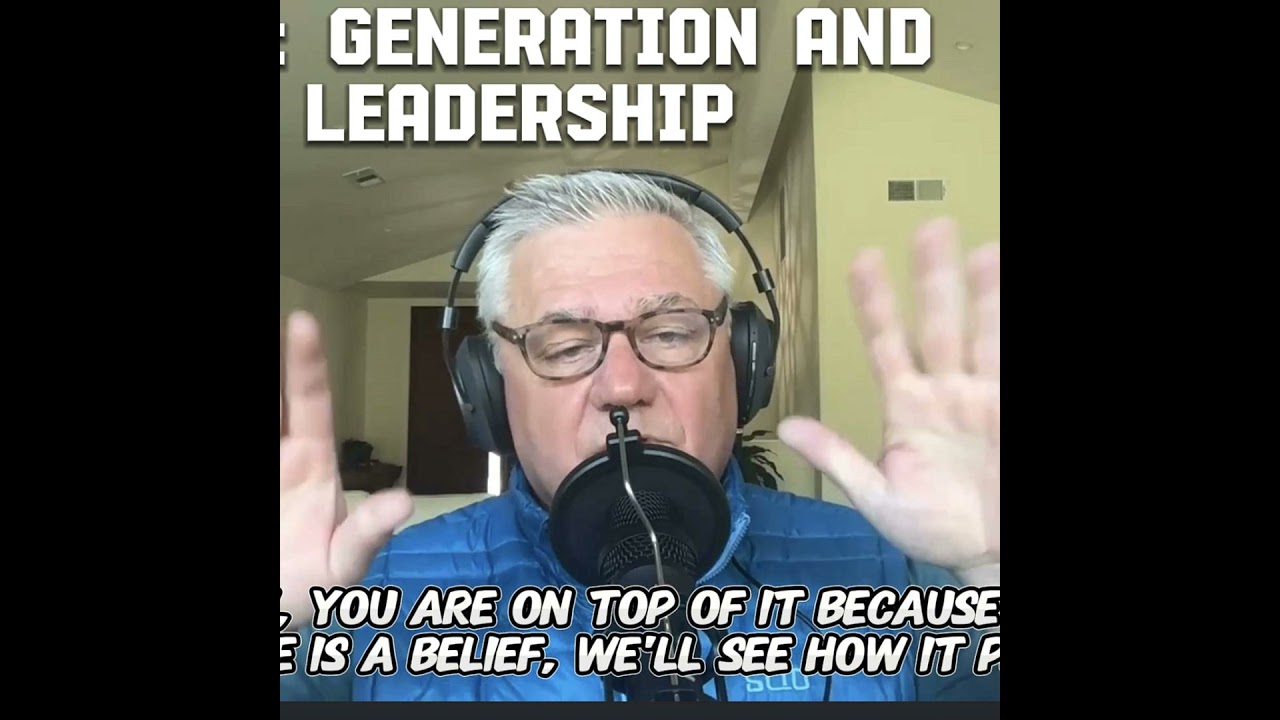
This content was created by Christophe Bodin. This content was uploaded by Christophe Bodin. This is a YouTube podcast/videocast episode titled "S1E5: Exploring different generations and leadership" (published 2024-05-08). It's a hosted panel discussion led by Christophe Bodin (host) with three guests: Marc (representing Gen X), Pipa (representing Millennials/Gen Y), and Mathilde (representing early Gen Z). The episode covers generational characteristics, whether leaders must adapt their style by generation versus by individual/age-group, cross-generational feedback, workplace values (work-life balance, empathy, meaning, technology), and practical tips for leading and collaborating across generations. The show is conversational, unprepared and candid in format.
Chapters
Good morning, leaders. Wake up, smell the coffee. It's 6:30 in the morning somewhere in the world. Welcome to the Irreverent, Bold, Unfiltered podcast and videocast about leadership. You want to move your career to the next level? Look nowhere else. You found the right place. Let's get going, shall we? All right, all right, all right. Pretty cool to be back here. Well, first I need to start with that is that I apologize. I have been out for the past month. Out in the sense of not doing any podcast. But I was so busy, as I said on LinkedIn, I was following my son, the hockey player, and then I sold the house and then preparing a big move to Luxembourg. So, I didn't have time to do podcast. But I'm super excited. I'm super excited because we have a great topic today, which is, hey, different generation, Different leadership? Question mark. Don't know. That's going to be what we're going to talk about. And I'm super excited because I have a great panel. I wanted not to have a podcast where I talk about the stuff. I wanted each generation to be on the podcast and discuss and represent their own generation. So, let's start with— sorry, Marc.
Older generation.
Season.
Your season.
Season. The season generation. We're going to call it that. So, Marc represents Gen X. So, Gen X, if you don't know, ranges from 1965 to 1980. Marc, like myself, actually, we only have one month difference. I'm obviously the youngest one and the good-looking one. But we're both on the verge of Gen X and Boomer, whether we like it or not, being from 1965. But I think Marc represents a lot Gen X. We'll talk about the characteristic of the generation later. And Marc and I are going back 20 years professionally and personally. We've been working in all those companies together. Marc, anything you want to say about yourself or the generation?
No, I think you summed it up really well. That verge of the boomer and the Gen X, I think, is an important nuance of what I'll be talking about, right? I mean, if you're really grounded in it.
Yep, sure. And both you and I have glasses. That's a privilege of Gen X as well. All right. So, moving down in age. age and generation, Gen Y, better known as the millennials, represented by Pipa. So, the great thing is that, as you can see, we have 2 male and 2 female. I didn't check if somebody doesn't want to be referred by that gender. I'm sorry about that. Welcome to California. But that's great. At least it's representative of the society.
I'm not.
Yeah, right. And we also have a very diverse representation from a continent standpoint because Marc is full US-bred and Pipa is calling from London right now or around London in the UK. And we'll see that Mathilde is kind of bridging across that. So, Pipa represents the millennial. I think, Pipa, I'm not asking your age. I know you shouldn't do that. But you're in the middle of the 1981 and 1996. which is what the millennials are. And you are very millennials, I have to say that. I'm going to explain what it is. And Pipa and I worked in the same company called TradeShift back in the days where actually Marc was at some point too. And it's really great to see you again. Anything you want to tell us about you? Like you were in the Royal Air Force initially and all that kind of good stuff and marketing and anything you want to add.
Modeling, Royal Air Force, marketing, B2B, Yeah. It's been a roller coaster. I'm interested in why you identify me as a millennial so quickly. So, maybe we'll come on to that.
We'll come on to that. Absolutely. And then, last but not least, Mathilde. So, representing Gen Z. Gen Z goes from 1997 to 2010. I wanted somebody who's working. So, it's really the early stage of Gen Z. I know that you're almost also on the border of millennials and Gen Z, but you're a Gen Z. And well, we go quite a bit back in the past. I think the first time I saw you, you were not even 10 years old. You're a daughter of very good friends of us, us being Nadia and myself. And now you're working, and I think that you're a very good representation of Gen Z. Anything you want to tell us about you or the generation?
Yeah, I think I bring a unique perspective because I started my career in 2020, so right in the midst of COVID-19. So I think I can talk to the adaptability of my generation. So looking forward to hearing what are, I guess, the The rumors about us and how we defy them.
Wow. You are on top of it because yes, there is a belief. We'll see how it plays out. But there's a belief that actually Gen Z is going to behave a lot like the boomers.
Oh, gosh.
Yeah.
Because, well, I'm taking a tangent. I wasn't planning to do that, but now you're opening the door. So, the thing is, Because your generation has gone through a big economical issue and crisis with 2008, which was the case also with the boomers. And then, okay, it wasn't a war, but we lost as many people as in a war. And it had a lot of similarities. COVID-19 had a lot of similarities with the war.
Yeah.
So, there is an expectation that Maybe Gen Z is going to behave a bit like the boomer, but with the technology because, of course, the boomers didn't have any technology. We'll watch that space, but very, very different generations. And also, Mathilde is bridging the ocean because actually, correct me if I'm wrong, Mathilde, but I think you were the first one of your family born in the US.
Yeah, in Texas, actually.
Texas?
It doesn't get much more American than that. I was born in Texas but raised in a French household. So, I do find myself living a little bit of both worlds for sure.
Yeah. No, no, no, no.
So—
Wow.
Yeah, yeah. No, great, great story. The family had— her elder sister was born in France, the only one who was born in France. Then, Mathilde was born in Texas and Tim was born in California, right?
California. Yeah. Santa Clara.
Yeah.
There you go. So, nice mix. And, yes, raised by a very French family. I have to say.
Very French.
All right, cool. Now, that's enough for the introduction. So, we're going to have 2 chapters. Chapter 1 is going to answer the question while getting your input on the question, which is, hey, does different generation require different leadership? I know what I'm thinking. I'm not telling. You guys will tell me. Fine. Chapter 2 is that we're going to have a bit of a conversation around how generations work together. So, we'll play with that. We'll have some fun. We'll see how it goes. I'm not going to tell you too much. The principle of the podcast is that no preparation, no cut, bold. And there is no limit almost of what we can say and do in the podcast. So, chapter 1 question. So, the question is, when you lead different generations, do you have to apply different leadership skills? Yes or no? So, before I ask each of you the question, and especially for the audience and even for you, I did some research. Johns Hopkins University, Harvard Business Review, and also next door, Berkeley. Berkeley, UC Berkeley is— go Bears. UC Berkeley is very renowned for everything that is social and that has to do with human relation and all that. So, I did some readings and trying to identify what are the characteristics of the different generations. And we're going to talk about that. But before that, there is something that I'm asking you, the panel, and the audience also to take into account. Do not confuse yourself between age group and generation. That's very important. Of course, leadership skills have to be different when you lead or being led And you're early in your career like Mathilde or mid-stage of your career like Pipa or soon to be retired like Marc, right? So, it's normal that you have to apply different leadership skills, but it's not the question. So, remove that from your head. I see so many people and so many articles that are actually confusing themselves and their readers. They talk about generation gap or generation difference when actually they're talking about Age group difference. So, keep that in mind. It's super important, super important because that confusion is done all the time versus generation difference. It doesn't matter which— how old you are. The same differences will stay forever, right? If there is a difference, you'll tell me.
All right.
So, keep that in mind. And when I'm going to ask you the question, yes or no, But before we do that, I'm going to switch screen. You're not going to see anything, but let's talk about Gen X. And by the way, we don't have any boomers because those guys are going to get out of the workforce pretty soon. I'm sorry about that for them, but they have to. So, I don't think that it would be relevant to have boomers, but I love them too. So, Gen X, 65 to 80. It's roughly right now about 30% of the workforce. It's going to go down as we start retiring like I did, but it's still 30% or so of the workforce. So, what I have in front of me is Gen Xers is a generation that follows the baby boomers. Fine. And knowing that the preceding generation was characterized by a work-centric lifestyle, It's no surprise that the generation that followed almost entirely rejected these beliefs. So, first thing on the Gen Xers is that they invented— I should say we, but they invented the work-life balance terminology. And it's a generation that is hyper-independent and hyper-flexible.
Why?
I discovered in my research that the Gen X are also called the latchkey generation.
Why?
Because most of us, I can talk about us, most of us lived in a house where there was no parents or very little parents because they were obsessed by work or divorced or both. And so, we had to be very independent and hyper-flexible. And adapt rapidly. Work-life balance, work hard, play hard mentality. That's in the research that people did is the 2 key things of the Gen X people. And according to a few of our research, common workplace value to Gen Xers, self-sufficiency, healthy work-life balance, flexibility, informality, technological creativity. That's Gen X, according to what I read. Gen Y, the millennials, of course, following the Gen X and before Gen Z, witnessing extreme technology growth during their early days, but also going through things like 9/11, especially for us in the US. But 9/11 was a global thing, right?
Mm-hmm.
And the importance and benefits of the work-life balance that Gen X has prioritized. So, highly progressive, empathetic generation. That's the emergence of empathy, which let me tell you, Gen X have very little. Empathy was brought to the workplace by Gen Y, by the millennials. Even at the cost of the pay cut, the most important things is finding work that align with their core, Sociopolitical values. And feel free to disagree later, Pipa, but that's the first time that sociopolitical values entered the workplace with the millennials. Work hard, play harder is what I found the key differentiator from Gen X. And try not only to work where you can see yourself play. Frequent internal communication, diversity, inclusion, flexibility, remote, teamwork, professional growth, and more than anything else, professional development. Learning new skills is very important for the millennials. I'm happy you agree with that. That's the correspondence of Gen Y, of the millennials. What I found out is that at a time we call the millennials the me, me, me generation, it's a lot about the development of the person. Gen Z. So, pretty cool what I found out here. Gen Z, 30% of the world's population. By the way, millennials are about 35%. of the workforce. But Gen Z right now, only 5% to 10% of the workforce. They're starting to come in, but they're going to be pretty soon 30% as the boomers are going to get out. And the millennials are going to be the biggest part of the workforce. Gen Z is named the first global generation. And when you think about it, it makes a lot of sense. This is the first generation that is totally global. Mathilde is a great example. Born here, raised here. It's like the world is global and at a click of a button. They don't know anything else. You don't know anything else, which I talked about the boomers earlier and the similarity. We'll see that. But according to— actually, it was McKinsey. I found that at McKinsey. Gen Z is a generation of truth, exploration, identity, Gen Z is driven by an insatiable hunger for underlying truth and seeks freedom from any confining labels that limits any exploration of this truth. As a result, retaining Gen Z is very difficult, and they took the previous generation, so the millennials' prioritization of working at companies with similar sociopolitical values a step further. Gen Z No problem leaving a company if it's not aligning with their belief. Gen Z, the generation with the least regard of salary. You may disagree with that. Often placing workplace values over competitive pay. For this generation, values include meaningful work, diverse, inclusive company culture, mental health prioritization, open, honest communication, stability and balance, professional growth and development, Collaboration, autonomy, and flexibility. Mathilde, you saying yes? Yeah, you recognize yourself in there?
100%, yeah.
There you go. I'm glad I did my homework. So, well, maybe let's start with Pipa. I'm going to change a bit the order here.
Sure.
Pipa, the question is— so first, you can react on what you heard, right?
Yeah.
And then answer the question, do we need to apply different leadership skills for different generations? The floor is yours.
Yeah, I think, can I take the easy answer, which is it depends? And I'll explain that. I think there's, there's 2 parts to it. I think how you manage people depends on the generation and how all those things you spoke about, you need to be aware of in the day-to-day and how you're managing how they're working and what they're doing. I think how you're leading, it sounds like from what you said, it sounds a bit like an evolution through the generations. Maybe millennials had a little dip, but otherwise it feels like it's a, it's a progression, especially like if you add in that empathy piece with the millennials, and I think that evolution in terms of a leader If the leader's evolved and is a strong leader, they should be evolved where it would be inclusive of all 3 generations because all of them are within the other one. It's just the priorities may have shifted, in my view. Yeah, so I think it does depend. That's great. Let me—
I'm going to do that as I usually do, which is cutting people off and then asking questions.
Do it.
Where was I going? Oh, yeah. Do you think, do you see a difference when you're led by another millennial or a Gen X, or for you, it's the same thing?
For me, it's been the same thing. It's been about who's a strong leader and who's got, you know, the skills to be a good leader. And I think that's ability over experience for me. So it's not necessarily how long they've been a leader for. it's focused more on their ability to be a leader, because some people naturally fit that position, whereas others may need to train or work harder at it, but were given the position just because they happen to be more senior in the company. I think that doesn't always make a good leader, so for me, the best leaders have been a total mix of generations.
Okay, interesting.
Yeah, yeah, and also I would say people within my team that a younger also can lead from behind. It doesn't have to be your manager that's the leader. You've got other people. Yeah, yeah, yeah.
I make always that very distinction. You don't need to be— you don't need to be manager to lead. You have natural leader at every level in your organization, every level. And actually, one of the reasons, although I don't know for sure, but pretty much for sure for Mathilde, but the reason why I picked you 3 is that I know you're natural leaders. So, by experience or by feeling?
There you go.
You're very smart, Christophe.
I take PayPal, Zelle, everything. Cool. So, let me rephrase, Pipa, and tell me if I got it right or not. So, I think what you're saying in your it depends answer, thanks for being the consulting person on the call. You were saying, hey, Leading is leading. It's not a generational thing. Now, a good leader has to take into account the specificity and characteristics of each generation that he or she can adapt her leadership skills to the generation. But being a leader is not something that is different across generations. Am I right?
I think you're nearly there. Yeah. I think I meant if you're a good leader, you have certain abilities that would work across all generations. So, you don't necessarily need to adapt. You are already there. You're able to lead across all generations. Yeah. Cool.
All right. We're going to leave some rooms for the others. Let's go to Marc. So, Marc, same question. Comments? What do you want to say on top of what Pippa said?
Well, I think I agree with Pippa. I would say what you have to do is you have to understand the motivations of the generations. And I think that's super helpful. And then, The motivations gives you context. And I think context is super important when you think about working with Gen X as an example. I actually understand the motivations of the generation. The latchkey kid thing, my, look, my parents didn't know where I was most of the time I was growing up. And so when my mom talks to me about this being a dangerous world, I, my response to her always is, you had no idea where I was 8 to 10 hours a day. And so, so in that, I think understanding that, I think the leadership piece is leadership, right? I mean, I think good leaders are good leaders, but I think understanding Motivations, gives you context, and allows you to kind of tailor your approach to how you lead. And I think that's pretty critical. It also opens you up to getting feedback and being able to take it full cycle.
Yeah, yeah, which I don't think that Gen X are really good at taking feedback if you ask me.
I agree.
Yeah, I would agree.
Yeah.
Well, maybe it's just you and I. Anyways.
No, I agree. All right.
You agree. Here you go. Yeah, yeah, starborn people. All right. So, Mathilde, You were early in your career. And again, I said, don't think about age group, think about generation. You were surrounded by people like the rest of us here on the screen more than the people of your generation. What do you— when you hear us talking here, where is it that you go, you guys are missing the point, or things that you feel is very specific to your generation?
No, I identify with Things that Mark and Pippa are both saying. I think, first of all, at a point in my career where I'm starting to manage up and down, I think being a leader across all levels is important and it's possible. I don't think that there, for my generation, there's as much of an emphasis on seniority as far as where is the best advice coming from. I think that my generation values change, efficiency, like you touched on, You know, I've never had to open a book to find an answer. I just Google it. And I think that that is something that translates to my work. I don't want to wait for a Gen X to read his email and open it, think about it, get back to me. I'll just ask someone my rank who's done the same thing that I trust, who has a great answer. So, I think that there's a little bit more flexibility for me to look for leaders that aren't necessarily different generation than me. They might be exact same rank, they might be lower than me. Hey, what do you think? Having more of that open conversation style so that we can come to a conclusion together. But, um, I do agree with Pippa. I think when you were describing Gen X, there's a lot of that that I identify with as well. You know, work hard, play hard as well. Um, maybe even harder, so millennial. But, um, I do think that you take the best piece of every generation and you say, okay, I like that. I don't like that. So I'll bring that down. Okay. So millennials got the work hard, play hard. And they said, well, why don't we play harder? And now it's, you know, my generation. It's like, well, why don't we just play? Like, I think it just, you just continue to go further and further with it. And you take what you value. And I think like, obviously, like societal-wise, like my generation's at the forefront of leading, you know, movements against racism, discrimination, gun violence, climate change. And we really push for change that we want to see. So, for me, when I'm looking at my leaders, I'm thinking, do they care about change? And if not, why would I ask them? So, that's just something I've experienced a little bit.
Sure.
If it sucked for you, it doesn't have to suck for everyone else after you kind of thing.
Great, great, great conclusion. So, let me ask you a question. Do you feel that you have the 2 overgenerations here and you're on the receiving end? Most of the people that you have to kind of quote unquote report to are either millennials or Gen X. Do you see a difference in between the 2 generations or it's like, no, it depends on the person actually?
It depends. I'm an accountant, so Pippa, my answer is always it depends because you never know. So I do think it depends on the type of person that you're dealing with. Obviously there are different caliber of professionals no matter where you are, what company you're at. I will say the people who tend to be most successful As in like promoted quicker or just tend to be the higher performers. And the millennials tend to have like, they bridge the gap between Gen X and millennial. They know when to be serious and they know when to be easy on me. So I think I'm going on a tangent, but I think a little bit of both. I think—
No, it's really cool, Mathilde, because you just say something very important that I didn't realize, and you're totally right, and I want to say it again just first to make sure that I got it right and two, that I can play it back to the audience. But, what you said is actually the good leaders that I'm seeing above me, they're bridging between X and millennials. They took what's good in the X and they're taking what's good in millennials. And, it doesn't matter if they're Xers or millennials, it's just that they're mixing that and then they apply that to Me, and it works well. That's what you're saying?
Exactly. Yeah. It's knowing your audience to me, like, knowing how can I phrase this so that the person that I'm talking to or coaching will take the feedback and implement it into their work.
So, yeah. Cool. Before we move to chapter 2, I don't know what you think, Mark and Pipa, but in my interaction with Gen Z, the iGen also, it's what they're called, It always struck me is that we, well, my daughter and my son are Gen Z. So, they're kids in my mind. And then, I talk to them and I'm blown away all the time.
Yeah, in awe. Yeah. I just had a moment. I was like, oh, she might be the smartest one.
Oh dear.
I better be a damn good leader.
Yeah, there is something in this generation. And I don't know, it's because of the global thing or it's because of what they had to face with financial crisis and then COVID and then starting work in that environment. I know that my daughter, for instance, never met anybody in person before getting to work. And that's the same thing for you at EY, Mathilde. So, it's mind-blowing, right? And they had that wisdom. But yeah, you feel at times like, I'm the stupid one here. All right. So, great feedback for you. Well, talking about feedback, that's a great sideways into chapter 2. So, chapter 2, here is how it's going to work. And, I'm going to give you a bit of time. We're going to do a commercial break for the people that I will do post-production. But, here is what we're going to do. Each of you, so listen carefully, each of you, and there's an order, it's in front of me, are going to give feedback to the older generation. You're talking about as your generation, not you as a person, but you as a generation. So, let's take an example. The first one is going to be Marc and Pipa. So, Marc, You're going to talk to— Marc Jeniének is going to talk to PIPA Millennial and say, hey, either when you lead us or when we lead you or for adoption, when we work with you. So, working for one way, the other way, or working with, and give feedback to the generation.
Mm-hmm.
Right? And, we're going to Put aside the shit sandwich. You know, maybe you don't know what I'm talking about. Some of you do. The shit sandwich, right? It's normally how you give feedback. Good, bad, good. No, good, bad, good. That's how the sandwich works, right? So, don't need to do that. You can do— but give constructive feedback. I don't want, hey, it's great. No, it's like give constructive feedback. So, it's going to be actually 6 interactions, right? Marc, Pipa, Pipa, Marc, Marc, Mathilde, Mathilde, Marc, Pipa, Mathilde, Mathilde, Marc. Right? So you are the generation giving feedback to the over-generation. Then we turn the table and then we go all the way up and down. We good? All right. So I'm going to give you 5 minutes. If we need less, great. And here is a very transgenerational TV commercial from Super Bowl 2023. Home internet, what a pain in the—
Hey, neighbor!
Try T-Mobile, it sets up so fast. It's like Wi-Fi that runs on 5G. Home internet from T-Mobile, wait till you see. Tell me more, tell me more. One cord's all that you need. Tell me more, tell me more.
Don't you worry about speed.
I can't believe it, it's just $50. Why pay more? More. Paying more sucks. T-Mobile Home Internet seems too good to be true. But that's what T-Mobile can do. Tell me more. Tell me more. All right, commercial is out. So now, so we're going to do the feedback session. And the first one is Marc as Gen X giving millennial feedback. Go ahead, Marc, to Pipa.
Pipa, I think the feedback I would give is in terms of structure of day, when I'm interacting with the millennial, a lot of times, They pop into my office constantly, which, which creates kind of a lack of structure in my day. And it throws off a lot of what I'm working on. Um, and so it's, it's just more kind of in flight. I think it would be more—
What would you like instead of that?
Yeah. Well, um, hey, um, look at my calendar and see what slots are open and see naturally where I'm in a non-work cadence or a, or a not working on a project cadence, that kind of a thing. Does that make sense?
That makes sense to me. Yeah. What if it's an urgent matter and you don't have time in your diary?
Well, and that works out okay, right? Because a Slack message on, hey, do you have a second? I've got something urgent. But, but not always popping in and sitting down and chatting and for things that are less urgent. I think that's a great clarification on your part. I do absolutely love the energy that comes from the millennial. And actually, I learned a lot Right, in terms of not being so structured in my thoughts. So, it works kind of two-sided from a generational standpoint.
That's interesting. Yeah, but the structure thing, I can see that. And then, the way you clarified, you asked for clarification, Pipa, it was really showing that empathy and tell me more that usually comes from millennials. So, let's turn the table. Pipa, what do you want to tell, well, Gen Xers? Why millennials? What do you want to tell to the Gen Xs?
So that's, that's interesting because what I wrote down was a sort of active listening part, Marc. So it was when we're having a conversation, can you take a moment to clarify what I'm trying to say? Because sometimes we have many tabs open. We're used to, you know, we're not necessarily native tech folk. Someone has asked someone. But helping us to clarify what we're meaning and what we're actually asking, what's at the core of it, really helps. So some of that active listening piece, I think that really is something that Gen X can work on.
Is that checking for understanding, or is that— is that— is that—
okay. It's making sure you— exactly what you just did, making sure you understood what they were actually trying to say. Yeah.
Active listening. I'm trying to stay away from the conversation being a Gen X myself, but I can see that we're— and I used to do all that all the time to cut off, not to have that active listening saying, okay, what is it that you're trying to do? What's behind— not behind, but what's really there versus making stuff up, right? Saying, oh yeah, you want me— and then getting in our structure the thing that you were saying earlier, Marc, right?
Yes.
That's great feedback.
All right.
What do I have next? Marc, to— well, Stop saying words, um, Gen X to Gen Z.
I, I think the one piece of feedback, um, I think the one piece of feedback I would have is around technology, which is just the, the rapid use of all the different technologies. And, and what I have found is not, hey, have you used Twitter? Have you used X? Have you used— but it's, it's just a rapid pace at which new ones come out that may not even be like that really kind of evolved. So I think that's the piece that would be more helpful from my perspective is just give a little context around the technology and why the technology, right? Versus just the name of the technology. Like you talked about AI.
Why does it bother you?
What's that?
Why does it bother you?
I don't know that it bothers me, but for me, then I have to kind of stop and process it and kind of work backwards on on the why the technology, not the technology itself. So then I have to go back and think about as I'm— so it takes me kind of off course in the conversation around the purpose of the technology. Does that make sense?
Yeah.
And they keep switching between those, right, Mathilde? That's what you do all the time, is that—
Yeah. Yeah.
And I think, like, to give it— to give back the feedback, I guess, from my side hearing that, I think that technology Obviously huge for my generation, but it also creates a level of uncertainty for us because things do change every single day. The way that things are today will not be the same that they are a week from now, a year from now. And I think that when you think about my generation, you think, oh, well, they like the participation trophies. That's the participation trophy generation. But I think The difference for me is that I'm not looking— I think my feedback would be I need a little bit of reassurance from a Gen X to tell me, hey, you're doing a good job adapting, you're doing really well implementing these changes, because it's so uncertain for me. I'm not looking for a good job for doing it, I'm looking for a good job staying on top of it.
Yeah.
So I think where like the feedback would come from is just, Don't give people participation trophies, but do give them recognition when it's due. Because a lot of times people in my generation are making the changes happen. So I think I understand better explaining the why, because I think sometimes we just think it's so inherent, like, well, of course he understands why. Because we do think, oh, well, they're senior, they must know. They must see what I see. So, So understanding that there's definitely like a communication gap there, but I think at the end of the day, like my feedback for the Gen X would be to compliment a little bit more, a little bit of positive reinforcement in the workplace. I don't often get that from my Gen X superiors, but I do from my millennial superiors. So I think that's the difference for me is just acknowledgment a little bit.
And I just want to add on there, I'd put a note down which was build up as well for Gen X, like continue to build up.
I think that's such—
yeah, no, it's, it's, it's great.
It's great. Sorry, Mark, go ahead.
I was gonna say, I think that's such great feedback. Look, Christophe, our generation came from this point where our parents didn't give us a lot of kind of kudos. It was always like, well, why didn't you work harder? Why didn't you? And so it's great feedback to Gen X Because we come from that piece, which is we were so independent that we had to like tell ourselves we were doing a good job, right?
Right.
Yeah, we're the best generation at self-patting.
Right.
Yeah, yeah, yeah, yeah, yeah. Because yeah, if they were— oh no, no, we're gonna— the boomers are not here, so we can tell. But yeah, it's like, well, if they were here, they were like, yeah, whatever. And most of the time they were not here anyways. Um, so latchkey generation, right? So yeah, great feedback, Mathilde. Super great. The question I kind of bounce back. We have time. The question is much more based on what Mathilde said. The question is to Marc and Pipa because I'm having that age group stuff in my mind.
Yeah.
And the need for trophies as Mathilde was describing them, how much is linked to the generation and how much is it because she's early in her career? I'm not leading the conversation— the conclusion here because actually I don't know. But I wonder what's leading— so what do you think, Pippa?
Yeah, I think when I was, so when I was just coming into my career, my first job, that's when email was around. So yeah, so, and then social media started, it was this exciting new thing. So I wanted to be on everything. I wanted to try everything, especially if you're doing marketing. But that did fade off a bit. And then I kind of prioritized and I thought about what was important to me in my career, what technology I wanted to follow or what Influencers I wanted to listen to. And so that did come, that was maturity. But also, as you get busier and more focused, you have less time. Time is not infinite. Yeah.
Yeah, there's only one, a couple, 3 things that you cannot change: the IRS, your death, and 24 hours in a day. All right, that's really funny, huh?
Even water?
Maybe water, maybe, maybe. Water? What is that? Water? Water. Potato, potatoes, whatever. Where are we? Pipa to Mathilde.
Yes. Okay. So the thing I love about your generation is that it's very much about the journey and not the destination. And that's something that I think has been an evolution. I think everyone's wanted to understand that, that the work can be fun if you play to your strengths and all these things are kind of, these themes are coming through, but your generation have really got that. So I think keep hold of that. It's about the journey, the destination. The one thing I would say is that creativity needs space. You need to not be on technology all the time, or not be having a conversation all the time, or not be watching Netflix, and you need that for your own mental health, I'm sure people are aware, but that creativity that comes from the human aspect of work needs space to cultivate. You know, some of the best ideas come from not a meeting and not a workshop. It comes from the brain being able to relax and have that space. So I think that for me is important that yes, there's lots going on, but give yourself some space because that creativity is needed for it and it'll put, you know, connect the dots so much quicker for you. Yeah.
That's great. That's great. And to finish, Mathilde to Pipa.
Yeah, I think I've been really lucky in that all of my professional interactions with millennials have been nothing but positive. Like, I think I touched on a little bit that I think millennials above me, my mentors and my leaders have done a really good job bridging the gap for me between my generation and the Gen X generation above them. The one thing I would say is accessibility to my time. And because I think there's millennials specifically, there's such a push for virtual. I actually prefer in-person interactions. I would rather come to the office Work in the office, leave, and that's it. Like the when I leave, it's my time. But I think where millennials, what from what I've seen, obviously as junior as I am in my career, it doesn't stop when you leave. It stops kind of when they're done thinking about it. And and because my generation is the way that we are, and we are on our phones all the time, I have a need to respond to your email or to your ping as soon as I see it. So when you do message me at nine p.m. at night, you might think, oh, I'm just getting. I don't expect a response from her, but know that I will be getting you a response because that's important to my generation. I want to do things timely. It's, it's who I am. It's what I was brought up to do, right?
Yeah.
If you're asking a question, I owe you a response in 10 seconds because that's what I get when I want a question answered. So I think a little bit of, there is like more of an emphasis for my generation to maybe, you know, Work-life balance is such a buzzword, but it really is important. And, and kind of shutting off— I don't feel like I always get that, that time to shut off. So exactly what you're saying, Pippa, like valuing and making a point for myself to value the creativity that comes from that alone time, but also maybe being more decisive about when messages are sent, for example, or, you know, when you're asking for things. Because I won't put it down until I get it done.
Christophe, can you answer this one? Arianna Huffington wrote this amazing book, and she's done some great research around, you know, like if someone's on holiday in their company, they delete the email. If you send them an email, it will just get deleted. It doesn't get put in out of office. I just really like that. That kind of plays into what you're saying. Like, for millennials, I think it's something— when I did the research, it sounds like our job is kind of our life, so we want our job to be what we enjoy doing. So that's important to us, but it's also quite a lot of life because we don't have a lot of political, community, religious things as previous generations do. So for us, the job is a big part of our lives and who we talk to. So understanding that that's not the same for everyone, we need to have those, you know, boundaries are really important. Yeah, really good point.
Thank you. I think Martine made a very important point for everybody here, is that Her generation is always on. That's because they've been always on since they're born, right? And that the phone is basically an extension. It's kind of the case for all of us, but Gen Z were born with that.
Yeah.
So whenever it is that you're pinging Mathilde and her generation, it's like there is that urge to answer, to respond, because that's what they do for the past 25 years. And then you violate that space, right? For Gen X, at times, it's like, I remember when I was working, I looked at that email and said, yeah, screw you. I'm not going to answer that one. But it's not possible for Gen X.
Gen X doesn't see it. They don't have email on their phone. They don't know how. But for me, it's like—
Then you get a Slack.
He's like, what is Slack?
Yeah. Can I ask this question? All right, cool, cool. Because, yeah, because if you're on the other side of it and you're receiving messages from people, do you receive a lot on the weekend from Gen X? Do you receive a lot from, from millennials?
No, I think so. I think with my interactions with Gen X is that, um, I think at a certain point, once you get senior enough in your career, you start to—
you pivot.
You went from being all career to now mostly personal, still doing what you need to do to make your money and retire comfortably, great. But you pivot at one point where it goes from being 100% work-focused to, okay, now I get to relax, I get to take my personal time because I worked so hard upfront. I think for millennials, it's different. It's 100% work all the time. And I don't know when it'll stop. Maybe they'll have the same pivot to personal at some point. But I think for my generation, it's like, well, why can't I have both? Right now, why do I have to wait until I'm 50 to enjoy life and take vacation? Why do I have to wait to do to get to experience those things? So when I do have like a boss who who is in the phase of work very hard now and set myself up for later, it's like but I'm I'm doing both right now. So it's like it I think that's the difference maybe is that we're not waiting to enjoy the pleasures of life. It's It's happening now for us. Why are we delaying the vacations? Why are you delaying, you know, like those experiences for yourself when you can afford them now? So just do it now while you're 26 and you can walk up the mountain. You know, you don't have to take the tram. So I think that's the difference that I'm seeing.
That's great.
I don't know if I'm speaking for Gen X here, but I actually appreciate that about your generation. Like when I look at Gen Z, I go, oh my gosh, it's so great that you guys do it. Like, I didn't feel like I did that almost my entire career, or even the people I worked with my entire career. And it was one of those things we struggled with. It's something I really appreciate about Gen Z is that you've kind of created more balance.
Yeah. Good, good, good, good, good stuff. All right. So we are getting towards the end of it. That was a great conversation. Thank you. Thank you. Thank you. I think And I'll open up for you to comment if and when you want. But to me, the big learning, and it's great because it doesn't matter how old you are, you always learn something all the time with human interaction, is there are similarities. And when I'm hearing you guys talking, there's a lot of similarities. But what I enjoyed is that also the millennials and Mathilde and Marc actually said the same thing. which the millennials are the bridge between the other two. It's like, yeah, there's a bit of that and a bit of this. So, that's great. I saw and I heard a lot more similarities between Z and millennials, honestly. I think that if I had advice to give to actually my own generation, and I can give advice now that I'm not working anymore, is that listening, that active listening that Pipa was talking about.
Yeah.
And, Mathilde was saying, hey, you guys don't explain. It's like, of course he knows, right? And for the years that are remaining for the Gen X, and some of us will work for the next 10 or 15 years still, if you're born in the late '70s, it's to unlearn this. And there is nothing more complicated than unlearning something. The great thing about Gen Z and Mathilde is that she's only learning. But, for Gen X, we were born with phone with a string, right?
There was nothing.
And now, it's like, hey, I Slack you. It's like, yeah, I was born with a landline, okay? It's how we unlearn all these things, how the Gen X unlearn all these things. There's a lot of good feedback for the millennials as well. It's like, hey, you guys are all over the place. You have to be a bit more structured, right? And the Gen Z is like, wow, right? The generation that they know a lot of things and it's how to apply that and how to— there's a lot of, I don't know if you feel it, Mathilde, but there's a lot of fear in your generation because of climate, because of COVID because of all the crisis. Gen X were totally unconscious of that, right? Actually, Gen X and boomers are the reason why climate is changing. And the millennials are somewhere in between. It's like, chill out. You're going to get the power. All right. So, great, great, great conversation. Hopefully, it was helpful. I don't know what you guys think. Was it something?
Was it cool?
Yes, fantastic.
It was good.
What did you learn? I think I love that. I think everyone wants to get experience from other people on this podcast. And that's the same, like, for good leaders and across the generations. can learn different things across the generations, which I— yeah, so I really enjoyed Jack and Teal. Cool.
Mark, Mathilde, any word of wisdom?
No?
I think embracing change. Yeah.
Embracing change.
Like continuing to— like you just touched on, I think our generation is very affected by fear because we don't know what's coming next. We're used to change and change is uncertain. Uncertainty just breeds fear naturally.
That's right.
I think when you go from a generation that stays at the same company for 25, 30 years to my generation now, like, you're lucky to have someone for 3 years. It's because of the change, because of the uncertainty. It's every man for himself. So, just taking into account, like, what can I ask for from my mentors and my leaders to provide a little bit more of that security where I feel like I'm being developed for a purpose?
Cool. Develop for a purpose. That's a quote.
Yeah, exactly. Totally, totally.
First off, I think the only thing I would add on top of it just real quick is I would say that learning is bidirectional. And it's not just the what you learn, but it's the how you learn, right? The context of how the different generations approach things, I think, gives you a lot of tools in your toolkit as a leader.
Cool.
No, no, totally, totally, totally, totally.
All right.
We've been talking for 51 minutes now, which is great. I think it was really, really Cool and useful. We'll see what people think once we do everything that we need to do to publish that. Really, really cool. Hope you enjoyed it.
More from Christophe




From 70 30 to 15 85 My Journey of Inversion #podcast #everydayleadershippodcast #changemanagement



My Best Management Tool, the Kubler-Ross/DREC Curve #leadershiptraining #businessleadershippodcast

My best management tool. Part 6/6, last #podcast #managementwisdom #leadershiptrainingformanagers

My best management tool. Part 4/6 #podcast #managementwisdom #leadershiptrainingformanagers

My best management tool. Part 3/6 #podcast #managementwisdom #leadershiptrainingformanagers