Can Empowering AI and IoT Bring in Competitive Advantage to Industries? | DLC Fireside Chat
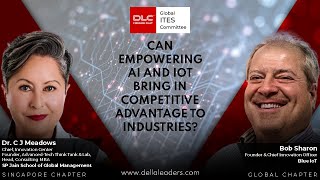
In this DLC Fireside Chat, Dr. Cj Meadows (Innovation & Entrepreneurship Center, S.P. Jane’s School of Global Management) interviews Bob Chiron, founder and Chief Innovation Officer of Blue IoT. The conversation explores how AI and IoT can transform buildings into competitive assets. They discuss post‑COVID health and safety concerns, emphasizing real‑time monitoring of indoor air quality, ventilation, CO₂ and VOCs, and how sensor data combined with AI can drive preventive actions and carbon‑reduction outcomes. Human‑centered design is examined, including occupancy sensing, lighting, noise, green walls, and the privacy challenges of facial‑recognition and data compliance. The pair describe predictive‑maintenance use cases—power‑factor trends, vibration and harmonic analysis for chillers and pumps—to anticipate failures and extend asset life. They outline Blue IoT’s platform strategy: a “single pane of glass” that aggregates edge‑device data, provides audit trails, and supports outcome‑based commercial models (sub‑3‑year payback, 30‑70 % emissions cuts). The discussion expands to biotech sensors for elder‑care, smart‑campus applications, autonomous/self‑healing buildings, and the importance of ecosystem partnerships with universities, green‑tech vendors, and global standards bodies. Finally, they stress disciplined prioritisation—focusing on low‑hanging ESG and health wins before scaling to broader campus, marine, defense, and smart‑grid initiatives—while warning against “boiling the ocean” and emphasizing strategic, data‑driven decision‑making.
Chapters
Hi and welcome. I'm Dr. Cj Meadows. I lead an Innovation and Entrepreneurship Center at S.P. Jane's School of Global Management. I'm also the head of the MBA Consulting Management Program. I've got about 20 years as an entrepreneur. I'm from Accenture IT and Accenture Strategy, DBA Harvard Business School. So I've done a whole lot of stuff, but really rooted in technology and human-centered design. Over to you, Bob.
Thank you, Dr. Meadows, and welcome everyone. Thank you for having me on. My name is Bob Chiron, and I'm the founder and chief innovation officer of Blue IoT, the Australian Computer Society Disruptor of the Year Award, CXO Disruptor of the Year Award, which I was honored to receive a couple of months ago. I call it the Troublemaker of the Year. And I'm very happy to be on this program and talk about technology, artificial intelligence, and a whole lot of other things and what good we can do for the community and the world as a whole. So over back to you, Dr. Meadows.
Hey, and do call me Cj Meadows. Okay, so Bob, you know, I saw flashing up there on the screen something about smart buildings, but you know, now that COVID has been here a while and offices are decentralised, has there been any change in what you do? And do we need smart buildings? Don't we just all have Zoom?
I believe that we're created as social creatures. And though Zoom is absolutely necessary, especially in bringing people from all over the globe together, but there is no substitute for face-to-face. And particularly in team building and building relationships. And I find as I've talked to business people, they do want to get together. And they want to meet face to face because remember the verbal language is only about 6 or 7% of total body language. And yes, we can read some of it on Zoom, but by far and away the bulk is face to face. So though this is necessary medium, however, what you say has changed, as in COVID-19. Many people are still working from home. However, in the suburbs of the cities in Australia, the people are returning to offices quite a lot, but in the central city areas, not so quickly. And so one of the big factors that has come up, even by the unions, is about health and safety. In other words, How easy is it to transmit bacteria or viruses within a building space? And this has come up, and this is where IoT and artificial intelligence are going to play a very big role moving forward. And we're already moving in this space because the demand for measuring, monitoring— what, what is the air quality? What's the ventilation like? How easy it is to catch something here, and what can we do if it is easy to catch something? Because, you know, we have poor ventilation and we don't have the number of air changes per hour necessary to keep the building safe. These are the issues that are now coming to the fore and where we can now deal with and measure and then manage and then do something about it.
So are you saying that AI and IoT and other advanced technologies can make a building competitive?
Correct. We need to understand what's happening in the building. So test and measure. A gazillion air purifiers, portable air purifiers. And so I know that in Australia and I'm sure other parts of the world, people have gone off and bought a lot of them. The problem is they didn't understand that when they bought them, they bought them with HEPA filters, many of them. And because HEPA filters require people with full PPE gear to replace them every 3 months, the annual maintenance will cost more than the actual air purifier, and they'll be thrown away in the garbage. And again, we're going to build this carbon footprint the size of a million Titanics as a result of poor selection of product and not measuring anything but going off half cocked. Trying to, you know, find a solution, but it's a square peg in a round hole. What we like to do is let's measure, let's find out how is the air quality, what's it like. Measure your CO2 and measure your total volatile organic compounds and see, you know, it's a crude method of trying, but a low-cost method of trying to work out what's going on using IoT-based sensors, wireless networks. Preferably non-IP wireless networks, so we mitigate the risk of cyber hacks. And then we can then determine, ah, here are the problematic areas, right? What can we do? Can we use the existing infrastructure to manage that better? If yes, great, and we measure that. If not, how do we remediate it? Oh well, now in these areas we need to look at air purification, preferably without HEPA filters, and manage them remotely from the cloud. And then do it in a smarter way based on the conditions in the rooms and trying to improve quality of life within those areas. And then ongoing, look at further possible remediation, long-term budgeting to perhaps replace ducting and doing other things in a more long-term method a few years down. But in the meantime, we make the building safe, we make the area safe, we make it comfortable and healthy, and we're measuring and we have an audit trail, so we know exactly what's going on. We can always go back on the data and we can continually improve it, enhance it, and send alerts when there are problems.
So one of the key areas you're saying is the, the health and safety of the building. But one of the things that people ask me about a lot is future of work. So I did this big doctoral thesis on Indian outsourcing, as a matter of fact, because IT teams need to be tightly tightly interwoven, tightly intermeshed. And nobody wanted to do it. It took a pandemic to get everybody onto Zoom working as global teams. So one of the things I come up against is number one, the tech being ahead of our uses for it and people not wanting to use it. And number two, the buildings and the tech need to, have human-centered design. It needs to be designed so that the people can be more effective, more engaged in their work and their workplace. And you'll get a lot of economic benefit if you do that. Does your company get involved in the human-centered design and using tech, for example, using facial recognition to not just recognize who's there, and who's punched in their time card, but recognize the wellbeing of employees. Some companies are actually doing that already. How do you humanize what you're, what you're doing?
That's a very good question, Cj Meadows. So I guess from one point of view, we've got to take care of the privacy laws that are moving all over the world. So recognizing faces, et cetera, for the meantime, we're staying away from ourselves. Rules, because that presents a whole raft of compliance and regulatory functions and a lot of costs associated with that. We're looking at a quality indoor environment. So that includes many factors like your air quality, like your light levels. Are the light levels correct? Is there too much noise? In other words, are the conditions conducive to a nice, comfortable space? So they're things we can help with. Measured occupancy, you know, how's the density, how many people are on the floor at any one time, or in this particular function room or whatever. We can measure these today and we can alert when there are problems in this area and ensure that the environment is really nice, everything is working well, and people would be happy to keep coming back. But at the same time, when you do talk human-centred design, the flexibility these days is now required. And this is where the pandemic has come in and said, okay, now, okay, we can have some flexibility of people working from home and people coming into the office. I think if you make office spaces really beautiful and build more human-centered design, and that includes things like green walls, lots of real green walls with real plants, and real plants breathe in CO2, by the way.
Do you get involved involved in some of the low-tech parts of designing these buildings as well as the high-tech, or only the high-tech part?
We don't design buildings, so we don't get involved in the design per se. However, we do collaborate with organizations and do make recommendations, and even to existing buildings. We work mainly in existing buildings, though we are moving to new buildings, greenfield buildings now, but what we do is we do collaborate with organizations and companies who do provide such green— and when I say green walls, I mean proper, you know, planted green walls with their own irrigation system, so they're properly watered and it's all without waste and the water is used very, very well and it's highly efficient and you've got these beautiful green walls area, and then you'll have your plants. So we collaborate and we can bring in these organizations where we'll make recommendations and then they go and provide that service, even though that's not directly our service, but it's related because what we're trying to do is deliver— when we talk about smart buildings and cities, it includes livable buildings and cities. And so this aspect, it's It's techy in the sense that it's established in a very efficient way on a wall that normal low-tech wouldn't. So in that sense, the company who developed it has developed a really good irrigation system to keep the plants going very well. And there is some tech involved in that, even though it's not—
Oh, yeah.
Green tech. Green tech. Exactly.
Well, and actually, if you run the economics on some of the sustainable buildings and sustainable landscaping, putting in landscaping actually saves money in the short run. You don't even have to go to the long run. But, you know, there's a whole host of applications for artificial technology and IoT within working spaces. One that comes to mind actually is mapping the social system. So are you using other technologies in different ways to map social systems to do more than the health and safety?
We have innovation on technology, and that's, of course, a big discussion in itself. But then we have innovation on customer engagement model. And the traditional model of customer engagement was we'll supply you with something, a service or a box or a product, and then if it breaks, come back to us and we'll fix it, replace it, or whatever. That's the traditional model of customer service. But what we like to think of is disruption in this area of continuous customer service and continuous service delivery and continuous support in a level that really, you know, people haven't seen before. So that's one innovation layer in the service delivery mode. But then in order to deliver good service, you got to start at home. That is the corporate culture, which goes into what you were suggesting, though I have not gone into that. I would like to, so I want to explore this very much so. But the way we've fostered our corporate culture is firstly, we have one very highly discriminatory employment policy. And that is if you haven't got a sense of humor, you can't work for us. So this is number one. This one is not negotiable. And then we also have a policy of we don't do quotas. That's a policy. But at the same time, we have a highly non-discriminatory policy. So we've got people from all over the world. We've got people working for us from Sri Lanka, from India, from from China, from Iran, from— we've had people from Sudan, from all over the place. And we very much encourage that collaboration, fun, engagement, and mutual respect. And it's great. And so when you foster this corporate culture of you know, mutual engagement, respect, and fun, um, and excellence and innovation, then you build the platform in which you can deliver this disruptive customer engagement model. So when we talk about numbers and delivery and savings of up to 70% in carbon emissions, um, you know, we, we talk about outcomes that can be delivered and things that we have delivered not smoke and mirrors, which is another problem. Again, we're in the Wild West in our industry, and there are a lot of people putting out fakery, as I like to put it. And you go to their website and you think, wow, this is great. But when you look down to the nuts and bolts, what have they really delivered? What? Where? How much? What, 10% savings? 15%? That's chicken. Anyone can save that blindfolded. You know, so, you know, show me, show me the outcomes and then I'll show you the results and the customers that, you know, are happy with such results.
You know, and besides what we've talked about, are there some applications of AI and IoT, maybe even beyond buildings that excite you today?
So the answer to all of that is yes. And, you know, comparing numbers and doing data analytics is a given these days. So this is not rocket science today.
I mean, one of the things that AI does so beautifully that gives competitive advantage to factories and to particular products like cars that tell you when a part is about to expire, you know, and, you know, Prediction. Do you do anything with prediction?
Absolutely. Again, this is fundamental. So by gathering various information from various sources. So let me give you an example. Let's talk about a big piece of infrastructure in a building, in most buildings, and that would be a big chiller. And they have a number of chillers to run, send cold water to keep the various parts of the building nice and cold. We don't want those things to die. We don't want those things to fail. Nor do we want the pumps that send the water around the building to fail. So we can measure everything from two aspects. One, we're measuring the power quality of, into those devices. So how much amps, voltage, and what is this thing called power factor? The closer to 1 you get, the better. But what happens is we see a trend line going. So if we're running at, say, 0.98,, and over 6 months we see it going down to 0.92. Uh-oh, we know that something's wrong. Now, a normal building management system would not pick this up at all because it's working. So there's no alarm coming out. And this is where the predictive stuff comes in. So we're monitoring the trend lines. We can say there's a problem with this thing. We need to have this thing checked and we need to get a service call raised and have the vendors come in and check this out. And it could be a pump. Now we've got a huge pump sending water around the place that's So it might be a 30-kilowatt pump, a really big one. And again, we can measure those factors, but also measure things like harmonics and measure things like vibration on the motor as well. So we get a number of sources to tell us if this is going to fail. We're going to know long in advance and we're not going to wait for it to break. So then we find, okay, there's a problem with this. They send the, the electrical contractors in.
Yes.
They open it up, they find, yeah, the bearings are going, but, you know, we'll order the parts, we'll get them in 3 weeks' time, put it back together because it's still working okay. And there's a planned maintenance shutdown for a repair, and then those bearings are replaced, not the whole pump because the pump hasn't broken. And then we've got another 10 years of life that we've given to that pump. So we've saved a lot of carbon footprint because we haven't had to buy a whole new pump., and spend 3 times the price trying to get one ASAP because it's busted.
And you know, it's exciting to think that not only are you basically putting in a nervous system into the building so it can say to you, oh, you know, I'm not feeling really well over here. You know, I think I need to be fixed here. You can also use the advanced technologies for the people. And I was talking with somebody the other day about an elder facility.. And one of the things that was so exciting there was something called the magic carpet. And the carpet would record and analyze the elder's footfall patterns. And if they went in a certain direction, if the pattern was broken and it looked like there was a problem, the carpet could call the elder's daughter or son, whoever, and say, you know, your mom's footfalls aren't going quite right today. We think— I think she might be about to fall in about 3 days. So you may want to keep an eye on her. And there are certain things like speech recognition that are used not only for to figure out who you are, but also your speech patterns can predict whether you're about to encounter early onset Alzheimer's. There's a whole lot of technologies that you can build into a building keep track of the, the well-being of the people. Have you considered getting into any of those?
Uh, well, actually, we've started, uh, getting into biotech sensory. Um, so we're, we're getting ready to release a line of, funnily enough, COVID-19 sensors, but then we'll follow up with influenza and other things. Uh, but then there are other things that we can, because we are moving into aged care facilities. And so things like rings. So you get a ring which can actually do what you say in terms of— but it's more their vital signs and other things and a whole bunch of aspects of their body condition that then can be sent messages through the IoT network. Even today they have things that you can use. It might go through a local Bluetooth or whatever and send things. There's more crude methods of the old sort of heavy-duty sort of system around the neck. But now there are more of these biotech-type sensors coming. So we intend to partner with companies around the world in order to then bring together these kinds of technologies and build them into the single platform because I like to call it the single pane of glass. So you don't have to run through a bunch of disparate systems in order to get something done, but rather integrated into this single pane of glass, which could be on your phone, it could be on your laptop, it could be on the control room. It doesn't really matter.
Interconnecting these sorts of systems and the data, that's something that Gartner, um, in their Tech Trends 2022, they identified data fabric as being very essential. And there are also ways to share data across the ecosystem, you know, having scrubbed it a bit before you share it, and etc., etc. And it— you don't have to notify, for example, an elder's child, you could just notify the elder, um, hey, you're getting dehydrated, take some water, or, or what have you. Um, but you know, one of the things that I think we need to think about as well is we've got to think about autonomous systems, buildings that fix themselves, and elder facilities that won't have to call anybody. It'll just take care of the elder itself. My personal dream is a kitchen that has all of my contacts from my phone, senses in the, the, you know, what food I've got in the fridge, and, you know, can just throw dinner parties by itself and clean up after it so that I could be a guest at my dinner parties. But a couple things, a couple of trends we've, we've been seeing are hyper-personalization and autonomous systems. So buildings that fix themselves, but also hyper-personalization. Can a worker in an office building, for example, set up their own space the way they need their space? And are you— I know some places like JLL, um, are very concerned about not only designing for the social system to get people to talk who might not otherwise talk. And there's a great old article on this called Designing Like Greenwich Village, or it was something similar to that, um, to encourage innovation and cross-functional teams and interaction, everything. Um, but nowadays you've got to coordinate and integrate physical and virtual infrastructures. And what, what I'm seeing is that the future of work is individual, and we need to allow people to work how, as and when they are most productive and support them, not, not try to control people and make everything one size fits all. Correct. Are you working in those spaces at all?
Correct. So we're definitely, we're moving down that path. I mean, you know, we like to practice that ourselves, but we're certainly moving down that path. And so we're actually from an indoor environment perspective, we're also working with a world-renowned professor, Professor Lydia Morawski from Queensland University of Technology. And she's a renowned expert in indoor ventilation, air quality, and also climate. And she's on a number of UN committees, works with the WHO and a whole range of, of things.
And probably does things on like earthquakes and other kinds of of safety issues like that?
Yeah, she, she's involved in that many committees and things. It's a list as long as your arm. But she, in fact, has seen some of the work we've been doing in a big private school in terms of making classrooms healthier and safer and evacuating excess CO2 and at least starting there. But in terms of moving to the areas you're talking about, I can easily foresee for example, a worker comes and then they, they recognize the face, then the computer, the laptop that's there, either theirs or just a hot desk version, is there, recognizes them, and, and then goes through the standard sequence of security and authentication, and off you go. You're all set up in the environment that you like, in the way that you like to have it set up. But certainly having that kind of flexibility and workplace is something that we would be— we will be promoting. So in order to do that, you can't be the one company does it all. It doesn't work that way. It's a collaboration of companies, and this is where we need to partner with various organizations, which we already are. Even indoor air purification. We found a very innovative Australian company that have developed indoor air purifiers the size of a pizza box and as quiet as a mouse, but yet highly effective. And yet we can measure all the parameters straight out of it to get a full audit trail for compliance to say the thing's actually working and actually doing its thing. So we get real audit trails. Very rarely do you get that. But that's only one tiny aspect of the whole thing. And as you say, there are so many aspects to this whole area of wanting people to be highly productive and wanting the environment to be, you know, as it should be. And there's a combination of many factors, including the design of the space, again, as you rightly brought up earlier. And so this is where we need to be partnering with all kinds of organizations, and we're building our network of such organizations to partner with, to collaborate with. So together we can deliver these kinds of outcomes in a combination, but also going into autonomous and self-healing buildings. This is something that we are working on, and this is one of my exciting projects in order to do real-time modeling and what-if scenarios and then have the AI automate the changes and the continuous improvements and enhancements in the operation of the Building and Facilities in order to have this whole self-healing, self-operation, autonomous improvement within the operation of the building to a point. But you'll always get problems with devices and infrastructure. But then the beauty with this is then when you have things that are out of pattern, then alerts are raised, automatic work orders are raised, and then you then proactively have your preferred vendors go out and, and, and find out what the problems are long before things break down. But meanwhile, we're continuously gaining efficiencies, running smart grids and microgrids. Okay, where should we hold battery space? Where should we release power and not rely on the grid? There's a whole bunch of things that we can do.
It sounds like there are so many opportunities out there, it's, it's hard to prioritize. I mean, if, how can you prioritize what to go after? Because there's so much cool stuff out there.
Totally. So one of the things I learned in my former business is don't boil the ocean, right? Many entrepreneurs have failed and I've had my own experience. So with lessons learned, What we're trying to do is move in a very methodical, sort of methodical manner going forward in a, excuse the pun, a sustainable way forward so we can build our tech. And we could build it 50 ways going forward, but then we're going to lose focus. So we've got to be very careful not to lose focus on the main game, build the scale-up tech platform, which we're doing, and then build the basics when I say the basics, getting it running well, getting the flexibility running well, getting all of those, which we're actually doing, and then building out the AI, the machine learning, and these other things into the fully autonomous area that it should be in so many— in these main areas. But then Once we've got these basics, what I call basics, they're still quite advanced, in train, then, and we grow the business, we can then have product managers, as I like to call them, and relationship managers partnering in different areas. And you're right, there's so many areas. So for us, we've got the main areas, of course, like we have ESG. It's a major focus globally. And that is carbon emissions. So right now we are able to deliver 30 to 70% of emission reductions in buildings without replacing infrastructure, which is huge. So this is low-lying fruit. So we can get to that. And health and wellbeing, we can get to that pretty well immediately. So they're low-lying fruit things, but then we will be extending on these things into these areas that you rightly suggest in terms of the the full environment, the campus also. It's not just the building. What about the campus of buildings or the city of buildings or the township? In other words, what's happening in between? What about the soil? What about the pollution? What about the water? What about the flooding? What about all of these other things, the parameters? So traffic flows and so forth. So we will be branching out slowly into a whole bunch of areas, um, including marine, shipping, defense, and using this, but in a very positive fashion that will have a great impact on the environment. But you're right, there's a gazillion things, not even 100 that we could go into. So we've just got to try and keep focused as best as we can. But then the way to leverage out more is to partner. And the more we can partner with like-minded companies who are focused on outcomes, then together we can deliver more sooner.
Exactly. So whenever I'm doing things in startup land instead of the corporate world, you know, it's all about ecosystem because the startups have to focus. But to provide an integrated solution to someone, you've got a partner, you know, and whether I'm doing exec ed or consulting or coaching, when I sit down with a corporate executive team or a startup executive team, you know, we have to figure out what is it that needs to be our focus and how can we build and extend, but with some strategic direction. We can't just, you know, try to, as you said, boil the ocean or blossom into a daisy that doesn't do anything in particular. So, so what I've— what I find with all of this is that yes, tech can provide you with some, some competitive advantage, some strategic advantage. It can— it will be short-lived because anybody else can copy it. So you have to keep growing in the direction that is the right future you believe should be built. Um, also the stickiness of the data, the relationships. And, you know, most companies will put in tech to fix a problem. You know, it's— they've got to process something, they've got to make sure it's accurate, whatever the problem is. Um, but then they discover the real strategic bang out of it late, only later. So Another, another key that I tell people is make sure that you don't just solve your immediate problem with tech, but see what additional capabilities it gives you and see how you could turn that into strategic advantage. So integrate the physical and the virtual. Do real strategy, not just install your favorite shiny new toys. And go from there, but with an ecosystem.
Yeah, well, look, a lot of people love to talk about AI and they love to talk about IoT and metaverse and digital twins, and they raise all these lovely terminologies and you'd think they were talking rocket science. But all they're doing are raising smoke and mirrors. Oh, we've got this great tech. I've got this IoT thing. Oh, look, you have to buy one. Look, it's shiny. It's great. You've got to have one, surely. Well, but why? Why do I have to have one? And the whole point of this is not about a shiny toy. It's about what it can deliver and what people are interested in. Is what is it going to solve for them? How is this going to solve? What problems is it going to solve for them? And not that it's a shiny toy. And I think what's important is that we're able to deliver something that will solve problems and hopefully more than just one, but a whole lot of problems that we can solve. And we are and we can.
And that's one of the things that Cj Meadows: See, core to what my organization offers is strategy, you know, helping our clients and our executive education learners develop their strategy, do design thinking, get organized about their innovation so the innovation efforts really do get some traction. And in design thinking in particular, The first thing you establish is the need or the want, the problem to be solved, the job to be done in disruption speak, and then you move on to technical feasibility. These days, whatever it is, you can probably do it. And then you also move over to business viability. So that's why we wind up doing not just tech awareness type work, but the real strategy, design thinking, and innovation processes and structures that are necessary. You know, what offerings do you think— what offerings are most important to your clients?
Well, look, I think again, the— look, we're doing some work with KPMG at the moment, and they They're saying that they've got a global focus on ESG, and many organizations now do, and it's growing. It really is. So we're looking at good carbon emission reductions, corporate governance, audit, audit trail measure, a whole bunch of things. And so from that perspective, we believe we can support this. Better than most within the built environment, within campuses and buildings in that area, because they emit a huge chunk of carbon emissions. And with our smart cities platform suite, which we call Encompass Blue, we're able to offer very massive reductions in the way we automate and control buildings from the cloud, but with both edge devices and cloud systems and platforms with that. But it's flexible. See, we, for example, we started in a school just measuring indoor air quality. And then they came to us and said, look, we've got problems with water leakages in between the buildings. They've got a big, big space of about many, several hectares. And so we said, absolutely. And we put in a number of wireless water meters. And within the first week, found found a massive leak of water. Again, further savings. And then they said, look, we've got a problem with assets being knocked off, sporting assets. So, okay, well, let's track those. So we've got to track the assets. And then we had a problem with power quality. People are blaming each other for problems with power in the main plant rooms. No problem. And so the beauty about these things is that they're flexible. And so if a client today wants this, then that's fine. But then tomorrow they don't have to go to some other place and spend a fortune getting a disparate system. But we can just, just simply be adding things as they need or require, or as they learn about new available services that we can just add to the platform and deliver continuous improvement and outcomes for the betterment of their building or school or campus or whatever that may be. So saving, certainly improving indoor air quality would be actually probably number 2, though that's coming more like number 1. But the cost savings is massive. And again, because of COVID and what's happening in offices, then to manage their systems, they still have to be running. So we need to manage them in a much smarter way and not use traditional systems, um, in order to save a lot more energy and carbon emissions. And so these areas of savings in energy, savings in maintenance, so we have a lot less unplanned maintenance and breakdowns, is huge on the list. And so therefore, these are the areas that we're able to really deliver very much in spades. And so we're already doing work with people like Marriott Hotels, Accor, and office building operators and so forth. Hospitals, we're doing our first hospital at the moment and really building out, but then also into campuses, universities and schools.
So what you're seeing is cost impact, new capabilities, and ultimately benefits for humans.
Absolutely. And the best part, with an amazing commercial return. So it's not just that, you know, you should do it for the benefit of the planet, though that's a good thing, but we're going to make it commercially viable for you. So when we talk about these massive savings, uh, we're talking typically of a sub-3-year payback, including capital costs and ongoing subscriptions. So, uh, in some cases it'll be 2 years, but, uh, typically it's sub-3 years. Um, it is absolutely massive. So it's about sustainability on the triple bottom line, and, and it's got to work for everyone. The model of Blue IoT is everyone's a winner, and that includes staff, suppliers, customers, everyone in the supply chain, the planet, and the community. So everyone's gonna be a winner.
And when you come to one of our programs at our, at our business school, well, either you're collecting ideas that then will lead to that, or if you're doing an ExecEd or a consulting program, you come out with new business initiatives and new reorientation the minute you walk out the door. So that's pretty fast. Thank you, Bob, for being here tonight and sharing so much wonderful information with myself and all the listeners.
Well, thank you so much yourself, Cj Meadows. I really enjoyed your wonderful questioning and, and the chat. And of course, I do want to very much acknowledge Della Leda's Club, of which I'm honored to be part of, and would certainly encourage more people to become members of this fantastic group, and particularly, uh, ITES, uh, as well, uh, within Della Leaders Club. So a big thank you, um, to you, Cj Meadows and DLC.
And I'm honored, I'm thrilled to be part of Della Leaders Club. It's a great place to meet people who are successful and care about the significance of what they do. Success with significance. Um, it's great to be part of Della Leaders Club and ITES.
More from Dr.



Leading Innovation for the Corporate Business Through Impact | CSI Insights Ep. 7

AI Transformation: Is the Consulting Career Model Breaking Down? | Dr. C.J. Meadows | S1E5


CIO Leadership Live ASEAN with Dr CJ Meadows, S P Jain School of Global Management


Usha International - Tiger Center Sewing Center 2025 - Now a Learning-and-Production Center


