CBL Book Talks | Q & A Session with Audience| ft. Ruchira Chaudhary & Dr. CJ Meadows | Part 5 (Last)
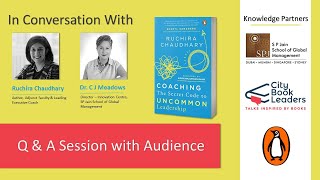
Leadership coach Ruchira Chaudhary identifies four mental blocks that prevent managers from coaching: unlearning old habits, the urge to give directives, judging too quickly, and lacking growth mindset. She outlines four pillars for coaching: active listening, growth mindset, suspended judgment, and deep trust, especially critical in hybrid work where employees feel over-monitored.
Chapters
Really well.
I have a question for you, Ruchira. I mean, with the current times, with the changes that we are seeing in, whether it is in organizations or with folks, with people, with the kind of millennials that we are looking at, what are some of the top mental blocks, you know, Ruchira, that you feel, you know, that basically, you know, holds, you know, leaders, you know, uh, from transforming, you know, from that per se leadership, leadership into coaches? Because I feel, you know, coaching is not something that will gel with every leader. There is that differentiation where you— wherein it's more like a nurturing, wherein it's very similar, I would say, to, you know, growing plants or training them, uh, in my garden. Uh, I would want to hear from you, what are those top mental blocks, you know, which holds back those leaders to get them transformed?
Into coaches? Thank you. It's a fantastic question, Sureshka. Chapter 4 in the book, if you're interested, that's all about it. But just to sort of simply talk about it, the whole act of coaching or transforming into that leader coach, it's not about learning something new. I think the hardest part is unlearning or letting go of your old beliefs, as I was telling you. Often we think we are coaching when we are basically telling people what to do. We have 30 minutes in the calendar. Professor Nii, who's at IMD, she says it's called the dumping phenomenon. So this is how I did it right now, I'm going to tell you what to do because we have limited time, we are chasing fires, we have things to do, we have a business to run, right? And so somehow this gets relegated to the back burner. There are many things that, you know, the whole chapter really talks about that, but I think at the heart of it is You truly need to think about how you suspend that judgment. Because as managers, we have very clear ideas about how somebody's performing, right? Sometimes you might be this perfectly super organized individual and you have somebody reporting to you who's good at his or her work but is supremely disorganized and messy and is late for work. When you coach, you have to wear a different hat. And we find it very hard to distinguish the manager from that coach because we let that judgment come into that frame when we're trying to take somebody to the next level or make them become a better version of themselves. The second bit which Satya Nadella talks about a lot in his book Hit Refresh, if you're interested, is the growth mindset. It's by Carol Dweck. She's a leading Stanford psychologist and she says it's centered on the belief that everybody can change. Honestly, it's not an easy one for all of us because think about it, right? I've been leading teams when there was somebody I inherited, I didn't hire, and I was told that the person is very inert. It's hard to let go that I can truly change the person, and if I can't, then I can find the right place for that person to grow and flourish and shine, right?. But these are not easy tasks and I said it's all about unlearning and of course, all the standard things that we say, you need to listen. It's a highly underrated quality but it's supremely important to listen, to assimilate and to be able to support the individual on that journey and there's a whole list but I think listening, a growth mindset, suspending judgment and building that reservoir of trust which I should have started with, where somebody can be themselves in front of you. That trust is very important and the pandemic is showing us why. Because research after research is telling us that employees feel that their bosses don't trust them. They're constantly checking on them, they're breathing down their neck, they need to be available on call. And that's a bit you need to change. Hybrid work, work from home or no work from home, unless you have the trust, you can't coach somebody and they won't open up in front of you either.
Mohit, I think we have more questions.
Yeah, so there's one more question from Mr. Sanjeev Jain from Gurgaon. What he's asking is, Rachara, how to approach management or the promoters and convince the top performers to embrace coaching? How do you build the ecosystem around it? That's what he's asking.
They can read my book. No, I'm kidding. But you know, there's no easy answer for that. The reason we don't have as many leader coaches as one hopes is because somehow coaching has been associated, as I said earlier, in my own belief, that there's something very amorphous. It's soft, it's fluid. Ask an investment banker and he'll say, but Truchida, tell me where it starts. And this is my senior from Chicago Booth, and I really look up to him. He runs an investment bank in Asia Pacific, and he said, you know, I really want to do what you say, but I don't know how to get started. I don't know where it starts, where it ends, and how is it tangible, because you can't see, you know, a financial metric to measure it, right? So there is no right answer for it. I think the results are visible in how the individual becomes more capable, you know, gets more clarity and consciousness. But I think the way I would say this is for the person, the leader who's coaching, there's also a benefit, which is one, you become more strategic, or rather you have more bandwidth because you're making people around you more capable, which means you're micromanaging a lot less, you're breathing down their neck a lot less, you're trusting them with jobs that you wouldn't have in the past. And the second bit is what Cj Meadows was saying rather eloquently, Let's face it, a leader, the job of a leader is not to create followers but to create more leaders. If you can leave a legacy behind and make sure that that impact lasts a lifetime, that's good leadership.
Hari, who actually did the moderation march for Richard Gere's book in India, he is asking a question and he said, okay, he's okay if that question can be taken. His question is more related to how the coaching mindset can be taught to students. How do we take it to students?
That's his question. I think when I started to write the book, my brief from Penguin was pretty clear. They said it has to be a book for aspiring managers or somebody who's been there and done it. It should be for a leader. But as I started to distill what coaching is, I went very deep into the whole premise. I feel coaching is a life skill.. It doesn't have to be for somebody who has teams reporting into them. You could be a gig worker, you could be somebody starting out their own venture, you could be an entrepreneur. I think an entrepreneur could really do well with coaching. You could be a student starting out in your life, because at the very heart of coaching, it is the act of enabling and building others, right? It's shining a light on others, and when you do that, you also shine brighter. When you elevate others, you go higher. That's what we're saying through a series of stories which I've weaved into it. I've talked about my own life, I've talked about sport, performing arts, right. So I think the sooner we start this mindset that it's not always about having the answer. The answer can be, it could be a collaborative effort. You could ask people more and tell them less. That is true coaching. I've experienced it in my own life. I mean, as a consultant, you don't walk into an organization saying, hey, all of this is crap, I'll tell you what to do.. And I've learned this through, you know, my own life story that I often do interim assignments and do remember I'm brought in as a specialist, which means people think they're paying me money, I know a thing or two about it. And because I'm at the periphery of that organization, I don't have any reporting hierarchies, right? I have always made it my sort of business to ask people how they feel we could do things differently. And that changes the whole dynamic because these conversations are richer, you learn more, but people appreciate you for who you are because you're also helping them grow, you're also helping them become a better version of themselves. And that's, I guess, my long-winded answer. I think coaching is for everybody, for a young student. I've just recently done one for Gen Z and millennials, and it was a roaring success. It could be for a freelancer, an entrepreneur who gets very little feedback, because he really doesn't know who to turn to, a CEO who gets even less feedback because he's at the top of the pyramid, or people like you and me. We could all do with more coaching.
Is it also for parents?
Absolutely.
One of the things I really enjoyed was your dedication for my mom, the best coach I've had, and for Raghav, who I hope will someday say the same about me.
He doesn't say that currently, and I didn't say the same growing up.
Once they hit those teen years, you really are a coach, and that relationship should be a coaching one.
Beautiful.
You said unsolicited advice we give to people. So is there a way we could transform the next generation, whether it's here in India or anywhere else, Can coaching help with that?
Absolutely. I think if we can consciously inculcate a mindset, as you said, you use the word mindset, where it's okay to not be okay, it's okay to not have all the answers, and if we can contain the urge to offer solutions, I think we are programmed to do it. People come to us with challenges, we feel a compelling need to tell them what to do. That happens to all of us, not just managers. It happens to us because we feel we need to support people. If someone's come to us, we need to start early and explain to people that it's okay to ask, seek views, listen, and guide people to the answer rather than give them the answer.
It sounds like it's part of becoming more innovative in this VUCA world. Changing organizations, because so many of us want to rush ahead to crafting the solution that we don't spend a lot of time exploring the problem and really understanding. And if you don't get the problem right, you're not gonna get the answer right. Indeed. Yeah. So coaching makes us innovative as well. Absolutely.
Yeah.
So Pranjali would like to ask a question now.
Uh, yeah.
So, uh, I would like to ask that, uh, you know, you were talking all about coaching and, you know, providing, comforting them with a very nice coaching environment. I just need to understand how do you differentiate between, you know, being a comfortable coach and still, you know, maintaining your dignity and still holding that respect? Because many times that is a very thin line. So I just needed to understand that.
Thank you. I think it's a good question. I should really add here that while it seems like coaching is all soft and nurturing and wonderful, you could also get tough love coaching, right? What is the role of the job of the coach? The coach is making you a better version of yourself, making you go higher, soar higher, become more creative, and as Cj Meadows was saying, more innovative. So you were those untapped reservoirs of creativity and innovation That's what a good coach does, right? Gives you the confidence, gives you the clarity, and makes you more self-aware. That's coaching. Now, it doesn't always have to be soft and fuzzy and nurturing. Coaches come in many forms. Some of the best coaches I've had have been very tough love coaches. So they expect exacting standards. You have these conversations and, you know, in a few months' time, they expect those results. The only difference is that you know that it's coming from a place of love. So as I said earlier, you have to clearly communicate that you're doing all of this because you want that individual, your coachee, your colleague, your team member to go higher, and that you're committed to doing what it takes to take the person to the next level. My best coach has been my client who used to actually accost me in corridors and say, "So Ruchira, what do you think about it?" And she would do it in front of the CEO. And I would be squirming because I hadn't read up anything and I didn't expect it to happen. And it was very uncomfortable for me, but I soon realized why she was doing it. And she's been a fantastic influence. I have told her later that, you know, that was horrible, you shouldn't have done this to me, but I know where she's coming from and I've had coaches like that. So I just want to point out to you that whether it's, you know, I won't say Jack Welch, he's not a great example, but you know, We've seen enough and more coaches who can be all hard and sort of business-like, but these are people who truly support you, who are there for you, and they make you go higher.
Mohit, do we have some more questions from the audience?
Yes, we have a question which is very interesting. In fact, Richira and you, you have inspired a lady named as Mamta Bhaskar to become a coach. She's asking, How could we start our career as a coach? Because after seeing you both, it feels very inspiring to take it up as a career as a coach. So give us some tips to both Richira and Dr. Cj Meadows.
You should start, I'll take a pause.
Oh man, um, my career is actually what we call a mess. I, I have followed my heart and followed great opportunities that posed themselves to me at the time. One of the things I love to do is to think, to teach, to come up with new ideas, and to help people grow. So that's an education sort of career. But another thing that happens is I get really antsy and tired of sitting around talking all the time. It drives me nutty. And I want to do things. So then, you know, as a consultant and an entrepreneur and a business person, I get things done, but then we don't always take the time to reflect. So during the course of my career, flip-flopping between entrepreneurship and consulting and corporate work and, and teaching and academics, I never really until recently had a place to sit. I could get action over here, I can get impact over there, and I can people development over here, but then I— and in coaching, which is now becoming popular and people understand what it is, we don't have to call it edu-sulting anymore, which is what I used to call it. I can call it coaching and people have started to understand what that is. So you can start from anywhere. You can start as a consultant, impacting many, many businesses and clients. You can start as a business person making an impact and, and making things happen. You can start as an educator, even if you're an educator within your own company, and then ultimately you can go into the coaching seat and integrate them.
Ruchira? Fantastic. Again, I'm not a great example, right?
Because— are you a mess too?
I thought I was, but I'm getting better at it now. You know, so now I say eclectic career path. I think that's what they put— Penguin's put on my bio, eclectic. But what does eclectic mean? It's been, as I was saying, a lot of squiggly lines. So if you're sure that you want to be a coach, you can follow a more standardized approach. I'm sure Hariharan and some of the people who are in ICF or have been career coaches or really have embraced coaching coaching for a long time would be the perfect people to tell you that. Mine was more accidental and it was serendipity, I guess. I was told don't use the word accident because I was at a juncture in my career where I was, you know, as I was saying, I was working for this large financial services firm and I was not enjoying it at all. I was meant to run part of strategy and org design for them. I was in Singapore and I would wake up every morning saying, why am I doing this? Because I wasn't really designing anything. We'd been given a mandate from New York saying you have to show savings of X percent. So I was looking at Excel sheets and then really deciding where we would cut costs, and the bigger costs were really people. And that really bothered me because I don't know whether I was cutting out the muscle or the fat in an organization. I was new, and all those grandiose dreams, you know, doing the MBA the previous year and sort of changing things, I was just not enjoying myself. And then Chicago Booth called me and said, hey, you can do this. I've been certified, so yes, I was qualified. I mean, I was certified in a few tools, but I never thought of myself as a coach. So I got fortunate that my alma mater approached me. I did coaching, I realized it was very fulfilling for me, and I continued to untangle knots in leaders' heads. Did that for many other business schools. So my sort of launch pad was through the business school route, right? And I started teaching this way, but it's not a conventional path, as Cj Meadows was saying. So both our careers are not your straight line ones. So I don't know where you are in your career journey. I'm happy to help you, but if you're sure you want to be a coach, which I definitely wasn't, I'm sure there are much better people here on this webinar to guide you who've been there, done it, and are fantastic coaches.
And you know, there's another thing, um, something that's relatively new. I mean, over the past 30, 40 years is coaching certification. Yeah. So don't think that you have to be an organizational star, get the credibility to then be a coach when you're retired. Yeah. You can actually early in your career study coaching itself as a profession and practice, get certified, and then go out and practice. ICF, International Confederation, is just one of them.
ICF, I've got the European one. So there are counterparts like that. Yeah, yeah. So, and so I think it's pretty straightforward, but I think you have clarity of thought, and I'm sure it's not just Cj Meadows and me inspiring you, but if you have that clarity in your head, I think the path can be a lot simpler. It's out there, as she's saying. There are certifications, there are classes, there are tools, and there are people to guide you.
Absolutely.
More from Dr.



Leading Innovation for the Corporate Business Through Impact | CSI Insights Ep. 7

AI Transformation: Is the Consulting Career Model Breaking Down? | Dr. C.J. Meadows | S1E5


CIO Leadership Live ASEAN with Dr CJ Meadows, S P Jain School of Global Management


Usha International - Tiger Center Sewing Center 2025 - Now a Learning-and-Production Center


