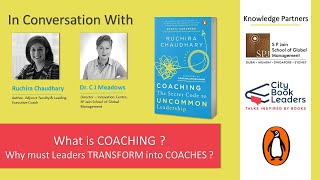
Ruchira Chaudhary and Dr. C.J. Meadows define coaching as maximizing performance through questions rather than answers. Manager behavior drives employee engagement more than anything else, yet most leaders default to directive instruction because they were taught that having answers equals leadership. In a VUCA world, coaching taps collective intelligence instead.
Chapters
The book is in 3 parts, and only the first part starts with a question, and it's a damn good question that I think everybody's gonna want to hear.
I forgot.
The answer to. And the question is this: What is coaching, and why must leaders transform into coaches?
It's, uh, you want the short answer, the very long answer?
Short, because I have a lot more questions to throw today.
Well, to be fair, I mean, it seems like a statement come question, but it took us a long time, and my editor had a point of view, and we went back and forth a few times. But there's a reason that there is a question. What is coaching? You hit Google and I I can't remember when I was first searching, it was 800,000 hits. Now it must be many, many more. But the one that grabbed me, and I use it a lot in my definitions, is coaching is the act of maximizing an individual's current performance and future potential through a series of non-directive self-enabling interactions or conversations, right? And the keywords here are self-enabling and non-directive, which is You are not telling people what to do, as Mohit started off our session with. It's asking people. It's helping them help themselves. So they have to find their own path and they have to find their own solutions. It's about giving more power to the question than the answer. Now, why is that a question mark? Because the first few chapters have been devoted to build a compelling business case for why the leader should coach. And I say that because if you look at all the data and research, despite all the evidence telling us that your manager your boss is the single most important factor in an employee's engagement, productivity. And this is something we've known for a very long time. We also know that most managers do not coach, and when they do, they're just abysmal at coaching.
They're just what?
They're abysmal. They're just, they're bad. They're horrible. They're terrible. They're horrible. All of those things. And it's not always malintent. It's because we've been conditioned to always have the answers. So often in surveys, when you ask a manager, are you a good coach? And they'll say yes, but go back to the drawing board and realize when they think they're coaching, they're actually telling people what to do, right? Because we've always been conditioned through school and college and in business schools, the best students have all the answers. Good managers solve your problem, right? So you go to your boss and he tells you what to do because he knows it, he's been there, he's done it. And in the process, he's creating a mini-me. This is how I was successful. This is how you should be successful. So for a variety of reasons, despite all this knowledge, most leaders, most managers are either bad at coaching or just don't know what coaching is all about. So we spent a lot of time in the first part building the compelling business case for coaching and what coaching really is before we sort of got into the practical aspects of how you should coach, tips and tricks. And frameworks and, and, you know, how the best have done it right.
In a stable corporate hierarchy, industrial age management, you know, shouldn't the manager be teaching what he or she does to the lowers up so they can go up and do the same thing?
Yes and no, because teaching is great coaching as well. Absolutely. And I think you said that in one of the LinkedIn posts that you put up. But coaching comes in many ways. You teach, you instruct at times, you ask a lot. But what's also changed for us is the narrative around leadership has changed. Prior to World War II, we were these self-contained businesses. Post-World War II, we had some offshore operations, sales, manufacturing. Now, today, it's a VUCA world. We're wired, digitized, it's a very complex network of alliances and supply chain. No leader can have all the answers, and frankly, no leader can do it all. So you need to leverage the collective intelligence of the people. And in order to leverage that intelligence, you need to ask them questions. You need to give them a platform to voice their suggestions. Like the pandemic has shown us, right? Nobody had the answers. And that is also coaching. Coaching is not a 30-minute slot in your conference room that you block 30 minutes from now. Coaching is all of this. It's giving people exposure. It's giving them a platform to air their thoughts. It's creating a safe space so that they can think and innovate and do things differently. All of that is coaching.
So in a VUCA world and in a time of organizational change, now is the time when organizations are not stable. So just teaching someone to be you and fit into a hierarchy that may die isn't going to work. You've got to create people who can think for themselves and create tomorrow. One of the things I loved in your book was a quote from Mahatma Gandhi, who famously said, "A sign of a good leader is not how many followers you have, but how many leaders you create."