Coaching for Disruption and Fusion
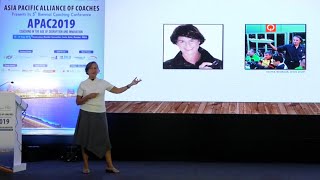
CJ Meadows argues that leaders need to become "fusionaires" who combine skills across different domains to survive disruption. He cites that 90% of Fortune 500 firms from 60 years ago have vanished, and shows how a dancer-turned-scholar and an e-commerce pioneer built disproportionate value by fusing disparate expertise.
Chapters
I'd like to tell you a story, actually two stories, of coach-advisor disruptive drivers with lessons learned that might be useful for your journey and your clients' journeys. First, meet Dr. Edie. PhD in organizational behavior and master's in social psychology at Harvard, also master's in dance ethnology. Edie is part of Marshall Goldsmith's prestigious award-winning 100 Coaches Pay It Forward program and one of the first certified coach supervisors in North America. She's a pioneer in resilience and embodied leadership who's had a deep impact on hundreds of thousands of leaders and employees. But she didn't start out that way. Edie is a gifted dancer, and by age 10, her world dance teacher was preparing her to be a professional instructor. And not only can Edie dance with precision, but she was very sensitive to culture and style, dancing a Bulgarian dance like a Bulgarian. And a Turkish dance like a Turk. She could see patterns and integrate style where appropriate, connecting with people deeply, not just as representatives of their nation, but as people. And she could see commonalities across cultures, styles, dance, music, and later in other fields. She was headed to pre-bio, pre-med at UCLA, but the call of dance and new countries and cultures was irresistible. She took 6 months off and lived in Macedonia, found a mentor, danced, learned the language, lived with a local family, documented weddings, culture, life. Which she learned later is called anthropological fieldwork. When she returned to school, she knew exactly what she wanted to do. Yes, pre-bio, pre-med, and world arts and culture. She supported herself teaching dance, sports, working in travel, real estate, and then— Her mother got sick, and no one could diagnose her. Ironically, Edith dropped out of formal studies to study a range of medical disciplines needed by her mother. Her experience integrating dancers across cultures helped her integrate doctors across disciplines and levels of seniority. Eventually, she choreographed them into giving the right treatment. Her mother would be all right. And by the end of it, she had taken classes in every building on campus. Well, as it turns out, she didn't return to medical school. She decided to accept the largest scholarship ever offered for a master's in dance ethnology. But by that time, she had stressed her body with dance and work, her mind with studies, her emotions caring for a loved one's illness. She instinctively realized that her lifestyle was unsustainable. If she kept going the way she was going, she would burn out. A chance conversation one day became persistent urging and a new direction for her life. Faculty members at Harvard encouraged her to join the PhD program, a joint program in organizational behavior, cross-campus, of course, between the Business School and the School of Arts and Sciences. She would use her deep ethnology skills— and her instinctive understanding of burnout to contribute to a field she had not yet mastered: business. Her doctoral research drew on her background in medicine, dance and sports, ethnology, culture— be it national or organizational— and more. She developed methods to treat and prevent burnout, a shockingly common condition that robs people of joy and well-being and drains productivity out of companies, industries, entire economies. As a matter of fact, stress and burnout is estimated to cost companies about $500 billion a year. Every piece of her background was necessary to solve the burnout puzzle. And not only did she integrate different disciplines, she helped people with her new methods to reintegrate work and life, raising both instead of just trading them off, raising productivity and well-being by reintegrating body, mind, and emotion. Her impact depended on certain things. First, she was open to herself and followed her passions, not someone else's predefined school program or a career path someone else had laid out. She was open outward and crossed boundaries of nation, of field, and more. She collected knowledge and skills into the mental workshop of her mind, creating a very unique workshop. And she saw the world differently from everyone else through the window of that workshop. Then when she sensed a problem or an opportunity that others were missing, she integrated everything and created something of great value that no one else could create without her unique background. Is she entirely unique? She sounds pretty unique. No, not entirely. I found a number of other people a lot like her in my 2-year global research study of cross-domain innovators from the arts, business, Startups, science and technology, inventing, social entrepreneurship, and education. These people have taken a piece of this and a piece of that and created billions of dollars of value and new technology that can save millions of lives. I call them fusionaires, because in nuclear fusion, A great amount of energy is released when two nuclei come together to form something new. Likewise, a fusion in business, technology, and the arts can release a great deal of value. The second story is George Kolovos, e-commerce pioneer, Nike partner, and café owner? Yes, and that's actually a key part of who he is. George was a Greek boy growing up in Australia, and he first started serving customers in the family business at age 5. When he finished secondary school, he took a job as a projectionist and then partnered with a friend to take over and run cinemas. He tried university, but he didn't like being boxed in. He wanted to study what he wanted to study in any field that had something interesting to offer. And then, something came along. The internet came along, and he connected ideas of internet and business with his friend's beauty therapy business. Practice. And he created one of the world's first e-cosmetics companies. He also brought together different people— designer, coder, industry experts to give advice. And he ran and grew the business successfully, but ultimately shut it down because it was a little too early. He took the learnings, though, from that enterprise and joined the startup team of another enterprise, MenuLog, which IPO'd at $850 million. George challenged my ideas of innovation in a way that I think is important for you and for your clients. See, until that time, I had been studying the inventor, the founder and CEO. But at Menulog, George was none of those. He was a creative force of nature crafting new vision, creating content, pulling teams together, focusing, integrating them. He was the creative sidekick, not the CEO. He pulled people and ideas together and let someone else run the day-to-day business. And he confided in me that he couldn't have the creative impact that he had if he had to run the business and be the CEO. He needed to be a creative sidekick to have an innovation impact. He's had other ventures since then. But the one I think he'll never let go of is the Quad Café. In the café, he's hyperattentive to needs and serving people's needs in a way that trains his mind. And when he's outside the café, he recognizes entrepreneurial opportunities in a way that's very special. He also, while he's there, he's a super connector. Of people and ideas in new ways, sometimes handing out other people's business cards. Like Edie, George's creative impact depended on certain things. First, he was open to him— does this sound familiar? He was open to himself and his passions, learning and doing what he wanted to do, not what someone else told him. He was open outward and crossed boundaries of nation, a Greek in Australia, of industries, and connecting internet and business. He connected— he collected people and ideas broadly into a unique mental workshop and then saw the world differently from others through that workshop window. He sensed opportunities others missed. And when he did so, he integrated things in a way that created something of real value. Now, Edie and George are fusioneers. Are they also disruptors? Are their advisees disruptors? What is disruption? Well, a disruptor is something that shakes up an industry or creates a new industry. George was a pioneer in a notably disruptive field, e-commerce. Edie pioneered a new field, resilience. In fact, she's now disrupting herself with her new tech venture, Restoration Vacations, which fuses the leadership development, resilience, and travel industries with AI-enabled recommendations to fight the burnout epidemic. In fact, her friend and mentor, Marshall Goldsmith, has been disrupting himself for quite some time. Moving from coaching to training and enabling coaches to partnering and co-authoring to now releasing an app with automated coaching advice. Is disruption important? Yes. Of the Fortune 500 companies from 60 years ago, 90% have been— are gone, merged, or dropped out, and have been replaced by Google, Amazon, and the like. The S&P 500 over the next 10 years, 50% of them are expected to be gone. According to a Credit Suisse research report, the lifespan of the S&P 500 today is expected to be less than 20 years. Your clients want to survive, and if anyone's going to disrupt their industry, they want to be the one to do it. But who's going to help them gain those skills and do that job? It's incredibly hard to run today's business while creating tomorrow's. It's kind of like changing the tires on a car while you're still driving it. Now, they're going to need to do a lot more than just buy new tech and hire coders, because technology itself is not inherently disruptive. But it enables new solutions that can be. Who's going to teach them how to do that. Who's going to help? And these new solutions normally need a new business model and radical new designs that serve customers 10 times better, not just 10%. Now, your clients know their industry, but do they know where to look for disruption? Have you told them? Opportunities for disruption and disruptive threats are not usually at the top end of the market, in the high-profit margin areas most people love to look at. They're at the bottom. A situation is ripe for disruption when today's solution overshoots what people actually need and what they want to or are able to pay for. Like owning multiple cars that spend most of their time sitting in the garage instead of just paying for a ride? Have you told your clients that a business cannot disrupt itself? One of the rare survivors from the S&P 500 is actually a tech company that's been around for over a century— IBM. They survived because they set up new businesses as different businesses, albeit with the IBM brand name. The waves of disruption and the businesses they set up are the mainframe, the mini, the PC, cloud-based services for startups, and now the world's largest design practice, Design thinking practice. Yes, leveraging technology, but based on design. Why? Because these are fundamentally different businesses that need new resources, different resources, different processes, and a new profit formula. Now, they also need a new strategy. But how to make one? Most of your clients will know how to make strategy for today's business, a deliberate strategy based in past data. But when they're doing something high-growth or disruptive, they'll need emergent strategy based on experimentation. Also, a new growth or disruptive product or service needs to be designed with a deep understanding of customer needs and wants, or job to be done. Does your CEO client have that understanding? Or does it sit at the bottom of the organization in customer support and tech support? Who's going to help them connect the top of the organization with the bottom and the outside, the customers? Do your clients know how to operate in this new way? Do they have these skills? Who will they turn to for help? You will need to learn disruption and fusion in order to get— help them develop and gain those skills. So what does it mean for you? Well, first, this should be familiar now, know your passion and your role. What are your passions? Are you bringing different passions and capabilities from your client? Are you helping them develop theirs? Are you open outward and crossing boundaries? Are you helping them do so? Of country, industry, which most of them would not have crossed, but maybe you have, of function and more. And are you connecting them with people and ideas outside their normal domain? Are you collecting people and ideas broadly, creating a unique mental workshop? Are you helping them do that? Do you sense the world differently from others around you? Do you sense the world and see the world differently from your client? Are you helping them learn how to see the world differently from everyone around them? And when you sense a new opportunity, are you helping them put together a piece of this and a piece of that and create something of high value? And is it disruptive? Because you'll have to alert them not to run the disruptive new venture inside their current business. They'll need to make a new business. So whether you're a pioneer and a coach, or a creative sidekick and a disruptive driver, whether you have an impact on thousands of leaders and organizations, or command an IPO of $850 million, cross boundaries. Innovate. Be a disruptor or a fusionaire. Learn to see disruptions and fusions and help your clients see it too. Guide them as only you can, but keep changing how you guide them because coaching itself— thank you, David— is being disruptive. You and your clients have a wonderful future to build together. Good luck. Thank you.
More from Dr.



Leading Innovation for the Corporate Business Through Impact | CSI Insights Ep. 7

AI Transformation: Is the Consulting Career Model Breaking Down? | Dr. C.J. Meadows | S1E5


CIO Leadership Live ASEAN with Dr CJ Meadows, S P Jain School of Global Management


Usha International - Tiger Center Sewing Center 2025 - Now a Learning-and-Production Center


