Fighting burnout - How to flourish, instead - JobTalk with Dr. Edy
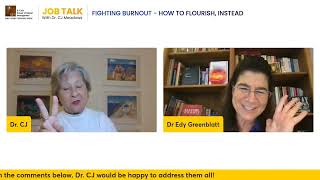
Dr. Edie Greenblatt, who spent 20 years researching burnout, argues the problem isn't work-life balance but managing energy on a spectrum of restoration versus depletion. She offers tools like her Resilience Oasis app and explains why the same activity—a commute, family time—can restore you or drain you depending on your needs and boundaries.
Chapters
Hello and welcome to Job Talk with SP Jain School of Global Management. I'm Dr. Cj Meadows, your host, and we're broadcasting from the Burnout and Flourishing Department at SP Jain Singapore campus. This show is a tribute to Car Talk, but gives you a chance to ask questions about jobs, work, careers, and life mission. So if you have a work-related question or problem, just send an email to jobtalk@spjain.org and our secret moderator will pass it to us. We'll either help you solve your problem or at least help you laugh and know you're not alone. Now, let's mix it up a little bit. Before I introduce this week's guest, I'd like to share some notable news relevant to today's topic. Fresh from the news desk at SP Jane, did you know employee stress and burnout cost US companies an estimated $500 billion a year. US employers lose $44 billion a year in productivity due to depression. This is from the APA. The care costs for individuals with both complex chronic illness, such as burnout syndrome, and mental illness are 5 times more than that for those who only have a mental illness. This is from PwC, employer-based insurance. Only 2 more, 3 more. Stress causes between $150 and $300 billion a year in lost days and $125 to $190 billion US dollars a year in extra healthcare costs. That's from Forbes. And more than 60% of employees engage in unhealthy behaviors to combat work-related stress. That's from Mental Health America. And yet the final bit of news, in 2018, over 700 million paid vacation days went unused in the US. Now, my guest today is Dr. Edie Greenblatt, PhD, from Harvard brilliant person, president of ExecuCare Coaching and Consulting and founder and CEO of RVI, Restoration Vacation Inc. Now our theme for today is burnout, how you cannot do that and flourish instead. Welcome to the show, Dr. Edie.
Thank you. Hi, thanks, Dr. Cj Meadows. Thank you for having me. I'm really glad to be here. I'm here with you from Tel Aviv today.
So that, that's got to bring up an issue. We're all, all day long and part of our nighttime too, talking to each other around the world virtually. Is this leading to burnout, and did COVID affect burnout?
Okay, so we only have a short period of time, so I can't give you a full answer. OK, so first of all, thank you very much for having me. I've been looking at burnout and turnover and resilience for almost 20 years. Yeah, almost 20 years. And when I filed my dissertation at Harvard, my chair asked me, are you trying to get a job in a biology department? Like, why are you talking about wellness and fitness and neuropsychopharmacology? And like, what does this have to do with business? So we've come a long way. Unfortunately, we've come a long way very quickly because of COVID So the enlightened organization understood that this was a problem a few years ago, but pretty much everybody's got it now. COVID made things much more apparent, and it also probably made it okay to talk about it. So, you know, we've lifted the curtain in many ways because we've been working virtually, because we're working from home, because our dogs start barking and our kids change the settings on our Zoom settings. And so a lot of it, we've lifted the veil. And part of lifting the veil about who we are and what goes on in our lives is what challenges we face. And all those numbers that you quoted, they've simply increased because of COVID So, yeah, yeah, in part it's gotten worse. And what was here has been made clear.
Okay, so now this brings to mind, so you're in a business school, but you're all— you were also across the river at the university in the psych department, and you could have just done some simple business dissertation, but you chose to do this and integrate a whole lot of different fields. Why did you work on this?
Okay, so, um, it— the introduction in my book Restore Yourself, I talk about how I came to this, and it looked like the way I came to it was I was a dance anthropologist in my first career, and I soon realized that not only was I working at universities, but I was also— so I was teaching world dance and dance cultures of various geographic regions and history of dance in Western culture. And, um, but not only did I teach part-time at the university, I was also teaching in the community. So I was running what you would call recreational dance events. I was an educator in schools. I was working at community centers helping adults do things after work. And I pretty soon realized that I wasn't providing just dance lessons. I thought I was providing and DJing dance events. And what it turned out I was providing was a set of conditions that helped people survive the traumas of work. So I had people who would come to me after work and say, oh my God, you know, if you hadn't been here the last 3 months, I would have quit my job. Somebody came to me and said, you know, thank you for coming to this class. I came to this class twice a week while my daughter was being treated for cancer and she died, and I wouldn't have gotten through it without you. And it became pretty clear to me that What I was doing was creating restorative behaviors and conditions. And it just happened that it was through dancing. But there are all kinds of sets of restorative behaviors and conditions or restorative events, like, ostensibly like vacations. And I decided I wanted to get on the other side of it. Instead of repairing the damage done by work, I decided I wanted to make work less damaging. Like, there's no reason Like, we work to make our lives better, to have food and shelter and support our families and practice what we believe is important in our lives and what's meaningful to us. So if work is supposed to support that, it shouldn't have to be that work destroys that. And so that was my goal in doing the research at Harvard and to basically figure out, OK, how do we make work something that's ostensibly supposed to be positive, return it to what it should be, which is something that at minimum is not so depleting that we're debilitating everyone around us and costing us our health and our family ties and the rest of our lives.
I love what you've said about work, that, you know, in some regard, work is a privilege. This is why people actually go out and try to get jobs. And work does make our lives better. But then again, if you start to complain about work in the office, somebody is going to say to you, That's why they call it work. So what can you do to make work a positive force in your life instead of being destructive on yourself?
So the whole point of the research and what we found out was not really about talking about work versus non-work. And that's part of the reason we haven't solved the sort of work-life balance, work burns me out question. Because people have been looking at this for a while. We've been trying to figure it out. But part of the problem is that this whole work-life balance definition doesn't work. So the definition that people operate with is, okay, work is depleting, right? Depletes our energies, our physical, cognitive, social, emotional energies. And non-work is restorative. So what you want to do, if you want to maximize restoration, you work less. This fundamentally pits work against non-work. And look at your face, what's wrong with the model?
Well, it seems to me that, you know, we're not calling work all the stuff that is actually work. Because I mean, like, I'm not only a mom, I'm not only a worker during the day, and I'm also a mom. So I go out and work in an office and work on a bunch of stuff and get tired. And then I go home and help the kids with this and fix that and take care of these problems. And I got people all over me all the time. I say, oh my God, I'm exhausted now. Fall into bed and then go to work the next morning and find that it is not as hard as home, right?
Right.
So I, I— the big question in my mind is, what is work? And then Okay, how can I simply not think about work and non-work? How can I just construct a life that's good for me and for everybody? Are you able to help people with that?
Of course. So when we talk about work and non-work, work being depleting and non-work being restorative, you've basically said the model's wrong. Because parts of work can be very restorative and parts of home are can be very depleting. So we're optimizing the wrong thing. The truth, the reality is work and non-work are on one continuum, and restoration and depletion are on another. So what we need to optimize is the behaviors and conditions that restore us. And it doesn't matter what you call it. If you call it work, if you call it non-work, work is just a social tag, right? So what do you call gardening if you grow vegetables? Is it work, or is it recreation, or is it farming, like, was it? So you can't get stuck in this. The question is that, like our colleague, the late— under what are the behaviors and the conditions under which you do things in your life? And you—
oh, I am afraid we've got bandwidth problems. But I think I understand some of it. You know, Dr. Edie and I have talked about some of this before. You know, whether something is done for money in the marketplace does not define whether or not it's work. That's just an activity. So if something— I think if something creates value for yourself and others, seems to me that's work. And you might be doing it for the outcome of the work. So it's not part of the marketplace, or you might be going into the marketplace and trading it. But if I can make a portfolio of activities and manage my activities, then there's got to be a way that I cannot burn myself out. Is that, is that kind of fair enough?
Yeah. So what you need to do is you need to become an expert at knowing the exact behaviors and conditions that restore your energy and those that deplete you. And if you know that, you apply that same lens, regardless of what you call what you're doing, whether it's productive or counterproductive, or fun or not fun, or work or going to the gym, it doesn't matter. So for example, that we came up with two fundamental things you need to know to be able to manage your, your, your energy. You need to know exactly what you need and define it. We help you figure that out. And manage it all the time. It's not okay, on the weekend, I'll restore. It's something you pay attention to all the time. All the time. It's like, am I thirsty? You don't check to see if you're thirsty on Saturday. Right? You manage— there are things that you manage all the time. When you get in a car, you make sure you're not too sleepy, right? When you get this right, so you're paying attention to those needs, you pay attention to your restoration and depletion needs all the time. Right? And you, so for example, there are 3 best practices, right? 3 things you need to really understand to be able to manage your energy well. Okay. Let's talk about one of them. We make some mistakes, common mistakes. One of them is we need to realize that it's not the social tag. So if you call it vacation, or if you call it a commute, it doesn't tell you if it's restorative or depleting. For example, lots of people, do you have a restorative or depleting commute? Is going to work positive for your energy, or does it drain your energy?
It kind of drains the energy because it's just oftentimes so useless. Um, and actually, I resent having to go and do something that, that doesn't help the actual work. So while I'm doing this thing that I don't want to do I try to make it enjoyable by reading a book, or I get some stuff done. So I'm on the phone getting my emails done. So I, I would say my commute is depleting. So instead of just walking over to my home office fresh, I've already gone through something I don't want to do, and I come to the office grumpy.
Good. So the question is, so how can we change the behaviors and conditions, internal and external, to make that commute less depleting? You're a brilliant coach. You've already, you've already, you already know the answer, right? What's the answer?
There's two answers, I would say. One, don't do the thing that you find depleting, or two, if you have to do that depleting thing, find ways to make it not so depleting.
Right. For example, change the narrative. You have a narrative that says this is a waste of time. I could do better elsewhere. So that narrative doesn't serve you, right? It doesn't serve you. Well, it doesn't deplete you.
But if I make another narrative, oh, this is special time where I can read my little book during my commute, then it becomes a more positive time. And I try to talk myself into, okay, this special good time. I like to read.
Right. So that's something, that's you actually taking control of the internal behaviors and conditions, changing the narrative. Another thing you could do is like you've already, you're already doing it. You can listen to a podcast, right? You can figure out whatever other aspects of the commute are depleting for you. You, you try to switch them. You try. Okay. So the goal, this is about little tiny baby changes, little tiny adjustments. You're, you're, you're turning, you're turning an oil tanker. Okay. You make a little adjustment over the long haul. It gives you a big change in direction. Okay. So number one, one of the things you have to do is, so, so that's one of the things you want to do is you want to manage your narrative. Second, you want to communicate with people and make sure that you're having the kinds of conversations that are necessary and possible so that everybody really understands the behaviors and conditions that are restorative for people. So for some people, going into the office is a relief because they don't have their boundaries managed well at home. They're distracted by whatever it is. They feel guilty. They have their— I have a friend who's— all of her relatives rag on her because She has so much free time because she's at home. Why aren't you doing this? Why aren't you doing that? And as soon as she relocates 4 blocks down the road at the family office, all of a sudden they're saying, oh, we're so appreciative that you're working. So, so you can't make generalizations about what's restorative and depleting because the second musketeer of resilience is they're different for everyone.
Oh, so everybody So everybody listening here has got to figure out what's restorative and/or depleting, what gives and takes energy. For me, because I've got a friend who's particularly— when she takes a new job, she moves at least a half an hour away because she wants a commute to separate work and life and to warm up in the morning and to decompress on her way home. And for her, she needs it and it's good for her. And it would drive me absolutely insane.
Right. And it's really important to know that we're different. We are different. And you could just think about anything, right? So if we, if we poll the audience and we say, how many of you like to— so you throw towels in the washing machine, then you throw them in the dryer. And now you have to fold them, right? Okay. So I would bet that for at least half of the audience, folding the towels is depleting. Now, Cj, what is it for you? Depleting?
Depleting.
It's a nuisance.
Why? It's a nuisance.
Why?
Well, I'd rather do something else that's more productive.
Right. And if we've got people— there we go. If we, If we go to other people like me, I'll give you an example of me. My favorite thing is to do is to fold towels. They feel good. They're warm. It's something that gets finished. When they're done, they look nice. Everything is parallel. And I can think when I'm doing it and the towels aren't telling me I'm going too fast or too slow or not good enough. Okay. We're all different and you can use those differences. So my mistake, before I did this work was I thought we were all the same and I hated doing dishes. And I used to think that anyone who came, like house guests, I'd give them my car, my house, my bed. They could have anything they wanted if they'd do the dishes because I hated it so much. And I thought they were doing me such a favor. And I realized that there's about 25% of the people in the world love doing dishes. It's warm. It's soothing. It gets them warm. You like doing dishes? They talk.
Talk time. And it's their special time together. Yep.
And Radhika folds towels. Yeah.
Okay.
We're different. Okay. So that's the second musketeer and it's really important. And there's one more thing which we especially became very salient during COVID which is it changes over time. What restores and depletes you changes. So if you can think about something that used to restore you, that has become depleting, or something that used to be depleting that now restores you. Can you think of one?
I can. I remember a particular time where I was feeling so stressed and so burned out at my company. And we finished a huge project. And I actually enjoyed going to the grocery store. Normally it's a nuisance, but to do something homey and normal just felt so nice. It made me feel normal and not pressured. And as a matter of fact, we've got a note from Geetika Taneja. Anything that gives me relaxation without getting judged or accountable for it is not work. I can understand that.
What I would say is it's not depleting because it's very likely that there are things, Gita, you're doing all day every day that nobody's judging except you maybe. And it's also sometimes your narrative. What am I— we're our own worst enemies, right? All right, so, you know, if when I go to the grocery store, I'm, I'm If I'm making decisions for other people's budget, other people's money, and I'm afraid I'm going to be a sucker because I'm at an expensive grocery store in a country I don't know and I don't know what's right, I'm judging myself. I can create a narrative and make it miserable. Right? So it really depends. So we need to understand that it changes over time. With COVID a lot of people realized that there were things that were restorative for them that they didn't realize were restoring them.
Oh, that were in the office and now they don't get that.
Like what? Like what? Like having a conversation with someone, like a chair that feels good, like walking from the parking lot to the building, smelling a tree, being away from your family, getting out of your house, right? Like people didn't understand that. So there are some sneaky depleters. That sneak up on us. And one of them is overdose effects. So what was a little of something restores us until all of a sudden we overdose on it and now it becomes a depleter. COVID showed us that one too. Time with family. People said, oh, you know, if only I had time to be home, I'd clean my house. Okay. I would love to see the statistics on whose houses are cleaner since COVID And I always used to hear from—
and it was usually men, it was usually husbands who would say, oh, I want more time with my family and my kids, etc. And then, yeah, I didn't really— I never really understood how that's restorative because I had 4 little kids at home, all of whom would climb on me saying, I want this, I need this, I need that. And, and just, it was constant crisis.
Right. It's overdose.
Overdose effect.
If you had one, one who came to you after, in the afternoon, like on your lunch break and said, oh, mommy, mommy, mommy, I need this. It's like, oh, how nice. I need it. I'm valuable. I'm cute. Right. So, yeah. So overdose effects is overdosing is one of the sneaky depleters you want to watch out for. There are others that sneaked up on us during COVID which was boundary management. You know, we have, we have intrapersonal boundaries and interpersonal boundaries. Boundaries between myself and others, boundary between work and others, myself and work, boundaries between my free time and my time to think, space boundaries, where I keep my stuff. Like, okay, I put my phone here. What, like, why are you transgressing on my territory, right? So boundary infractions became a huge, hugely obvious source of depletion. It's always been— again, COVID amplified everything, right? So, you know, it's one, it's one thing to have your boundaries managed by the fact that I'm not home, or it's 7 in the morning, Okay, but if it's 7 in the morning and I'm working from home, what am I going to say? I, I'm stuck in traffic. So we might research— it shows working hours during COVID expanded. People have less commute and their working hours expanded because like there was no way to say no. There was no way to manage the boundary that people felt safe using.
See, I think part of that expansion of the work time, though, was poor boundary management. And part of it, I believe, was just businesses in crisis. So whether you're working from home or working in the office, if your business is in crisis, your work hours are going to expand. But I think you're right. There's a significant number of people who didn't know how to set up boundaries and how to set up a working environment because they'd never done that. It had been set up for them by the office.
Right. And look, it's always easier to help someone else than help yourself. It's easier to set up boundaries for other people than it is for yourself. And the term guilt has become a major part of the work narrative. I'm sitting here and my 3-year-old is crying. What do I do? If I was at the office and my 3-year-old is crying, I don't know about it. Yeah. Okay. So now what? I have to shut off my motor neurons. I'm sorry, my mirror neurons. I have mirror neurons. They feel— mirror neurons, we feel the feelings of others for better or for worse. That's why when your child falls down and you feel it, you really felt it. It's not in your head. It's in your nervous system. Okay, so mirror neurons, proximity makes it worse. So if you, you know, you're feeling all the turmoil of your house, if you're sitting in your house, if you're at your office 3 blocks away, you literally physiologically feel less of the home stress. They're not there. Okay, so it's so managing. So the trick is Getting good at diagnosis, getting good at diagnosing what you need, getting good at diagnosing what you need, and then come sharing that with others.
Speaking of sharing, I've just been reminded by our secret moderator that it's time for a fun fact, a have you heard. So have you heard the following from the Totally Awesome Book of crazy stories by Bill O'Neill. BBC Radio began its regular evening news bulletin at 8:45 one day with the following announcement: there is no news. They felt nothing newsworthy had been reported, so they played 15 minutes of piano music. Sadly, the last time this happened was on April 28th, 19— 30. So based on this little fun fact, are we filling every minute of every day with some sort of what we think is news, and if we really looked at it, it's not? And things we think are important, and no, they're just urgent.
So actually, the news isn't even urgent. The news just is, is, is sensory overload.
So yeah, and what are you going to do about it anyway?
Well, so that's the question. The question. So again, if you need to get really good at knowing what restores and depletes you. Now, for most people, hearing about things which are sad or anxiety-producing doesn't help them unless there's something they can do about it. Okay. So typically, the news is about what has happened and about being a victim. And it doesn't tell you what you can do about it. So this— we saw this happen. We saw people self-traumatize with the media when the Twin Towers fell. Right. Yeah. The news, right. And one of the boundary management things we have to do is we have to protect ourselves from the endless bombardment of information that you can't do anything about. Okay. And every time somebody introduces a thought, that part of your brain lights up. That's why you have to protect yourself from interruptions. Okay. Every time we're interrupted, we lose up to 15 minutes of cognitive focus, usually 15 minutes. If you're in flow, you break flow and you can't get back into it. Okay. So people say, well, I have my phone on silent. Okay, so I see it. I see a WhatsApp message, but I'm not going to read who it's from. That part of my brain lit up. So now I have to use energy. I'm already there. It's gone. It's all— I'm gone, right? Pretending like I didn't hear it. So when I do the— we do Restore Yourself workshops. I do them all over the world for all kinds of leaders and teams and, and organizations that are dealing with stress, whoever. I just came back. I've been traveling again. Okay. The first thing we do in the workshop is there's gift bags on the table and people look in the gift bag and there's nothing in the gift bag. Why? Because I tell people when we start, they put their phones in the gift bag on silent because every time your phone vibrates or every time you look at it, that's it. You are pulled out and you are cognitively interrupted. Okay. So now you're being depleted. We only have so many decisions per day. So the parts of your brain that help you make decisions and the parts of your brain that help you understand emotions and all of those things, you've only got so much capacity before you sleep long enough to sleep, which we don't sleep enough. Biggest source of depletion, best source of restoration, right? You only have so many decisions in you. You only have so much time before You're done. So if, if I use up all my decision-making and focus on answer the text, don't answer the text, look at the phone, don't look at the phone, interrupt, don't look at the phone. Okay. By 11 o'clock, I can't make any decisions. And we all know this because most people are toast, right? Most people have a couple of, they've got a couple of hours of ability to make decisions and then they stop. That's why they end up working on their inbox, deleting things, things that don't require any kind of significant decision-making because they're done. They've used it up.
You know, this is actually a very important thing. One of the things that I've, that I've read and heard is that companies are trying to change how people work to improve productivity. One thing I think is super important that I haven't heard a lot of people talk about is help people experiment on themselves and set their own conditions for how they work best. But also some companies are having what are called library days where everybody is silent and it's like a library and you're not allowed to interrupt folks. Some people who have creative work, like you've got to work on a proposal, you're writing a book or whatever, They do that in the morning without looking at blasted email. And then after you've worn yourself out with your creative work and really focused on it, then go and do your email and call people back and all this administrative type of stuff. Where can we go for kind of like a guidebook of how to diagnose and manage me? And how to diagnose and manage my company.
So the book Restore Yourself that, you know, I wrote a long time ago, that's so long ago that we talk about how to manage your BlackBerry, not the fruit. All right.
But there's a new version out and it's on Amazon and it's Kindle, right?
No, it's not the new version. Still the old version. It's still there. Same version. It says BlackBerry, but it doesn't matter. Because the core— how to do this hasn't changed, right? The answer is that we're still human beings. We still have the same brains. We still have the same hearts. We still have the same families. We still have the same basic things. And so things have— circumstances can change, so they heighten particular sets of depleters, or they take away certain sets of restorers, right? So we can't find silence anymore. It's almost impossible to find silence, right? So we have to seek out silence. Used to be silence was easier to find. It's hard for us to be alone. Yep. Right. People don't know how to be alone or— right. So there's things, but, but in general, the book, the book Restore Yourself: The Antidote for Professional Exhaustion is a good place to start. It basically helps you see what you need to do and how to look at it. And it's written for people who are exhausted. So there's no footnotes, there's no, big fancy words. It's kind of easy to deal with. We have, we have an app that we've developed. It's a beta. It's in a beta. And people who want help with coaching, it basically cuts down on the amount of time you need for resilience coaching. So at this, you know, you basically put in what's going on for you and we do an assessment and then we do a quick coaching session to check in that we're right and give you recommendations. And it saves a lot of time and a lot of money. Corporations are starting to get those for their employees. Correct.
And that's RVI.
So Restoration Vacation, we actually founded before RVI. It's called, the app's called Resilience Oasis, but it's still a secret. But if you want to, if you want to beta, get in touch with Cj Meadows or me. RVI was started because we carved out a particular niche of the resilience world. Before COVID people weren't so familiar with resilience. So there wasn't so much demand. So we took the dip, the part that nobody understood, which was the vacation piece, which was that nobody understands that you have to plan, execute, and restore from— return from a reliably restorative vacation. To do that is almost impossible without help and understanding and assessment. And, and so we created that business to take this technique and really focus it into vacations. And then COVID hit and all of a sudden the world recognized that they need the whole thing. So the app helps people at home, at work, between their ears, and when they're traveling. And so basically pulled back out to do what I've always been doing because the market said, gosh, we need this. So the easiest thing to do is if you need something, let me know.
Right. So, so as a matter of fact, Shiva Priya has done just that. And I think you've probably partially or fully answer that question. The question was, how can companies, organizations, and universities help individuals have and maintain a good focus?
So at the individual level, individuals— they need to help individuals learn what tools are available, whether it's Restore Yourself workshop or whatever. There are tools for helping people manage their own resilience. Then the organization needs to help have conversations about it, have policies in place that help people have conversations, make it psychologically safe, make, make the environment something where people can discuss boundaries, where expectations are explicit, right? If you're in an organization and you get an email at 2 o'clock in the morning because you forgot to turn off your phone, are you supposed to answer it? And at McKinsey, when we first did this work with McKinsey, we actually had the conversation live between the business analyst and the partner. And the business analyst said, I sleep with my phone on because I get emails from the business, from the partner. At 2 o'clock in the morning and I want to reply. And he said, I'm in China. I'm sending you a message during my business hours. I expect you to answer them during your— but you have as an organization, you have to make all of these things explicit. So it's about team effectiveness, communication, and understanding the resilience piece.
So there need to be some conversations. There needs to be some training for the new guys. There needs to be a culture where expectations are set and these are the rules. You know, we answer the email within business hours, et cetera.
Yeah, so, you know, pretty much everything in organizations is really at core, it's treating people like adults, creating conditions for them to thrive, opening communication channels, training people how to be effective in teams, to be effective leaders, and how to, how to, how to, you know, how to help people thrive. Absolutely. There isn't a lot new. What we have now, what we didn't have, is we have more data. So the things that I wrote about in the book 20 years ago that I knew to be true, that I had case studies for, that I had to go to neuropsychopharmacology original research, or I had to I had to train with an occupational therapist to learn about sensory integration theory. Now that information is easy to find in the business world. That's the difference. But humans haven't changed. So if we— one thing we have to hit, if there's one thing that you're going to do, you got to sleep. Number one, most, most, most, most important thing, you have to protect and manage your sleep. Symptoms of sleep deprivation, and most people have it, are the same symptoms of people who have Alzheimer's. They're the same symptoms of people who have compromised immune systems. If you do nothing else, manage your boundaries and go to bed after this podcast is over.
Excellent, excellent advice. Now, that's the most important for the individual. What's your final piece of advice for a company or leader in a company to put into place?
Learn this yourself so that you understand the impact you're having on others. And then you can decide how you want to implement it in the organization.
How to roll it out as a culture.
If you don't— if you haven't embodied what this means to do, it's very hard for you to understand how to apply to others. And even if you do it as an experiment. Yeah. Sure, why not? Well, and— and—
That makes a lot of sense because we're all different. You're going to have to let people— help people learn how to experiment on themselves and give them the freedom to do so. And once they figure out what works best for them, give them the freedom to manage their work to be productive. You know, and it all also comes back to positive psychology. You know, don't work and then think you're going to be happy later when after you're successful because your goals then constantly change. Get happy first. And happy people are creative and productive. So it's part of managing that.
Yeah. And the tie is if you don't have the energy to be happy, you can use all the happiness tricks in the world. But if you're too tired to do all that stuff that makes you happy or sustains your happiness, So they go together. So you have to do another talk with, with Tal Ben-Shahar or somebody about happiness, because they support each other. But you need— the resilience is about having the energy to do everything that's important to you. The happiness is about extracting the psycho-emotional state from that which you do. And no matter what it is, you need them both.
And don't think, and don't think it's a work-life balance. Work is part of your life. So just manage your life, manage all of it.
You need to optimize your energy. It's manage your energy. Manage your energy to do whatever you need. Work, don't work, whatever, walk the dog, you know, whatever it is.
And we've got something here from Geethika. Would you say you need to contract at the onset in an organization what your expectations and boundaries are to avoid any depleting behaviors?
Excellent question. Geeta, yeah, Geeta gets this. So you can't avoid the depleting behaviors, but you can at least have the conversations about seeing what— so there are organizational-level depleters and there are team-level depleters. And so having a conversation about how the work gets done And knowing what you need, you can, you can make that fit. Usually the organization can't tell you explicitly, we have this depleting aspect of our culture. But they'll say things like, well, you know, we get a lot of all-nighters, right? We don't manage emergencies well. We have a culture that's all about producing and producing and pushing, right? We have— so the first question I'd ask is, What's the average number of unused vacation days you have? Because maybe an organization— in an organization where people don't take their vacation days, something is creating conditions for overdose, right? People don't feel like they can go away, whether they feel unsafe or they're too motivated or whatever it is. If people— if a company is carrying too many vacation days, on average, then there's something there. There is something in the culture that's going to make it hard for you to manage your own wellness. It's my guess.
That's incredible. Because if, if I were the company, I'd think, oh, nobody's using vacation days. That's a bonus for me. I didn't have to pay for people to go and goof around.
But you have to pay because you owe it to them. So it's a liability on your books.
And I'm sitting on a time bomb and I need to know.
That was why we started Restoration Vacation, to help get rid of that time bomb. Exactly. Exactly.
Well, believe it or not, it's time for a puzzler. So no, this is not a time bomb, but it is puzzler time. Last week, the puzzler was what comes once in a minute, twice in a moment, but never in a thousand years. Last week's correct answer was given by Rohan Walia and Lawrence Tse. It's the letter M. Once in a minute, twice in a moment, but never in a thousand years. Good job, guys. This week, since it has to do with occupational safety, here's your puzzler. And if you think you've got an answer, Just send your answer to this week's challenge to jobtalk@spjane.org. Here it is. How can you drop a whole uncooked egg onto a cement floor without breaking it? If you think you have the answer, just email it in. Well, it's happened again. As they say on Car Talk, you have lost the ability to speak. As they can't say here without a drink of tea, or as they say in India, drink more water, drink more water. Um, it's happened again. As they say on Car Talk, you have squandered another perfectly good hour listening to Job Talk. Thank you very much, our esteemed guest Dr. Edie Greenblatt, for your insightful comments. I'm sure people can find you online and reach out for help, be it coaching for their organizations or coaching as an individual. And we'll see you next week.
Thank you, Dr. Edie. Dr. Meadows, it's always a pleasure, and thank you for doing this. You know, I've known Dr. Meadows for years, and she never ceases to amaze me in terms of what you do for the world is just amazing. And thank you for being you, and thank you for having me. It was my pleasure.
Bless your heart, friend for many years, and I hope many to come. Thank you. Good night, everybody.
Bye.
More from Dr.



Leading Innovation for the Corporate Business Through Impact | CSI Insights Ep. 7

AI Transformation: Is the Consulting Career Model Breaking Down? | Dr. C.J. Meadows | S1E5


CIO Leadership Live ASEAN with Dr CJ Meadows, S P Jain School of Global Management


Usha International - Tiger Center Sewing Center 2025 - Now a Learning-and-Production Center


