JobTalk with Dr. CJ Meadows & Mr. Jawahar Kanjilal
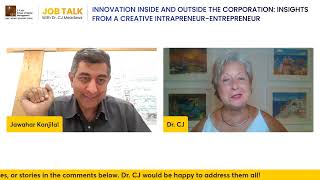
Jawahar Kanjilal, who pioneered digital music licensing and 3G streaming at Nokia, now runs Streams.ai, an AI platform that teaches salespeople through autonomous learning loops. He shares how he scaled a Life Tools platform to 125 million users across emerging markets, and why failures teach more than successes.
Chapters
Hello and welcome to Job Talk with SP Jain School of Global Management. I'm Dr. Cj Meadows, your host, and we're broadcasting from the Corporate Creativity Department at SP Jain Singapore campus. This is your chance to ask questions about your job, work, careers, and life mission. So if you have a work-related question or problem, on any topic. Doesn't have to be today's theme. Just type it into the LinkedIn comments field and our secret moderator will pass it to us. We'll either help you solve your problem or at least help you laugh and know you're not alone. My guest today is Jawahar Kanjilal, mobile technology pioneer from Nokia, founder and CEO of Streams.ai, intrapreneur, entrepreneur, and behavioral architect. That's something I want to hear more about. Our theme for the day is innovation inside and outside the corporation, insights from a creative intrapreneur entrepreneur. Thank you so much for joining us today, Jawahar.
Thank you very much for this opportunity, Cj Meadows. It's always a delight speaking with you.
So to start off with you, you know, we were flashing up some of the information as people were waiting to log in, but for anybody who's just logged in right now, can you share with us some of the amazing things you did at Nokia? And I will probably follow on to what you say because I'm blown away by the things you did.
Thank you. I mean, for that, I'll have to take you into the previous century.
Take us into any century you want. Time travel is like my thing, past, forward, both good.
Okay, cool. So yeah, I was at the right time, right place with a fair amount of curiosity and a good amount of autonomy that Nokia offered in the environment. And I was lucky enough to be able to do what I did. So, you know, the world's first digital music deal ever. In 1999, legally, was architected and signed by Nokia. It was me who drove that at that point in time.
And that was Nokia and Sony, right?
That was Nokia and Sony Music.
An unlikely partnership, like, wow.
Well, Nokia and Sony Music, and it was in a small way it was done in India. But then it, you know, it became a global precedence for what followed because this predated— if people on this podcast are able to relate to Kazaa and Napster, it predated that. So basically it was literally laying the foundations for what is supposed to come. I was involved in the first phone that was translated into the Hindi language way back, and I A little bit of a trivia there. The first phone that came with a Hindi language interface was in 1999. So early in the day.
So now 1.3 billion people on the planet can have a phone in Hindi.
Well, it was, it was at that point in time, a few hundred thousand people. So it was quite early in the day.
Yes, we can start with 100,000, 200,000, no problem.
To that, right?
Yeah.
So then it started making sense, but it was early enough. And I have been involved with, you know, the first instances of a phone printing directly into a printer. Those days there was, I mean, photo sharing and 3G. This predated the 3G networks, etc. With the first 3G networks, I was behind the first in Asia Pacific, the first streaming services, video streaming services. I was involved with a lot of experiments like interactive equity between broadcast radio and the mobile phone. In fact, I have a few patents around there. I was also involved around broadcast television onto your mobile device and galvanizing the ecosystem around Asia Pacific for it. So a lot of firsts.
And speaking of patents, there's the one that got away that Nokia did not want to do. Had something to do with time and date stamps?
Very good, you remember it, Cj. Thank you. So it was, it was a very early days and nobody had remembered, you know, I was just toying around with the first camera phone and I said, if I'm, why not, if I'm just taking pictures, just like any other camera would have the time and date stamp, why don't I get the location stamp on the picture itself, you know, in a broad location basis.. So at that point in time, GPS and assisted GPS and Maps, etc., were not at all in anyone's realm. I'm taking you close to 2002, 2003, right? 2002, 2003, that was time period. And it was beyond people's imagination that what it could turn out to be today. So I'm, you know, amongst many other patent and creative filings, I had applied for it, but Filing for a patent costs too much. So I was said by the internal people within Nokia, and nobody will use it, let it be.
No, nobody wants that.
Yeah, nobody wants that. So imagine how valuable it would be today. Anyway, uh, so my last assignment in Nokia, uh, was, uh, as a global head for emerging market services, in which, during which time I created a platform, uh, which to date is referred to as an example of connecting the bottom of the pyramid. At that point in time, I'm talking taking you back again more than a decade ago, 2009 to 2013. And in that period of time, we managed to scale to 125 million users across the world. When I say across the world, it was actually 4 countries: India, China, Indonesia, and Nigeria. And this platform was delivering agri-advisory to farmers. It was delivering education, learning English, education, local curriculum from education tips to students to health tips to microfinance advisory, you know, financial literacy kind of stuff. So all that you hear and see of today, health tech, ag tech, ed tech, had its roots in that platform. It was called Life Tools. People on the podcast could later on go and— they'll Google it— Google search, right? So that's what I did at Nokia, and as an entrepreneur, because I was always living life on the edge.
And Life Tools, was that just kind of one of those leading-edge things that not very many people found useful?
Well, a lot of people found useful, 125 million of them, but not— they were not the target audience that we are talking to on this podcast, or not in our social milieu. They were, they were farmers, they were people in the rural areas, they were people who didn't have access to education, you know, the right resources, I would say. So the phone became the life tool. So for instance, it was aptly named that way. And it turned out to deliver the same kind of goods.
So if anybody here, if anybody here wants to start up an offering that goes pretty quickly to 125 million people, you're the guy who, one of the guys who made that happen, one of the rare ones.
Well, one of the rare ones, but it took a lot of toil and effort. And as usual, I always say it's like the tip of the iceberg. You see only what you can see, but you don't see the sweat and toil that goes underneath and the time it takes. You know, success is a long-drawn effort. So nobody should even believe that, you know, success is a matter of a snap of a finger and it just happens. You need to put in effort and toil, and you need to be on that journey. And that really characterizes Anyone who is an intrapreneur or an entrepreneur.
So, so, so, you sounds like you believe very much in overnight successes after you've been on a 10, 20-year journey and toiled and toiled and toiled, right?
So, so usually when you are successful, people are— you, you are, you know, whatever is the iceberg above the surface, that's, that's visible. Visible, but you don't see the struggles that one goes through. But yes, there are.
Now, especially for our corporate listeners, people who are inside corporations saying, oh my God, they don't want to do anything new. How did you do so many new, really super leading-edge things inside a big company? How would anybody do that?
Well, a strong conviction and belief in what you see and what you believe, right? And then being able to articulate that. But one of the most important things here is stakeholder management. And how do you align teams? How do you align people? How do you ensure that what you are going out there with helps them and their objectives? So more often than not, it's always about me, me, me, and then you fail. Because you're just looking at yourself. But life is not that. Life is an interdependent maze, and you have so many things that you're not even conscious of that are aiding you or pulling you down. So how do you, how do you manage that and help that? And how do you ensure that you have effective stakeholder management? That is key. So obviously, you know, you have to put up a fight where you have to put up a fight.. But more often than not, you have to spend time to understand what the other person is thinking, what are their objectives. Because, you know, one thing is for sure, you never doubt the intent of a person's starting, right? So given, given, given everything equal, everyone is working for a corporation, they are doing their jobs, they are doing their jobs from their perspective, whether it be a narrow perspective or a wide perspective depending on where the is, but they are doing their job from their perspective. So it's also about understanding the other person's point of view and being able to get them to see your point of view, right? Critically, that is stakeholder management at the end of the day, and how you create a win-win.
You know, we hear so much about leadership, empathy in leadership, and what you're describing is cognitive empathy. So apparently, I, I was so thrilled some time ago to read that there's 3 types of empathy: cognitive, affective, and active. Active, you're going to go out and do something for somebody else. You're actually going to go out and help and make it happen. You certainly did that. Emotional empathy is what most people think of. I feel what you're feeling. We're sharing an experience. I can really feel it. But what you're saying is super, super important, is the Cognitive empathy, I can understand this situation from your point of view, not just mine. And if you can understand from the customer's point of view, and your partner's point of view, and your manager's point of view, and your team's point of view, then you can bring everybody together and say, look, I understand what you're all going through. But here's how we come together.
It takes a lot of energy, Cj Meadows. Yeah. Believe you me, right. And that's where people fail, and it takes a lot of patience. But you've got to have that right mindset that you are aligning the stars, literally, literally. You're pulling the constellation together. I'm making it visual for people, right? I mean, yeah, moving these heavenly bodies with large departments, large egos, large momentum is not easy. But you are doing that in a large organization. Unless and until you build that into a constellation Yeah, the divine forces won't work.
You gotta make constellations, yeah, and then you can make things happen. What, what were some of the difficult stars that you had to deal with? And how do you deal with some of these? You just mentioned big egos, for example. I think we all come across that.
Yes, yes, yes. So once again, uh, you know, big egos, uh, can be there. You can counter them. Provided, you know, how you get perceived. So it's very important how you reflect your energies outwardly, and for that you have to be very genuine. And if you're genuinely in pursuit of an objective, of a task which is in the betterment of a company, which is in the betterment of, you know, there's no personal motivation, no personal—
it's not personal now. You're there's an objective for the company or the customer, you know, let's focus on that.
Yes, there's a higher objective than you, and there's a higher objective than the individual that you're talking to, right? Then you rise above everyone's ego. And that's the key aspect. But you have to be very genuine. And you have to be— you have to believe in yourself, right? You can't just have a facelift. It can be easily You're not going to fix it. You really have to believe it. And you have to really be genuine in your walking the talk.
So now it sounds like you got into a position after a while of being a creative, forward-thinking guy. You got into a position in which you're supposed to innovate. How did you start your career journey and get yourself into that kind of a position?
Well, there was never one trigger that I was supposed to start innovating. You know, I've always had the— I've never feared an outcome. So, so, so—
That was catastrophe, failure?
I've never feared failure. I've never feared a catastrophe. I've never feared an outcome. That it could be untoward towards you, right? As long as you give your best and as long as you ensure that you are doing it for the right reasons, things will fall in place. But you've got to be super intelligent and observant on capturing signals and aligning yourselves, aligning the forces, aligning the stars, as I say, and being able to, uh, drive that. Now, all this may be kind of very esoteric and subjective to many people, and they will say, um, where is the meat? Where is the example? Um, but when you are a few years into corporate life, obviously, uh, people who are, uh, will, uh, will relate to that. Now, this is a mindset, uh, and the mindset is of whatever you have been dished out with, whatever you've been served with, whatever cards you hold in your hand, right? What what best can you do with it? If you are in that mindset, you are already in a resourceful mindset. You're already looking at what I have and what to make best out of it, right? Rather than waiting for some, you know, a monsoon shower that will shower me with funds or that will shower me with things. And so you always start there. If you start there, you know, that's where you can start. So it doesn't restrict you from starting to think at least.
So you're not coming up with some big vision and you can't start because you don't have the resources. So you just— nothing happens.
No, no, you must have a big vision.
You must have something. So have a big vision. Okay, so have a big vision, but start with what you've got.
Yes, start with what you have and then figure out the steps from there which lead to that big vision into the horizon where you've got, right? And so the part about don't fear what you'll face from that starting point till the point that you see in the horizon, there's a large open space, anything can happen, right? But you keep walking that path. And that's where in that field of unknown is where you need to be super agile, super observant. Super connecting the dots constantly and seeing what best is charting your course. Yeah, so predominantly that's what has happened as long as the vision was there on what to make and the environment. I was very fortunate, Scandinavian companies are a delight to work with, no politics, if you show initiative, they enable you, teams align very easily. So that, that was a delight. It was a, it was an organized, large organization support that one, one cannot ignore, right? So it's not about oneself, but it is about the environment and how best you make use of that environment.
Okay, and then what about your training going into Nokia? Did you, did you go there straight after MBA or undergrad telecom engineer? What, how, what did you train as?
No, I'm a mechanical engineer, and I worked for a year in a design office, machine tool design, hardcore engineering, mechanical engineering. Then did my MBA and then worked for Tata Motors, uh, then worked for, for 2 years for, worked for, uh, Max Touch, which is these days Vodafone Idea. Max Touch used to be— this was like 1995 to '97. And then '97 onwards, I joined Nokia in India till 2000. And then from the end of 2000 till 2013, I was in Singapore in Nokia, in which I did myriad of roles, including heading the region for all mobile services. And my last assignment, as I said, I was based in Singapore, but my last assignment was a global assignment, being the head of emerging markets.
Which is unusual. So often, if you've got a multinational corporation, if it's headquartered in the U.S., all of the big thinking, they want to happen there. And all the global roles are over there. Or Scandinavia. All the lead roles are there. But you had a global role in Singapore. Is— was that—
I had, uh, I had my team scattered all over the world, and, uh, I had a fair degree of travel, uh, to Europe. And that was, uh, stakeholder management in headquarters. But primarily my teams were in India, China— easy from Singapore— Indonesia, again easy from Singapore. And, uh, Nigeria and Kenya.
So again, so again, you found a company that was a really good fit for you with that, that Scandinavian meritocracy. And yes, you can have a global role in Asia and all that. So what, what on earth possessed you to move from corporate life to entrepreneurship?
Well, when I when I was helming Life Tools, created Life Tools, it had reached 125 million users, and then Nokia sold its mobile phone business to Microsoft. Um, uh, this, this setup had to be, uh, shut down, right? And because it was, it was not a smartphone, uh, you know, unit. It was, it was serving the bottom of the pyramid, as I said, bottom of the connectivity pyramid. Limit, I should say, at that point in time, feature phone audience. And I felt unfulfilled. I felt that 125 million users, that's something that, you know, very few get to build that scale. And clearly there was something there beyond Life Tools. And I said, let me give it a shot myself and see where I can take the next step. So that's, that's what prompted me to join, and that's what prompted me to found Streams.
So now, did corporate intrapreneurship perfectly position you and train you up to be an entrepreneur, or were there still new skills that you had to learn?
Um, Uh, Cj Meadows, I would like to ensure that people actually catch the word that you used here, which is very important. See, a corporate role does not, or may not, prepare you for entrepreneurship, but a corporate intrapreneurship role might prepare you for your role, right? Because an intrapreneurship is, again, as I said, right, you you're resource-starved always, and you do a lot of things yourself. And you stitch the first deals yourself, you get the first few customers yourself, you are writing the first specification yourself, you are brainstorming with the engineers and your product team yourself, you are going and evangelizing yourself, you are managing a cost and a budget yourself. There's a lot of hands-on stuff that you do, you know, dotting the—
you're not just watching your team do it and keep track of what other people do. Right, exactly. You're really doing— you're doing the job, you're doing the content, right?
So you are in the middle of the swamp. You're not just getting hands dirty, but you are knee-deep or maybe waist-deep in it with your team, right? You're doing it. Now, if you're doing it, then you're well prepared for entrepreneurship. Because when you are out of your big corporate organization and the label, you've got to find a way, the ways of the world yourself. And you should be able to know, and you should not have left doing this 20 years back that now you cannot do it or you cannot get yourself to do it. Most people even face that block mentally, that I cannot get myself to do it, right? No, no, then you're not fit for entrepreneurship. So yes, so being an intrapreneur, having done those kind of things, being in the swamp yourself prepares you for entrepreneurship to an extent, I would say, because each time you hear, you see, there is always something new and there's always something else that you you know, what you didn't know and you've got to conquer.
You just mentioned a label and I thought to myself, oh, brand. And of course, as an entrepreneur, you're not going to have the same resources as Nokia ready at hand. How do you handle that very different environment where you've got no brand, no resources, and certain other nos after having been in a, like, an entrepreneur in a Nokia?
Well, you end up building a lot of credibility, you end up building a good network of people, you end up knowing what you need to do and what you need to get to and how to do it. So it's not always in the cold that you are. So your resources turn out to be these intangibles, right? And, uh, and that's what your starting point is. And if that's your starting point, then you go about creating, building, showing proof of concepts, building on further, getting, getting, um, you know, once again, the stakeholdership is very important here. You cannot forget the fact that your customers, your investors, your employees are all stakeholders, Right? Yes. So how do you manage stakeholders? At that point in time, it was someone in a large organization. It's always like me versus you, my agenda versus your agenda, and how you, how you align stakeholders.
And who's going to get the budget? Are you going to get the bigger share? Am I going to get the bigger share?
Right. And so therefore, those are our players. There are constant pulls and pushes on those counts. But as an entrepreneur, stakeholder management is also key and important. So when you start off life, you start off life on a journey with what you have, and many of these are intangibles. If you've spent a fair amount of time doing what you did and it's not an absolute new area, so you also have a perspective on what you want to solve and how you want to of it, right? Um, yeah, basically, uh, basically that's what it is. The big difference here is from mindset point of view, uh, or rather not mindset, bank balance point of view, it's a different story. At that point in time, you keep getting your salary. As an intrapreneur, as an entrepreneur, you've not just got to manage yours but, uh, ensure that everyone who's with is, uh, you know, is you're fending for them as well.
Yeah, yeah.
So that's a big difference.
And your employees are going to get paid before you do. You may get nothing right now, you'll get something later. But before we go on to the next question, I want to remind everybody to please don't be shy. Please ask Jawahar any kind of a job, career, life mission related question. Draw on his experience. He's got wonderful experience. Before I go on to another question, it's time for a fun fact. We always do this, Joar, as, as part of the show. In keeping with the need for corporate creativity, here's something from the totally awesome book of crazy stories by Bill O'Neill. What company manufactures more tires each year than anyone else? Somebody who's super creative, I think, will think of something out of the box here.
More tires.
Here it is. What company manufactures more tires each year than anyone else? Answer: LEGO. Ah, see, your eyebrows went up. Yes, everyone first of all thinks about the tire industry and the auto industry, but no, no, no, no, no, we had a lot more tires being made by toy companies. So with that, uh, little foray into creativity, I'm gonna ask about your creative title. Behavioral architect? Seriously? What is that?
You know, I've been fortunate to have been able to build services at scale. And in my experience doing Life Tools, I could see transformation at scale. So for example, you know, when we built agriculture information services. You would imagine that you build a service, deliver information, and people would start believing. No, they don't. So they, they— so they will, uh, start, uh, seeing your service, validating it with their existing sources for about 2 to 3 weeks, and only after they get the confidence, they start trusting it. Fully, then they trust it fully, right? So you've switched their usage pattern into something else. Then there were— I'll give a few insights which are, you know, non-obvious insights. For example, so most of the time we were told, go ahead, make a voice service. Who will read I'm taking you back in time, right? 2009, very early days, no smartphones, no WhatsApp, no Facebook. Taking you back into the hinterlands in China, India, Malaysia, etc. Imagine that, right? And we city bumpkins, you know, you get advice dished out by your peers and your friends. This is who the hell will read all this? He says, no, no, but you guys wait, there is a reason to actually send written material rather than a phone. Okay, so a phone, rather than calling them up and saying today's market price is whatever, or you plant your crops in this way or that way, etc. Imagine what if I'm not in a position to receive that call, then the advice is gone. First point. Second point is if I have something written It is reference. Yes, I can show to someone else who is challenging me and trying to get a better price off me. I says, no, no, the price is this, and this is what it is, right? So, so, so a few of these insights then started triggering a lot more interest in me in trying to see how you can manage transformations at scale, influence positively behaviors at scale. And, uh, we, uh, we started at that point in time with sequencing messages in a particular way to be able to drive people's attention and then assimilation, right? So we disseminated information in a particular way, in a particular instructional methodology, to ensure that people understood and assimilated that very, very well, and that caused behavior changes, right? So, so that, that really inspired me into a lot more thinking and trying and instilling that thought process and observation of human behavior, observation and reading up on science, scientific principles, behavioral sciences, and building a lot more of capabilities capabilities, functionalities into the services that we deliver, right? From a positive perspective, I mean, human brain— children learn differently than adults. When you're talking about skilling, adults obviously will learn when they need to, and when they, when they need to, that's the point when you've got to actually contextually deliver the right information. You can't deliver something totally different, right? So you've got to be contextually very, very precise at that point in time to be able to deliver. And if you've done that, then a light bulb moment happens, but people forget. So you've got to repeat and refresh and remind them over a period of time very, very creatively, right? Because if you say the same thing, obviously there's fatigue. Fatigue. So how do you ensure that there's no fatigue but there's still intake input and you are refreshing whatever has now slipped from the fore of the mind to the back of the mind, but before it drops off you bring it back by ensuring, right? So, so a lot of— there are scientific theories to do this, uh, but how do you put all these into practice in a product, in a service?
Like Streams.ai?
Yes, like Streams.ai. Streams.ai actually has a lot of behavioral science-based small, you know, you won't even notice them, but they actually aid a lot of capability building, reminding, reinforcing how people assimilate knowledge, remember, And that could make all the difference because it's not just an intelligence service, it's a service that has an impact because it changes people's actual behavior. Well, what we— absolutely. So what we do is, uh, we ensure that, uh, you know, your knowledge levels are at a particular point. When your knowledge levels are high, your confidence is high. When your confidence is high, you you can stand up and talk about it much more. So imagine a salesperson being able to pitch a higher value product rather than something that doesn't need so much explanation and sells on price, right? But for a company, you need the higher end product because it's a higher margin product, etc. But you need to also understand the customers, the end users' psyche.
It's harder to sell— more intelligent salesperson.
Right. So you create a more intelligent salesperson, but not just intelligent, more confident salesperson. And more confident salesperson will then start seeing better results. And then that gets reinforced, and he does that better and more, right? So it's, it's that loop that you need to actually invigorate. It's a loop that you need to initiate. And, and there are many of those loops in there that create the right behaviors.
That sounds like a learning loop. And we do have a question from the audience. Um, how is— how are AI and ML different? Artificial intelligence and machine learning.
Well, I'm not an expert in AI and I'm not an expert in ML, but they are different. Uh, machine learning is basically you feed a lot of data, uh, and, and the— and, and, uh, the patterns are recognized based on what data is flowing through the system. And the algorithm is dynamically shaping up, right? So both AI and ML, they cannot, can never be 100%. So there's always a probability score to it. You always start low and over a period of time you improve, increase. But Yeah, so, so in concept, that's what it is. ML is more about data, and ML is more about— AI also about data. ML is more about flowing through stream of data, and the algorithm is learning itself, self-learning and refining and being able and delivering it much more.
And, and so artificial intelligence is based on these various algorithms, algorithms as our own thinking is, and you build the algorithms either by programming them in or by feeding in data and letting machine learning develop the algorithms itself. So with ML, your AI gets more I and more I and more I, smarter, smarter, smarter. But it sounds like what you're really thinking about is not just the machine learning, but the human learning when you compare a human and technology. So human intelligence plus artificial intelligence, and how do you manage both learning loops to keep the synergy going and keep them growing in performance. So is that what most of what Streams is doing? Is it mainly sales information and technique and tracking of sales activity?
Well, when you are a startup, you've got to choose your area of expertise and narrow it down sharply because every function, every functionality has its own nuances, right? So every vertical has its own nuances. And then even within an industry, you'll have super, super specialization. So yes, today we are looking at enabling salespeople for enterprises that deploy armies of them. And these could be their own people who manage further channels and, you know, third-party channel partners. The challenge for the company has always been to ensure how does the frontline, the person who's far removed from the headquarters, is able to understand and get all the resources resources, material, is also able to speak correctly and stand up confidently in every customer interaction. And that's the key. So this is not possible by any other means other than use of technology. So what we do is imagine this, that from the mothership, the headquarters, you have umbilical cords going out to tens of thousands of people. And through these umbilical cords, it is information that is drip-fed. Now I'm just helping you visualize this, but basically it is from this, uh, the individuals, uh, use a mobile app, and this mobile app is capturing a lot of signals about that individual through, through their experience on the app, through various assessments on the app, to know what they know and know what they don't know, uh, and know what they've forgotten. The important part, right? So they may have known something sometime back, but now they may have forgotten because people forget. So how do you ensure that people do not forget, or just before they are about to forget, how do you ensure you brush them up? And that's what readiness is all about. How do you ensure, uh, that you clearly let people know what they need to to be able to stay current, to be able to stay in the knowledge. Because in case you forget something, the human brain will plug misinformation in that gap, right? And this is what the human brain does. And so basically, and then that becomes your spiel. So over a period of time, it's like what you've learned And what you are delivering over a period of time, if there's no refresh, can be different.
And you're giving people the wrong information, then you've got unhappy customers and problems.
So how do you, how do you keep, how do you always in a continuous loop try and keep people current and knowledgeable and confident, right? And speaking correctly. And the company is knowing who's not and being able to take action, etc.. But the primary thing is it's an autonomous loop. It's an autonomous learning loop that the AI is delivering. So it's assessing, it's recommending, it's analyzing, it's assessing, analyzing, recommending, etc. And it's motivating the person to be able to do it. At the end of the day, it's a human. So, you know, they'll be motivated by X amount of— people get motivated differently. Some people for loss avoidance, some people for wanting to achieve something, some other people for recognition. Depends on who you are, where you are, what your personal motivations are. And what drives you will be different in a cohort. So then how do you ensure that you are giving the right nudges, right messages to the right people to be more effective for them to be able to take action, right? So all these—
so the human and the AI, every time a human partners with the system, there's a different interaction, a very unique partnership. That's beautiful. Now, we are— speaking of spiels— we're running out of time for our spiel, but I have one pretty important question for you. What advice would you give to young professionals based on your own career journey?
Well, don't take life too be, uh, you don't assume that things will come your way automatically. Uh, you've got to strive for it, and you've got to, you've got to know what you want to do. But you don't have to be in a hurry to it. You, you, you, you set yourself up, uh, the first few years in your own discovery, um, you know, to discover what you like, what you are good at, what you would love keep doing And that's important because to be able to be an expert, you need to be able to do it and build your expertise, for which you need energy. And for that energy, you need to love doing what you do, right? So think about this in your first discovery phase of a few years. Try and do as much as you can at the edges, right? So at the edges rather than mainstream, right? So at the edges is where you have the risk of failure, you have the risk of sudden exponential growth. You find your edge, literally. And once you find your edge, you know, life is there for you.
And it makes perfect sense because when you're selling a product, Well, same as every other product, that's commodity, and you're just going to compete on price, and it's going to be a hard, a hard life. But if you have something that's niche and leading edge or on the edge, then it's a unique product and you can sell it sometimes at almost any price, and that's a good business to be in.
And you are your own product. You are your own product. You be a good product manager of your own self. Beautiful.
Keep learning. Product manage your own self. And if you have any desire to sell yourself better, then have a look at streams.ai. Well, it's time for a puzzler. I get these from Patrick King's book, Learn to Think Using Riddles, Brainteasers, and Wordplay. Last time, the puzzler was, what 5-letter word becomes shorter when you add 2 letters to it? And the correct answer from Shivapriya Ghanti is short. You add er and it becomes shorter. Okay, today I thought I'd give you this one. A man takes his car to a hotel and the moment he arrives he's declared bankrupt. Why? Send your answer to this week's challenge to jobtalk@spjane.org. Well, it's happened again. You have squandered another perfectly good hour listening to Job Talk. Thank you so much, Jawahar Khanjilal, and I'm not going to say we'll see you next week because we've got 2 minutes for any sort of thing that comes into your head that was the most surprising? He just— he doesn't know I'm going to ask this. Something that was the most surprising insight of your career, surprising insight, or a real pivot moment.
I think the pivot moment is when you realize that, you know, you are always built on what doesn't work, the knowledge of what doesn't work, because that's easy to get. So when— what doesn't work is when you fail, you know why things failed. But when things succeed, you cannot pinpoint on one singular thing of why it succeeded. It's actually coming together of a perfect storm condition, right? And the earlier you realize that, the humbler you start feeling that success is not— you know, you try your best, but it's not always in your hands.
Wow. So You learn more easily from your failures. It's tough to learn from those successes, but try and understand that perfect storm and be humble. That's beautiful. Thank you everyone, and thank you so much, Jawahar. We will see you all next week— ah, sorry, next month. Bye for now.
Bye-bye.
More from Dr.



Leading Innovation for the Corporate Business Through Impact | CSI Insights Ep. 7

AI Transformation: Is the Consulting Career Model Breaking Down? | Dr. C.J. Meadows | S1E5


CIO Leadership Live ASEAN with Dr CJ Meadows, S P Jain School of Global Management


Usha International - Tiger Center Sewing Center 2025 - Now a Learning-and-Production Center


