JobTalk with Dr CJ & Peta Latimer
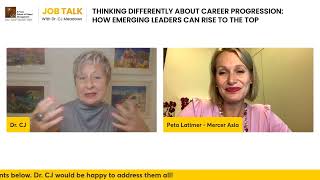
Peta Latimer, President Asia & CEO Singapore at Mercer, talks career success with Dr. CJ Meadows. Employers and employees disagree on who drives development. Latimer shares five strategies for rapid acceleration: breadth of skills, mastering performance and exposure, diverse networks, self-belief, and deep self-reflection.
Chapters
Hello and welcome to Job Talk with SP Jain School of Global Management. I'm Dr. Cj Meadows, your host, and we're broadcasting from the Career Progression Department at SP Jain Singapore campus. This is your chance to ask questions about your job, work, career, life mission. So if you have a work-related question or problem on any topic, doesn't have to be today's theme, just type it in the chat and our secret moderator will pass it to us. We'll either help you solve your problem or at least help you laugh and know you're not alone. First, time for some did you knows, notable news, to set the stage for today's talk. Okay, from Forbes article, "Who's in Charge of Career Planning? You." An article actually from way back in 2014 and research from University of Phoenix. 74% of employees say employers should provide professional development training. 71% say they should— the employer should identify job opportunities and career paths. And 68% say the employer should provide career advancement mentoring. Now, let's look at the flip side. Most managers believe employees must take responsibility for their career development. 98% say workers should continually update and improve their own skills.
85% say employees should identify job opportunities and career paths to Does that sound familiar? Just the flip.
And 80% of managers say they should be responsible for build— employees should be responsible for building their job hunting and career planning skills. Yikes. Very big mismatch. My guest today is Peter Latimer, President Asia and CEO Singapore at Mercer. Our theme for today is Thinking Differently About Career Progression: How Emerging Leaders Can Rise to the Top. Thank you so much for being with us, Peter.
Oh, it's my pleasure. Thank you, Dr. Cj Meadows.
So has career responsibility changed since 2014? And what's your take on all this?
Well, it's fascinating actually looking at those statistics because I did my master's of organizational behavior in 2011. And my dissertation title was on the boundarylessness of career success. And so actually, even from back then, a lot of the research was talking about who has accountability, and as organizations move into more ecosystem structures, does that accountability shift? So seeing that 2014 data that you just shared, and I'm trying to think about whether I'm responding as a executive now.
Yeah, you're an employer and an employee.
Correct. You know, I think it hasn't changed since 2014, and in fact, I think probably the divide between what employers' expectations are and what employee expectation is in this topic has gotten more extreme. It's probably closer to 90/10 and reverse in terms of what you've seen, certainly the conversations that are taking place in the market.
So one of the, one of the things that you wanted to talk about today was the employee versus the employer's role in career progression. What's— as an employee, what do you feel?
Well, I think it— firstly, before you talk about career progression, you need to talk about career success.
Oh, and what is that?
And what is that, right? Because we don't— we're not just progressing for the sake of progressing. You're, you're typically moving in a direction. And so therefore that direction and what career success looks like, I think, is very, very individual. And this is where I think that the lean is towards the employees needing to deeply understand that they have agency in both defining what career success means for them and then equally pursuing a pathway in the corporations that they choose to work for that gets them there. And so I think we don't often talk about that type of, that side of the conversation because so many people are just looking at the next step up the rung of the ladder versus where do I actually want to go. And if you deeply understand that, right, you know, things like milestones, positions, job titles, how much money you need, what your financial goals are, who you actually want to work for, how hard you want to work, when you want to pull what lever in your career, when you want to take time out. Those are all decisions that you make as an employee that ultimately lead to whether you're progressing and achieving the levels of success that you want. And each of us have a different level of success that we would define for ourselves.
What about multiple careers? And, you know, career— do we have to progress? What if you just like what you do?
Lots of people like what they do. I think the point is, is are people happy also earning the same income if they're not progressing? And if you're meeting your financial needs based on the income you're earning and you're getting a small incremental lift, not necessarily relative to inflation because that's not the responsibility of an organization, but if if you can continue to afford what you want to do, then for many people, that's perfectly acceptable to stay in that place. And it's, it's good to know that, in fact, right? And it's good to be open about that, I think, to the employer that you work for so that the right types of investments and support are coming to you versus other employees that might want something different.
Absolutely. So in answer to that question they always ask you, so where do you want to be in 5 years? It's okay to say, well, yeah, here's good.
Yeah, I think so. But it's equally, it's difficult, I think, as an employer, employee to say yes here, but I still expect 10% pay rise every single year. And I don't want to take on more work. And at the end of the day, if you do have different financial ambitions and if you do need to grow, or if you have a change of circumstance and you need to change your financial position, that doesn't just happen because you're good at the job that you do today. It happens because you take on more responsibility.
You're creating more value for the company. So of course they can share that with you.
Correct.
Yeah, that makes sense. And then, you know, a lot of people with the Great Resignation, a lot of people just quit because they're bored. They want to do something else. Are employers— do you think employers should give people a chance to just make a total shift into something totally new rather than lose the employee.
I love that as well. Again, it's a, it's an employment contract. And when that contract doesn't suit either party, as long as it's a fair and open conversation and respectful conversation, I don't see why you would ever want to keep people that didn't want to stay with you. And, you know, the pandemic created, you know, for me, the Great Resignation wasn't a revolt against organizations. It was an opportunity to step back and reevaluate what you actually wanted out of life and ask yourselves all those questions about what does career success really mean to you. And I think a lot of people that were working themselves up without active management through that, you know, career ladder got to the point where they realized that they didn't know why they were doing what they were doing. And so Actually stepping out of that environment gives you a different perspective. We've seen, by the way, an equal number of people return to the workplace. And we had a tremendous amount, almost 60% of our employees at Mercer here in Singapore were rebound employees that had left and then decided to come back to the organization once they saw that the grass was not greener on the other side. But that's an important experience for people to have, and I think organizations should be flexible to allow that.
As a matter of fact, I did the same with Accenture. We call them double dippers. Some people are even triple dippers. They go, they come back. And Accenture always treated the former employees like alumni. And being a consulting firm, of course, if they go into corporations, hey, hire us. You know we're good. Yeah.
And all the research shows that rebound employees or boomerang employees are actually the most motivated and highest producers. So again, a lot of the actual studies do demonstrate that because they come in with a very different understanding and a reality, a sense of reality that a lot of new people don't have. And you can get to production very, very quickly when you come back. You also know the system, you know how to navigate. Yes. Um, so speed of success and career progression tends to be faster.
Pretty cool. What about your own career progression? Would you be willing to share some of that with us?
Yeah, it's interesting actually. So I've just taken on a new role in Mercer, so looking after the zone now, 11 different markets. And Mercer is part of a bigger organization called Marsh McLennan. So we've got a big insurance business, Marsh, a big reinsurance business, Guy Carpenter, the biggest HR consultancy provider, Mercer, and then we've also got Oliver Wyman, the big strategy firm. Um, and so in my new role, I have a far closer working relationship with those, you know, with all four businesses. And what's interesting is looking at different companies who prioritizes what. So a lot of my fellow leaders actually have all been in the firm for 30-plus years. Um, and by the way, there's tremendous history and experience that comes with that, actually. Now, I'm the complete opposite, and I've just come back from a North Asia tour. And, you know, there was a lot of people with a lot of tenure and, you know, this idea of I need to stay in an organization for a long time and look, because that's what my leaders are. And my answer was actually, I'm the complete reverse. I've bounced around so fast in my entire career. I've been an equities analyst. I've worked in fast-moving consumer goods. In both training, biscuit sales, point of sale production, trade marketing. I've worked as a psychologist, I've done leadership assessment, I've worked in a technology firm at IBM, I'm doing work, I was a partner at KPMG running their people and advisory practice, and then moved into more operational and commercial leadership when I joined Mercer as a CEO. So, you know, I think for me my career trajectory has been very different and has really been— I think it's because, one, I enjoy learning a lot, and two, I've always kind of considered my career as a game of skill acquisition. So what do I want to learn next? And, you know, I looked ahead. I've been very lucky in my life to have access and exposure to a lot of senior leaders. And when you understand that senior leaders bring breadth of experience, not just depth of technical expertise. Like, that just helped me drive this idea of, well, I kind of want to learn everything— marketing, sales, finance, P&L, new product development, new market, new territory.
So that's incredible diversity. Was it hard to take those new roles, hard to let somebody give you a chance in something you hadn't done before?
Um, it gets harder actually the more senior you get, definitely, because Again, the expectation about your ability to influence directly outcomes of an organization, much more under pressure the more senior you are. Everyone talking about 90-day plans when you join an organization. Trust me, it takes at least 12 months to understand an organization before you can put the right sorts of change mechanisms in. But, you know, so no, I've never had a challenge with people taking a chance on me. Again, if you can prove that you've got transferable skills and you've got the learning agility, most senior leaders are looking for people that bring different opinions and different skill sets into their organization. And Dr. Cj Meadows, the one big difference that this has made for me, I think, as something that I do see very different in the work that I've done, particularly with women around confidence and this imposter syndrome, is if you think about it, if I've never experienced that because every role I take, I'm taking it to learn. I'm not taking it to immediately step in and be able to be successful. And that takes the pressure off very much, and it gives yourself a little bit of grace in terms of how you approach the role. It means you take your time getting to know the organization, and you can build better alliances and relationships, um, and hopefully you can demonstrate growth and learning and pick the business up quickly, and so you get to outcome. But That's been really helpful for me. It's never been a, I'm not good enough to do this job. It's always been a, let me take an opportunity to learn this.
Oh, wow. And this is, I think, is a key thing for women leaders to learn. A lot of women, they've had to become super, super competent, and then they had to be super good at delivering and explaining what they're doing. The initiatives that they're leading. But at some point in time, when you're a leader, you have to open up and say, I don't know everything. And organizations are no longer the hierarchy, super traditionally led, where the person who knows the most is at the top and gives all the orders. We have to be open to others and say, well, I don't know who has ideas, let's co-create. Create. So have— how's been your experience as a woman leader? Have you faced any challenges of apparently not imposter syndrome, but when you're learning and you're asking those questions, do, do you ever feel that your credibility is kind of slipping away, or people start to ask questions about your confidence because you don't know this, you don't know that?
Well, I'm sure people have thought that about me along the way.
Um, you don't seem that bothered by it. No, no, don't care. We're doing good stuff.
Well, does it worry me? No. What would worry me is if I'm making the same mistake more than once, right? And, and that's been a really big leadership lesson for me as well, right? You have to give people two things. You need to give people space to grow. And no matter what your experience was of somebody 3 or 4 years ago, you can't carry that opinion through because people do grow as well. So, you know, I don't think I've had any concerns. In fact, I've— there's a lot of value sometimes of being in the minority in some of these rooms. And equally, I think it's given me a lot more perspective thinking about just the opportunities that sit out there for everybody. And so, you know, I've done a lot of work, by the way, in diversity and inclusion. I was— I led the practice for IBM for a while doing consulting work in this space, and I've run women in leadership programs for many years. And it's quite frustrating that we continue to approach this like we need to fix the women and teach them about self-control and fate, you know, you fate and self-control and belief and confidence. And, you know, I think for me, as long as you're not jumping and think you've got a skill within one, you know, it takes you a couple of times to learn a skill. I think we hold ourselves back and it's just not— the only person that's doing that is you, not the system. So I find it an awkward conversation when asked, you know, what impact have I had as a woman leader? Or had any effects for me? The answer is no. And maybe that's naive. Maybe that's naive.
Well, I wouldn't call you naive given where you are and what you're doing. But, you know, so it sounds like the approach is go ahead and be bold. Go ahead and get out there and learn stuff and pull people in to co-create, to build something together.
And like what you said, you're not going to be great at everything. That's a tough lesson when you realize that this is something that you— you know, I've definitely taken on roles that I was not suited to, but again, what a great learning experience. Okay, I'm not suited to that. Next. And so it's a slightly different frame of reference rather than getting really caught down. And maybe the difference is I've never had a very clear plan, right? Again, I know, I know what I want to achieve in life in terms of aspiration, but am I clear about exactly what role I want to be in, what grade I want to hit, and by when? No. And that has given me a lot of fluidity, I think, in making these decisions.
And you can grab opportunities if you're not stuck on your own vision, your own schedule.
Correct. And by the way, I've had a lot of people, right, because I like to move people and I always like to move people in an organization faster than when they're ready. And what's interesting, I think a lot of people will say, no, no, I need to do another year in this role. And, you know, I think again, there's a lot of trust, you know, senior leaders pick people and help them move through an organization when they've got some kind of affinity with that individual and nobody wants somebody to be not successful. And so again, it's listening to those cues and those opportunities that are in front of you because I think Too often we're busy and we've got focus and we don't look around and see what's actually happening.
Absolutely. So it's time for a fun fact. This is one of the things that we do here. A have you heard, one of the many, this is one of the many versions of Abraham Lincoln's CV. And we were just talking about, you know, you're gonna fail sometimes. Apparently he did fail quite a lot. 1832, Lost job, defeated for state legislature. 1833, failed in business. 1835, sweetheart died. 1836, nervous breakdown. 1838, defeated for speaker. Yes, it goes on. 1843, defeated for nomination for Congress. 1848, lost renomination. 1849, rejected for land officer. 1854, defeated for U.S. Senate. 1856, defeated for vice presidential nomination. 1858, again defeated for U.S. Senate. 1860, elected U.S. president and became one of the best ever. So, I mean, you probably haven't seen that many CVs like that in your roles, but what do you— would you, would you hire a person who has gone from this to that to something else and has tried new things and failed. Definitely. Yeah, yeah. You take it seriously.
For me, the question is, is what have you learned? And let's be honest, most of us learn far faster and more deeply in terms of actual behavioral change when it's happened through a mistake. Versus when it's happened through success. And so actually, I think we should celebrate failure far more. Again, the only— so I have no problem with jumpy CVs if again there's explanation and sensible reason for that. Yeah, it gets a little bit harder as you get more, as you get more senior, I must say, because again the cost to acquire is a lot higher, so people do get a bit nervous then. But, but equally, if people have— if they can actually demonstrate understanding of their failures in learning, then what an astute person. Isn't that a wonderful person to have in your organization that has self-awareness? Yeah. The only concern would be is if, again, it's the same mistake happened repeatedly, and if they've been given the same feedback throughout their entire career and haven't taken that on, like, that would be the only concerning—
that would be a problem. So, you know, and, and a lot of creative leaders do not want to see a 20-year CV where you had 1 year of experience 20 times. They want to see 20 different years of different experiences. We do have a question from Jdeep Singh. In today's connected world where physical geographies are no more— are not limitations anymore, but still organizations mostly rely on local source of hiring while building their global business. So how can individuals progress their career as global leaders? And when they're open to work anywhere in the world, and how can organizations hire from different parts of the world? What are some recommendations for employees and employers?
Yeah, it's a, it's a really good question. And of course, that's something that has been challenged with the pandemic and the way that we've been working in a more flexible manner. Um, there's a couple of things. It really depends on company strategy. So for most organizations, especially multinationals, there is a construct that sits at the center, but a view that it's kind of globally enabled, locally activated. Because for the most part, if you have clients and clients on the ground, you want to be as close to those clients as possible. So there is a reality that building relationships, deeply understanding the nuance of what's occurring in market requires people in market and face-to-face. So I'm not a fan of the heavy focus right now on remote working and work from anywhere and dial-in, um, because predominantly I've worked for US multinationals who operate this structure, and I can, I can see the benefit of this kind of local activation and local nuance. But then again, so it comes down to flexibility for employees, right? That doesn't mean you can't pick up jobs and work agile on projects that are happening across an organization. Yeah. Again, most people don't put their hand up and say that they want to do it. They're waiting to be tapped. And it's near impossible. You did the shape like this. You know, there's very few leadership positions at the top compared to the mass. And so You know, it's hard for the people at the top to know hundreds of thousands of individuals and what their motivations are. So again, this is— the employee has agency to say, I want to do this. Now, we've seen mobility really drop around the world a little bit, again, partly because of the pandemic and people really thinking about where they want to be based. Yeah. But equally changing expectations, right? People, people want a company to pay them and send them overseas on these fat packages.
No, that stopped happening many years ago.
Many years ago. Yeah. And people, and you know, unfortunately a lot because people's, people are starting later with families, etc. You know, that kind of middle-level career management tends to be when people have got families. So they're caught in this, I'm really at the time where I want to accelerate my career because I need financial growth. Yeah. Yeah, I've got a family or young kids and I can't move them. And I think that that's more the problem. So, that is very difficult for both the employer and the employee. And I think there's just a much more open conversation that needs to take place. International roles do open all the time. So, I actually set this up in China. A lot of our Chinese colleagues were asking about mobility and they really want to come out and, you know, they've been so locked down the last couple of years. And how come the firm doesn't support international mobility, or have any? And my answer was, hang on a minute, we have open job roles all the time. We always publish internally ahead of when— before it goes externally. How many of you have ever applied for a job outside of your market? And not one person put their hand up.
Oh, oh, tough.
It's very difficult to get those sort of signals to know who wants to move.
Yeah, yeah.
So I would encourage people to do this very much. Put your hand up, be flexible. A move doesn't happen exactly when you need. It's likely to happen at a time that you don't need it. Yeah, but again, a lot of organizations are very realistic about how transition can happen, what support does happen for families, etc. And again, the more open you are with your employer, the better.
Absolutely. And families can move. I mean, I, I know so many families have moved The— but you're right, the— in the early stages of your career, most people do want to go international, and then by the time they get to the middle and all the opportunities open up, they don't want to move anymore.
Yeah, yeah, yeah.
That's a problem. Reminder for everybody out there, if you have work-related question or problem, just type it in the chat and we'd love to address it. Um, and we have 3 things talked about today. Um, the next one was career as game of skills acquisition, which I think partly you've addressed. You've had a learning journey. But I really want to get to the 5 strategies for getting to the top. Everybody wants to know that. Okay, what are the 5 ways that I can get to the top? I'll do at least one.
Well, okay, I'm going to answer this in 2 ways. We had done a lot of work in the past. This is from a past organization that I'd spent some time at looking at what drives career acceleration. And it's very clear, number one, that you need breadth of skill, right? So that's, that's, that's very clear.
And most people just want to be specialists and silo up.
Yeah. Yeah. Now, so there's definitely technical career tracks, so I don't want to dismiss that. There are technical career tracks for people that with the world of technology and the high-tech firms that is definitely growing and you can get very senior in that. But, you know, when you do take on people management responsibility, you take on— that is a very different skill set because now it is no longer about your technical capability. It is about your ability to bring out technical skills of others. And everybody needs managers, you know, in, in that way to guide, coach, steer.
Develop.
Equally, if you have the opportunity to take on any kind of commercial decision-making, which lots of technical people want to be able to do because they feel like they understand, you need to develop those skills. So along the way, it's clear that you need P&L skills, you need sales skills, sales or marketing, you need to have international exposure because again, you are going to manage diverse crowds. The fastest way to do that is to be in an alternative location. You need to have been a manager of managers, right? There's a number of things if you just think about general skills that you need to gain. So that's one side, is thinking about breadth of skills. The second side is like, there's been some great studies about what actually gets you promoted between performance, image, or exposure. So how well you do, how you're seen to be doing it, and who sees you doing it. Performance, image, and exposure. And if you ask a room of people, most people say performance is what drives success. So I'll get promoted because I'm outperforming my peers. And actually, 60% of all promotion decisions hedge on exposure— who knows you and who sees you doing your performance.. And I think that that's something that we really underestimate. And over the years, people have said to me, well, exposure, that's terrible. That's just people who are going to walk around and go and make friends and manage upwards and, you know, play politics, etc., etc., etc. But again, like I said, that, you know, you don't get— job opportunities don't just come to you, right? You need to be able to know who they are. People to be able to know who you are. They need to be able to have seen you in action to have formed opinions. So therefore, the more people that you've interacted with, that you have a network with, that can say that you add some sort of value and have a formed opinion of you and your capability, the more opportunities you'll get. And we deeply underestimate this level of exposure that you need. And it's not just in the workplace, it is in your network. In the external environment as well, right? And, and again, I do worry a little bit for the way we're moving in terms of the lean on social media, because you might think you know people and you have a relationship with them, but you don't know people that would go out of their way to tap you on a shoulder for an opportunity or to mentor you in a, in a more meaningful way. So, you know, those kind of networking skills and ability to establish a much broader trust circle is very, very important that we underestimate.
Absolutely. We do actually have another question if you're ready for a question. Sanjay Gupta has said, how does one balance people or team centricity versus company centricity in a leadership role?
I think it really depends on what level leadership you're looking at. And I, like, I spent a lot of time in my most recent career, going back to basics with the likes of Ram Charan's Leadership Pipeline. So, you know, when you're a first-time people manager and you've got a very specific task that your team is doing, then your team orientation and that team culture that you're operating in is very important. As you progress and you're managing teams of managers, right, or you're managing across territory, now you're a different level. You're a steward of the firm in a very, very different way, and you have to be able to pivot throughout your career on that. And again, I think we think that leadership or cultural management or tone from the top is just kind of gifted to people, but there's a lot of work you have to do every time you step up into a new role. So Sanjay, I know that doesn't probably answer it directly because I don't think it's one or the other. I think it depends on where you are in the organization, what is the outcome you're being asked to deliver in the role that you're in, and, and how much influence you have over others. And again, the more senior you get, the reason you become a steward of the firm is because far more people see you and the shadow that you cast as a leader. Even if you're just managing your small team, more— you have more people having exposure to you, and that becomes really important. So the minute you're over-indexing on an, like, a smaller group of people, yet you cast a really wide shadow, um, that, that's not, that's not a great position to be in. And you'll find that that's where we get a lot of people stagnating, um, and, and where you start to see people separating and moving up to stronger leaders, leadership levels that are more influence-orientated, behind the scenes, etc., requiring others to you know, pulling the right components together rather than being the people leading from the front.
So, so let's get back for just a moment to 5 strategies. Forget it for rising to the top. Yeah. What are the 5 strategies?
Build meaningful connections.
Okay.
Okay. So you deeply have to understand that network and you have to have far more than a LinkedIn connection. So have meaningful connections. That are very diverse from you. You must understand this importance of performance, image, and exposure. Okay. You must have your own fate. You control it, right? Self-belief and fate control. Like, I'm going to take ownership and I've got agency for this. You have to be able to define your own career. Uh, honestly, if you do not know what you want to do and what brings you joy and what brings you success, you just won't be successful. And then the last one, again, just topping at the tail is you've got to know yourself and exactly where that endgame looks like so that you can have those conversations.
So if you add—
It's very soft. It's not hard metrics. It's soft cultural dynamics around personal reflection, personal understanding, network, community, learning agility.
Aspiration. Absolutely. So then, um, wow. So, so these are kind of big questions to be asking. What is this best done with, a coach or on your own? Do you need to go and reach out to a mentor or an ally? I've learned that mentors—
yeah.
Are inside the organization allies or outside, who knew? How do you answer those questions? Because these are tough questions.
They're tough questions. And you know, the challenge too is for the most part, most of us don't get breadth of input, right? We'll ask a couple of people and we tend to ask people like ourselves. So you'll get restrictive views. I love coaching. I think You know, again, don't wait for a company to pay for you to get coaching. It's a very meaningful investment in yourself. I've always had an executive coach when I've stepped into a different leadership level. Equally, I think none of us do the work that just says, where do I want to go this year? What are my aspirations, right? What does good look like? Who do I know? What is my stakeholder map versus And I do think—
And how often does anybody actually sit down and think?
Very rarely.
John Cleese had a most wonderful skit that he did, and he kept shooing people away. No, no, go away, go away. I'm busy. Well, what are you doing? You're looking out the window. Well, I'm thinking. I'm doing really hard work of thinking.
Now go away. Yeah. That's exactly— we get caught in the treadmill of life.
Yeah, yeah, yeah. You know, and remember John Lennon, you know, life is hap— what happens when you're making other plans? And it sounds like people— it's not that people don't plan, it sounds like you're saying people don't dream enough or reflect on key questions.
Yeah, well pointed out. I, I don't think— because plans change, right? So It, you have to have plans all go to hell. Yeah, exactly, the best plan. Yeah, but, but I think that that is the point. Dream and then deeply consider what it is that will ultimately make you happy, um, and what you need. And from there you can work your way back to a plan. And if you've got flexibility in that plan and you land up, you know, as long as you're moving closer to your dream, it doesn't matter if it's horizontal, lattice, down, up, you know, I think that's your North Star. I didn't believe this for a very long time, by the way. I thought, oh, come on, I'm just lucky. I was very lucky through some acquisitions. I was in a company that got bought 3 times over. And so when you get that, you do get a little bit lazy in terms of, well, this is nice, like I'm just taking over more. And it wasn't until again, most of us don't take this time to think about it until we're unhappy with our situation, which is also not ideal, right?
Wouldn't it? It's a little late by then, isn't it?
A little late. Yeah. And then you also— and then when you, when you're doing that, when you're unhappy in your current situation, starting to plan, actually we underestimate what our current employer can do for us. So by that stage, most people are looking out externally And again, remember, you can have a tremendous career in a company staying there 30 years, but if you are moving and learning different skills, you do different things in the company, you're not doing the same thing. Correct. And there's deep value that, again, I probably didn't appreciate when I was younger, but, but now being in an organization with a lot of more tenured people, there is deep strength that comes from understanding how things get done and knowing who to go to that you just, you just can't form those quickly. So I also think that this, the jumpy behavior, I'd love to see more people jumping internally in an organization than always jumping out. But if you're jumping out equally, I'd love to see people jumping to completely different things. I don't love when I see people jumping across all the banks or all the Big Four or all the insurers, because I do wonder, like, what are you actually seeking, right? The grass is not greener in these types of environments, but if you're jumping from banking to tech to a startup to get those different skill sets, you know, back to what we talked about before, that sort of CV jump, no issue whatsoever.
And oftentimes what I find is that people jump into a new organization, but they only get hired because they're doing exactly what they did before successfully. So sometimes a jumping CV means they haven't really gone someplace new and learned things new except a new environment. They're still doing the same thing. So final question for you. You mentioned dreams, you mentioned joy. What's your favorite way to induce dreaming and reflection in yourself? And what gives you joy?
So I'm a terrible person because I don't have a hobby on the side. That's something I always think about. But I have to say, remember, I'm a psychologist, so I'm deeply fascinated by people and change. So I think, I think I'm very lucky that I've found that I enjoy the corporate environment very much because I like learning about team dynamics and everything. So, so for me, actually, all the challenges that you typically face and frustrations in a workplace are actually very interesting. So, so I'm not always the best person to ask on that because I, I do work very much as an identity of mine, and I, and I get a lot of joy from it. But, you know, for me, it's about doing things different. So I, I will always, every normally around every 3 to 5 years within that period, depending on if I've moved roles or if I'm still in role, I, I will, I will be out for 3 months and I'll go and backpack around different locations.
You just recently went to Antarctica, didn't you?
I did, I did. And, oh my gosh, yeah, yeah. And that was, I was on 5 years at Mercer and I, you know, I wanted to go and do something completely different because it's only in a different environment for me I can only think outside the box and think differently when I've removed myself from the day-to-day. And I do that, I do that through travel, and I absolutely love it.
Yeah, I find that very good, um, travel for that as well.
And that was amazing. So if anybody has ever got it on their bucket list, I highly recommend it.
And they can probably find you on LinkedIn and ask, where'd you go? How do I connect with whoever did that trip? So it's time for a puzzler, folks, from the 125 Best Brain Teasers of All Time by Marcel Danesi. Last time we gave you this one: before they're blindfolded, 3 women are told that each one will have either a red or blue cross painted on her forehead. When the blindfolds were— are removed, each woman is then supposed to raise her hand if she sees a red cross and to figure out the color of the cross on her own head. Now here's what actually happens. The three women are blindfolded and a blue cross is drawn on each of their foreheads. The blindfolds are removed. After looking at each other, the three women do not raise their hands, of course. After a short time, one of the women says, Well, crosses are all blue. How would she figure it out? And the correct answer from no one this time is— if any woman had raised her hand, it would mean that the woman saw at least one red cross on her forehead. This did not happen, so one of the astute women said, yeah, all three are blue. And today I thought I'd give you this one. For career-enhancing creativity. What single word can be added to all of the following words to create new commonly used compound words? Now here's the words for you to add something to this, and you got to add the same something to every one of them. Jail, cage, brain, call, song? Just send your answer to this week's challenge to jobtalk@spjane.org. And remember, as Albert Einstein said, "Logic will get you from A to B. Imagination will take you everywhere." Well, it's happened again. You have squandered another a perfectly good hour listening to Job Talk. Thank you so much to our esteemed guest, Pejta Latimer. We'll see you next month. But Pejta's not going to be here next month. She's going on a very special journey. She's about to pop. Pejta's gonna have a baby. Like, we were hoping it would be during the show. That would be a first. But okay, okay, you can have a baby a little later. In a few days' time. Congratulations, we all wish you well.
Thank you very much.
Thank you everyone, see you next month.
Bye.
Bye-bye.
More from Dr.



Leading Innovation for the Corporate Business Through Impact | CSI Insights Ep. 7

AI Transformation: Is the Consulting Career Model Breaking Down? | Dr. C.J. Meadows | S1E5


CIO Leadership Live ASEAN with Dr CJ Meadows, S P Jain School of Global Management


Usha International - Tiger Center Sewing Center 2025 - Now a Learning-and-Production Center


