Passion & Practicality - How World-Leading Innovators Harness Passion to Create Value
CJ Meadows studied over 100 world-leading innovators and found that breakthroughs come from combining unrelated fields. A corporate anthropologist merged art and quantum chemistry to build network-analysis tools; a sports scientist fused physics and coaching to model Olympic diving. The pattern: build a unique workshop of the mind by pulling ideas from outside your field.
Chapters
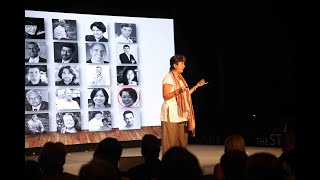
My son and I were talking one night and he said to me, "Mom, I don't know what to do." I said, "Great, clean your room." He said, "No, no, no, no, no, I was serious." I was like, "So was I." He said, "I love stop-motion filmmaking, but I'm also good at math. So should I go into film or math?" "Art or science?" I said, "So you mean, should you follow your passions or do something practical?" He said, "Yeah." And that's his stop-motion photograph up there. Not the fluffy one, the other one. So I said, "Well, maybe we could draw on some inspirations from Mom and Dad's lives. When I was younger, I had a dream." I was going to be that professional woman at the end of the day with a glass of chilled Chardonnay in one hand, looking out my condo window at the New York skyline. I would be the most glamorous professional I could imagine. I would be an accountant. Okay, it's my dream, okay? So I started with something practical, accounting, And I found my passions later in entrepreneurship, innovation, design thinking, and disruption. Dad, on the other hand, he loved the beauty of math and physics. And he started with that and took a job in finance. So if you're going to wind up doing something practical anyway, maybe it doesn't matter choosing passion or practicality. So then he said to me, "Do your kids sigh at you?" "Mom, you still didn't answer my question." And I said, "Oh, yeah, you're right. Maybe I didn't." Well, maybe we could draw inspiration from my research into world-leading innovators and how they create the unexpected, lateral innovation across domains. So my question was, why and how do they do that? And why do other people in the same circumstance not do that? So I designed a research study, qualitative research, and I flew around the world multiple times and did over 100 interviews, 30 of them with the innovators themselves and over 70 with their colleagues. Coworkers, friends, family. In the exploratory phase, I also shadowed them for a day or part of a day. In the validation phase, it was interviews only. But I also collected articles about them, by them, their TED Talks, websites, and more. I listened and learned from innovators in the arts, business, startups, science and technology, inventing, social activism, and education. And I'd like to share with you two of their stories, both rooted in science and mathematical modeling. One of them connect— one of them combined with art, the other with sports. And both with lessons for business, science, and our lives. First, meet Dr. Karen Stephenson, CEO of NetForm and corporate anthropologist. She took art and quantum chemistry in school, and her friend said to her, "What kind of a job are you going to get with that?" She said, "It's a liberal arts college. Can't I take what I want?" "Fine, fine. Take what you want." One of the interesting things they did in art class was put a painting at the head of the room, and the professor would say, "Now class, identify the painter and the year by the brush strokes." She did it 100% of the time. He'd never seen that before. She can recognize patterns. Well, she did graduate, and she did get a job. And she was at work one day on a mezzanine. And she looked down, and she saw people moving in a pattern she recognized from quantum chemistry. She said, "Wow! I have to investigate this." So she did. She went back to school and took classes and did research, drawing on anthropology, ethnology, mathematical modeling, software development, and more. Her advisor looked at her class schedule and said, "Whaaat are you taking? You need to focus." She said, "I don't understand. I'm focused like a laser beam on this one thing. I'm just drawing from multiple disciplines to do it." And she did it. She came up with social system radiology, mathematical modeling tools CJ Meadows for social network analysis and quantification. Now, she was originally told, "This is never gonna amount to anything," but she created a company anyway, and for— to map, analyze, and provide management recommendations. 35 years later, she's still at it, consulting for corporations, many of whom want to increase their innovativeness by enhancing their connectivity within and without. E-commerce activity, connected security systems, big data, which wasn't around back then. These are a couple of high-level schematics, one from the LA Philharmonic and one from the Pentagon. So CIO Magazine, called hers one of the 100 most innovative firms in the world. Malcolm Gladwell wrote about her work in The New Yorker. In fact, she created the tools to model and measure what Malcolm had popularized in "The Tipping Point." Now, one of the most engaging social systems to watch is the Olympics. Meet Dr. Kenneth Graham. Principal scientist at the New South Wales Institute of Sports. He helps the Australian Olympic teams go for the gold. Now, he loved sports and he loved science— math, physics, biochemistry, and more. By the way, I couldn't get a picture of him not moving, so that's the best I could do. Now, he was a coach before he was a, a sports scientist. So he's careful to do something a little different from the coach. While the coach is with the player on the field, he goes up to the stands to take a different perspective. While the coach works in one sport, he looks across sports for inspiration and ideas. While the coach is focused on activity with the athlete, he's focused on analysis. He goes back to the lab and makes mathematical models. One model he created for scoring the divers. Now, usually it worked quite well, but sometimes the error term was too big. He thought, "Why?" So he dug into the data and he found two patterns. One, Judges scored higher than predicted on the harder dives. Two, the athlete he was working with scored higher than predicted towards the end of the routine. Now, this was significant because most divers put the hard dive at the beginning when they're fresh and less likely to make a mistake. So he thought, what if we put the hard dive at the end? Would the athlete make extra judging points and extra performance points? The year was 2008. The city was Beijing. The athlete was Matt Mitchum. And here's how it went. Wow, that's what happy looks like. It was the top 10-meter platform dive score in Olympic history. A fusion of of great athletics and great science. So what can we learn from Karen and Kenneth? Well, Karen saw a pattern and had to investigate with mathematical modeling. Kenneth was modeling and found something to investigate and saw a pattern. Both of them drew from different disciplines to create something of value. But how? Both Karen and Kenneth love learning, and they're open to going wherever their passions take them, even if they don't belong together or have a particular use. Each one created a unique collection, a unique workshop of the mind. Karen in art and quantum chemistry, Kenneth in sports and science. Now, each of them looked through the window of that unique workshop and saw opportunities others missed. Karen was not the only person on the mezzanine that day, but she was the only one who saw a pattern and didn't ignore it. Kenneth saw something, and he didn't ignore it either, tempting though it is when the world doesn't conform to our models. And finally, they drew something together, they drew on different disciplines to put some— create something new, something of value. Karen, a methodology and an innovative company. Kenneth, Olympic gold. Are they representative of the other innovators I studied? Yes. Is this relevant for those of us who are not CEOs or Olympic scientists? Or are they all just different? Well, as I look at this portrait gallery of world-leading innovators, I see a struggling businessman who couldn't make his silk projects flourish. So he partnered with a scientist and drew together a team to bring silk protein fiber injected vaccines to millions of people worldwide outside the cold distribution chain. Imagine vaccines without refrigerators. I see a young cancer researcher who is having trouble with the dosing device on her advanced biopolymer medication device. So she used a design from the pocket watch designed in 1893. I see a father of an autistic son who created a way to diagnose autism by taking a reading from the inner ear at birth, when you can make a difference in the early childhood development years. Businessman, scientist, parent. They are just like us. But they reached outside their departments and their fields and their homes to make a difference. You know, practicality is a good thing. We should be good stewards of the talents and resources we're given. But sometimes, when we're being practical, we're poor stewards of the passions that help us leapfrog ahead and make a disruptive difference. Maybe we should be focused more on passionality. Is there something we can do, maybe even today? First, explore something outside your domain. Maybe something that's just cool or interesting or happy. Create a unique workshop of your mind. How unique an oddball are you? Is this the age of oddballs? A follow-on to the computer age of nerds. Next, look through the window of that unique workshop. Go up to the mezzanine like Karen. Go into the stands like Kenneth. Go where you don't belong and where no one sees things the way you do? Instead of learning something in order to do it, maybe you should learn something and leave it. And if no one's paying attention, maybe that's the best reason you should. And finally, are you playing in two different worlds, or can you bring them together to create something new and of value? In nuclear fusion, Two nuclei come together to make a new one and release a great deal of energy into the world. Likewise in business, the science, the arts. Two ideas, two technologies, two something that don't normally go together can come together, make something new, and release a great deal of value into the world. So, uh, I actually never did answer my son's question. But that's OK, because he's here now, in the front row. And it's his birthday. And— And maybe this could be his gift. Son, be the unique and wonderful person God created you to be. Do both, film and math. Fuse them together, maybe. Create something practical with your passions. Maybe a new algorithm for computer animation software. Or something, I don't know. I'm just an accountant. But happy birthday. I love you. And maybe for— if anybody else is listening in to our conversation, We should let them know that in this age of innovation, when it'll be more important to create jobs and fields than to train for them, be the most unique oddball you can be. See something different, create something different, and enjoy your journey. And clean your room. And call your mother. Thank you.
More from Dr.



Leading Innovation for the Corporate Business Through Impact | CSI Insights Ep. 7

AI Transformation: Is the Consulting Career Model Breaking Down? | Dr. C.J. Meadows | S1E5


CIO Leadership Live ASEAN with Dr CJ Meadows, S P Jain School of Global Management


Usha International - Tiger Center Sewing Center 2025 - Now a Learning-and-Production Center


