Slaves to the Algo| Dr. CJ Meadows | Building the Enterprise of Tomorrow
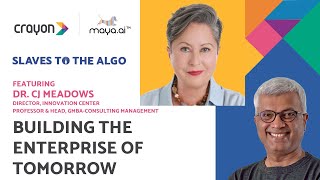
Dr. CJ Meadows discusses how algorithms shape behavior and corporate structure, from AI's bias against saying "no" to the shift from hierarchies to network organizations where machines are colleagues. She argues AI should augment human judgment, not replace it, and calls for transparent interfaces and diverse leadership perspectives.
Chapters
Hello viewers and listeners, welcome to another episode of Slaves to the Algo. I'm Suresh Shankar, founder and CEO of Prayon Data, an AI and big data company, a podcaster and host of Slaves to the Algo. And Slaves to the Algo is my attempt to demystify the age of the algorithm, sharing learnings from myself and other professionals on how they are using or being used by data and algorithms in both the personal and professional lives. I don't attempt to look at the future as either dystopian or utopian. Slaves to the Algo merely seeks to bring alive the use of data and algorithms into our conscious thinking selves. One of the themes I've been very fascinated with at Crayon is the life stories and professional achievements of many female leaders who choose to challenge, who break the bias. The tech industry industry has been notoriously challenged when it comes to women representation in tech. A 2020 study found that women make up only 28.8% of the tech workforce, and that's a steady increase, no doubt, but it's not fast enough. And at this pace, you know, it could take us a few more decades before we actually help women get to equal representation in the industry, which is no more than what they deserve. And while the industry is working on making this a reality, what's also very clear is that we need female role models who are already blazing a path for other women in tech and for men too, which is why this month we're doing a series of mini episodes featuring women leaders in tech, those who are reinventing the technology landscape as we speak. Yes, I know March is Women's Day, but shouldn't every day, every month be Women's Day actually? So I'm particularly thrilled to welcome to the show today one of the top women in tech in Asia, Dr. Cj Meadows. Cj is a thought leader, a coach, an author, a speaker. I don't know how she packs so much into a day, but she's a leader on innovation. She's led and advised companies and leaders around the world. She co-founded and currently leads the Innovation Entrepreneurship Center at the SP Jain School of Global Management in Singapore. She has decades of experience in Asia, Europe, North America, radical innovation, creativity, design thinking, leadership, globalization. She's really covered a lot in her extensive career, and she stayed very, very abreast of how technology is Aiding This Revolution in Leadership. Welcome to the show, Cj Meadows.
Thank you so much for letting me be here.
Cj, I always like to start by asking a slightly more personal question, right? I mean, you know, we all tend to look at data and algorithms from a professional perspective most of the time, but we're also affected as individuals by this whole development. And beyond the usual, you know, that Amazon makes a great recommendation, can you share some examples of some way that you've been impacted personally or professionally, positively or negatively, by data algorithms. Any particular examples?
Actually, I do have one, and I'm sorry, it's not mine. It's a friend of mine in Europe, uh, in France as a matter of fact. And she had just bought a new car, so, so excited, she decided to take her two kids on a road trip. And they were gonna see a wildlife show and go see some sights and all kind of good stuff. So it was the early days of booking engines, all right? So instead of talking to a travel agent, she went to a booking engine and she typed in where she wanted to go and, you know, various criteria, you know. And she didn't like what she saw. And that's expensive, and that's not very nice. And she kind of scrolled down, and then, oh, I like that one. So she booked it. All right, so now they get in the car, they have their drinks in hand, they're excited to go, and she types in the address into the GPS. All right, and they go and go and go and go, and then, and then they go some more, and then they go some more and more. And she thought, gee, this is taking awfully long. And they kept going, and they got to a funny little place, she told me. Which looked a lot like a shopping mall. She thought, oh, maybe everybody's routed through the shopping area or something, and, and, but there's no signs on any of the buildings, and some folks are routed over there, and, but most people are going this way. And they waved her on, she went, and they found the place. It was lovely, had a great time, packed up, and decided to go for their big day of wildlife shows and historic sites, all right? So to get there, the GPS took her back through this funny little area that looked like a shopping complex. And again, some people are routed over there, and then she, you know, they look in the car, and woman and kids, yeah, yeah, yeah, go on, go on, go on. And they had their great day, and she went home so happy. But it bothered her. What was that place? And then she Google mapped it and found that she had gone to Andorra, which is actually a foreign country, and she and her kids had gone in and gone out without any passports or right to be there whatsoever. So what does this tell us? A, we need to have really good user interfaces to to share with the humanoids what kinds of decisions is the AI making and why. Number 2, anytime you get something from an AI, you have to ask, did it really answer my question? As a person who loves to shop online, I can tell you for sure, I, I plug in 5 tech criteria that I want met by this thing that I want to buy, and then I look through all of that the AI engine gave me None of them meet all 5 because nobody has designed it yet.
Well, we're trying to work on that at Crayon, but that's another story. But it's so fascinating as to what you say that, you know, when you said there's the human interface and the fact that we need to ask the AI what exactly are we seeking from it. And far too often, I think human beings have gone into this default mode of just saying, hey, I'm going to ask this question, something comes out, and I'm going to trust it blindly. Right. And whether it's the news, fake news, or recommendations, or like, you know, online shopping or shows. Yeah. And this one behavior that I think this is triggering is that while there's no doubt that all this data and AI has made life more convenient, it's also made us unthinking in a way. Would you agree?
Absolutely. I myself plug things into the GPS and just go. But then again, that's a great luxury for me because I used to be the person who did all the driving and planned all the trips. Trips and worked out all the maps and then had to fix the car. So the big question is, what are you willing to give up for that luxury, and what is that luxury enabling you to do or helping you give up? The, the other question that I, that I think is important to follow on to the story is I was sitting next to a world-leading expert in AI, and I can't remember his name, and if I had an AI chip, I would know. Um, but he said, look, there's two things that AI can't say to you, and this can cause big problems. Number one, it can't say no. And number two, it can't say I don't know. And I was astounded that we've built all these incredibly complex machines that cannot say these two very simple but incredibly important things. And you and I were just talking about how you and I get involved in this and that and the other, and too much stuff to do. It's probably our own bias that has worked its way into the machine. And like it or not, our own bias will work its way into our culture, our machines, and our children. So we've got to be careful.
You know, that is absolutely fascinating, and I probably need to do an episode on how we kind of get this whole bias into AI. But it is also so true because I wish, as you were talking, one, why is there not something in my calendar application that tells me, Suresh, stop, you're packing in too much. It just tells me I have a conflict and like, but I go ahead and schedule the conflict and put in one more meeting anyway. Why can't something say, link to my wellness and say, I think you're doing too much today. That's useful.
Funny enough, I've got a friend working on that. And given what you just said earlier, it's a woman tech CEO. Yeah, she's doing RVI, and this is important. Yeah, this well-being.
It is, and I think it's because women tend to have to optimize so many more things, and they're used to doing that. So the bias, as you call it, in this case a positive one, that they're bringing to that thing is not like a man, I want to pack 100 things and like get that done, but How do I efficiently allocate my time to the right things?
Although if you look at people pleasers, a great many of them are women. I'm sorry, I don't have a statistic, but it's— it— don't be biased now. Everybody does that. I think, I think the big thing is successful people do that, and because it helped them be successful, it's reinforced. So how do we break our own cycles of doing, thinking, and ultimately being? And how do we help machines learn to break their own incorrect cycle? We, we've talked about machine learning. Is there such a thing as machine unlearning?
That is again such a fascinating thing because, um, uh, I think people are talking about machines forgetting, meaning— but they're talking about forgetting in the privacy sense of the word, you know, if I don't want you to track me anymore, take me out of— take my data out of your system. And the EU has led the way in that. But the unlearning, and you know, it's also another facet of this unlearning is the fact that machines or algorithms actually learn more. They need a negative set, if you will, like, you know, when you're doing lending and banking, you want to say I have people who have bad loans, otherwise I can't figure it out. Who's a good learner. So they need people who dislike certain things, they need people who kind of say I don't want something as well for the machine to work. And far too often I think we get into this loop of, hey, this is what everybody is seeing and we get more of that and then as you know, a few hours have gone by and we're still stuck in that loop. But anyway, coming back, I think Cj, you've been an expert in not just the tech side of the of business, but I think on org design. And one of the challenges that I think companies face in the new tomorrow, and you've written actually, you know, and talked a lot about the enterprise of tomorrow, is how does the organization chart balance what is traditionally prized by organizations, human intelligence, and tech intelligence or machine intelligence, which is the new age led by data. There's obviously good things to both, but how does an enterprise strike this balance? What does an enterprise that strikes balance look like?
Well, I, I think I would first question whether organizations actually do prize intelligence. Many, many organizations are out there that prize obedience, and they didn't actually start in the Knowledge Age organizations. They began with military, which prized a human being's back and physical ability to do things. Then we moved into the Industrial Age And the organizations grew quite large. We had to figure out how to do that, and it prized again people physically doing things, but now it's physically taking care of machine. Then we move into the Knowledge Age, and in some regard, we, we then no longer valued human intelligence because computers could compute data en masse and far more correctly and quickly than we could. But we still needed the humans to do something with the data. Okay, now we're moving into the creative age where machines have taken over a lot of physical labor, they've taken over a lot of intellectual labor, but they— there still are shortcomings in what can they can do creatively. And when there is no past data and you need a messy neural net that we've never been able to replicate really, that collects the dots and connects them in novel ways. Now, yes, as some AI can do that, we have writing bots and we have music bots, composers. And then as we move forward, I'll, I'll, I can share some truly wacky stuff with you. But what What does the organization look like in this new age where we have a new tool that takes over some of our labor? All right. We've generated hierarchical organizations that I believe will meld into networks far more like the fungible networks inside, outside, a lot of gig workers who miraculously make a living, and both internal and external marketplaces that are AI-enabled. To help not just find humans and to do jobs, but find humans to do tasks and coordinate that, and tech to do tasks. Because tech's— the tech is our new colleague, and we need to treat it as such. And jobs are broken down into little bits. Um, we don't have to have jobs that don't fit the person. So do you change the job, or do you change the person? How about just having a person work on the tasks they are appropriate for and manage everything? You know, then the org chart looks like a big network and a big mess, and it's not static. It changes real time, every second, as people—
talking about how it looks like a really big mess. And you know, at that point, I had a question. Yeah, isn't that really just a description of the human brain? Because it is a big mess. It is a really big mess, but it does brilliantly well. And it's like, you know, it somehow manages to pull things out at just the right time. It knows that, yeah, with different kinds of things. So, you know, and I think the military analogy strikes me as something that's also very fascinating because, you know, we're used to running companies like that. Now we are unable to appreciate the fact that one, there's the human and tech, but also the fact that, hey, maybe the guy actually sitting in the field is the person who knows most. I had a person on the show, I think the first season, and he said, the person with the data should always win the argument. And far too often in organizations, it's the person with the experience who wins the argument, and you talked about obedience. How do people, and what in your own thinking, is it just a general bias that we think that younger people with data and tech savvy tend to be less unbiased and be more willing to use data? Or is it like, you know, all the people are, you know, I know about this, I've been here 20 years, I've been doing it. Is that a bias of my own? Is that a bias that you see in companies?
It's a bias I see everywhere. Um, you know, I was talking to a tech CEO, another one who's a woman, and, um, she said until she got into tech, she never, never realized You know, the moment she opens her mouth, she is dismissed in very subtle but pervasive ways. And she noticed a pattern, a difference. You know, when somebody asks her a direct question, she gives an answer that she's hoping will fulfill that person's need for information, inspiration, whatever they want. And then in tech conferences, she would observe that a question goes to a man and then he'll come back with whatever the hell he wants to say, maybe related to the question, maybe not. So she learned that sometimes she's gonna have to push her own agenda and sometimes fulfill the other person's agenda. But when we're in an age of creativity where we're trying to understand other people's needs, and design solutions for them, you need that empathy. So we're going to see in organizations a lot more network style, which is a feminine style, and a lot more empathy, which is key not only for design and product and service development. But CCL did a marvelous study showing that leaders with more empathy, their business results are better. It's correlated.
Absolutely, and I've read about this and I wondered, right, I mean, you know that also, I think even if you take computer networks or internet networks, you know, the most resilient ones are the ones with the most connected ones because, you know, they don't break down, there is no single point of failure. Traditional organizations have multiple single points of failure. It's very hard, I think, to kind of get people to think of the organization as a network where the collective wisdom in general far exceeds an individual's personal experience, right. I mean, and I think this is a bias that I don't know how many decades it's going to take, and you're an expert on this, so I should ask you, how long do you think it'll take before this truly networked organization where knowledge drives the actual decision-making rather than anything, any other form of hierarchy?
To be honest, I do not trust myself to give you an answer because what we're doing right now, this virtual interactive thing, this was my doctoral thesis 25 years ago. I thought it was going to happen back then. But, you know, there's, there's two things I, I want to share. One is that Entrepreneurs and innovators love opportunity and the excitement of the new, and they'll go out and do that thing. Most people, especially organizations set up for hierarchical obedience, do not. They need a burning platform. And before we could all do virtual work, we had to have a pandemic. The other key thing in what you just said— I love your mug, by the way— the key thing in what you just said is wisdom. So an organization at its best operates as a group brain, as a design thinking team does, as any team, and an organization is a team of teams. So then we get into Carl Jung and collective consciousness and all kinds of stuff, you know, all this philosophy stuff and, and cognition and everything that used to be your kiss of death career-wise. Now it's super important, and these guys, ethicists and philosophers, are being hired in to take care of some of problem with that. So we start with any example of—
uh, could you give us some example people who are actually hiring ethicists, philosophers, uh, to help them with this? Google.
Google has made real strides from keyword search and, um, search engine optimization on keywords into semantic search, looking at the context of a query, trying to understand why does this person want to ask this question, what do they really want to know, and given the web pages and information I could give them, what is the best fit semantically, not just in terms of brute force keywords. If you also look back at the origin of Google, the reason Google and Yahoo were so dramatically different was this very similar to this issue. Yahoo and a lot of other search engines were keyword-driven, and it was all like a big hierarchical index. Google was started by PhDs who knew academic citation rankings. So for people who live and die by publishing, perishing, sometimes both, or, you know, and thought leadership, the greater impact your thoughts have, the more likely you are to get tenure and be promoted and have bonuses, yada yada yada. So academic citation rankings would rank information based on how many people are actually using them, what kind of impact, what kind of context, yada yada. So this was a far more useful approach than the other one, but what you have to do is you have to get pretty deep into how things actually work to understand why they work, how to game them and work them, and how to fix them if they're kind of broken. So I'm sorry, I'm, I am going to go back.
I think that's a great thing, but you know, I have a question. I love the origin of Google because the way they talked about, you know, going and using PageRank based on the academic ranking model. Yeah, I think it's a company that's lost its way completely. Look at the, you know, you go and fire in a Google search and you get 7 ads. This is the classic case where the business model has taken over all ethical approaches to finding information. And that's probably a topic in itself, and I don't want to kind of go there because there is so much that Google could be doing. And I always ask the question, if Google knows so much, why do they have to give me even so many results? Why the top 5 results not literally give me the answer? But increasingly I find that a lot of AI companies, and this goes back to ethics of this, the business model is overtaking the actual use of the data for, you know, for doing something useful to you. And certainly in other cases, I mean, not in search, but you take Google Maps and your other things, I can see where that is leading. But I'm going to come back to this idea, you know, who, you know, you mentioned something earlier about the human being has to do certain look at it as a set of tasks that are done better by machines than better by humans. But where do you kind of draw the line, and who draws that line, right? Because, for example, sometimes, you know, personal conversation, I'm talking to a senior business leader, I said, this is the data, this is what the model shows, and he says, no, but I've been doing this. And I say, oh, and what will happen to my team? And I say, listen, let the machine do what the machine is good doing, because machines learn backwards. As one of the guests on my show said. I said it frees you as a human being to imagine forwards because a machine can't imagine forward. And so where do you draw this line? How do you decide what is better done by machine, what's better done by a human in an organization?
Well, I think one of the things that you've got to realize, you already have realized, you are advising the person who makes that decision. So we've already established who our leaders are and who's going to make that decision. Um, you know, it all— it does come down to data, information, knowledge, judgment, and wisdom. And you had mentioned the wisdom aspect earlier. So the machines are really good at data, they're good at information. AI is actually pretty good at knowledge. But that's where we start to get into human territory, judgment, and ultimately wisdom, that we don't trust anyone else, i.e., our own tech, um, to make those decisions. Now, if you look at, you know, videos like Humans Need Not Apply, that predicts that— that shows us that 45% of jobs could be done by a machine. But then go back to an analogous example, the ATM. ATMs were supposed to replace tellers. And how many tellers do we have now? More than ever. Why? Because it's not the same job. Tellers now are people who help you solve your problems and, and help you connect with the company in ways that are useful to you, the customer. So what we're going to see, I believe, is not that the tech is going to take over our jobs. It will take over tasks. And not only do we still need the humans to collaborate with the technology, but the humans also can now be freed up to find new needs, design new solutions, and implement them. So why hold people back?
That is absolutely true. It's just going to take a little bit of a mental switch for people to learn to trust the data and the algorithm, and a second mental switch, if you will, which is probably an even bigger step, to say this is not a threat to me, it can be an aid to me, don't you think?
Absolutely. See, organizations may find that AI, machine learning, bots, and so forth make an impact very quickly. And leaders are actually concerned about this, and they are mapping today's workforce, tomorrow's workforce—funny enough, using computers—and, and making the roadmap to get there, because they realize that just firing all of today's workers and trying to hire in people isn't going to work. It's expensive. You got to recreate your culture. You've got all new people, and then society is filled with outcasts. I mean, like, come on, not good. Not a sensible decision. Bad for business, bad for society.
Absolutely. And, uh, coming back to this idea about, um, AI ethics and, and, and, and I think philosophers, if you will, for me this is a fascinating thing because, um, It's obvious that organizations of all kinds pour up a lot of your data. They're able to buy or access other parts of data. They're able to put these together to form patterns about it. But really speaking, like, you have typically an HR and a people thing, but then you have a values person in a company who says, these are the values that I will hold dear, and I will use everything to shape the policy. And AI ethicist's job seems to be that I will shape the policies in the way in which data and AI can be used to make lives of various stakeholders, whether they be your employees or your consumers, better. But do you think, or are you seeing examples of people saying, like, we all now have a Chief Data Officer, Chief Digital Officer, are you going to have a Chief AI Ethics Officer of some kind in companies?
Or— Oh, a lot of companies do. Yeah, a lot of companies do. And, you know, what happens with bias is that you just said it, You know, data looks backward, people imagine forward. Bias is a thing of looking backward. So we need people to actively be, be looking forward, combating the bias by exploring the new and by deeply understanding. I mean, one of the biggest biases I haven't even mentioned yet— why is a gray-haired guy talking to a gray-haired woman about advanced technologies? Aren't we dinosaurs? What the hell would we know about it? Yeah, you wouldn't believe how many times somebody sees me with my phone and it's just being a little slow and they come over and say, oh, may I help you, ma'am? I'm like, no, bloody get away. I've been programming these things since, since the Defense Department in 1987. Come on. So I would have helped that person to explore something new.
But you're right, and I think, um, so much of that is, um, a bias. And I'm going to go back to a different point about the bias, right? You're making one which is that, um, you know, that people tend to look at somebody, whether it's a woman, an older person, a younger person, a person just wears dresses badly with a hoodie and assumes they know something about tech. But The question I have is bias can be— breaking the bias can be both good and bad. It can be good because sometimes we tend to be biased and overweight our experiences and, you know, not look at the data. So the data can help correct the bias, but equally data can lead to fostering a bias, right? Like a lot of lending decisions because they're based on past lending, or like, you know, purchase decisions because they're based on past purchase behavior. So actually, even the issue of what is the bias is a pretty deep topic, don't you think?
Absolutely. You know, one of the things that banks struggle with is, you know, and this happened long ago in the US, they would make decisions partly based on your postal code. And then whoopsie-doo, that's highly correlated with your race. So, you know, what do we do about that? And how do we find new ways to predict who's a good person to lend to and who's not. And one of the ways that we've come up with is social media and tracking phone data. You know, one of the things you do in emerging economies where people don't have credit histories yet, you want to get in at the base of the market, is you track, you know, phone calls and phone activity. Does this person appear to have regular sleeping patterns? You might track communication with gas propane sellers. If somebody's ordering gas propane, they probably are cooking at home. You track what they do on social media and see how they look and, you know, try to correlate some of the indicators you think there might be with how people behave and then make future predictions based on that. But again, the human's still in there deciding what data to track, you know, where to point the algorithm, you know, either we've got our hands in the algorithm or we have our hands in the data setting the data set for the algorithm and the machine learning to go through. There's no way to get away from bias altogether, but we do have at least an awareness to try. That's the thing that saves us.
And I had Ian Miles on the show, you might know Ian, a couple of seasons ago, and he talked about how we're going to get explainable AI. And the fascinating example that we talked about, Cj, was the idea that in the '70s, which not a lot of our listeners might be aware of, there used to be no labels on food or on drugs even. Yeah. And today you wouldn't buy it, you may not always read it, but you wouldn't buy something that didn't carry the label. And he says every piece of code is going to come with a label eventually that says, how did the AI break this up and arrive at the decision? Do you see that day coming closer, or do you think it's still far in the future?
Um, I actually have already seen someone talk about blockchain for fruit. I swear to God that this is true, you know. Putting labels on every individual piece of fruit so that you know it's sustainable fruit, responsibly sourced, and you can, you can see who is the person who picked your fruit, who is the person who grew your fruit. So we can already do things like that, but the question is, should we? Is it useful? Are we filling our data coffers with junk? And that comes back to to your idea of forgetting. If we're creating a big mess out of data the way we jettison so much junk into space, at some point in time, is it all going to fill up and we need to clean our act up?
Absolutely. You can already see that in the rising cost of, um, practically everything that you do in tech today. But I'm going to go on from the tech and the data and the bias aspect to another area, uh, Cj Meadows, that is fascinating. You're a pioneer in design thinking, using the right brain to reimagine things from a user perspective. And typically, if you look at the way people are using data and AI, they're also talking about using data and AI to create better journeys. And as you sit in between these two worlds, my question to you is, do you see them complementing or conflicting each other, and how?
Actually, I'm glad you brought up the brain. 'Cause it isn't just the right brain you use. What you want is a whole brain team. The right brain, the left brain, so you get creative and logical. Also the top brain.
Or you want a whole brain person like me.
I mean, you know, I'm completely heart. If you're all heart, you're useful too because you make a whole brain team. You could be the glue, you know? And then the bottom brain part of our brains is the seat of emotion and action. So you want all of these different styles. I think one of the things we've gotta put in as well is the tech brain, so that we have truly diverse design thinking teams. So the tech currently, what it can do is point out anomalies, extremes, things that we can investigate, but it isn't necessarily good at investigating. It hasn't progressed from the days of Pampers and beer. Do you know that old story?
Yep.
Yeah. We still need the humans to go and investigate, ask the questions, and think forward. But the AI team member can be a fantastic resource for identifying lead users, and we go find out how does that happen and why. The extremes, people who really hate your product, really love your product, they can teach you more about your product than you ever dreamed possible, and they do it quick. So your AI can help you find them. But for analogies, analogous situations for fresh ideas, like emergency rooms and the Formula 1 pit crew, that's still a human thinking kind of thing.
And could you explain that emergency room, Formula 1, and why it's human thinking? I mean, it's fascinating.
It's a classic and one of my favorite design thinking stories. So, and, and this is also another thing: AI is good with statistics, we're good with stories. You gotta match them together. So, um, an emergency room wanted to get better at what they do, and they hired a design team that said, well, what do you mean by better? Well, uh, our service has to be fast or people could die, and it damn well better be right or people could die. So what other industry can we look at for fresh new ideas where it's got to be fast and it's got to be right? Aha, Formula 1 pit crews. So the hospital staff and the design team went to Formula 1, not just for a day at the races. They watched the pit crew and they kept nudging each other, saying, yo, hey, hey, hey, see what he's doing? Do we do that? Why don't we do that? And they came back with so many great ideas, put them into the hospital, and saved so many more lives. They didn't stop there. They invited the pit crew to come to the emergency room and said, well, here's what we do. How would you do it? So it's these kinds of lateral connections that can help you to create radical new value.
That is such a fantastic thing. I didn't know that. I mean, I can see the analogy now that you point it out, but it's not very obvious. I keep using the emergency room situation a lot in my own company from a different perspective, saying the way you use an emergency room, the data you need to kind of solve a problem like that is very different from the way you use it in not getting people into the room itself, right, which is how do you prevent something from happening. But when you do these workshops, when you do these design thinking workshops, you got these very left-brain detailed technology people who says, you know, where's the data, where's that thing, and then you have these— and I'm not imagining, there's a bias here in what I'm saying clearly, but then you have these people who are almost these fairly like, you know, system thinkers, design thinkers who are processing information very differently. How do these two people even interact and get a language that's common between each other?
I'm so glad you said that. There's actually even research studies on this. When people are different, they first— exactly what you said— they first come down to establishing a language so they can try to understand each other. By doing that, they come to deeper understanding and understand their assumptions. Whereas if you get a unified monolithic team, they don't do that. Now, in coming to deeper understanding and learning how to interact with each other, it enables them to become a more productive problem-solving team. The key, you know, the reason that we say diversity and inclusion is because you need the inclusion part. So in whether it's a design thinking team or an organization or the mind of an individual leader, you need diversity You need diversity, and you need the ability to co-create and collaborate, and that is missing from a lot of situations.
And I'm just going to go on from that too. We talked about how do you bring this together, and you— I know that you kind of believe in fusionering, you're a fusioner yourself. You talked about how just like nuclear fusion releases energy, technology, business, arts all can come together to release massive energy. And can you share with us some examples in some of the workshops you've done about how the fusion of what I call data and imagination has led to an explosive amount of energy, explosive amount of value creation?
Oh, one of my favorite examples is Dr. Karen Stephenson. Now, when Karen went to school, she went to a liberal arts college and decided to study art and quantum chemistry. And, you know, her friend said to her, "Eh, what kind of a job are you going to get with that?" And she said, "Eh, it's a liberal arts college. Can't I study what I want?" "Yeah, yeah, fine, fine, fine, fine." And now, as part of her art training, one of the things they did as a test was to have a student examine the brush strokes of a painting, and they wanted to know the artist, and the year. She got 100% on that exam. Lovely lady, she said, "Eh, I got lucky. This is good." And then they did the same exam the following year and the following. How did it go? 100% every time. She's a master pattern matcher. She can see patterns. Now, After school, she didn't take a job as an artist. She took a job in a lab as a quantum chemist. And she was sitting on a mezzanine one day and looked down. There's all these people moving around in a pattern that she had seen in quantum chemistry. And she was floored. She was like, oh my God, I've got to investigate this thing. Maybe there's a universal theory of interaction, whether it's chemicals or people. So she did that, and she went off to get her master's at Harvard, and she took classes in anthropology, ethnology, mathematical modeling, computer programming, and business consulting. So her advisor hauled her into the office one day and said, you know, Karen, you really need to focus. Focus. And she said, "Eh, what? I'm focused like a laser beam on this one thing. I'm just drawing from different disciplines to address it." So what she did was she came up with a new way to mathematically model human interaction. And she had to create some of the mathematics in order to do that. She was then brought in when the AIDS crisis occurred to ground zero, and she was told, "Look, we don't know how this thing spreads. We don't know where it started. We don't know what's going on. Can you model it and help?" And she did. Many, many— you know, like 35 years later, she's still doing this kind of modeling of humans. And it found its way into her friend Malcolm Gladwell's The Tipping Point. Yep. With mavens and gatekeepers, all that kind of stuff. She does work with companies like Merrill Lynch that say, look, we can, we can promote people and keep them based on meeting KPIs, but if we let go some of these important people who contribute to others' success We're screwed. We want to make sure we know who are the important people and make sure they're taken care of and kept. So it's, it's relevant for HR now, it's relevant for big data, cybersecurity, international security, and much more. So would an AI have made— have been able to pattern match and get the, the the artist in the year. We could probably train an AI to do that, yes. Would the AI have seen that pattern in a mezzanine and created a company that's been called by CIO Magazine one of the 100 most innovative firms in the world? Probably not.
And it's kind of really, really interesting, such a fascinating story, um, and For me, what's really interesting is the fact that if you look at it, we are trying to take all of those things. I mean, there were these pattern matching, spotting individuals. I mean, and Cj, we know each other, my company offering, my guys tell me, you see things that we don't see, and I'm like, maybe that's all I do. But what I keep telling them is it's there in the data, it's there if you really go and look at it, except that maybe I'm looking at this differently. But increasingly, when I look at it, there are now Firms that are saying I can predict whether a startup will do well, whether what this piece of art is. I just read this morning about a new robot that's been built that can paint. It's called AIDA after, you know, Ada, and it's just been apparently can do it brilliantly and it has some really great questions. My question, however, is that as we do this stuff, there's also a different thing that's happening is that our brains are getting rewired. And I don't know for good or bad. For example, and I'm sure you know this, when we were young, remembering a fact was a big thing. How many capital cities do you know in the world? Now, who cares, you just Google it. But I'm sure the amount of space that's being freed up in the brain is leading to other things that the brain can be used for. I don't know whether this is good or bad, but I do believe that there's a whole amount of rewiring going in as we now start to take some of these patterns that we see and start putting into programs. I don't know whether you're seeing this in companies, but how do you recreate the mind of Karen Stevenson into a computer program is, I think, a big issue that you're going to face.
You know, one of the things that I heard from another tech founder is, I wish I had worked on my character and self-enlightenment before starting my company because now I see all my character flaws embedded in my company. That's so true. So I— isn't it? So I think what we're going to find is that our own character flaws are going to be embedded in our companies, our datasets, our AI, our children, our cultures, everything. But again, it's not necessary. I don't think it's necessary. I don't think it's realistic to try to eliminate them all. I think it is important to try, and it is the journey of trying that makes all the difference, because then you create systems that can grow.
Absolutely. And that's such a wonderful thing. And, um, see, we could keep talking. I had more questions for you, but I'm going to come back and do one more episode, perhaps focusing on you know, a couple of industries and things that you're doing. But I do want to kind of end with this one thought. You're a tech innovator, you're a business thinker, and then a design thinker, you're a woman. What is an example of a bias that you see in this year when the whole theme is break the bias? What is a bias that you'd like to break? How are you breaking it?
That's a good one that wasn't on your list.
You must always surprise people.
I think surprises are good. Um, you know, I think one of the things, one of the biases that we need to break is that personal and professional are different. That you have a home life and a work life and they're not both your life. We need to be reintegrating more of ourselves and bring our entire selves to work. As Gary Hamel said, you know, bring your whole heart to work, bring your whole self to work. And if we integrate better and diversify not only our workplaces and employee pools, but diversify our own minds, who knows what we can create. Absolutely, absolutely.
And that's a lovely thing that, you know, a bias that we have towards personal and professional work and home. And we made a great strike towards that in the pandemic, haven't we? Because it needed that completely, you know, bad event to make us realize, I mean, it's normal. I mean, I've had podcasts where like children appear, babies appear, and, you know, no one says it's not professional anymore.
Exactly. You know, we went in your home.
I mean, I shouldn't be— I mean, I don't have a right to be in your home if you really look at it, but we're all in each other's homes. Everybody's, uh, people talk about working from home, other people talked about living at work.
Exactly, exactly. But don't forget that we are interconnected and vulnerable now in a way that in human history we never have been before, and we are facing crises that are more frequent and more widespread. And the "this shouldn't be in your home" thing started with television when the Kennedy assassination and the Vietnam War were televised in people's homes. It made It made faraway things personal and real. And when things become real and personal, then we get up off our butts and make the world better.
Yeah, but there is one thing that I would, uh, but I personally face, and I just want to share that it's really not about AI or data, but I have now find that in this whole blurring that happened during the pandemic In a way, I guess as an entrepreneur, and you're one too, in some ways, you know, your life is already integrated. But I found that it had over-blurred everything into one another. And so now I'm actually welcoming the transition period. I'm now realizing at the end of this episode, I'm going to go and take a taxi and go to the office. And those transition moments are also important moments because they— it's not like a boundary, but it's like I use the word transition for that reason. It helps you pass from one state of mine. And sometimes I think one of the things that happened in the pandemic is that it just blurred everything, blurred into one thing after the other.
One of the— sorry, go ahead. One of the things that, that people have really struggled with, um, who have never worked from home, uh, is that the whole separation thing and, and the, the culture of a workplace, they had to replicate themselves when in a workplace it's already been done for you. Oh, sorry, can't talk, honey, I'm at work or I'm in a meeting or what have you. You know, try sitting in your living room and do that. So we do need, we have needed, all of us, the ability to set boundaries and create culture even in our own homes. And when you gain those abilities, you have gained very big bricks in the wall of leadership. And we all need to become leadership because in a network, different leaders will emerge. Exactly. Leaders will emerge as they're needed. So be prepared.
That is such a lovely thought to end this episode on, Cj. Thank you. I've taken out so much from, um, uh, this episode. I mean, I think I just love the piece on fusioneering and Karen Stevens the example, we talked about the fact that there are biases towards the gray hair that people share. Look who's talking. And women who kind of say things at conferences. So many little nuggets, I think, in what you just said that we're kind of going to take those out and put that into a mini episode, if you will. We'll be back with you for more. Thank you for being on the show. It is really a pleasure to have you with us.
Thank you so much. It's been a pleasure to be here, and I look forward to speaking with you again and learning from you.
To my viewers and listeners, thank you for listening to us today. Slaves to the Algo is available on YouTube, on Spotify, Google, and Apple Podcasts. We release a new episode every week, sometimes even more frequently. If you like this episode, don't forget to like, share, and subscribe. Remember to stay relevant because we are in the age of data and AI. And we do not want to be a slave to the algo. See you all next week. Thank you. Thank you.
More from Dr.



Leading Innovation for the Corporate Business Through Impact | CSI Insights Ep. 7

AI Transformation: Is the Consulting Career Model Breaking Down? | Dr. C.J. Meadows | S1E5


CIO Leadership Live ASEAN with Dr CJ Meadows, S P Jain School of Global Management


Usha International - Tiger Center Sewing Center 2025 - Now a Learning-and-Production Center


