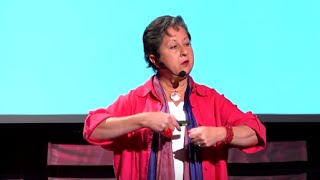
In this TEDx talk, CJ Meadows shares her own multicultural, multinational family experience to explore how technology and globalization are reshaping the concept of family. She recounts adopting children from Vietnam and the Philippines, creating a test‑tube baby in Singapore, and later adopting an Indian‑Malaysian child, illustrating a household that spans four continents, multiple languages, and several citizenships. Throughout the narrative she highlights how digital tools (mobile phones, PayPal, Skype, virtual classrooms) enable distant connections, while also exposing bureaucratic hurdles such as visa restrictions, bank account limitations, and complex naming conventions. She expands the definition of family to include domestic helpers, godparents, foster arrangements, and cultural rituals like the Indian rakhi, arguing that love and responsibility—not biology or nationality—bind families together. The talk questions whether the traditional nuclear family will be replaced by “fusion families” and what kinds of schools and societal structures are needed to nurture the next generation of global leaders. CJ ends by inviting the audience to imagine and create new models of family and education in an increasingly borderless world.
Chapters
Technology and globalization. These are big words, exciting words. Everyone can see how they help us innovate new businesses, industries, impact nations. But they can also change our lives in very small, personal ways. One way is by having an impact on the building block of society and most businesses: family. So today, I'll tell a very small personal story of family. Once upon a time, there was a US mom and a UK dad living in Singapore, and they decided to start a family. We wanted to give life to two kids and give a home to two kids who needed a home. So we went to Vietnam and adopted baby number one. And then we went to the Philippines and adopted baby number two. Then for baby number three, we made a test tube baby in high-tech Singapore. Because of medical complications and health problems, we changed our plans and adopted baby number 4, a little Indian girl from Malaysia. Now, as a Christian family, we baptized the kids, and here you see my brother, their godfather. Oh yeah, he and I don't look alike. I'm Caucasian, and he's Indian. Did our parents adopt us? No. There's a tradition in India called rakhi, celebrated on a day called Raksha Bandhan, where a girl without a brother can tie a cord around his wrist, they exchange vows, and they're brother and sister. No lawyers involved. As a matter of fact, in the Christian church, we call each other brother and sister because we have the same Father, God. Now, you'll notice up here, he's on his hand phone. Is that because he's bored with the ceremony and texting his friends? No, no, no. That's because the godmother was in the United States attending the ceremony by mobile phone technology. So at last, the family is complete. And basically, we wound up with twins. No, not these guys on top, the ones on the bottom. One is light, one is dark. One's biological, one's adopted. One's a boy, one's a girl. But basically, they grow up as twins because they're 9 days apart. Somebody said to me, "Ooh, didn't that hurt?" And then people started saying other odd things, like when we took our Vietnamese son in a stroller to the store and the clerk said to us, "Ooh, so cute, wa! How much you pay?" And then we went to the playground and somebody said, "Wow, is this an orphanage?" And I finally got the kids settled down on the airplane And the stewardess said to me, "Oh, is this some sort of school trip?" And so obviously, 3 of these guys are adopted. It's no secret. And then Mr. Test Tube Baby got a little older, and he perked up one day and said, "I miss my Chinese family." I say, "You're what?" Well, I was born in Singapore. Well, at the time, Singapore was 85% Chinese, and the other 3 kids were adopted, so— oh! I knew we had to have a talk. So I said to him, "Son," I should have told you long ago, but there was never a right time. I am your birth mother. And he said, "No!" Eventually he got over it. Don't worry, don't worry. And then the other kids started to have other questions too. Like when our oldest daughter said about the young one, "Hey, Mom, is she Indian or Malaysian?" I said, "Good question." Well, she's Indian by race and ethnicity, and she was born in Malaysia, had a Malaysian passport. Now she has a UK passport. Does that help? No. But the best comment, I think, came from my husband, who then one day popped up and said, "You know what we really need?" I'm thinking, a vacation, aspirin. Said, "We really need a foster baby." I said, "Why do we need a foster baby?" "Well, there's this Chinese baby. He's gotta come to Singapore for surgery. They need a place to stay, la la la." I said, "We are fully stretched." Now, if he comes with a helper, that's fine. And he did. So the family Christmas card that year had 8 languages on it, representing all our ethnicities. And my cousin said to me, "Who are these people in the family photo?" And I said, "Oh, they're khandan." She said, "A what?" Well, there's an Urdu word Kandan, meaning part of the family. You know, these helpers in Singapore, they come on employment contract, they earn a salary, they're on work permit, they have little green cards, they have insurance and vacations, public holidays— moms don't get that— but they live with us, and they help us in very personal ways. They're a key core part of our lives and our families. So when their families back home need medical assistance, we help out. When they need a no-interest loan to build a house for children, grandchildren, we help out. After all, they're part of the family. Which then brings to mind also when my husband's ex-wife lost her job and wanted to jump-start a new life. So what do we say? "Come live with us. After all, you're family." One thing that marks her as family is that she and my husband share the same last name still. I don't. This brought no end of PayPal problems. And customer service got really annoyed with me one day and said, "Ma'am, how many PayPal accounts do you have?" And I said, "19." They said, "Why do you need 19 PayPal accounts?" I said, "Because you won't let me change the country or the family name." So, business, husband, wife, 6 different nations, 18. Oh yeah, there's also the one with the French bank account that wouldn't let me use my name. I had to use his name. That was not the only problem. Administrative or otherwise, that we had with France. At this point in time, what did we really want to be? Normal. We just wanted to be a little normal family, buy a house among the farmland, grow up in a village, all of that. So what do you do when you buy a house? I went to the embassy, of course. I said, "Can we do this? Is something going to go wrong?" They said, "Oh, oui! Of course! A US wife married to a UK husband, UK children, they are all in the EU. You just go. Bienvenue." I said, "Please, please, Check the fine print. Something's going to go wrong. Can I apply for a settlement visa or something? No, there is nothing we can give you. You have the right to come. You just go. Okay. So I went. And I showed my papers at the préfecture, and they said, "Oh, this is very nice. You don't belong here. Get out." So I go back to the embassy, and they say, "What's wrong?" Here's what's wrong. My husband doesn't have a job in France. So when I explained the situation, they said, "Whoa, whoa, whoa, whoa, whoa. You have different names, you are from different place, you work all over the world, you want to buy a house in France and live there, and your husband works in China." "Wha' sort of a family are you?" Well, we're the kind of family that does not live in France. Very appreciative though I am of all the help they gave us. So we went home to Singapore, and I joined SP Jain School of Global Management, global of course. We send our students to Singapore to learn Asian business, Dubai for Middle East, and Sydney for West, fostering a global mindset. When the founder told his dad about this school he wants to build, the dad said, "Son, nowhere in the world do students study in 3 countries. They study on 1 campus. Please rethink your grand plans." Happily, like most children, he did it anyway. And we're a Forbes top 20 school with amazing global leaders coming out. But it's not the only innovative school that touches our lives. My daughter lives in Singapore and goes to school in the UK. How do we send her around the world? No, the world comes to her. She goes to Inter High. A UK-accredited school where students log into the virtual global classroom from Brazil, UK, Germany, France, Singapore, Thailand, China— you get the idea. It's an amazing experience and a great education. But there is one problem. She starts school at 5 PM. I had to take her out of French because it finished at 10 or 11 o'clock at night. This drove our Indonesian helper crazy. She said, "What am I supposed to do? Two little kids go to local school early morning. You have a business day. Big kids go to school all evening. When do you people have dinner?" We don't, except Sunday after church. That's not the only tradition we had to give up. The children never met their grandparents. But after weekly telephone calls for some time, one time they got to Skype their grandmother. Did they ever Skype my dad? No. He never knew I had 4 children because they're not all white. I learned of his death via SMS. "Dad passed. Funeral tomorrow morning. You don't need to come." I did not SMS back, "Thanks for sharing. I couldn't get there from here anyway. Tomorrow morning." I learned of my mother's death on email from a cousin I haven't seen in years and another one I've only seen on Facebook. Now, that family of origin was all the same race, all the same biology, same name, lived in the same house, same language, same citizenship, nuclear as it gets. But something clearly didn't work. So, I have to ask, What is a family? Do we determine a family by race, biology, species? Our hamster climbs up on the rabbit thinking she's her mother. Living in the same house or country? Your citizenship? Your language? I had to learn a lot of good French words. That's the spicy language in our house. Is it determined by marriage? Adoption? What about rakhi? It's kind of adoption. Church brothers and sisters, godparents, are they part of the family? Fostering? Kandahan? Are they family? Divorce? Are you still family? Name? Can you have another name? Or is family defined by life long, active love? And what kind of love? The Greeks had at least 4 kinds, with different words for each: romantic love, parent-child, dear close friend, friends and neighbors. And if your love changes over time, have you lost your love? I asked these questions of a lady a little while ago, and she said, "Oh yeah, I'm a third culture kid too." And then I thought about it. My kids have blown way past three cultures. What am I supposed to call them? Fusion kids? Will the nuclear family be replaced by the fusion family? Is this the start of something big? Are there more of these to come? And what are these kids who grow up like this gonna do? How will they change the world? Will they create infrastructure so we can have more of this? So I can have one PayPal account? So you could buy a house anywhere and live in a world without borders? Are technology and globalization enabling us to come together or to fling ourselves apart, living long-distance lives? What kind of families and schools should we be creating to foster tomorrow's global leaders? What will you create? Thank you.