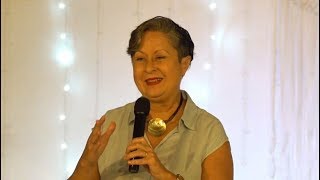
In this presentation CJ Meadows explores how education has evolved from the Agricultural Age, through the Industrial and Knowledge revolutions, to the emerging Creative Age driven by the fourth industrial revolution. He opens with famous quotes from Louis Pasteur, Thomas Edison, Mark Twain, and Steve Jobs to illustrate timeless ideas about preparation, curiosity, and connecting the dots. Meadows argues that the traditional separation of schooling, work, and life is outdated, especially as automation threatens 45% of jobs. He proposes reintegrating life, learning, and work so that education becomes a continuous, reflective process rather than a finite stage. To embody this vision, he is creating a multimedia book, workbook, and interactive course on the NOBI platform, which enables learners to capture ideas, prototype, and share them instantly. He emphasizes active, community‑driven learning, offers a promo code for the new NOBI course, and thanks collaborators for building the future of education.
Chapters
I'm gonna give you a quote, and can you tell me who said this? "Chance favors the prepared mind." Anybody know? Who said that? It must be an Edwardian. Louis Pasteur. Here's another one. "I was at the foot of my class." That's actually Thomas Edison. How about this one? "I've never let my schooling interfere with my education." What's the quotation? Mark Twain? Yes. Here's one that casts education as collecting the dots and then connecting the dots. You can't connect the dots looking forward. You can only connect them looking backwards. So you have to trust that the dots will somehow connect in your future. You have to trust in something. Your gut, destiny, life, karma, whatever. This approach has never let me down, and it's made all the difference in my life. That's Steve Jobs. Steve Jobs. Now, for those of you who won the game, and as a matter of fact, those of you who didn't, we've got a promo code! I'll tell you about the new course that's going on to NOBI, and you can all go to Qiming and say, "Hey, hey, I want a promo code." It might be Fusion or Innovation, something like that. So that last quote was Steve at a Stanford commencement address. It made me think, commencement. They're commencing their lives after their education. By the way, how old are these people? My husband, his lifelong goal for so long was to retire at 40, and I said to him, "But darling, you were in school till you were 35." Why is it that we get an education and then we start our lives? Well, it didn't used to be like that. In the Agriculture Age, well, kids would help out on a farm, learn, eventually take over that farm and that work. Then there was the Industrial Revolution. All those kids moved into the cities and they went to schools and then they trained for a little while and took a factory job. Then the Knowledge Revolution, the, the Information Age came. And oh, oh, oh, well, that's— that little bit of training isn't really enough. Now everybody had to have an undergraduate degree. And to get ahead, a master's degree. And to get far ahead, a doctorate. So education, school, and life separated. Now we're facing the fourth industrial revolution. And we're entering the creative age, a time when digital and physical, technological and biological are integrating, and when robots are supposed to take over 45% of the jobs. Well, wait a minute. Do you really want to spend so long in school investing so much in a job that won't even be there. We need to reintegrate life and learning. Now, do I sit around all day thinking about this stuff? Actually, I do. I'm a professor. Um, that's only part of what I do with my time. Um, I study innovators, people who collect and connect. And I've learned so much from the 30 amazing innovators that I ran around the world learning from. And I want to share it. So I thought, "Hey, I don't just want the content to be innovation, I want the delivery to be innovative." So why don't I make a multimedia book? That would be pretty cool. But if people are just watching and listening and reading stuff, Is it going to make all the difference in whose life? I know, let's get some, some reflective questions in there and have people decide how they're going to use this in their own lives. What are they going to do with it? So I could make a workbook. Okay, that's another step forward. But you know, it's all kind of lonely. Making a change in your life by yourself? Wouldn't it be nice if there was some way to answer those questions, learn the material, figure out how you're going to change your life, and while you have your technology in your hand, take a picture, take a video, make a prototype, I don't know, do a dance, and share it with somebody. That's why I chose NOBI, and I believe so strongly that NOBI is the future of education. So let's collect our dots in a fusion of life, technology, and work where we don't have to leave one to do another. Let's learn in a class where there's no head or foot, just people who help. Let's prepare our minds, not just for chance or for a job that may not be there, but to continually discover and create. Once we've collected all that, let's connect. Not only the ideas and ideas in action, but ourselves, like all of us in the room. So thank you, Seo-young and her team, and all the partners, and all the people here today for building the future of education and reintegrating life, learning, technology, and all of us. Go Nobi! Thank you. Oh, oh, remember, promo code "Chi Ming." Thank you so much, Cj Meadows.