Types of Innovation and Why They're Important
CJ Meadows defines innovation as "creativity that is accepted and used" and breaks down ten types: product performance, profit model, service, channel, brand, and others. Netflix, LinkedIn, and MinuteClinic show how combining multiple innovation types increases the chance of success.
Chapters
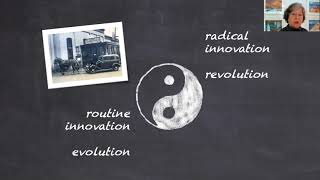
A lot of people talk about innovation without really defining the term or thinking about, hey, are there different types of innovation? There actually is a reason to manage different types of innovation differently and maybe even to combine them. Let me show you how and why. First of all, what is innovation? Everybody uses the term. What is it? So we know what we're talking about dealing with. The easiest and simplest definition that I know of is that it's creativity that's accepted and used. So most people focus on the creative aspect of it. Yes. There's novelty. It's a new way of doing things. I'd also like to focus on the usefulness. All right, a piece of art or music is creative, and it is useful in the sense that we enjoy, or it makes us think or feel. But there's something beyond that that we are talking about when we talk about innovation in a business or healthcare or other type of context. It's gotta be useful. And that's why we do things like design thinking. Now, it's also got to be accepted. Solving your own problem creatively in a useful way is not innovation. It's problem solving. Innovation is innovation, and entrepreneurs are entrepreneurs when they solve problems for other people. And if an innovation isn't that useful to other people and not going to be accepted, we can't really call it an innovation. Maybe it's a prototype, maybe it's something else. So when I talk about innovation here, I'm going to talk about innovation something that's creativity that's accepted and used. Right. When I talk with people, I oftentimes flash up this picture and ask, what's the innovation here? And sometimes they'll tell me, ah, the car has broken down. So this guy has hooked up his horse to tow the car. That's an innovation. Wait, wait, wait, wait, wait, wait, wait. But is it? He's only solved his own problem. And you don't see a lot of horses pulling cars these days on the road, do you? So it wasn't accepted, even though it was useful for this man in this one instance. What might be another innovation here? Well, people usually will then say, "Ah, it's the car!" To which I respond, "If it's so damn useful, why is it being towed?" The car, when it first came out, was unreliable, noisy, it stank, it was expensive. There's all kinds of things wrong with it. But it had capabilities that the previous solution, a horse-drawn carriage, did not have. It could go— eventually it could go faster, it could go longer, etc., etc. But there's a lot of stuff wrong with it. So because it was a radically new design with, with extended useful capabilities, It was a radical innovation, but it was important to have little innovations on that dominant design to make it a really great and acceptable innovation. The muffler was introduced to make it quiet. All the different pieces were changed to make them more reliable. Henry Ford and Oldsmobile introduced the assembly line to make it cheaper, exhaust systems made it not smell quite so bad, etc. So what we see here is that a radical innovation is rarely perfect, but it introduces new capabilities that people want and introduces a new dominant design. It's revolutionary. But it's not really going to be successful without the routine innovations to make it affordable, reliable, and every other thing people want. So those little tweaky routine innovations are just as important as the radical ones. And we today glamorize the radical and we forget oftentimes the evolutionary innovations, the routine ones. You need both to make something as successful as the car, which millions of them are driven around every day. Okay, now disruption is something I've covered in another video, but I would have to say something here about it. Disruptive innovation and sustaining innovation are a little bit like routine and radical. A disruptive innovation shakes up an industry or creates a new industry. It often is radical. A sustaining innovation helps a big company, usually a big one, make money in the way they're designed to make money. Oftentimes that is an evolutionary routine innovation just to make their products and services a little better. But sometimes it's a radical innovation. So the product or service changed in a radical way, but the underlying business did not. Okay, so radical and routine. Is different from disruption— disruptive and sustaining. There's another kind that is near and dear to my heart: fusion. Lateral innovation across industries, across fields, across organizational silos, social classes, countries, across big boundaries. And we find oftentimes that moving across in this way If you can take a piece of this and a piece of that and put it together and create something new, it is often a radical innovation of very, very high value. I will leave you to your devices to look up my website, drcjmeadows.com. Go to the fusion page and learn more about it. So if you're looking to create high value, you may want to do fusion. You may want to disrupt. You may want to do something radical. But there's a wonderful book that you should be aware of, um, 10 Types of Innovation, and research showed that there's different kinds of innovation, and the more kinds you integrate into a new innovation, the more likely it is to succeed. So what are these types? Okay, let's go down to the bottom first. The offering, the product performance. So if you improve the product performance, that's an innovation, and people may want that additional performance. You may have to introduce a product system of complementary products and services. Nobody's going to drive a car unless they have Petrol pedals. stations and garages and so forth. You might innovate the profit model, how you make money. Netflix switched from video rental fees to subscription. You may innovate a network so that connecting with other people creates more and more and more value. This reminds me of LinkedIn. It also reminds me of the AI engines that are used by Netflix now that make suggestions to you more accurately and better because they have a larger and larger base of people to learn from. You might make a structural change, how you organize or align talent or assets, how you process, how you produce something. Going back to the car, The assembly line was absolutely essential to the car being both affordable and to producing enough of them to meet demand. How about experience? You can make an innovation in service to support or amplify your product value. How you deliver. You might innovate your channel. As a matter of fact, in the early days of dot-coms, and e-business. There was a big debate over whether physical is better or virtual is better, brick or click. And what we discovered was brick and click are better. It's, it's the most powerful combination. But then we had to do channel management to ensure consistent customer experience across all channels. All right, so there's some innovation that you might be needing to do right there. Brand— how you represent your business and your offerings. What does the brand mean? Are you introducing a new brand that means something that people want? MinuteClinics, for example, is a wonderful brand partly because it tells you in an instant what it is. If you want to see a doctor and you want to see a doctor quickly and without wasting a lot of time, that's what MinuteClinic is. All right, customer engaging, fostering compelling interaction. Um, Pinterest and some of the other, um, online businesses, for example, draw people together And if you're on Pinterest, then you have a more— a better experience if other people have gotten on and shared. Same with Facebook. As a matter of fact, same with LinkedIn, same with a lot of companies. People— you can help people serve each other. So the more types of these innovations you include in a new offering, the higher your chance of success. With the car, it had product performance, it had a product system of complementary products and services. It had a new process, the assembly line, it had service, it had a new profit model, everything. All right. So I think you get the idea. There's a very big difference between an invention and a system. Every brochure of innovation has light bulb somewhere, but a lot of people think that that was not Thomas Edison's greatest contribution to create a commercially successful and viable light bulb. It had actually been invented 77 years earlier, um, but needed a more powerful vacuum and certain other changes to make it commercially viable. But it still would have been just a parlor trick without the bigger innovation, the electric company. So he founded General Electric, and electrification projects sprung up all over the world. So are you trying to introduce an invention? You may have to introduce a system as well, and the system could be a bigger invention. An example of this is OYO. So there are all kinds of small hotels everywhere, and people are never really sure what they're going to get when they go to a small hotel. But OYO shows you quality ratings and pictures and comments from other customers, etc. So you know what you're going to get. So you're more comfortable booking a room in a small hotel instead of a big chain. This company provides information, but it owns no hotels. Is it just air, or is it a system? They invented a system, and the system is of value. So whether you're wanting to introduce a radical innovation, a routine innovation, disruption sustaining, or any of the other types of innovation, I wish you a wonderful innovative journey, seeing and finding new ways to make life better. Thank you.
More from Dr.



Leading Innovation for the Corporate Business Through Impact | CSI Insights Ep. 7

AI Transformation: Is the Consulting Career Model Breaking Down? | Dr. C.J. Meadows | S1E5


CIO Leadership Live ASEAN with Dr CJ Meadows, S P Jain School of Global Management


Usha International - Tiger Center Sewing Center 2025 - Now a Learning-and-Production Center


