Women in Leadership - JobTalk with Dr CJ & Ms Mukta Arya
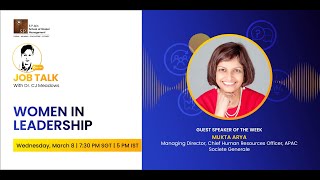
In this 2‑hour JobTalk episode, Dr. CJ Meadows hosts Mukta Arya, Managing Director and Chief Human Resources Officer at Société Générale, to explore women’s representation in leadership and practical ways to close the gender gap. The conversation opens with IBM and Harvard Business Review statistics that link gender equity to higher revenue growth and a healthier talent pipeline, then details the steep decline of female representation from entry‑level (≈50%) to C‑suite (≈8%). Mukta shares the personal competencies that propelled her career – consistent performance, emotional intelligence, resilience, continuous learning, and strategic networking both inside and outside the firm. They discuss how to nurture relationships efficiently using social media, the importance of being a connector, and the role of mentorship and sponsorship. Mukta outlines Société Générale’s APAC gender‑equity program: institutionalized women’s network, senior‑leadership sponsorship, promotion‑list gender parity targets, family‑friendly policies (flexible work, parental coaching, equal paternity/maternity leave), and a sponsorship program for high‑potential women. The dialogue also covers leadership style differences (empathy, authenticity), the growing scientific basis of HR (psychometrics, data‑driven assessments), and advice for aspiring women leaders and HR graduates seeking international careers. The episode ends with a light‑hearted brain‑teaser and a reminder that imagination complements logic in leadership.
Chapters
Hello and welcome to Job Talk with SP Jain School of Global Management. I'm Dr. Cj Meadows, your host, and we're broadcasting from the Women's Leadership Department at SP Jain Singapore campus. This is your chance to ask questions about your jobs, work, careers, and life mission. So if you have a work-related question or problem on any topic, doesn't have to be today's theme, Just type it in the chat and our secret moderator will pass it to us. We'll either help you solve your problem or at least help you laugh and know you're not alone. Time for some did you knows, otherwise known as notable news, to set the stage for today's talk. So, secret moderator, are you able to show us the slides? I'd love for everyone to have a visual, but if we can't do that, then I will talk you through some of the notable news. And 3, 2, 1. Okay. I'm live. I'll be alive.
All right.
This is from IBM's Women Leadership and Missed Opportunities Department. No, no, that's not a department. That's just the name of the series. Gender Equity and the Bottom Line. This should be interesting. Organizations experience a 61% higher rate of revenue growth when they designate the advancement of women as a top business priority, see gender inclusivity as a driver of financial performance, and fully support making changes to achieve gender equity. Interesting about the pipeline potential. When a woman sits in the corner office, that organization's pipeline, talent pipeline is filled with 23% more women than other organizations. How about pipeline as a priority? Among women CEOs, 72%, say their organizations have made the advancement of more women a top formal business priority. 83% of men CEOs say, "Meh, advancing women is not a priority, but they try to do it when they can." Totally different perspectives. The real kicker is this one. I saved the best for last. The shrinking pipeline. All right, so college-age workers in the U.S., women are 50%. This is cool, not bad. When we get to junior professional level in companies, I'm going to give you the 2019 figure and then the— actually, 2019 to 2021, everything went down. So I'll give you the 2021 figures. Junior professional level in companies, 35% are women. Senior professional, uh-oh, we're down to 30%. Middle manager, whoops, we went down to 23%. Senior manager, 20%. This is like an auction going the wrong way, you know, going down instead of going up. Vice president or director, uh-oh, down to 15%. Senior vice president, whoa, 13%. C-suite professional, uh-oh, 10%. And executive board, 8%. Now, according— final fact— according to Harvard Business Review, among Fortune 500 companies, 8% are led by women. And let's throw another thing into the mix. If it's women of color, 1%. Okay. Now, for those of you who love math, I know I do. Okay, Fortune 500 companies, 1% led by women of color. That sounds like 5 women in a world of how many billions of people? I'll let you do the math. So my guest today is Mukta Aria, Managing Director and Chief Human Resource Officer of Société Générale. And our theme for the day, yeah, you guessed it based on the stuff I've been saying, women in leadership. First of all, welcome Mukta, and thank you so much for being with us on this very special day.
Hi, Dr. Cj Meadows, it's a pleasure to be here, and I'm looking forward to our conversation.
Oh, super, me too. Now, okay, I've hit everybody with some fast facts, and you are not only a woman leader, but you're also working with HR, you know, all of the important resource, most important resource in any company. You work with the human resources, so you see a lot of women leaders and a lot of women who aren't quite able to break that ceiling that you broke through. So Can you share with us what really was useful for you in becoming a leader in a company? And number 2, what do you advise other women? What do you see? That's actually 3 questions. So you can talk now for about 2.5 hours.
It's a number of things. I've been with my current organization, Société Générale, for the last 17 years, actually. So it's my longest And I feel that for women, but for anybody else to grow in an organization, apart from your consistent performance, because it's important, that's, that for me is bedrock, is bottom line, is, sorry, it's the, is the baseline that you need to have. You also need to have an EQ, is, is really quite important. EQ, networking skills, really knowing how the organization works. And for that, it is It requires resilience, you know, it requires perseverance because nothing comes to you, you know, on a platter, whether you are a male or a female. And we really need to be, we really need to be patient because sometimes, you know, organizations go through ups and downs. But if you are able to stick on to the organization when they are down, then you also get to reap the rewards when things are going better. And for me, I think this has happened that I've been with the bank for some time. Really working, knowing my domain, which I think is very important. Continuous learning. And I think the moment when we stop learning and we think we know everything, that's the end of any career. So, so I think that, that is quite important that you continuously move with the times which are there. Really connecting with people internally and externally, it has been quite important for me and it has helped me in my career. You know, because people, when they know you, when they trust you, then also they give you chances to grow in the organization. And I think that is extremely important for anybody. Yeah.
Oh, can I interrupt just for a moment? You mentioned your connections inside and outside, and earlier you mentioned networking. And I remember seeing a study that showed that when men network, they tend to network inside their organization. So when they go to another organization, they, they have a big dip in productivity because they don't have their network. They didn't bring it with them. Whereas women in organizations, they network, tend to network outside. So when you hire a woman, she's not going to have that dip, but all the advantages of networking within the organization, especially upwards. She doesn't do as much of that as the men. Have you seen that in your 17 years at Société Générale?
Oh, for me, I think it also depends on personality of people. So people like, for example, I'm an extreme extrovert according to my Myers-Briggs profile. And for me, it's easier to connect to people internally and externally. And I think for me, I do internally as much as I do externally. You do both. And I think it's very important because when you do internally, you are building that web of network, you know, which is not with an agenda, but generally really getting to know people and keeping in touch with them on a consistent basis. It's not like when you need them, you know, that kind of thing. But externally is, you equally important because you, you know, the people, you know what's going on in the market, you are attuned to things that are changing, and then you can adapt. So for me, it's a mix of both, not one over the other.
So, so the external contacts will help you in your profession and help you deal with the marketplace. The internal connections will help you be productive and help you advance in that particular place.
Yeah, because when, when there is trust between the people internally, then your work-related issues get sorted out much more easily. So it's very important to build that trust in any organization.
Can I ask this about your networking internally? You said, you know, don't just make a connection with someone and then dump them. You have to keep in contact. Now, how do you keep in contact with your contacts without like being a real time waster, you know, just being one of those people who says, oh, can we have coffee? And you suck up half an hour, 45 minutes of somebody's time with no agenda or work to be done.
I don't go as far as only having coffees and all. I feel that in today's world, you know, with the, with the social media, it's so easy. With LinkedIn, for example, even if you are genuinely, you know, commenting on somebody's post, or for example, dropping them a note and say that, oh, you know, I was— I attend— like, for example, for me, these are real examples that I, I attend a course and I remember, you know, one of my colleagues from Paris, for example, and then I will drop them a note to say that, oh, you know, we were going through this and I remembered the time when we did it together, you know, or some kind of connections. But what I do is I do it quite quickly because otherwise I lose, you know, the momentum. And what I feel is that even those little, little things, or, you know, we have like a lot of employees across the world, and I have connected with them for some things in the past or met them in conferences and all. And, and suddenly, frankly, I will, I will write to them and say that, oh, you know, we were looking for a program and I heard that you did something, so can we connect? And I think that, that is quite, that is quite, um powerful than just, you know, asking for coffee for nothing. But for example, if we go to a location, I will maybe ask them, oh, you know, I'm here and we have not met for many years, do you— are you free for a coffee or not? And we just talk about the weather or family and other things. For me, it's a, it's a constant social media, Facebook, Instagram, etc. It is just keeping in touch, you know. Or sending them new things. It's very easy nowadays. Earlier it was difficult when you didn't have all these kind of things, but now I don't think we have any excuses not to be in touch.
So, so what you're— so what I'm hearing is use social media, sometimes face to face, you know, do just little pings, you know, not big time. And what I've heard from other experts on networking is that you're not just You don't just reach out to get something from people. Reach out to give them an idea. Oh, I thought of this and this might help you, or to connect other people in your network. You don't have to be the center to all the connections, but you can be a connector helping them connect.
Yes, connector is important one.
Yeah. Yeah. So, so how is it that some women really feel stymied and blocked. And yet you have made it to a very senior level. How— what's, what's the difference?
It's, um, I would still say resilience is one of the most important things where you are really able to take the, the downturns with the upturns, you know, that is important. Having a positive attitude, because I mean, frankly, if I don't believe in the organization or I get, you know, blindsided by when people are talking negative things and I refuse to go down on, you know, like in the downward spiral, I think that is quite important that you need to have that kind of an optimism, which again, it's a cautious optimism. It's not like completely, you know, I'm not completely fooled by what is going on.
I, I'm not crazy, but you see the positive and you can make use of it.
And, and for me, it's, it's the, it's a question of more positives than negatives, because nobody is perfect, no organization is perfect. So when you see more positives for you compared to the negatives, I think then it's a winning combination. So I think that is important. And, and again, it is really getting to know the people, knowing what works for the organization. And even though we may say that, okay, but this is a theory that we learned, you know, and I have to do it like this, those kind of things, I have to really look at what will work here. Can I make tweaks? Am I adaptable? You know, those kind of things are extremely important because things do not remain the same. We have changes every year, every week. You never know what's going to happen tomorrow in human resources. Everything is so unpredictable. So it's, I think, really how do you actually embrace the weakness or ambiguity is very, very important, at least in my field.
Last question before I move on to how you're managing your workforce. Last question on just you. Have you ever felt discriminated against as a woman? And yes, that could be over 17 years ago. It doesn't necessarily mean today's organization.
Actually, I have not, because in all the organizations that I have worked, frankly, I was promoted based on what I bring to the table.
Merit.
I really did not feel I have a seat at the table, you know, in my current organization. People do listen to me, and, and I really don't feel discriminated actually at all in my, in my various roles that I had. I have seen it, there are, there are employees who sometimes would talk about it and all, but personally for me, I have not felt. So I feel that I can do my work as a, as an employee, you know, without thinking I'm a woman or a man, you know.
So You're just you. So, so actually, I, I, I forgot, I lied, I'm sorry. I am going to ask one more question about you. Um, so you must be grooming someone to take your position so that you can move up. Is that person a woman or a man?
You know, in human resources we have mostly, we have mostly women.
Yeah, mostly women anyway.
I actually have in mind multiple, multiple successors, and it's a mix of males and females. So yeah, for me, I don't, I don't, I don't see, I don't discriminate based on sex, you know. So for me, good, who does the best job for the organization, yeah, would be the one.
So you're also doing merit-based, and that's, I, that makes sense. It's the way to go. About this time in JobTalk, people usually are waiting for a fun fact, a have you heard. So here's a fun fact from the Totally Awesome Book of Crazy Stories by Bill O'Neill. Since it is a key issue for leaders, succession planning, I thought I'd share this one. In the US, as many as 1 million of these are currently listed as the primary beneficiary in wills. Who is it? Privately owned dogs. Oh, so at least a million people are worried about their dog resources, not their human resources at home. Let's, let's return though to you and women in leadership. Now here's a reminder, everybody, if you have a work-related question or problem. Please type it in the chat. We'd love to address it. You've got free consulting from Mukta for another short time. So how about shifting to the organization? How are you ensuring that women are treated fairly and are included and making it up to the leadership ranks in your organization?
So in Société Générale APAC, so I will focus on that one, we actually started, we had women's network from 2010 onwards, but it was more ad hoc. In 2015, we decided to have like a proper institutionalized diversity and inclusion network with focus on gender network because we didn't want to say that it's only for women. For us, it's gender equity more because, you know, you have countries like China and Taiwan where you have more females senior positions compared to males. So, so we were looking at equity and not, not specially only women. However, the fact is that women in financial services— so ours is corporate and investment banking in APAC— women are still a minority, especially in senior positions. So like you were saying, you know, when we go up the rank, it just drops, you know, the number of people drops. Incredibly, it is. Yeah, I mean, there are a variety of reasons, but again, I think what we have to be mindful of is that it's still not 50-50% at senior level, you know. So when we start off at analyst, it is 51%, then it goes up, it goes down a bit, and then at MD level, we are right now at 28%. Now this is This is actually much higher than when we, when we started in 2015. It was 15% managing directors, which is our highest level, okay, in Asia Pacific. Now, I, uh, contribute— there are a few factors which led to this, and it was not easy in the beginning when we had the gender network, the cultural network, etc., all those things. The first thing is you really need to have sponsorship from the top. You need to have for diversity topics senior management committed and ready to push. Then you need to have employee volunteers, because if it is not— if you don't have those champions or influencers within your organizations who can champion the cause, it doesn't help that much, you know. So it's just then remains a policy. So in the beginning, it was more awareness about issues related to women and gender equity, so we were focusing on that, but will come to women, you know, because we are lesser women in the senior management than others. And then we started embedding it in our policies. So for example, when we are promoting people, we need to at least make sure that the equal proportion of women are there in the promotion list compared to our, you know, our total population. So if we are 41% women, we should have 41% promotees as women. In succession plans, we have targets globally.
If I can hop in just for a moment, I was listening to someone else who'd said in his company, they had to bring forth equal men and women CVs for a promotion. They didn't have to promote them, but they had to be on the table. That sounds like a key thing.
Yeah, yeah, we started it actually recently, though again I must say that it's not that easy because it looks good on paper, but certain positions sometimes you just don't have so many women in the market, you know, for our global markets, for IT. But again, we need to, we need to dig deeper, we need to make extra effort, and it does, it does move, the needle moves. I mean, as I told you, from 15% to 28%, We did move the needle by institutionalizing, making sure they are embedded in the day-to-day policy. It becomes a way of life. If we just do awareness, then, you know, it leads to— you need to go to the next level and make sure it happens. And programs do— they, they do help, okay? Even though, you know, there are some research which says that when you have women-only program, they do not help, but I think they do help, especially for Asian women. Because, I mean, there is a difference in culture. So the women are still considered as primary caregivers. We have employees who are highly qualified, but they are still primary caregivers for their families, you know. So it's, it's a different way of— the problems that they encounter maybe are very different from the Western world. So we do actually—
there was, if I can hop in, there was a really important, um, policy that I'd seen in a German company. Um, there was paternity leave, there was maternity leave, and it was equal. If you want additional leave, then you have to make sure that your partner has taken their leave in full, and then you both get the leave. Okay, so, so yeah, yeah, companies can do a little bit of re-engineering of society and of families, of personal circumstance. And the carrot of more time off, I think, is worthwhile. I would go for it, definitely.
So we did actually look at all those, the policies which are family-friendly, you know, work from home. Even before COVID we started piloting because we felt it was important. And now it has become a way of life, and it helps employees. Coaching, parental coaching, not only for, you know, the, the lady who is pregnant, but also for the spouse, also for the manager, because sometimes managers don't understand the changes, uh, that the women is going through, you know. So we did some— and sponsorship program which we launched, uh, in 2021, which was basically for international profiles and for women. So we did a number of things. And for me, I think it's not just one thing which will sort out the problem, it is multiple actions. Yeah, the same.
That makes sense.
That I managed to make some difference, you know, to, to our gender network objectives that were there. And finally, I think now after 7 years of that, I feel that it is something which is very much on the mind of managers. They think about it Systematically, I mean, most of them, I would not say everybody, but systematically when we have compensation review, they do look at the gender pay gap because we do have the data. And I think it's extremely important that this is adhered to strictly because otherwise you cannot move the needle. It's consistent efforts.
Yeah, not gonna have— I— speaking of women in leadership positions, have you seen, or do you self yourself feel about your own style. Do you think women have a different style of leadership to men?
It is, it could be either way, frankly, because there are some women who can act like men. And then, you know, but there are, I think, way more manly than men. Yeah. And then can be very strict and stringent. But I do feel that women leaders bring the softer touch, frankly, uh, the different perspective, uh, being females, you know. I think there is a different perspective which comes from being a mother, sister, you know, daughter, or, or whatever else you can have. Um, I do feel that there is, there is a difference. And when we are talking about various topics, women leaders do bring up Well, you know, some really interesting ones because they are looking at it from different angles. And I do think that they should retain it. And they should be feminine because it brings a lot of value to all the topics that we have.
You know, you're bringing to mind a study from the Center for Creative Leadership on empathy. So some of what I think I'm hearing is that women are very empathetic leaders, you know, or have that style just on average. Their study showed that businesses led by CEOs with a great deal of empathy actually do better as businesses. The financial performance is higher. And that relationship between empathy and business performance is even more profound in high power distance cultures. Mm-hmm. Such as Asia is, you know, you find a lot of that around Asia. So it sounds like research is backing up what you have just seen, that women are a little more empathetic and empathy is connected to better business results. So don't give up your style when you reach the leadership level, integrate it usefully.
Yeah, I completely agree. Because, you know, when you are genuine, you can kind of— which people can see, you know, people can understand when you are pretending to be somebody else, you know, authenticity.
I can smell it.
Yeah. And frankly, pretending something is very difficult. You get tired and stressed out, etc. So for me, genuine leaders, people can feel that warmth, you know, the way people talk, the way they actually make decisions, and all. And, and for me, I think genuineness is extremely important to be an effective leader and impact the bottom line.
Absolutely. Do you have any particular amazing stories that, that you've encountered as an HR leader helping people to move up, or mistakes people have made? Do any stories come to mind?
I don't know whether they are like big stories and all, but—
No, no, no, it can be very insightful.
Okay, so frankly, I've encountered a number of women in my organization, past and present, where women really, even though they are extremely competent, they doubt themselves quite a lot, you know, where they will say that— You know, I'm— this position is there, I would like to apply, but you know, I don't have these skills. And maybe, maybe 2 years down the line I'll be ready for it. Many times I have to tell them, no, you already fit the bill. It's just few things we always learn, you know, otherwise we will never be able to do things. So there— and I see it, I can tell you, many, many, many times And so many times I would speak to the women and say that, no, please apply for the position because for me you are an extremely good candidate. But we do have many cases like that where women have a little bit less confidence, maybe 50% less confidence than men who would apply for the same position. And it is the truth.
And I've seen that in people applying for jobs, not for promotions, but just applying to get into a company. Women will apply if they meet all of the requirements. Men will apply when they meet about half.
Okay.
Yeah. So, you know, if they're the only ones who apply, they get it. You learn the rest on the job. You're right.
Yeah. So I think those kind of stories are, um, are pretty, uh, pretty prevalent. Uh, and when we also interview, you know, women for director promotion, it also comes out Of course, there are some who are overconfident. But there are quite a few who do feel that, oh, they need to do this, and they need to do that to really be considered for that thing. So I find that, that it's still there, even after so many years of awareness. I think women generally feel like that. I really don't know what is the reason.
So I don't know, maybe it's high standards. I don't know. But we do have a question from Hetvi Jarwala. Mukta, could you please suggest a career path or a master's course for an HR graduate who's interested in business and psychology field from India, who wants to pursue a career abroad in Europe? So there's a lot packed into the question.
Yeah, so I think a master course in HR is, is, uh, is very important. It's the baseline if you want to enter an HR field. Because studies do matter. Sometimes people think that anybody can do HR. I do think that it's a mix of science and art, you know. So you do need to have understanding of how human resources psychology works. So, so for me, I think it's important that you are doing psychology. If you want to pursue your career abroad, for me, I would think that first you should, first you should work in India, okay, in for a few years. Get that, um, application of the knowledge that you have acquired from your master's course. Yeah. And then easiest thing is to get transferred from your same company. So I did the same. If I would have applied directly, uh, you know, to, to a position in Hong Kong, I don't think I would have got it because there are plenty of people who are available, you know. And normally when you have done HR, etc., people want to look at people who are from the same country. It may not be true anymore now, but I still feel that if you have done it in India, work there, gain some experience, then you become a more marketable kind of, you know, professional. And if your company can transfer you after 2-3 years, it's the best, because when you move with the company where you have worked and they know you, they will— and if they give you offer somewhere you will have the time to learn. Whereas if you join a company directly in a foreign country where you know nothing about, then, you know, people are looking at you and then saying that, oh, but this person does not know this. So you don't have the learning curve which is there. So that's my advice. But of course, you can, you can try directly. In Europe, you need to know the languages. So if you want to work in France, I think French is important. I work in a French organization. I don't need it here, but If I want to work in France, I think definitely language will be useful.
Yeah. That makes sense. That makes sense. Now, um, Hedi mentioned business and psychology in HR. What do you think of psychometrics?
Frankly, psychometrics are very important. And people who think that in HR you don't need the quantitative part, I think it doesn't work at all nowadays. Yeah, and psychometrics are, you know, I did in my MBA when I was doing it, we did have a chapter, not, we had a course on psychometrics. It was a, it was a, uh, what do you call it, elective. We did, we did that. And I think it's really important because when we are doing surveys, when we have assessments, etc., psychometrics are extremely important. So HR is highly scientific now. It is very important. And if you master that, I think you have a wonderful career in HR. It's not, it's not just qualitative anymore.
That's beautiful. And you're going to have to know something about tech and AI and etc., because increasingly humans and machines are, are, you know, trying to achieve some synergy, some productive synergy. Matter of fact, you mentioned Myers-Briggs a little while ago. And I'd like to make sure our listeners know that that was actually Mrs. Myers and Mrs. Briggs, a mother-in-law, daughter-in-law team in World War II. And the whole reason the test was put together was because all of a sudden men went out to fight and millions of women needed to go into factories, offices, businesses, and so forth. Had no idea what job to take. So psychometrics have many of— if they're like HPD, uh, HPDI and MBTI, a lot of them have their roots not just in psychology but in the application of psychology in business, which Hetfi is very interested in. So now if you If you— if somebody asked you for some words of wisdom to women professionals who want to enter the leadership level, what would you say to them?
I don't know about words of wisdom, but I would— I would recommend—
don't be overly modest.
No, no, no, not that, because, you know, frankly, I think word of wisdom is a big term. I do think that women in leadership positions, we really need to have conviction in our own abilities. And if we don't have that, you know, that term we talk about, imposter syndrome and other things, etc. Right. For me, nothing is impossible. I mean, if you want a job, you are not ready for it, you can learn, you know, you can learn before and you can learn after. You don't have to be perfectly fit for that. I think it's important that we have conviction in our own abilities, either to learn it or in our domain knowledge. I think it's extremely important. We need to, we need to make sure that we are not getting into the stereotypes, or we don't have to, for example, go for drinks and all, or drink alcohol, you know, just to be part of the crowd or part of that. It is not necessary. You can still drink orange juice and then still be in meetings or still be in drinks parties where you are networking with people. So for me, again, it's, it's important to be true to yourself, your authentic self. You don't have to pretend to be somebody else, you know. If you like to wear big earrings and you are working in a very stiff kind of environment, I mean, do it. Otherwise you will feel completely, you know, constrained and claustrophobic there. So for me, I think it's important to be true to yourself Really be resilient. This again, because even though people started talking about it more, you know, during COVID and other things, but resilience is extremely important. You will have ups and downs in your personal life, professional life, and all. Are you able to really—
the word failure, you will fail, you will fail.
And yeah, how do you get up, you know, after that failure? Now, you know, it's like when I was growing up and I was learning, you know, my sister taught me how to ride the bicycle. And I would fall down so many times before finally I learned it. But if I did not fall down, I will never learn. So there are those things which are important. And I still think continuous learning is very important for women leaders, or for anybody else. And having really mentors, you know, informal, formal mentors are important because sometimes you do need to have sounding boards who can talk to you. It, it could be mentors, but it could also be your best friends.
Should the mentors be men who are higher up in the organization, or should they be women I mean, how would you— if there aren't a lot of women higher up in the organization, you can't impose upon every woman leader to mentor 100 women under them. You go outside for a female mentor, or do you stick with a guy inside, or what the— hey, take both.
I think it's both. It depends on whom you click with, because even if you may have many people in the organization and you may think they are very good, but you may not have the chemistry. And as we know, in the mentoring relationship, if you don't click, it's not going to work, you know. So for me, it's trial and error. And, and you are basically, you know, sometimes it's your ex-bosses. So I'm, for example, in touch with my ex-bosses, and they are my mentors. Sometimes I go to them. Or for example, there are people in the organization whom you really feel that kind of a connect, you know, and then you build that relationship. Out saying that you talk over a period of time. It's just somebody whom you can discuss things with or who can give you advice and you value it. I think that's important.
Absolutely. Well, about this time, listeners usually want to hear a puzzler. So these are from The 125 Best Brain Teasers of All Time by Marcel Danacy. Last time I asked the audience, how many pets does my friend have if all but two are dogs, all but two are cats, and all but two are rabbits? You can tell we love creativity around here, which I think is also important for leadership. And the correct answer from no one is 3. Well, let's explain. Let's think about it. Since there's only 1 dog, they're all dogs but 2, since there's only 1, the cat and the rabbit. Since there's only 1 cat, they're all cats but 2, the dog and the rabbit. Since there's only 1 rabbit, they're all rabbits but 2, the dog and the cat. So today I thought I would give you folks this one. Um, because it features a clever woman. Before they're blindfolded, 3 women are told that each one will have either a red or a blue cross painted on their— her forehead. All right, now when blindfolds are removed, each woman is then supposed to raise her hand if she sees a red cross and to figure out the color of the cross on her own head. Oh my God, this is getting complicated. Now here's what actually happens. The 3 women are blindfolded and a blue cross is drawn on each of their foreheads. The blindfolds are removed. After looking at each other, the 3 women do not raise their hands, of course. After a short time, one of the women says, 'Oh, our crosses are all blue.' How did she figure it out? Now, if you think you're as clever as this woman, then just send your answer to this week's challenge to jobtalk@spjane.org. And remember, as Albert Einstein said, logic will get you from A to B, imagination will take you everywhere. Well, it's happened again. You have squandered another perfectly good hour listening to Job Talk. Thank you so much to our esteemed guest, Mukta Aria, and we'll see you next week.
Ah, thanks everyone.
More from Dr.



Leading Innovation for the Corporate Business Through Impact | CSI Insights Ep. 7

AI Transformation: Is the Consulting Career Model Breaking Down? | Dr. C.J. Meadows | S1E5


CIO Leadership Live ASEAN with Dr CJ Meadows, S P Jain School of Global Management


Usha International - Tiger Center Sewing Center 2025 - Now a Learning-and-Production Center


