You're not too young to be an Entrepreneur - or follow your Dream: JobTalk with Dr. CJ & Mr.Matthew.
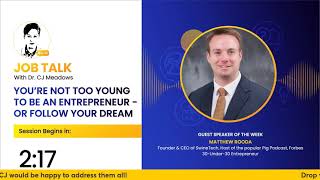
Matthew Rooda, CEO of Swine Tech, grew up on an Iowa farm and built a company that stops piglet crushing, which costs the industry $8 billion annually. His wearable device uses voice recognition and a TENS impulse to alert sows to stand. The pandemic pushed him from hardware to a farm-management platform now used across the US, Canada, and beyond.
Chapters
Hello and welcome to Job Talk with SP Jain School of Global Management. I'm Dr. Cj Meadows, your host, and we're broadcasting from the Entrepreneurship and Dreams Department at SP Jain Singapore campus. This is your chance to ask questions about your job, work, career, or life mission. So if you have a work-related question or problem on any topic, doesn't have to be today's theme, just send an email to jobtalk@spjane.org and our secret moderator will pass it to us. We'll either help you solve your problem or at least help you laugh, and know you're not alone. Time for a did you know notable news to set the stage for today's talk. The global agriculture market tops US $12 trillion, growing at a healthy 9.4% per year. In non-industrialized countries, 60 to 80% of farmers are women. So any help to them furthers the UN's Sustainable Development Goals. Final fact: preventable pig deaths cost the agriculture industry $8 billion a year. My guest today is Matthew Rooda, co-founder and CEO of Swine Tech, host of the popular Pig Podcast, and Forbes 30 Under 30 entrepreneur. Our theme for the day is you're not too young to be an entrepreneur or follow your dream. Welcome, Matthew, it's great to have you here today.
Uh, thanks for the opportunity to join you.
So I wonder if we could start off with a little background on why on earth did you get into Pigs and audiology. What is Swine Tech all about?
So I grew up in animal agriculture. My grandfather had the traditional backyard dirt lot family farm. I worked with him growing up a bit. My dad managed more commercial operations for a local, uh, local company. And then I had the opportunity while growing up to work for a variety of other producers, uh, doing contract work and driving my four-wheeler around and, uh, kind of creating a business of itself. Uh, I had the opportunity then to go to the University of Iowa, and I was actually going there to study genetics and biotechnology in hopes of being an obstetrician. And that led me down a couple of interesting paths. One of them was working in nursing homes and hospitals. And while working in nursing homes and hospitals, I had the opportunity of witnessing various sensors and technologies and management strategies that really drove greater efficiencies, employee engagement, and pay, and, uh, and patient care. And so, um, that really inspired my entrepreneurial journey. Uh, Swine Tech is an ag tech company really focused on empowering pork producers worldwide to provide each and every pig with high-quality individualized care. And our journey started with voice recognition technology and has now evolved into point-of-care management platform.
Whoa, no, wait, wait, wait, wait, wait, wait. Let's go back. So, I mean, this, this, this idea didn't just come out of, oh, I see tech and, oh, I work in agriculture. Um, how did you first come up with the idea of rescuing little piglets? And there was something about making the mothers stand up and something about the difference in baby cries. What was all that?
Yes, so in pork production, the vast majority of piglet deaths happen from the mother rolling on them, uh, during the birthing process and shortly after. And so this can be from her laying down and piglets running underneath of her to try to, to drink milk. It could be from her finishing up a nursing bout and little pigs chasing, uh, to try to get more food, or just being in the wrong place at the wrong time. And as a worker in these farms, you can very quickly learn what is the sound, the rhythm, the frequency of a piglet getting laid on. It's screaming for its life. It's a breath, squeal, breath, squeal. And I thought, there's got to be a way for us to use voice recognition algorithms to automate this process and then find a better way to alert the mom to stand up. Because today You have to run for your life to go find this pig, and then before it suffocates, which is only a matter of seconds, and then alert the mom by kind of pushing on her to get her up and lifting up, uh, her body off of that piglet to save its life. And so we wanted a more autonomous approach for that.
Wow. So now, um, can you walk us through this process of— okay, you've been working with the pigs, you know the squills are different, you know the importance of saving the piglets. Um, how did audiology and AI and voice recognition come into this?
Uh, very slowly. So I, I knew there had to be a way because Amazon Alexa was really a hot topic at the time, and I'm like, well, yeah, if, if they can do the things that they're doing— there's another technology called ShotPoint, which was basically microphones in communities to be able to triangulate public shooting events.
Wow. I mean, we have— we haven't— we haven't tried ShotPoint, but Alexa talks to my husband more than I do.
Yeah, yeah, it feels like that anymore is the— is the case. And so we— we went into a farm and for a year recorded as many audio samples as we could. So tried to take cameras and recording systems to capture real-life events and then use those to train an algorithm on what a piglet crushing event truly was. And what we had found was that a piglet crushing event and pigs fighting for milk can sound almost identical for the first 7 to 10 seconds. But after 10 seconds, you could clearly identify and distinguish a piglet that was fighting for its life. And then we developed a lightweight wearable with a medical adhesive.
Wait, wait, wait, wait, wait. Here's— there's something key here. Yeah. So you wanted to study medicine, so you know something about health and the mothers and everything. You know about agriculture. So were you also getting a degree in, like, computer science, engineering, software development?
I wasn't. I had no background or interaction with software development or engineering at all. Um, I, uh, we started this, went 4 months in, and then we found somebody to join our team that did. But it was just pure ambition, um, and, and genuine, uh, confidence that, you know, we're gonna find a way. If this could be solved, we're gonna find the way.
We're gonna find it. So there's a good deal of hubris, and every entrepreneur can tell you, you have to Um, but you just said we, so who's we? Did you— didn't start it alone?
No, a really good friend of mine named Abraham Espinoza. He was an immigrant from Mexico, uh, who I met at college, and he was studying computer science. And early on, we thought that was going to be the route, and then we learned very quickly, when you're developing AI algorithms for, for voice recognition, a couple years in school is just not quite enough to be able to compete. So he quickly moved into an operational role with us, and we went and found a third co-founder named John Rourke, who had decades of experience, uh, really developing solutions in various fields. And, um, we, we met him at an event, and he was from Arkansas. We're in Iowa, so we're talking 12 hours driving apart. Yeah, that's a long way, long ways. And, uh, he grew up in the same hometown we did, that I did, of 10,000 people. And so there was these weird synergies, it connected really quick, and we kind of moved on from there.
And, and this is really interesting, it started with a friendship, it started with some personal experience type ideas, but you weren't just a bunch of kids in a garage. They were— you had an older member with a lot of experience as well. And are all three of you still in the team?
Yeah, so Abraham and I are. John decided during the initial stages of COVID to move on and pursue some other things that he wanted to do. He was— he's a very good prototyper and kind of wanted to go on and do some other things there. So that was, that was good for him. And Yeah, early in the early stages, we went through a couple accelerators to really, um, ah, that was the next question. And yeah, it's, it's been, it's been fun. Wow.
So you went through a couple of accelerators, and how did Forbes 30 Under 30 get into all this?
Yeah, yeah. So the, the first accelerate, or the, the first big accelerator we went through, they came and found us 3 months in. They said, hey, we want to give you $25,000 We'd love for you to join the program. Uh, we only wanted 10 teams, but we're excited to bring you on as the 11th if you're interested. But you have 24 hours to let us know because we're at the very end of, of getting this figured out. And we need you to drop out of school for a semester. Uh, yeah. And I was going into my senior year prepping for MCAT, doing all that stuff. And, and so that was tough. But my buddy and I decided we were gonna do it. And so we decided to quit school. We quit school for a semester, and we went back and graduated, but we did quit school for a semester. And my parents, they were very supportive, but at the same time very concerned. Are you ever gonna go back?
Yeah, yeah. Well, I'm certain Bill Gates's parents were kind of upset too.
I bet. Yeah. And so that was, that was kind of fun, and, uh, that really taught us how to treat it like a full-time business. Even if we weren't selling anything at the time, it, uh, instilled a routine in us on what we needed to be doing. And I think that has led to a lot of success. But Forbes 30 Under 30 came from us competing in a lot of pitch competitions. So at the time, pitch competitions were fairly new. They were popping up all over the place, and we decided we were going to apply to them all. And Iowa— the University of Iowa They told us if you get accepted to a pitch competition, we will pay for your travel and your lodging because they were really trying to get their name out there.
No limits on this, did they?
They set no limits. Didn't you think it was a win-win? No, it was a win-win because we went out and, oh, I think we won 26 of the 31 that we competed in and brought in $350,000 in startup funding that allowed us to truly get to that next level. And one of those competitions was the Lemelson-MIT Invention Award. And so with that award, they had actually worked very closely with Forbes, and that's how we got on Forbes' radar. And, uh, then Forbes, uh, reached out to MIT, MIT reached out to us and they said, hey, you really should apply. Let's get something put together. And, uh, we ended up getting announced as the Forbes 30 Under 30, uh, manufacturing and industry.
Wow. Now, it— it— I'm, I'm certain it would have been really tempting to just focus on your product, just focus on the business, but this, this competition thing must have taken a huge amount of time.
Not a crazy amount, but at the same time, when it's hardware and you got to get all the data, uh, it was easy to manage them in parallel. Um, not doing the business plan competitions wouldn't have necessarily helped some of the other stuff go faster, and we needed the funding. When you're a student and you have a hardware device that you're trying to create, startup funding can be very, very difficult. And so we needed to be very creative about how we were going to access that capital without substantially diluting us too early in that innovation process.
So did the actual competitions, you know, did, did preparing yourself for those improve your business?
Absolutely. And it introduced us to partners and investors and other groups. So most of our seed funding came from individuals and investors that we had met at those competitions. And I think there was a certain level of social proof that we got from winning where investors in the room could be like, well, I guess if I throw a little money into this one, I can't be all that wrong. They did win. So I think there was some social proof that helped us get individuals and angels to jump in and maybe give us money that might have not otherwise.
Oh man. So that is a, that is a huge tip for everybody watching to go ahead and involve themselves in those competitions, accelerators, get your startup out there. Even before you have a product, even before you've sold it to anybody.
Yeah, we were always told by our first, uh, lead mentor from the first accelerator, he says the biggest mistake a lot of startups make is they get into people's minds and then they're forgotten. He goes, ah, you cannot be forgotten. Make sure you stay on top of everyone's minds in this seed stage. Because you, you need to stay relevant. Otherwise, going out and finding capital can be very difficult. So figure out ways, attend events, just be in front of people and stay relevant. He said that's just one thing you can do to give yourself a slight edge.
So wait a minute, other than sending Christmas cards, what are you doing to keep on people's minds? You're not just getting on new people's minds, you've got to stay on their minds.
Absolutely. So we did like, uh, updates, newsletters every month for those who were interested. We went and attended some Rotary events where we talked to, uh, local individuals through that, um, got involved with the local government and the state governments, uh, for the events that they were having for entrepreneurship, uh, the universities when they would put on events, we would attend and show up for that, and then tried to get as many speaking engagements as possible. So in reality When I look through my lens today and sales and what we're doing to really grow our business, it's not a whole lot different from those events that are relationship-driven. So relationship-driven business is not all that different from getting seed funding for, for a startup. You are focused on being in front of people, being seen as a thought leader for whatever you are trying to accomplish, and then making sure that you are being trustworthy and, uh, and respectful through that whole process. So Um, it's, it's crazy how similar both processes can be, whether it's a customer or a group of investors.
Brilliant. Now you mentioned that there's some hardware involved in this stuff that you're doing. So what, is there a little forklift that lifts the mother, or how does— you know, what actually works on the ground?
Yeah, it was kind of like a baby monitor and a wearable, so we had this monitor that was sitting in the pen with the pigs, and that was what was listening and talking to all the other baby monitors on a mesh network. And then it would triangulate the position of the pig and basically say, all right, it's in this pen. Because we're talking about hundreds of piglets. I mean, it can be anywhere, and you're in a room and it's echoey. So we really had to triangulate that piglet. And then we needed to alert the sow to stand up, which was problem number 2. We tried all different types, uh, like we tried sound, but all the pigs would get up if it was too loud because it scared them all, and that wasn't good because then you're increasing the prevalence of the problem. Um, like food or water wasn't nearly as, um, they already have access to food, so it really wasn't very exciting. Um, and so we had to look at how do you startle an individual mother just enough to get the pressure off of the pig. And so dog collars have been used quite often for conditioning, and we kind of looked at that. But for whatever reason, that, that when we worked with welfare, um, individuals and animal health specialists in the industry, that was probably not going to be the right path from a welfare standpoint just because of the, the strength of it and the, uh just how, how that process works. And so we started to look at chiropractic TENS impulses that are used for muscle and nerve therapy, those things you put on your back to help stimulate your muscles. And, and that was just enough to make the animal go, what the heck is that? And, and roll over or sit up. And that allowed the piglet to go free. And so we did research with Kansas State University on that, and Temple Grandin— I don't know if you know who Temple Grandin is, but she's a world-renowned animal welfare specialist, um, on the autistic spectrum. And so she's very, a very great advocate for, for that group, and she's just amazing. And she actually served as one of our advisors through that process, so that helped us a lot. And that allowed us to kind of figure out problem 2, which was how do you get a mom to stand up in a safe, healthy way? And then 3 was how do you put something on a pig and get it to stay there, right? How do you put something on a pig and actually get it to stay there? And so we tried like a belt. My grandma took Copper Fit belts, the Brett Favre like health thing, and like sewed them together. So we made this big like weight, like squat band for a pig. And that was, that was stupid, but it got us a little further. And then we eventually got to an adhesive patch, but we needed to test over like 60 different adhesives that were medical grade because they had to be good for the skin and not leave a rash, but they also had to be strong enough to stay for continuous days. Oh, we finally found one. Had to go to Japan and Vietnam to figure that whole process out, but we eventually figured that out and created a solution that could, with a monitor, identify a crushing event with the wearable attached to the sow with a medical adhesive then deliver a chiropractic tense impulse to safely alert her to sit up and let the piglet run free.
Oh my God, what an amazing, amazing invention, project, and company. This is awesome. I'm going to interrupt us just for a minute because it's time for a fun fact. Have you heard? These are from the Totally Awesome Book of Crazy Stories by Bill O'Neill. Speaking of farms, land, agriculture. A few years ago, an Australian man tried to sell some land on eBay. While this is not entirely unusual, he described it as a country with very ordinary weather. Sadly, even after the sale price reached over $3,000, eBay had to pull the ad since he didn't actually own the property. He was trying to sell New Zealand. Yeah. So, so tell me, tell us a little bit more about the— after you figured out all of this and exactly what product, how have you managed the growth since that time?
Yeah, so it's been a wild journey. We successfully developed the product got it in the field, commercialized it. And what we were finding was we had about 4,000 hours of video footage on the device and saving the pigs, and we knew it was working, and it was working really well. However, when we got it out to customers, it was very inconsistent what the throughput improvement was. Uh, what we were finding was we were saving the pigs, but the success or failure of the pigs we saved varied considerably from farm to farm. Because we're very early in that pig's life, which means there are countless other processes and other care that needs to provide— be provided in a compliant way to give that pig the greatest chance for success. And we learned that we really had very little control at the end of the day over our value. We had control over creating value, but we had no control over sustaining that value through the system. And so we started talking to other technology companies in precision tech, and we found they were facing the exact same problem. Oh, and we needed a way to solve that. And so enter COVID. So with COVID it broke our supply chain. Producers had nowhere to sell their pigs. They were losing money hand over fist. COVID then started hitting people in the facility, so there was nobody there to take care of the pigs except a few people who were getting burnt out. And producers were basically like, we're not investing in technology for at least a year. Like, we are— we have to be focused on what's going on, rightfully so. And so we realized that we had time to really pursue something that was going to help fix the problem we were facing. And this catalyst, which was COVID, created more of an opportunity than a crisis for us. The first week it seemed like a crisis, but we sat there and really tried to figure out how do we make the most of this bad situation. And so we started to think about that, and that's when the light switch came from healthcare again for me. And we were trying to figure out process compliance. Labor efficiencies, employee engagement, pig care, and patient management systems and point-of-care platforms in healthcare do just that. So I started to do some research and found that healthcare is a low-margin business. Their biggest issue right now is labor, and definition of success is throughput efficiency, cost management, and care. And then when you looked at the day-to-day processes that I worked through and that nurses work through, there's a routine of care, there's documentation and treatment intervention, there's entertainment, and there's also tragic events that can take place. All of that lined up similarly. And so we decided that we were going to work with local hospitals, local universities, and create a prototype of using patient management systems and point-of-care platforms as a solution to everything we were facing in pig production. And sure enough, through this research, we also found that the technology companies in human health were facing the same problem. You know why? We have sensors throughout nursing homes and hospitals that are supposed to tell us there's problems. It might be a pull cord, it might be a false signal, but we used to only have lights outside of the doors. And if a nurse walked into a hallway and they saw there was a light outside the door signaling there's a problem, they might see 8 lights in a hallway. Well, which one do I come to first? Yeah, and because you can't prioritize based on need, the value of that technology would be constantly inconsistent. And so they created patient management systems to help drive those emergencies through SOPs and prioritize emergency care for caregivers alongside daily workflows, administrative tasking, improved communication, and records transmission. And so we really brought that to the swine industry, and now today are working with over a few million pigs um, in the US and Canada, expanding potentially here soon to Australia, Spain, and Mexico. And it's been an exciting event, but we took full control over process compliance, over pig care, and helped put people in the right place at the right time more consistently. Not because they weren't trying, but because time management in a farm with so much going on is so hard. And with labor being so, um, so diverse today, there were so many bilingual language barriers that existed in the U.S. and in Canada and in the other places. And so we were able to make it easier for somebody from Iowa who didn't speak Spanish to work alongside and communicate efficiently with someone from Mexico who didn't hardly speak English. And it's really translated into more pig savings from a life-saving standpoint than SmartGuard was able to ever, ever able to do on its own. So it's been quite the successful pivot, and it was, uh, quite the journey.
Oh my gosh, and I wonder if in future some of the things you learn in the agricultural environment can be transferred back to hospitals and nursing homes to save human lives as well.
It's really cool. They're actually doing some of that. They're using computer vision in pig production to identify if an animal is developing a limp or like an injury that would be life-threatening, so that way they can intervene more quickly. And now in people, they're putting cameras in hallways to try to do the exact same thing so that they can identify— maybe somebody fell and we never knew about it. The best way then to figure it out is, are they limping today? Is there a substantial change in the way they walk? And if so, we might have identified a life-threatening event earlier than what we ever could have before. So it's really cool how it's crossing boundaries.
Absolutely. As a matter of fact, there's in, in human healthcare for the elders, there's something called a Magic Carpet that tracks your gait. When you're walking. And when your gait changes, it can alert your caretaker, your daughter, whoever, that, uh-oh, uh-oh, Gamma's gait has changed. We predict that she'll fall in about 3 days. So there are some of those kind of things that can be built even into your floors, or can be, you know, it could be cameras tracking your gait as well. Brilliant. Now, uh, we have a message from Farah Naz saying, this is so inspiring. It's not only business but actually caring for life. And that brings me to the next question. Oh, okay, before I get to that, if any of you out there do have any questions about entrepreneurship, crossing boundaries, the work you do, the work you want to do, anything at all just send an email to jobtalk@spjane.org. So I hate to bring it up, but you are saving lives, but there are lives that are going to get eaten later.
Yep.
How do you, how do you feel about that? How do you think about that? And does it, at the end of the day, are how do you stay excited about saving that life for a short period of time?
Absolutely. So I actually was having a really good conversation with an animal welfare specialist down in Melbourne, Australia, and I think he said it best. Everything that— the, the role of a, of a farmer, of a producer, is to provide a good life and a humane death. And to us, when we look at it, was suffocating underneath of your mother, uh, because you ran under. And, and piglet crushing, that happens in pasture farms even more so than traditional farms. It happens everywhere. It is a— it's a side effect of domesticated pig production, and everyone's trying to find a variety of ways to fix it. But it's not a humane death to, to suffocate and get crushed underneath your mother. And so we wanted to find a way to fix that. And then there's a sustainability component for every pig we save, it's a better utilization of the land, of feed and water. It's just better for the pig, it's better for the producer, and it's better for the environment. We like to say when we think about providing care in pig production or in any livestock agriculture, better welfare leads to better profitability, it's at least better sustainability. They're all intertwined. The more efficient we are, the better survivability rates we have, just the better it is for the producer, the environment, for the pig. So everybody wins when we, when we have lower mortality rates and provide better care. And so that's what drives us.
I love it. And, you know, speaking of sustainability, like the Sustainability Development Goals, not only do we need to be caring for good stewards of our resources, and getting food out to people who need it. But also, most farmers in the world are women and, you know, face very different opportunities from their male counterparts. Now, you mentioned some of the countries you're going into. Are you going to be going into some of the lesser developed economies? And why or why not?
Yeah, so some of the lesser development economies are much more backyard production that, uh, labor efficiencies, workflow automation, a lot of that is a lot less important. It's a lot less of a need. Now as we grow and we bring SmartGuard back and focus on that a little bit more after this platform is more, um, more globally present, I feel like that technology can have an impact in those environments. But the workforce automation and, and management, it's, um, that's going to be much more geared towards like China, Thailand, Vietnam, Australia, as opposed to some of the places in Africa. But South Africa is really developing as a grower of pig production. We'll really see what happens in Africa as a whole. But I think that's one of the— I mean, that is a continent with so much opportunity. And it's just gonna be a matter of, do we get there? Poultry starting to take off in Cameroon, and we'll just kind of see what happens.
Terrific. So for now, it's the big producers, but maybe someday you can— anybody could strap a belt on the pig, use your mobile phone, and you're ready to, to save some lives and, and be good stewards.
Absolutely.
Let's get back to you as an entrepreneur and your career. I mean, as far as I remember, you never envisioned being a founder and CEO of a swine tech type company.
Yeah, correct. I'd never— I was not looking for a problem to solve. I was not looking to be an entrepreneur growing up.
So many tendencies, all, all the things that you want to be a doctor, for heaven's sakes.
What's that?
You wanted to be a doctor?
I wanted to be a doctor, which looking back was probably not the right, right decision. But yeah, I mean, growing up there were so many things that I was doing to be creative and be efficient and, uh, and start little businesses, but I had never thought of it as a high-growth tech startup. That was just never anything that came to mind. But a lot of advice I have for individuals aspiring to be entrepreneurs comes from the route that I have taken. And that taken— that route was I put myself in an environment where I was trying to be successful. I applied a strong work ethic and a dedication to being the very best at what I was doing, and things held me back. And I quickly learned that the things that were holding me back were holding others back. And then I did research and found out that this was a bigger problem than just a billion-dollar problem. And so I think by applying ourselves in whatever field we're interested in, we're always going to find a barrier. And then it's just a matter of, is this barrier that I'm facing a billion-dollar problem? And, and that's ultimately what happened.
Okay, that makes sense. And so there's tons of opportunities out there that you could be taking advantage of, but Prioritize, get the big one, um, because all the entrepreneurial journeys are going to be hard.
Yeah, yeah, it's going to be hard, and you got to experience the problem, right? You need to know the pain point, and, and just thinking of a problem is so hard. And emulating what you see other people solving, if you don't have your core philosophy how you're going to solve it— what is it, uh, it says, uh was it success breeds imitation and imitation breeds failure? Because people want to imitate success and yet don't truly understand why that person, idea, solution was successful. And so when they imitate it, they miss the core identity and the core things that mattered, and it ultimately fails. And so it's so—
the idea they didn't really get, and then they're doing it somewhere else where just copycatting isn't gonna work.
It isn't. It needs to be authentic. And the only way to be authentic, in my opinion, is to experience it, to fight it, and to try to solve it without the solution.
And, you know, you had, you had deep, deep knowledge from a number of different dimensions. You knew pig farming. You, you got your hands dirty in all the tech. You had some, had training and got your hands dirty in all the business issues and so forth. So that depth of understanding and getting your hands dirty is absolutely necessary. Yeah.
Yeah. Yeah. We were probably up till 4 or 5 in the morning in a farm during school collecting data. And so, yeah, it's not going to be easy in any way at certain points of time. And it's, it's, it's a journey and it's fun. If, if, if you're passionate about it.
Absolutely. And you can't expect rewards in the early phases of that journey. It's— that's not going to come till later. You just have to keep doing it for whatever reason, but not because anybody's buying your products, because you don't have product yet.
You don't. You got to find small victories and you got to create wins and find ways to create wins, uh, to keep yourself inspired and excited. Because yeah, it's especially with hardware, it's a long road before you start to get customers and you get to see their faces and, and that inspiration and that victory starts to drive you.
So the hallmark of someone who succeeds at Zero to One is persistence.
Absolutely. Just keep going.
Now, okay, you're in a position that you kind of originally hadn't envisioned. Where would you go from here? I mean, yeah, you're gonna be an entrepreneur forever? Are you gonna do other things? Are you gonna be that doctor, do more ventures?
So it's hard to answer because at this time I'm so focused on what we're going through. Um, I'm sure after this stage, the next stage will, will become clear and, and prepare itself there. But, um, I, I'm, I'm excited about the industry I'm in and what it's doing to, to help feed the world. But I'm also excited about a wide variety of other interests and, and, uh, and industries. And so I think right now the, the future is an open book, and we'll, we'll finish this chapter out strongly and see where it goes from there.
Totally makes sense. And final question for you. Ah, at last she's gonna stop asking questions. Now, you've given some beautiful advice, um, to entrepreneurs All right, do you have any final advice for entrepreneurs, dreamers, anybody before, before leaving the stage?
Yeah, passionately pursue something. Doesn't have to be a business idea. Passionately pursue something, and in that something will breed ideas. So passionately pursue something stay curious, and don't be afraid to try something new. I think those are the 3 things that I would say I would recommend to aspiring entrepreneurs or anybody out there who's trying to make a difference.
Beautiful. I love that. So now I think it's time for a puzzler, folks, and keep thinking of questions to ask Matthew. You've got him here on stage right now. Um, Let's do a puzzler and give everybody a chance to send in some questions for Matthew. Alrighty, from The 125 Best Brain Teasers of All Time by Marcel Danesi, last time we asked: A man takes his car to a hotel, and the morning he arrives— the moment he arrives, he's declared bankrupt. Why? And the correct answer from No one sent the answer in. Correct answer is he was playing Monopoly. Now today, since we're on the topic of animals, I thought I'd give you this one. Here's this week's puzzler: How many pets does my friend have if all but 2 are dogs, all but 2 are cats, and all but 2 are rabbits? Say it again. How many pets does my friend have if all but 2 are dogs, all but 2 are cats, and all but 2 are rabbits? Just send your answer to this week's challenge to jobtalk@spjane.org. And remember, as Albert Einstein said, logic will get you from A to B, Imagination will take you everywhere. So we've got 4 minutes to explore some final questions for Matthew. Nobody has sent any in, um, but I gotta ask you something that I happen to know a little bit about Matthew because he was featured in my first book on lateral innovation, Fusion. One of the things you did as a young professional still in school was to become the boss of somebody, I think it was over twice your age.
Yeah.
Who had been in that firm for a long, long, long, long time. Here comes the kid. And now you're also a young guy. With a staff— I haven't asked the age of your staff, but here's the kid with the ideas. How do you manage that?
It was hard. It was probably a poor situation to put somebody in, uh, but it's just the best we had. And so I had, uh, I had been around, and yeah, they had promoted me over an individual that had been there for a while. And I think to have successfully navigated that as best as possible, a lot of patience and grace, uh, was the best approach. But I was, I was so ambitious about going and doing things. It was kind of like, join, join the ride, let's go. And, uh, so yeah, I think when you're in those situations, it's gonna be really hard because, yeah. There is a perceived way of doing things. Um, there is a clear experience gap, but that doesn't always mean there's a knowledge gap. And I don't think I walked into that situation thinking I knew more, but I did walk into that situation more coachable. And so working with the veterinarians, working with the owner, working with, with upper management, um, I knew what the goals were and I knew how to go accomplish those goals. And that was what was driving my decision-making. And so I think if I would have more clearly articulated what are the goals, why am I doing what I'm doing, and been more empathetic to the situation that that individual was in, it would have gone really well. Um, it didn't go terrible, but it didn't go great either. It was a great learning experience for me. Um, I later found out that, uh, after I'd kind of moved on to healthcare and all the other things, that It wasn't just me, it was a wide variety of other things, but it doesn't matter. It doesn't matter. There's those opportunities present themselves, and in the moment they feel like a, it's just an unfortunate thing that you have to deal with. But at the end of the day, a lot of the things that I went through there helped me be a better leader for our team with Swintek. So you never know what challenges are going to come across and be really, really crappy. And then end up being a great learning opportunity. And I think reflecting on those like this is super helpful because it makes you appreciate more what you did well and what you didn't do well and makes you more mindful the next time you come across something like that.
So a little piece of advice for everybody watching is probably going to be say yes to all the presentations, say yes to every talk show, including mine. And it'll, it'll be something that helps you reflect and grow, because we need that reflection after we've experienced and learned something.
Yeah. And I think one thing that really helped me early on that I'd like to give everyone advice on is when we started with Swine Tech and we started talking about it as a whole, I was very passionate, I was confident. I, I didn't do a lot of public speaking prior, but I wasn't afraid to get up and talk about it. Very nervous and full of energy and, uh, full of adrenaline, but I wasn't scared to get up there. Uh, but man, my first presentations, they really stunk. And I can go back and look at that and my PowerPoints, and they were terrible. The time we took in the first 5 to 6 months to truly refine how we communicated the problem, our proposed solution and the business opportunity made all the difference for us as we move forward. So don't underestimate the value of figuring out how to clearly articulate what you're trying to do. And that meant hundreds of hours of practice standing in front of a camera. And so talk with mentors, get better, get clear, understand what you're going to say and how you're going to say it. Script it if you need to, to start. Figure it out, because how you communicate what you do is going to be of the most importance. Because your philosophy, your true authentic vision, nobody else is gonna figure that out unless you clearly communicate it.
Beautiful. And that clarity of presentation and the clarity of your ideas comes back into clarity of your business strategy. And how you operate. Beautiful. Well, it's happened again. You've squandered another perfectly good hour listening to Job Talk. Thank you to our esteemed guest Matthew, and we'll see you next week. Bye for now.
More from Dr.



Leading Innovation for the Corporate Business Through Impact | CSI Insights Ep. 7

AI Transformation: Is the Consulting Career Model Breaking Down? | Dr. C.J. Meadows | S1E5


CIO Leadership Live ASEAN with Dr CJ Meadows, S P Jain School of Global Management


Usha International - Tiger Center Sewing Center 2025 - Now a Learning-and-Production Center


