How to Leverage AI for a Strategy Reboot
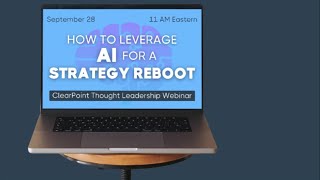
Ted Jackson and Ryan Werty show how to use ChatGPT and AI tools to rebuild your strategy. Clearpoint's software handles planning, milestones, data analysis, and reporting. They demo the product and answer questions about security and implementation.
Hello, everyone, and thank you for joining us for an exclusive thought leadership webinar, how to leverage AI for a strategy reboot. During this webinar, we will be sharing insights and experiences on integrating AI into various aspects of strategy execution. I'm excited to introduce clearpoint Strategies co founder Ted Jackson and one of our account executives, Ryan Werty. The audience will be muted for the duration of this webinar, but we encourage you to submit any questions into the Q and A tab. We will aim to keep this webinar around 30 minutes, but we have a lot of ground to cover. So without further delay, go ahead and take it away. Ted and Ryan.
Hey, Ryan, how are you doing today?
Hey. Pretty good, Ted. I see that you have the chatgpt already up and rolling, so that's exciting to see.
Well, I figured we can't do an AI webinar without referencing some AI.
Absolutely. All right, guys. Well, we're thrilled to have you all here as we look to be able to explore the key elements and not only help you formulate a winning strategy, but also to pretty much leverage the power of AI for effective execution of that strategy. So thank you, Jenna, for the warm introduction. In terms of a quick rundown for today's session, we're going to start by kind of laying out the groundwork, if you will, with best practices that are essentially crucial to achieving strategic success. Then from there, we'll kind of dive a little bit deeper into how those best practices can be enhanced using artificial intelligence. And then a little bit of a pivot following that into more real world examples. A couple of organizations who are leveraging AI in a couple of different facets of their business today. And then finally, we will kind of show you how all of this comes to life in clearpoint. As Jenna mentioned, we'll be keeping our eyes on the chat box, so feel free to ask questions throughout. But we will also try to hold a few minutes for Q and A at the tail end of this as well. So whatever works best for you all. Certainly don't want you to forget any questions as they're kind of coming to mind. Okay, perfect. So like I had mentioned, kind of laying the groundwork here for these best practices. So at Clearpoint, you know, we've onboarded hundreds of different organizations with strategic plans ranging from non existent, like, hey, Ryan, I have nothing to supremely complex over the past 15 years. And really, you know, regardless of where your organization is in your strategic journey, we've boiled this down to five best practices, which, believe me, it was difficult to get this down to 5. But we believe that these are going to really kind of work to mitigate potential hurdles and improve adoption across your strategic plan. Right. So kind of just going down the line here with organizing strategy. Right, that's kind of that first big best practice. You know, with that we're creating that structured, clear roadmap of our organization's strategic goals. We can kind of think of this as building almost the foundation of your strategy house. Right. Following that, aligning your organization. It's kind of the glue that's going to be holding the strategy together, if you will. Right. So we'll discuss how you can ensure that team members are understanding their role in the strategic plan and really kind of just creating a culture that fosters that type of alignment. And of course, when we're instituting well structured strategy, more often than not that's going to involve multiple projects, multiple initiatives. Right. So managing those effectively will be crucial. And then the last couple of components, right. Once we have everything structured, managing our project, have things aligned, simplifying execution and then being able to communicate those results effectively to key stakeholders.
Before we dig into that, it's also important to think about kind of AI overall and where it can be helpful. When we're talking about AI, we're mainly talking about these large language models like ChatGPT, like what's been deployed in Bing and in Google's Bard and in other areas like that. So we'll be kind of picking on ChatGPT a little bit as one of the examples and just want you to think there are a lot of different ways that you can use AI. And even though I might be in it every day, I know that still I think it's 80% of the population hasn't tried it out yet. So just wanted to give you some ideas that it can be used for research and education or for brainstorming or for building something or for doing some real time analysis and hopefully we can show some of that off as we walk through some of the strategy success best practices.
Perfect, Ted. So circling back to those, those five best practices, we'll start with organizing strategy. And you know, as I kind of alluded to, this involves using really any framework to be able to build out and manage your strategic plan and then track that plan using visuals. So, so Ted, I guess the first big question here is can, you know, how can we use AI to be able to think about some of these different strategic frameworks?
Yeah, it's a good question. So just in any tool like ChatGPT, you can just type in information in there. So one framework that is not as well known as others is something called the V2MOM framework. So you can just ask ChatGPT, you know, what is the V2BOM framework? This is a good way for you to research and understand that V2BOM stands for vision, Values, Methods, Obstacles and measures. So you can just very simply ask it questions very different than Google Result. It would point you to, you know, the top V2 mom article. What ChatGPT and all of the large language models do is they look at all of the results, they've read it all, and then they write it back to you in a way that, that you can understand. So, you know, there are other ways to do this as well, you know, probably more sophisticated when you think about some, some other questions around organizing your strategy or building out those, those measures and whatnot. So here I'm just asking, can you give me five example measures for improving public transportation in my city? And so you know what it does? It looks, you know, through here and gives you some examples like ridership, growth on time, performance, wait times for public transportation accessibility, the environmental impact. I'm not saying these are the five measures that you should use in your organization, but wow, what a quick way to get some ideas. And where we've seen some of our clients really move quickly with this is when you say, you know, I have a pretty robust strategy, but there are certain things I just don't know how to measure. And so you know, what is the best way to measure that? And using a tool like Chat GPT, just to ask, you know, what is the right measure is a good way to brainstorm that. Right. It's not going to understand your organization inside and out, although you'd be surprised at how much it knows based on your footprint online. But it will certainly help point you in the right direction.
That's really cool, Ted. As you know, I'm kind of on the front lines in my role here as an account executive. And you know, far and away the number one thing that I'll hear is, hey, we have the goals, we know what we want to be able to achieve, but we don't necessarily have the measures that are aligning to those goals. So I can certainly see how that would work for a brainstorming session or figuring out what makes sense. Right.
So, yeah, it's always amazing how fast it types. Makes it look like it's really thinking quickly.
Absolutely. So moving from there, I talked about aligning the organization as the glue that kind of holds the strategy together. Right. So I think we can kind of think about that in a couple of different lenses, both cascading that down from the sort of enterprise or senior leadership team down to the individuals and departments, but also being able to engage your whole team with real time communication and collaboration. So one of the specific pieces in there is okrs. So objectives, key results. Right, but what are okrs? Don't mean to steal your thunder there. How can AI help with those okrs?
Yeah, so it's really interesting. So you can just type in something like what are good okrs for a city parks manager? And then ask it for a number of examples. Right. And so what ChatGPT will do is explain what okrs is quickly. Let's try to regenerate that and, and then give you three examples. Right. One objective, a couple of key results. Another objective, a couple of key results, and a third objective, a couple of key results. Of course, I would say, I wouldn't give these, instead say these are your three objectives to your, you know, your, your city parks manager. But it's certainly a good way to think about what are your responsibilities and what's important to, to your strategy as an organization. So again, it's a, it's a great way to get started.
Okay. And then to probably the other kind of big elephant in the room around managing projects. Oftentimes when, you know, I'm talking to different types of organizations, they, they may have projects, they may have a project management tool. Right. But being able to align that and link those projects to strategy, being able to figure out what milestones make sense and the deadline for those milestones, you know that that's usually the piece where I see some folks having some trouble. So can, can AI help to be able to build those project milestones out?
Yeah. So this is another place where I've been kind of blown away by what a tool like Chat GPT can do, because I think you're right. It's also, it's an interesting spot that we see our clients in when, when they might brainstorm, let's do a public park improvement project and just hand it off to somebody and then assign it to someone. And that person's like, well, how do I get started? And so you can ask one of these tools like draft six milestones for a three month project. And what's going to happen is it will think about that three months and then break it down into six components, let's say two week components. And you can see every two weeks it's suggesting, here's A milestone and here three or four bullets of things that you could think about. And this is just a great way to break down a project into smaller components. And you can refine that search as well just by typing in. Explain more about one of these different areas. I know we have a lot to cover in this webinar, but just for those of you that start playing around and I'm just using the free version of ChatGPT, feel free to ask follow up questions or ask clarification to ChatGPT to get more information from it.
Perfect, Ted. And then kind of the part that the stakeholders see. Right. So being able to communicate these results and with this, I think the main piece that I want to be able to focus on is just around the analysis of the results. Right. Whether it's a large data set or something maybe a little bit more complex where me in my role with eight different other hats doesn't necessarily have the time to go in and do this. So can AI help with that?
Yeah, so this is pretty interesting. You can say things like, can you analyze this data? Before I throw in the data, I just wanted to pull it out on the screen so you could see it. It's just a simple information about park attendance. I have a target, I have three years worth of data. I can just grab this and paste it in here. And what's interesting is first, like it tells you that it's understanding the data, right? So it's reading the data first. Now you can see the, read it. And now it's doing analysis of that data, right. Saying, oh, it exceeded attendance for a couple of years and it started falling off. Here are a few things to think about. Right. It doesn't, it's not telling you the exact answer for all of this, but it's certainly a, it's a, it's a quick start to data, to looking at data and, and analyzing it. Of course, we showed extremely simple, an extremely simple data set, but, but you can grab more complex data if you have it.
Perfect. And then lastly, simplifying this entire process, I know, you know, when we're talking best practices, that's establishing a cadence that's, you know, figuring out what we want to be able to automate who these reports are being distributed to, you know, really to kind of streamline some of those processes. So can AI help with achieving those strategic results?
Yeah, this is a good question. I think what might be best is if I talk through a couple of real world examples of where organizations are using AI to execute their strategy and then maybe we step back and look at how clearpoint can help you use AI to manage that strategy process. Fair enough. So let's talk about two of them and we'll do it pretty briefly. You've probably heard of AB, InBev, world's largest brewery. So they're using AI to drive growth in their organization. Right. You can see it deep into their operations, they're optimizing their supply chain. They're predicting traffic patterns for identifying delivery routes and the sequence of delivery. They. They're using tools to monitor and control the quality of their products overall. So think about it. Deep into operations, you can use AI to really analyze what you're doing and give you ideas of how you can do it better, how you can optimize that demand. Then completely on a different front altogether, think about an organization like Sephora, right, in the cosmetics and beauty business. Right. Like, they integrate AI in a number of different ways as well. Completely different than InBev. They have, like, a virtual artist app that allows you to try on their products virtually imagine you on your phone, you know, looking at a picture of you and how you would look in different beauty projects, products. They have chat bots on the website, mobile app that can answer questions, make recommendations for you, and they can. They also use analysis AI for forecasting trends, managing their inventory, and launching their targeted promos overall. So, so this is just another way that you can use AI to tailor the experience of your. Your. Your customers. So both on the operational excellence and on the customer intimacy side, if you're thinking about, you know, what is your strategic approach, I think there's an opportunity for AI in all of these areas.
Yeah. I think what jumps out to me there is that a lot of the organizations that are maybe using AI in different facets of their business, more operational in nature. Right. So how do we connect that to our overall strategic vision and building a framework analysis. Right. And all the things that we've been talking about up to this point. So I think that's maybe a good segue to us diving in and walking through a little bit of how this could work in clearpoint.
Sure. I was thinking, you know, maybe the best way to show off clearpoint is if, like, I give you a demo. Ryan, I know you're normally the one giving demos in our organization, but I thought it could be fun if we did kind of a role play where I don't show everything in clearpoint, but I just show where we're leveraging AI to help organizations execute their strategy even faster.
Yeah, that sounds like A good change of pace from my perspective. So totally on board with that.
So let me do this. During the first half of our. Our webinar here, I was timed out, so give me a second to log in.
Starting to see some of the pitfalls of Ryan's day today.
I'm going to log in back here on this side as well, because I had one other thing I wanted to show. It's in a different location that keeps me logged in. So here in clearpoint, Ryan, why don't you be the city manager for, let's say, the city of Manassas, Virginia?
Got it. Okay. Manassas. Perfect. All right, that works for me. So I'll put my city manager hat on and. Yeah, we can kind of just get into this. Hey, Ted.
Hey, Ryan.
I saw you put some time on my calendar. Why are we talking? I don't. I don't even have a strategic plan. I'm kind of worrying when I saw this pop onto my calendar. That's too early to talk to clearpoint. I know some of my peers are using you. All I know Virginia beach, for example, is a client and they have some success with your software. So. Excited to learn a little bit, but of apprehensive, if I'm being honest.
Well, I'm glad you reached out. We've just rolled out some assistance for organizations like yours. This is going to be the pitfall. The downfall of me giving a demo is I can't talk and type at the same time. But we have an assistant here that will leverage AI to take what it can learn across your organization and then create goals, measures, and projects for you.
Okay. Awesome. That. That's pretty cool. I actually was working on drafting some. Some strategic ideas earlier. I had asked Strand to send those along. I'm not sure. Did you. Did you potentially get those?
She did. She sent them right to me. And that's what I cut and paste in that. In that top area there. So. So we're using that to feed our assistant to help build objectives for you.
Okay. That's actually pretty amazing. It seems like it structured it fairly quickly there, but you don't have to build out all of my stuff for a demo.
Well, clearpoint can get you started quickly, so I already have your information drafted in a scorecard here. Just I wanted to. To let you see what it would look like if we built it all the way out for you.
Okay. Yeah. I mean, that's pretty cool. You're clicking around a little bit, moving pretty quick. Is Clearpoint hard to use?
Good question. Clearpoint's a comprehensive management tool, so it does have more features than other tools you might be considering. But for that reason we've made it really easy to get started. If you just click on your profile up here, we've built some tutorials in for you. And in these tutorials we've put, you know, six or seven items to help you get started. Like if you wanted to add, edit or link elements, for example. It's just a step by step guide to walk you through all the pieces of it.
Okay, yeah, I mean, that seems straightforward enough. Looks really easy. You just follow each one of the steps.
Yeah, we also have a customer success portal for you, which I'm not going to be able to show you today, but we will. Let's not get distracted. Let me show you some of the real AI components.
Yeah, absolutely. One of the things that we struggle with here is, you know, at our, at our city, it's kind of getting people to update their information. Right. So A, it's getting people to update their information and then B, it's, you know, when, when they update their information, it's pretty, you know, poor analysis, if I'm being honest. Don't think of a nicer way to say that. It's almost like they're kind of just phoning it in.
Yeah, don't worry, we're, we're here for you. So, so we can take this poor analysis and use our AI assistant to analyze the data that you would see in those charts right there. So I've jumped over to a quick airline example because there's some data in here, but what you can see is it can read that data, put it right in here for you, and then instead of just some simple recommendations. Actually let me save this first. Instead of some simple recommendations, what the AI assistant can do is make a recommendation for you.
It's pretty amazing. And that, how is that happening?
Well, the assistant reads all the data that's related to this measure, gives you some preliminary analysis. You know, you can edit it, of course, but then what it's doing is reading that analysis and giving you some ideas on how you can improve your overall performance.
Okay. So that, that kind of leads me to another thought along with that poor analysis. We sometimes struggle with accountability. Right. So how do, how would we get someone to, I guess, take responsibility for those different recommendations that the AI is writing?
Yeah, so we can turn these right into action items for you. And what that's going to do is just add them directly to your tool, directly to your account. You can Then assign those to an owner and say, let's, let's make sure that the James takes on these action items and it puts them directly in the client point for you. And so that's going to give you quick accountability directly into to the information that we have here.
Okay. In that scenario, is there some sort of fashion that James would get notified that he has been assigned those items?
Yes. So we do have a notification system. He's going to get a notification, not only an email within the account, but also inside of our teams integration. So they'll get an immediate pop up saying you have three new action items assigned to you.
Fantastic. Yeah, I could certainly see the power of, I guess first figuring out what's wrong, what we need to do about it, but then being able to assign the appropriate responsibilities. So that's great. I was kind of holding this one back. But one of the big ironies in our organization is that our leadership team wants everyone to provide analysis, but then they don't really have the time to read the analysis, which then again leads to that poor analysis because we think nobody's reading it. So is there a way to be able to summarize some of this information for some sort of brief or our senior leadership team?
Yeah, the great thing here is we have analysis at the scorecard level or at the account level. Think about it that way. So what we can do is, is pulled together in this case, an executive summary that is showing you. I asked for an exception report, so it's showing me everything that is off track and summarizing all the analysis for you. So while you do have the detailed analysis throughout your organization, you will have, the leadership team will have a single, you know, a single page where they can see what's going on.
Okay. I mean, that's really incredible. I think that's exactly what I was just, just asking. So they'd have that, that kind of single like homepage that they could go to to get that summary of all the work that the department directors have been doing.
That's exactly right. And you could drill down to here to those, those detailed areas where you're on track.
Okay, perfect. Yeah. I mean, I could definitely see how these features could save us a ton of time and I guess help us get the strategy management off the ground quickly here at our city.
Yeah. And here at Clearpoint, we help you manage that strategy with AI and automation leading the way. That's helping you save time and increase the quality of your reporting.
Where do I sign up?
Excellent. All right, so that's for this webinar, just wanted to give you some ideas of where AI can play a role in your strategy. Right. From helping you build that initial strategic plan to analyzing particular measures. We also have that analysis at the initiative level. We can build in. We have an assistant that helps build your milestones if you want as well. And then as you can see, summarize the information at the enterprise level also.
So there was one question in here, Ted, around the Customer Success Portal, which is actually a very positive answer to this question. Do you want to take that one insofar as why we couldn't see it today?
Well, it's something that we are rolling out actually next week. We're really excited about it. So I'm just jumping into various demo accounts and I didn't have access to it. I thought I would at the last minute, but it's something that we're putting our, our finishing touches on. The nice thing about the, the support portal is that it will basically give you as an administrator, kind of a step by step approach to where you are and what are the next items you need to fill out or, or you need to take one and then we, we schedule and record all of our meetings in there. So you never lose track of where you are. You can always see what's coming next and get the help that you need right in one place.
Yeah, I was going to say that we revamped basically the interface. So some exciting things coming over the next week. So stay tuned there. Outside of that, there is a couple questions that I'll typically get actually before, before we get into that. Looks like Kate just, just chatted one through here. Can AI provide me with an executive summary of this webinar that I can share with my team?
Well, we typically do that with all of our webinars is we record them and then we will provide a summary. And we do get help from AI to do that for you. So we'll be sending that out to you at the end of this webinar. Any other questions, Ryan?
Yeah, it looks like basically scoping the AI responses. So how do we handle limiting the AI responses to avoid quote unquote, rogue responses?
Yeah, in this case, you know, there's a lot less hallucination going on because we're not asking the AI vague questions, we're asking very pointed questions. And we do have, you know, small data sets for it for all of our assistants. Let me go back to the, the assistant page. We have a lot of different assistance, whether you're a university or in the, you know, energy business, or you're thinking about Porter's five forces or using a balanced scorecard or doing a SWOT analysis or the V2MOM framework. We've tried to scope these pretty narrowly, but you know, as with anything with AI, we don't suggest that AI manager strategy, but we think it's a great tool to help push you along and push your thinking in the right way.
Perfect. And I know we're at, we're at 11:30. There was one question that I continually get asked about AI as, you know, folks are getting more used to IT and IT departments are, you know, I want to say panicking, but questioning, you know, sort of the use cases. So how about security? Data security, like how, how, how does that function? Should we be concerned about that?
Yeah. So we have an article that we've written in our support center about how we use it. Exactly. Because, you know, we, when we use it, we do data processing locally when possible. And any data that's sent to OpenAI is anonymized and no PII information goes. The way it works is we're storing data for 30 days. It's not being used to improve any data models like that. The reason why we do store it for some period of time is you may get interrupted when you're using our AI and we allow you to go back to IT and ask follow up questions. We're in compliance with all privacy regulations, including GDPR and you know, the California similar state regulations and all other regulations. And then we also use end to end encryption throughout and including our data stored at REST as well. So we have an article about this. We'll make sure it's in the following notes as well.
Perfect. Yeah, that certainly provides some peace of mind.
Yeah. So Ryan, thanks for, thanks for hanging out and participating today in this, in this webinar. Hopefully we were able to shed some light both on strategy and on AI.
Absolutely. Ted, thanks for taking us on that journey.
All right, have a good day.
All right, you too. See you all.
More from Ted




AI in Local Government: How the City of Durham Analyzes Strategy, Risk & Performance

How Coral Springs Won the Baldrige Award — Blueprint for City Excellence | ClearPoint Strategy



AI, Data, & the End of Gut-Feel Strategy: Why Strategy is Becoming More Data Driven

Strategy Needs Accountability: How to Drive Project Follow-Through and Execution

