Performance Management with the City of Goldsboro, NC
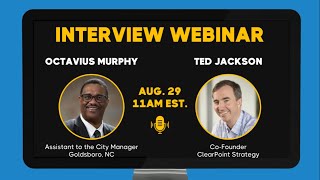
Octavius Murphy, assistant city manager of Goldsboro, North Carolina, explains how the city uses Clearpoint's platform to track performance metrics across departments and align budgeting with strategic goals.
Hello everyone. Thank you for joining us for our customer interview webinar. Today we are welcoming Octavius Murphy, assistant city manager for Goldsboro, North Carolina. He will be sharing insight into how their city manages performance. Interviewing Octavius will be Ted Jackson, one of clearpoint Strategy's two founders. The audience will be muted for the duration of this webinar, but we encourage you to submit any questions into the Q and A tab. Go ahead and take it away.
TED thanks, Jenna, and welcome. Octavius. Thanks for joining us for this webinar. Please tell us a little bit about your background and when you got started at Goldsboro.
Well, good morning, Ted. Thanks for having me here at the city of Goldsboro. A bit about myself. I started with the city of Goldsboro in January, January of 2017. I'm considered a corporate transplant, so I had zero experience in local government prior to coming here. But professionally I'm considered a small business expert. I've worked in many different capacities in corporate America, but I specialize in analyzing businesses and developing business plans and forecasting and flow charting all the necessities needed in order to run a successful small business.
And so is Goldsboro the next small business? Tell us a little bit about Goldsboro.
By by definition, because we employ less than 3, 500 employees were considered a small business doing big business. When you look at a budget of 78 million, that's a pretty strong budget. But Goldsboro itself, we're a small municipality. Our population is around 33,000. It's been declining over the past two or three years. But we got business tools in place that hopefully will help us not only grow our population, but grow business development in the area as well. We also are home to Seymour Johnson Air Force Base, which is been here quite a while. They employ right at 5,300 military, both active and and non active personnel. And their economic impact to the city of Goldsboro is some right at 900 million. That's that qualifies, Ted, as big business.
Yeah, for sure, for sure. So, so when you got there in 2017, what was performance management like in the in the city?
Performance management in 2017 was pretty much non. Well, it was, I don't want to say non existent, but it wasn't, it wasn't what it is today. When you look at performance management, you, you really have to be able to look at your trends, track and measure results that matter. So, so immediately when I got here, the city manager at the time was developing a strategic plan. Well, that in order to build a successful strategic plan, you have to have mayor, council buy in. So at the annual council retreat, we started working on it and it took about two and a half years to develop your, your, our basic strategic plan itself. Then that leader left. He may have expected it, but the city didn't expect it. So we, we had a new, we have a new city manager who's in and actually doing things a bit differently. And we had to adjust to that during the process.
Okay, so, so did you have like departments using strategic planning or linked to plans? Like how did you like or was that something that was implemented with this new strategic planning process?
Well, initially the department heads were engaged in the strategic planning initiative, so they were all in. But as I said, it was a year, year and a half process to get it in the design phase, not implementation phase, but design phase. So they were all in. So for those two or three years, the only reporting that was done was during the annual council retreat, the department heads would get up and present their departments. But now our worlds have changed. Our mayor and council and city manager staff all have access to the strategic plan and all the other platforms that we have available through clearpoint.
Okay, excellent. Well, that was, you led me right to my next question and we kind of quickly got a question from the audience. I was going to ask how does performance management work today? But we also got a question on, you know, how often are you reviewing this strategic plan? So let's go with.
That'S a great question. And the reason it's great is because once you hear a bit about my role in the city of Goldsboro, you'll understand better. And now is a good time to, to tell what my role actually is. I'm the assistant to the city manager here in Goldsboro and I've held this position now for over six years. My role is not, I don't manage individuals. I'm project based. So that includes strategic planning. That I don't have a title of any of these. So when I say senior budget analyst and property sales and benchmarking person, all those projects are embedded inside my world. I am, I'm in my previous career. I'm also one of those, a compliance principal. So I'm the guy who checks the checkers. So when it comes to developing our budget, I, I'm very engaged in the budget planning process for the benefit of the city manager. So having said that, it lends itself to my role here with clearpoint. And I just want to make sure I answer the question directly from a performance management standpoint. I re. We update the strategic Plan annually. We started quarterly and then we went to semiannual, and now we're at annuals. Simply because this is a forever changing document and the department has had the access to be able to change it as needed. But I actually cross all the T's, dot all the I's, send out the reports for updates once a year, and that's during the first quarter of each year or the third quarter of a fiscal year.
So you do like a. You're pushing for that formal annual report, but people can access the information whenever they need that?
That is correct. We have a department head and. Or a deputy or a administrator assigned to each department, so they have full access. They've also been trained on how to maintain their own metrics inside the strategic plan.
So with your plan, how is it. How is it structured that allows departments and the city to work together? Meaning, like, does the city has a strategic plan with goals in it? Do all the departments have the same goals or the departments responsible for measures? How does it work?
Well, that's a. Another great question. And the reason I say that is because unless you are aligned, the stars align properly, you'll never achieve your business goals. So in our strategic plan, we have clearly documented. We have clearly documented the mayor and council's goals. So everything in the city aligns with those goals. A more safe and secure community. Well, that involves our police department and crime rate. How does that crime rate? What is the trend? Is it going up or going down? Well, for three or four years, it was going down, but because of the need for public safety or police officers were understaffed. So the crime rate is trending upward again unexpectedly. So each department has measures that they hold themselves accountable for, and I say that specifically they hold themselves accountable for because it's their metric. It's not the city manager driving it. Of course, he has to approve it, but it's there. It's the department head that owns and has skin in the game with the specific measure itself.
That sounds pretty cool. Can you share it?
Are you absolutely, absolutely sharing anything? Yes, I can. All right, so.
Here.
Okay, so can you see this? Can you see my screen? Okay, so this is our platform. This is the city of Goldsboro's platform. And it comes in right here at our strategic plan. Within our strategic plan, we want everybody to look at what our mission, our vision, our values are. And this is the same information I train in. New orientation, new, higher orientation. So, and I tell them, at this stage of the game, you are professional. I can't teach you professionalism from an integrity standpoint, lying, stealing and cheating is. There's zero tolerance to some of this stuff. So I go over our mission, our visions, and they, to a large degree, they get it. But at a glance, what you see is the, the goals on the left side, safe and secure community, strong and diverse economy, exceptional quality of life, racial cultural harmony. We deal with a lot of. We have to be a diverse community. So we highlight some of our opportunities there and then model for excellence in government. This is new. A couple of these metrics are brand new. Specifically our finance. Well, the city of Goldsboro is currently being audited by the state. So they asked that we present a metric that directly impacts or measures our growth, or lack of growth, if you will. So we're doing that and we have clear targets defined. And this helps our finance director stay on track. And because we want to be transparent to all, not just the employees, but to all the residents and those people considering moving to the city of Goldberg, we want them to see in. On the strategic plan. You see indicators. If it's in red, we're not performing. If it's in green, we are performing. If, if it's in yellow, we're close to target. Blue is basically, we don't have the information needed in order to. The results are still pending. Let me say it that way. So our, again, our transparency, when we look at our crime rate, that's the brutal reality of our crime rate use. What's in red is our trend. So our target is way down where we're headed. That's important. That's extremely important for a city manager. Then when you look at the total other funds and you look at, this includes development funds. So you look at 2019, where we, we're at 1.2 million. Well, what happened in that year? Well, we pull money out to work with our campaign on, on Sinistry. So it's, it's a really accurate data that tells a powerful story. We didn't have any of this. All we had is this, this, this financial audit. Now we have everything in a data format, electronic data format, so you can see at a glance where we are, what direction we're headed. Even our net position. Now this is, we, we can look at it. And when, if you're a finance person, you're looking at these numbers. I, I am a finance person, but I don't study. I'm not an accountant. I'm not a professional finance person.
No, that's, that's great. And it's a great way to get all of Your information kind of easily accessible to those that need it. Yeah, I see one more. The capital improvement plan.
Yes. I'm really excited about our capital improvement plan. Our city manager has been asking for this for the past year. And we're now in the position that we can almost deliver it. And what almost deliver it means makes it. We can almost make it public, but before we make it public. So this is, this is internal only. Although it's a public document, it could be shared. There's nothing we're trying to not share. But within our capital improvement plan, you'll see we more or less have a portal versus a plan. Because a CIP can be 400 pages of clearly defined processes, clearly defined objectives. We don't have that. We have more or less of a portal. Just like our strategic plan. Our strategic plan is a dashboard full of our metrics. So the city manager is a retired Marine, he's a base commander, so he knows metrics, he understand information that has teeth in it. Well, same thing as our dashboard. What it was represented here is our long, our long range goals. It's a 10 year CPI and each department head has access to their projects. They rate each project between 1 and 10. One being the most serving with the most priority. So in addition to that we show the uses of funds we have. Planning, design, equipment, contingency construction is our biggest line item. You see $350 million here. The total use of funds is 411 million. Looking at our source of funds, where is this, this funding coming from? General funds, utility funds, Stormwater. If any of the people attending today, they can directly relate to these sources of fun because they deal with them on a daily basis. Then we go down into each our portal itself. If you want to just look at them at a glance, you can look at all the projects and just continue, continue. However, if you want to look at it the projects by department, you click on Engineering for example. Engineering is probably a combination of public utilities as well as public works. You deal with above ground infrastructure and below ground infrastructure. And you'll see here our projects that are being, that are in place, charted to be worked on. And we can again dig into the analytics of all this. If we wanted to see specifically what the waterline replacement on William street is, we can look at the rationales and the recommendations that support this. Again, we don't necessarily make this information public, but it helps us in case there's a. The department head leaves that his successor can come in and tie this all together. I, I need to mention this as well, we're using all, a lot of the advanced features in clearpoint in our capital improvement plan. We're, we're using the tag feature which if a department head lists a, a new project, it goes up to the use of funds and then it goes to the source of funds. It just travels all over the document. And a, this is a, this is a document that's used regularly because the city manager might decide no, we can't fund this, we can't fund this particular project and it has to be removed.
Yeah, this is all, I mean for.
A document that's used regularly because the city manager might decide, no, we can't fund this, we can't fund this particular project and it has to be removed.
Yeah, this is all. I mean for, I know we're running out of time, but for a small business of Goldsboro, you're doing quite a bit with you know, your financial audit, your capital improvement plans, your strategic plan, managing by departments. Do you want to just let you sum up this webinar with some of the benefits that you've seen, just kind of trying to pull this all together through clearpoint and then you know how you would recommend to someone who's, who's just getting started with this?
Well, I will gladly do that. In my world, being on an island by myself, I have what no other leader in the city of Goldsboro has. I have access from a performance management to all different departments. I, you can, in your annual, in their annual evaluations, they could go in and say I'm doing this and I'm doing that. Well, I can show you what you're doing in terms of trends and that we've been tracking with this platform. It's created opportunities that we never imagined. Now just getting, when we started what we did, I would encourage anyone to look at other clearpoint family members. We, we, we went to Durham, North Carolina. We went to, in, in Texas. Gosh, Sugar, Sugar Land, Texas. That was, that was my, one of my all time favorites. I still go to Sugarland, Texas and look at their platform and you don't have to recreate the wheel. Our community shares data or metrics in there in the library. You can, you can go to the library and look at them. So that's what I would encourage you to do. We still look at other, other communities because guess what, you have senior budget analysts who know what they're doing. We're able to look at some of the, their reporting features, how they're taught with their city leadership from a council standpoint or commissioner standpoint, what buy in do they get? So it's been a great experience for the city of Goldsboro being considered a small community, if that helps.
Right. Well, Octavius, I really appreciate you sharing your time with us and your story today. This has been really, really awesome. I greatly appreciate it.
Thank you.
All right, have a good rest of your day.
More from Ted




AI in Local Government: How the City of Durham Analyzes Strategy, Risk & Performance

How Coral Springs Won the Baldrige Award — Blueprint for City Excellence | ClearPoint Strategy



AI, Data, & the End of Gut-Feel Strategy: Why Strategy is Becoming More Data Driven

Strategy Needs Accountability: How to Drive Project Follow-Through and Execution

