Strategy Reporting with Arapahoe County, CO
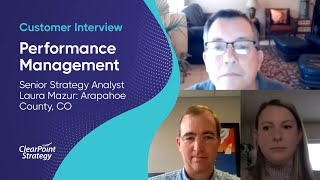
Ted Jackson and Laura Mazer discuss how Arapahoe County, Colorado uses ClearPoint software to collect, report, and track strategy performance across the organization. The county shares how it manages data for both internal decision-making and public reporting.
Good morning, everyone. My name is Shepard Smith, part of the marketing team here at clearpoint, and I'd like to thank you for joining us to discuss one of our favorite topics and I anticipate yours as well, Strategy Reporting and Performance Management. This webinar is set up in a manner that I'm sure is familiar to everyone. The audience is muted, but we encourage questions and comments and ask you to please submit them at any point in the Questions tab. We have two speakers today. Laura Mazer is Senior Strategy Analyst at Arapaho County, Colorado. Laura has deep experience in this role and a remarkable track record of continuous improvements both within county and city government. Interviewing Laura will be Ted Jackson, one of clearpoint's two founders. And there is no one on this planet who knows more about strategy reporting software. Ted, I'll turn the presentation over to you.
Thank you, Shepard, and welcome. Laura, we're really excited to have you here today. Why don't you start by just telling us a little bit about Arapahoe County.
Thanks, Ted. Arapahoe county is located south of Denver and extending east toward the Kansas border. We have a population of just over 650,000. As an organization, we currently have 16 departments and offices with a 17th department actually joining us in 2023 as we start our own public health department. And so with that, we have over 2300 full time employees across all of those departments and offices. So a lot of participants, who are a lot of participants in the performance management program at Arapahoe County. The county actually acts through its five member Board of County Commissioners, which serves as both the administrative and policymaking body of the county. I think it's important to note before we start these conversations that we actually do not have a separate county administrator or manager. So our department directors and elected officials really take on a lot in terms of managing the county.
Excellent. So from previous discussions, the way I understand it, your reporting process operates at the county level, at department levels, and also at team levels. So can you explain a little bit about how it works?
Yeah, absolutely. So some of our departments specifically are very large and have multiple divisions. And so we have division level scorecards, department level scorecards, and then an overall county scorecard. And those scorecards often interact with each other by having data kind of roll up from the division level to the department level, and then even from the department level up to the county scorecard level. So we do have reporting at each of those levels. And the way that our staff interact with the data is a little different at each level. Of course, at the division level, it's going to be most pertinent to them because it's the, it's data that is based on the tasks and responsibilities that they do on a day to day basis at the department level. It really allows for those divisions to kind of come together and see what they're doing as a department and how their responsibilities kind of connect to ensure that the department goals are being met. And then finally, we have just over 20 measures on our county scorecard. And many of those measures are what we call index measures. So it might be one measure, but it will often have, you know, like six to ten contributors to it. So that all of our departments and offices have an opportunity to present their data at an aggregate level.
So when you think about that at the division level, kind of that lowest level down, like what's the frequency of their reporting?
That's a great question. And it really does vary department to department. I know that I was just actually in a scorecard report out meeting on Monday, or sorry, last Monday, and one of our division managers was talking about how with his measures that are not performing quite as well, he checks in with his staff weekly to see how they're doing, how their performance is, so that when the quarterly report outcomes due at the department level, they are able to like see exactly where they're going to be. And they don't wait until that the close of the quarterly reporting frequency. But then we have other departments who only do it at like a monthly or a quarterly basis and they're not checking in on that weekly level. So I think it's both dependent on the operations of the department and then how specific measures are performing. So we definitely see a lot of variation at the county and we really encourage that because we want people to be excited about interacting with the data and we feel like if it's forced on them to, you know, talk about it at certain intervals, then that excitement quickly dwindles. So we really allow them to customize it based on their needs.
So if it's being customized down at the division level, is it also customized at the department level or do they need to produce a. It sounded like a quarterly report.
Right. So we do requires a hard word though, because you know, we as a department, we don't have like authority over other departments and offices. But our county commissioners strongly encourage that quarterly report outs occur. And so we do see that most of our departments and offices who are participating in the performance management program will report out at least quarterly. However, we do have a few departments, especially our larger ones, who are reporting out more on like a monthly basis. And that's generally because at these report outs they won't do all of their measures, they'll do specific divisions that they have planned out in advance so that staff are really receiving that information at least on a monthly basis, even if it's different information each month.
And so when that report out happens, is it, is it like a PDF document? Is it online? Because, you know, listening to your discussion about not having like a county administrator, but having, you know, five member board made me think that there's probably more public reporting than not. So I'm just curious as to, you know, when these departments are reporting, are they reporting kind of internally or is there a separate external report? How does that work?
Yeah, so all of those quarterly reports that we mentioned happen during meetings and usually the actual measure owners, or at least program owners are presenting those measures, developing the presentations, and then reporting out to the staff who are invited to those meetings. With some of our larger departments, it's generally just going to be division managers at those report out meetings. But some of our departments who do that will then send out information about those performance measures and how we're doing with them following the meeting. And I'm usually copied on all of those as well. And then actually on a monthly basis we have what we call a line Arapaho meetings, which are county level report outs. So those aren't going to be the same measure every time. We generally present on like one or two measures, but multiple contributing departments and offices might be presenting as our departments are really like growing into their own as like solid performance management programs. We have had a couple of departments who have actually reported out on how they've become successful at having their report outs and then also integrating performance management and process improvement programs because those really go hand in hand at the county. So the Alina Rappaho meetings are open to the public technically, but we don't really get a lot of people coming in into those meetings. And then on a quarterly basis is when we update our external facing website so that our residents are able to see that data, understand the analysis of the data, et cetera.
And is that a line of Rapo tied to your strategic plan or is it just things that are most important in the county at the moment? Like how do you think about.
Yeah, so our performance measures on the county scorecard are tied to the strategic plan. So I would say yes, the Alina Rapaho meetings are tied in that way, but we don't really pick a measure based on really, like where we're, what milestone we're meeting necessarily in the strategic plan or what's most important to the public. We really kind of look at like, okay, what haven't we talked about in a while? What has seen some changes in performance, what or even sometimes we are able to find like an improved methodology for collecting the data for those measures. So we'll have measure owners come in and discuss what those improvements are and how that could potentially change reporting for that measure.
Okay, excellent. I'm also reading some of the questions as they come in, so don't worry, you don't need to see them. I'll be asking them to you, to you verbally. Back at the, at the department level, would you say that all the performance measures are strategic or operational or a combination of both? And then I'll ask as a follow up to that, depending on what your answer is, how did you guide these departments on their measures as well?
So actually it might be more helpful for me to discuss your follow up question first. Because when our program launched in 2016, which was really before my tenure with the county, it was really about just getting data because we weren't really tracking it in a wide scale way. And we also, the data that was being tracked wasn't kept together. So it was like, here's a little data, here's a little data. But not a lot of people really knew where it was, what it meant. So, so at first we were just like, guys, get your data, put it into clearpoint. Let's just see what's available. And so then as the program really started to develop, more people felt like, you know, they were kind of inputting data just to input it. And it wasn't something that was helping them make short or long term operational decisions or helping them to be strategic about resource allocation or things like that. And, and so over the last two years, really since COVID I would say we've seen quite a shift in people just saying like, here's my data, here's my data to really thinking about what data is useful and how can we expand on those measures and then maybe archive those old ones of just like putting in numbers. So I would say that currently a lot of our departments and offices who have made those updates have really developed more operational level performance measures at the division level and then a little bit more strategic at the department level. So the way we have it set up in clearpoint is that we'll have like a parent scorecard, which is the department or office, and then underneath that parent scorecard will be the individual divisions. So sometimes the measures on the department level scorecard will be data that has rolled up from the division level. And then sometimes it'll be data that doesn't necessarily belong to one division, but is more of like a department level, like, like something that impacts all divisions. And so one division wouldn't own it, if that makes sense.
It does not to put you on the spot, do you have like an example of something that might not be down at a division level, but might be just more at the department level overall?
Yes, absolutely. And I know there's a few people from Arapaho county on the call, so if anyone from our IT department is here, I'm only putting you on the spot because this is the most recent scorecard that we worked on improving. So for example, we have one measure in it around basically like what they call fix, run and grow hours. So basically the amount of work hours that are going into just like fixing bugs, maintaining the system, and then actually growing the county and our functionalities and the divisions are really responsible for different parts of those hours. You know, like our business relationships is responsible for, you know, getting the projects going. And we'll work mostly on grow, whereas our infrastructure and our business applications divisions are going to be working more on that maintenance and fix. And so each of them contribute data at their division level, but then when they report out, it's really more about how all of those hours come together on the department level scorecard.
Okay, that sounds great. And so how did you, how did you get people or the divisions or departments excited about reporting or motivated to participate in this? Because it sounds like you. I don't want to say you're freeform, but everyone has like, it sounds like it's optional to participate. And I heard the story of, well, first time people just put in some whatever they had, and then they started migrating to things that were helpful. But like, are you peer pressuring people? Are they seeing success in other departments and they want to keep up? Or is there a carrot or a stick or like, how did you sell this process internally to get, to get the divisions and the departments motivated?
That's a great question. And kind of going with the freeform thing, it does kind of vary based on what's important to individuals and to departments. But I would say the most effective way that we have gotten people excited is to really have champions, not just at the department level, but even at the team level. So I, I often say that like 50% of my job is just relationship building, because if you don't cultivate those relationships and, you know, get people to trust you that they can count on you and work with you. Then when it comes to asking them to input data, it's going to go to the bottom of their priority list. And so it's really been a lot of getting to know the teams throughout the county to identify who I think would be a really great champion and getting them excited about it and then having them work on the rest of their team. Because we are actually, or as I mentioned, we have over 2300 full time employees and my department, the Department of Strategy and Performance, which facilitates the performance management program, is just two people. So getting all 2300 employees excited on myself would be very difficult. I do, you know, have a, have a big personality, as some people would say, and really get out there to talk to people, but it would just be impossible for me to get to everyone. So I feel like our strongest departments and offices in terms of the performance management program have at least one champion, but usually a handful of champions. And so I get those people excited and then they know how their people will get excited about it. So. And I kind of going back to like the carrot or the stick or like what's the prize that people get? That varies too. I would say that for some people, they really like the opportunity to present on their success. And so we offer those opportunities at those Align Arapaho meetings that I mentioned where people have really had the opportunity to highlight how they have found success and how they're maintaining it. And then sometimes we feel like just that spirit of competition will get people going. Then as they hear about how very large, very busy departments can make this work, they're like, okay, maybe we can be doing a little better than we're doing now. And then finally, I would say something that has really been working for me to get people excited. And it's touching base with new people right when they come into the county, hearing their ideas, helping them figure out how they can implement those ideas at the county. Because a lot of times just like a fresh pair of eyes can really help to ignite a little bit more of that spark.
No, that sounds great. And so we've got a lot of questions have come in while you've been talking, which is great, I've been trying to think through how to, how to merge them into a few questions that might be related. So I'm going to ask this as like a compound question. Choose what you want to answer is, are these measures tied to individual performance plans or, or trying to drive into individual performance. And then also, do you feel like your performance management system has driven true changes and outcomes in the county that you could point to and say we've done better as a result of our performance management system?
Yeah, absolutely. So I'll start first by like tying it to specific performance plans. I do know that our directors and our directors all, as I mentioned, report to that five member board and at the director level, their participation in the performance management program is a part of their annual performance reviews. So that really gets us that top down level engagement. And then we really only have some departments and offices who will tie specific performance measures to county employees and their performance reviews. And usually those are more at like the division manager level that I've seen. They don't necessarily have, you know, like front level staff who have a specific measure that their, the performance of that measure will impact their overall or I'm sorry, their division level performance measures. And that's usually just because it's multiple front level staff and their performance that feed up to that performance measure. So it's difficult to pinpoint how those individuals are impacting it. And then I think another one of your questions was like how performance measures, like how they have impacted operations of the county.
Yeah, just can you point to, I'm very sorry. No, it's very, it's appropriate. Can you, can you point to performance results as a result of just the efforts you're putting into your performance management program?
Yes, and I would really point to like one of our most successful measures is actually our utility use measure, which measures electric use, natural gas use and then water use at the county. And we have been green, meaning, you know, hitting our target for quite a while with that measure. And I have to say that it's based on, it's truly based on the efforts of the employees who impact that measure and the champion that we've identified in that department, really who is spearheading that. She is constantly looking for process improvement projects around our energy use and how we can continue to lower our use. And she has even identified that, you know, even though we've been green and we're doing really well in terms of use, our rates go up across the board. So we might be performing green, but we're still going to be costing the county more money through that energy use. So keeping an eye on that measure is really, this person has just made that a large component of her job. And so she has been able to consistently fall below target because she's trying to make those efforts for saving money. For the county, because if we stayed constant in terms of our energy use, our costs would go up drastically year after year.
Right. Okay, excellent. Then thinking about clearpoint itself and if we have time at the end, I might show clearpoint for just a few seconds. But in thinking about the application, are you allowing divisions and departments to see what's happening in other divisions and departments? Like are you getting collaboration or knowledge sharing through kind of your internal version of clearpoint? We'll talk about the dashboard in just a second.
That's a great question. Right now we leave that up to the department or office who's participating. Some of our departments who have like really stable or thriving actually performance management programs within their departments. I'll specifically ask them if we can open it up to all of our Clearpoint users to @ least browse through it. And a lot of them are open to that, but if they choose not to, then it can be closed off to just those individuals in the department or office who are using clearpoint. We really started off with clearpoint by restricting access and that's really how we started to increase engagement. We wanted people to input data without the fear that other directors or our commissioners were peeking in on them to see how they're doing in between report out periods. And so really, as the program has developed, we've started to open those up as departments or offices allow it.
So it sounds like you got people started in a safe space. Don't worry, whatever you put in here, it's going to be. It's just your information. And then as you start seeing great successes, you're like, oh, you should share this. Look how good you're doing.
Absolutely. And that's generally how we get people excited about it, is reminding them how awesome they are. I feel like people don't often give themselves enough credit that like even if they're performing in the yellow or the red will be like, even though you're red, you went from 40% success rate to 70%. And you should really show how you do that or you should show how you structure your scorecards so that they're easy for people to understand and navigate through. So I like to consider myself like the Arapahoe county hype woman who's just constantly reminding people how awesome they are.
That is great. I know we're running out of time. Tell me a little bit about the public facing dashboard and what has been feedback from the community or even from employees seeing their information posted.
Well, since we launched the dashboard, and I want to say end of 2018, maybe it was beginning of 2019. We haven't been doing a lot of marketing, you know, to the public to drive them there. So we haven't really gotten a lot of feedback from the public. But we did work very closely with our departments and offices when we were developing the external website with clearpoint so that we can ensure that they were comfortable with what information was being displayed, how the data was being interacted with. So we've had mostly positive feedback from our internal stakeholders. And I think moving forward into 2023, we'll have that opportunity to get more input from our external stakeholders because the county is doing like a total website revamp, which really won't impact our external dashboard with ClearPoint, but it will impact accessibility toward that website as people are hopefully able to find it more easily and interact with it and they don't have to dig through everything on the website to find it.
Awesome. Okay, we're basically out of time. So I have one more question for you. If you were going to tell somebody who's just getting started in performance management or someone who's struggling with it, like what kind of advice would you, would you give them?
I would say celebrate the small wins and start small. Like don't expect everybody to be on board right away. If you can find one or two champions who are doing really well, celebrate that, Celebrate them and really keep them motivated and continue to build on individuals who will help you to build more at the organization level. I know other organizations might have a lot more people who are like in my position so that they can spend more time interacting with the entire organization. But for those of you who, you know, you're just one person and you have a lot of organization to impact, really celebrate those small wins and build upon those incrementally. Don't shoot for the moon right, right at the beginning. You want to start small.
Excellent. I'm going to spend the last one minute for anyone that doesn't know what clearpoint is, just giving a very quick view into the application. So just hang in there. Let me see. So this is like a fake city called Metropolis. You could imagine being able to see your objectives or your goals, being able to drill down obviously add attachments, make qualitative analysis, be able to drill down to any measures that you have associated with this and being able to drill down into projects or initiatives as well. All of this information can be, can have departments similar to Arapo and even drill into divisions as well. And then I thought I would just brag on your public facing dashboard for a little bit showing how this information pulls also directly from clearpoint. So you don't need to do double entry of data. Everything that you're managing internally, you choose the elements that you want to post in an external manner. So, so with that, as I said, I promise it'd be really quick. Thank you, Laura, very much for sharing your. Your knowledge and wisdom. It's so great to see the success going on in Arapaho County. I know that you're looked up to in the greater Denver and Colorado area as a county that's doing wonderful things and of course, across our entire community. So again, thank you very, very much for this.
Yeah, thanks so much, Ted. And please, any questions that I didn't get to. You can feel free to give my contact information to anybody who would like to learn more. I'm happy to talk one on one with anybody who'd like to.
Yeah, we had just a few extras that I will be sharing in the chat. And, and for, for the questions that came in about this recording. We are, we are recording it. We will be posting it to everyone who registered, who attended, who wasn't able to attend. And that will be a link that can be shared on our website.
So thank you guys so much for having me.
All right, thank you. Bye.
More from Ted




AI in Local Government: How the City of Durham Analyzes Strategy, Risk & Performance

How Coral Springs Won the Baldrige Award — Blueprint for City Excellence | ClearPoint Strategy



AI, Data, & the End of Gut-Feel Strategy: Why Strategy is Becoming More Data Driven

Strategy Needs Accountability: How to Drive Project Follow-Through and Execution

