The ClearPoint Strategy Success Framework
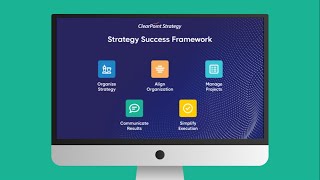
Ryan Wearity from ClearPoint walks through the Strategy Success framework, five areas designed to help organizations improve strategic planning and execution. The framework covers organizing strategy, aligning the organization, managing projects, communicating results, and simplifying execution.
Hello, everyone, and thank you for joining us. For today's webinar session, we'll be introducing the clearpoint Strategy Success framework, including the five key areas that help organizations drive strategic results. Leading this presentation will be Ryan Wearity, one of clearpoint's senior account executives. The audience will be muted for the duration of this webinar, but we encourage you to submit any questions in the Q and A tab without further delay. Ryan, I'll go ahead and pass things on to you.
Yes, thanks so much, Jenna. Excited to be talking and walking through kind of all the work that the clearpoint team has been doing around this over the past year or so. So, as Jenna had alluded to, and I'm sure you all know from signing up from this webinar, the, you know, the purpose of our call today is primarily to address the clearpoint Strategy Success framework. And just insofar as just an agenda for, you know, our 30 minute walkthrough for today, just throwing that on the screen. Do you want to kind of give y' all an intro or introduction into strategy success? Right. And kind of what that looks like from clearpoint's point of view and how we view that as being applicable to, you know, our client base and really any group that wants to be able to improve their approach to strategic planning. Um, we'll talk about that specifically how that, you know, how we address that here. And then I will pivot and show you actually in the clearpoint platform how with the sort of key five metrics of strategy success that we've identified at clearpoint, how we work with our clients initially.
Right.
To make sure that, you know, we're addressing those. Right. And then how we give you even a report card, an evaluation of how you're doing as an organization on those five key metrics.
Right.
And then again, how that comes to life within clearpoint. And then as Janet alluded to, we will leave a couple of minutes at the end for Q and A. So if you have questions throughout, feel free to chat those through. I will do my best to kind of get to those at the tail end of sort of the webinar or our walkthrough. So first off, why you should trust us here at clearpoint. So just a little bit about us. If you're not super familiar with who we are and what we do, our history here. Currently we have over 300 active customers utilizing the Clearpoint platform today. We got started in 2008, actually. Right. So we have a 16 year history of supporting organizations with strategic plan adoption, performance management, Improvement and really what we view as kind of being the key components that it takes to be successful and to be able to repeat the success with again, a strap plan adoption. Our two founders, Ted and Dylan, combined, they have over, you know, 30 some odd years experience of strategic planning in the space. They actually worked with Drs. Norton and Kaplan, late 90s, early 2000s, the guys who wrote the book on the balanced scorecard approach to strategic planning. And you know, on the screen there you can see plenty of the different awards that our system has won. The customer success team as well, who is largely responsible for this strategy success framework. And yeah, I mean we're not a fly by night company, right? We've done this for a while and plan to continue doing it for a while. So what we're all here for the strategy success framework. So really kind of what this is, is we took a fair amount of time, probably longer than we'd like to admit around boiling down what it takes to be successful with an adoption of a new strategic plan, a revamp of a strategic plan, or hey, I have a new CEO, a new city manager that wants to do their own thing. How do we know that this is going to be successful or at least put ourselves in a position to make this as successful as possible. And really kind of what we came up with was these features fee at these five criteria. So organized strategy, right? It's pretty, pretty broad. We'll expand on that in just a second. Utilizing a tool potentially like clearpoint or you know, there's a number of tools, right, to be able to help you be able to, you know, organize your, your plan, not have it in a multitude of different spreadsheets or different apps that aren't connected. We'll get into exactly how we help address that in a second. Aligning the organization. I probably as a account executive at clearpoint, say the word align two dozen times a day because it's, it's not only important, it's something that a lot of organizations, you know, know that they should be doing, right, but maybe aren't doing it as well as they would like. And usually that's some form of, you know, sort of enterprise wide or citywide and departmental alignment or lack thereof.
Right.
But how do we know that the work that our departments, our divisions are doing, you know, sort of at the bottom end is aligned with the strategic vision plan, mission values of the overall plan in and of itself, managing projects. We'll talk to that, I'll show you, you know, Gantt charts, project plans, how those can link and Relate to a strategic plan here in just a second and then communicating results.
Right.
So whether this be via a dashboard, more interactive both internally and externally for whatever audience you are communicating to, whether it is internal to a system that you're utilizing. We do take a collaborative approach here at clearpoint with being able to mention folks, which I'll cover. But all of this, it kind of leads to that fifth and most important piece and really outcome from doing the other four well, of simplifying your execution.
Right.
If we can organize our strategy, if we can align the organization, manage projects and communicate our results effectively, you know, we, we've done all the blocking and tackling to set ourselves up for success, and now we just need to sort of push that over the finish line.
Right.
So, you know, establishing a regular reporting cadence, being able to integrate systems into something like a clear point or into a single source of truth for your organization, and then just kind of continually work on honing and streamlining what we do. You know, a lot of strategic planning isn't guaranteed, right. It's not your first version of the strategic plan and the first things that you're doing, you know, if you fast forward six months, a year, if you have the same strategy, the same plan, you know, that's not normally a good thing.
Right.
We want to be able to hone and iterate and streamline our processes to be able to simplify this for all parties involved. So when I'm walking through clearpoint here in just a bit, you know, we'll focus on those again. First four key pieces of the strategy success framework with the end goal of at the bottom there, simplifying our strategy execution. Okay, so now we talked about what we're going to show you in a second. Talk about why we're going to show you that. And this visual, I think, does a really good job of representing a typical potential client when they talk to me and when they approach clearpoint.
Right.
So a snapshot of a typical reporting process that we'll see. You know, maybe There's Excel or SharePoint or a multitude of different apps and things that are being utilized. And by the time we get done gathering the data, cleaning the data, analyzing the data, now we're writing the report, maybe redoing it, reformatting it, distributing it, there's no time left to actually execute on our strategy. Right. So you know why we exist and you know why those five strategies success framework pieces are important, is to alleviate that reporting burden. So you can spend the vast majority of your time, we estimate around 70% of your time executing on your strategy versus, you know, data entry into a spreadsheet or creating a PowerPoint or all the kind of nuts and bolts of, you know, creating a successful plan and translating that outwards. So with all of this, right, with the framework, we also with our clients will help you evaluate where you stand, as I alluded to. So this is, this is just a quick peek insofar as the path for us evaluating with you your strategy. So you know, any new client that comes on board with us here, they would have their initial kickoff and goal assessment call with your customer success manager. And basically that's a lot of fact finding from our end, right. We're learning about your current goals. We're introducing this concept of the strategy success framework and want to align expectations in our timeline for onboarding with your time for like, hey, when do we want to have this thing live? We'll review your current strategy again with you and then evaluate those processes. Eventually what we end up with is a literal report card with that strategy assessment. So we will, on the sort of objective scale of these five strategies, success framework parade kind of where your organization stands, where we could, you know, maybe see some room for improvement if we see like, hey, you know, we're doing a really good job at everything outside of aligning the departments to the top tier, you know, enterprise or organization wide strategy. Maybe that's something we want to sort of focus on for, you know, Q1. And we're kind of getting this thing off the ground with y'. All. But this is going to be introduced for any new clients. It's, it's, you know, a free offer actually that we have for clients coming on board with us here in January.
Right.
And a lot of power and work that goes, you know, goes into this. And then lastly, just the fact that, you know, we're, we're partners and coaches in your success. You know, know, we view our strengths as a company as threefold. We view it as a help with adoption, right? You can get the best system in the world, best software system in the world. If you don't have a customer success team that is going to mold themselves around your goals and help you with handholding to get this adopted across your, your city or organization or business, you know, it's not going to make sense, ease of use within the system itself, which I'll show you here in just a second. And then along with that customization of the system, we don't want to be, have this be a square peg, round hole situation where you Know you're using a system that doesn't fit what you're trying to accomplish. So all these things kind of working in lockstep together in order to ensure your adoption and continued success using the system. So want to show you how this all kind of comes to life within clearpoint itself and basically what that means. I'll show you, I'll click through a few key features of clearpoint that focus on the success framework and then I'll actually show you in our customer success portal within clearpoint, you know, where these things are also living when we are onboarding, you know, somebody new. So let me end this slideshow and pivot my screen here and if that worked properly, we should see Metropolis now on the screen. So first and foremost, organizing your strategy. The biggest step that any organization can take towards this is either a having a very complicated spreadsheet with multiple tabs and sheets and, and links and all that stuff in there, which obviously I have a biased opinion on this, but probably not the best way to accomplish that, that outcome of organizing your strategy or you can utilize a purpose built system like a clearpoint in order to be able to accomplish this. So for example, the way that I have this organized right now, if we are kind of navigating through what clearpoint looks like, right? And this is just the fictitious, like I said city of Metropolis, but I have the overall citywide or organizational strategic plan, know, here at the top level. And then I have my different departments nested underneath of that.
Right.
So you know, outside of that I have my 35,000 foot view of Metropolis, right. My strategic pillars or focus areas. So in this case, enhancing economic growth, right. Public safety, infrastructure improvement. And what we're doing here is linking this and aligning it in a way that, you know, I can pick this up on, you know, day one and make sense of it. So you know, for example, we're organizing financial health under enhancing economic Growth. We have three linked measures towards gauging where we're at with our financial health. And then we see our connected initiatives or projects that are driving our strategy or moving our strategy forward. Now that's organized at that top tier city level. I also have this broken down into say like a departmental portfolio. So you know, if you're looking at this, if you're on the webinar and you aren't, you know, at that top tier management level, maybe you're working within a department, a division, something a little bit, you know, beneath that top tier, we can organize your strategy just the same so you can Imagine a world where you log in, you know, maybe you're the director of Parks and Rec and you know, we just want to have our stuff organized, right. So we could see within this our objectives, linked measures and then initiatives that we're tracking. So for Jim and Parks and Rec, in this instance, he's building a new fitness and bike trails, 90% complete.
Right.
Haven't really gotten started in that commissioning the public art installation, but when we start again talking about multiple departments or divisions, you know, the next piece comes, that comes in as is that aligning of the organization or the second piece of the strategy success framework. So with that alignment, there's actually a multitude of different ways that you can view that, right. And that you should be able to view that with whatever system that you're utilizing, the first of which is this Tree Explorer, right. So if you are living in a world where, you know, you have 15, 25 departments, maybe multiple business lines or programs living underneath of those, you know, those things can get pretty complicated, pretty quick unless you have an easy way to visualize it. So, you know, with this tree, you could actually see what is connected to what, what's rolling up to what plan. You know, if we have a multitude of different plans that we're tracking at our organization, you can see how those things are linked and aligned. And then we do have some purpose built alignment matrices that are built in. So again, not to belabor the point, but if you're utilizing either clearpoint or something else, right. We all should be able to clearly show that alignment and report out on that alignment. So in this case, you know, financial, health and economic vitality at the top tier, city or organization level, right. We could see that there's some alignment between our departments with community development, Parks and Rec, Fire department. Okay. So, you know, by the nature of organizing, by the way, aligning should come second nature should be easy for us to be able to do this once we have things organized into a solid framework, you know, potentially within a solid system, like, like a clearpoint. And then lastly with this, we're going to be talking about managing projects. So you know, with, with managing projects, this is another pitfall I see with a lot of organizations it's, you know, hey, we have like a Monday.com, we have a project management tool, our PM team, they have a thousand projects that they're tracking and we don't know how that aligns to our strategic plan.
Right.
Which you know, in and of itself is a problem because, you know, if we're actually investing money into these projects and they don't align with our, you know, our leadership's goals. You know, is that really furthering the needle of, you know, increasing our approach to strategy? So with this we have the capacity to track, you know, within your strategic plan and linking these initiatives and projects within your strategic plan. A multitude of different projects. So you know, know we'll have a cant chart, qualitative information, milestone completion, actually pretty cool stuff that if you've seen any of our past webinars, we have AI assistants that are even layered into this that can help you with building, you know, a project plan towards milestone completion.
Right.
And sort of building out the dates and times and those sorts of things that are going to be associated with the project. I'll spare you all for, for today's webinar, you know, that entire process, but it can be something a little bit more involved as well, right? Where they're, you know, maybe it's a website upgrade with data and charts, right. And same thing, you know, maybe we have, you know, variants and project data, you know, where are we at versus our projected budget percent complete and all these sorts of things. So you know, we've organized the strategy, we've aligned the organization, potentially a departmental alignment, you know, now we're again talking about managing these projects. Same idea with your initiatives or projects by the way, in the sense that you can pull out, you know, more summary level reports of these. So if you want like a full on Gantt chart of what's happening at the city, you know, maybe there's initiative prioritization or project prioritization reports. This one's just a simple level of effort versus level of impact type matrix, right. That's dictating our priority.
Right.
So we've done those three things. Now how are we going to communicate these results out to internal or external stakeholders? And the answer to that is there's a few different ways and I'm going to show you those different ways. So with any of these summary reports, whether it's those matrices or Gantt chart that I was just clicking into or full on dashboard like this, you can always pull straight from these, right, to translate this information out. Meaning if we want to be able to pull this out as a PDF or PowerPoint email the page perhaps, right, you can go down those paths, you can grab the specific images and you know, sort of port this into some sort of presentation. But those are very sort of one off ways of doing this. Built into clearpoint, we have some capacity around briefing books, around dashboards, and things that really simplify this process for that end user and make it easier for you to be able to tell a key story around your strategy. So for briefing books, for example, if I just pull up one here and we'll just start with our say like quarterly board report. You could imagine a world where, you know, we're walking into a quarterly meeting, maybe it's the end of month meeting with, you know, with our leadership team, whatever the case may be, we want to be able to translate the work that we've been doing with our strategy to them in a way that makes sense. Right. And that doesn't take all day for them to sift through an entire system, you know, quantitative, qualitative data, etc. But with this, you can actually create an interactive PDF through Clearpoint. And basically as you're clicking through these different instances, right, so we're talking about like financial health. Hey, we're in a caution indicator here. What's going on there? Let's actually click into it. You'll see it ports us right into that specific objective.
Right.
And then, you know, hey, Clarice, it looks like we're below because revenue is below with pour into that, you know, as there looks like we're launching an initiative to hopefully get this out of the red, you know, if you want to incorporate any of those dashboards or summary reports. So what we're doing is clearly communicating our results of our strategic plan to typically with a briefing book, your internal leadership team.
Right.
So that's one path. You also can create dashboards straight within clearpoint knowledge. Click into this. So, you know, basically this is going to give you the template of how to be able to build a dashboard within our system. And if we kind of drill into the, the nuts and bolts of this, right. You can click into either at that top organizational level or any of these different departments.
Right.
You can select what specific results that we want to be able to communicate out within a dashboard like this. In this instance, I've selected literacy rate, ems, response time, crime rate, and furthermore, you can actually select the specific fields and components that we want to have published on that dashboard. So again, this could be something that you have internal, right. If you have like a SharePoint environment or some sort of intranet where you want to have this dashboard live, that's fantastic. If you want to translate this information out onto more of a community facing or a public facing dashboard, that's even better, right? To be able to have that level of transparency. So this is a client of ours, City of Fort Collins and you can actually see their local unemployment rate. This is going to be a direct translation of what's being tracked internally, but them communicating those results of their strategic plan out to the public. And I really like this example actually, because it does a really good job of actually benchmarking against the city of Fort Collins, against the state of Colorado, against the country. Even though we didn't do too hot here in Q2 2020, hey, no one was doing well because of obvious reasons. But you know, we were back on track, you know, kind of Moving forward into 2024, along with qualitative data as well. So basically with communicating results based upon the audience that you're communicating it to, whether you want them to be able to interact with a PDF or brief or you want to just sort of lead them straight to the source with an interactive dashboard like what I just showed with Fort Collins and the one that I created internally, there's a handful of different paths in order to more effectively communicate those results. So if you've been following along so far, and I'll just pull back up this quick piece here, if you've been following along so far, you know, we talked through initially organizing that strategy, which again, using any framework to build and manage the strategic plan, be able to visualize that most important things, you know, regardless of whatever system you're utilizing to do those things. Aligning the organization right, you don't want to have three departments off doing their own thing that aren't linked or rolling up to the overall strategic plan. Managing projects, not just for the sake of managing projects, but being able to link those to strategy more effectively and ensure that the budget is delivering the desired results. And then communicating those out, whether it be with a briefing book, a public facing dashboard, an internal dashboard, or just one off kind of pulling the data out and then all of that in the end, if we do everything correctly, should lead to simplifying our execution and then the iterative process that everyone loves of kind of honing things, making them better as the, you know, as the months, quarters and years go on. So at a high level, those are the main components that I wanted to talk to before I forget. We do support these things actually within our customer success portal, which is a really unique area of clearpoint for any new group that comes on board with us. Your customer success manager and implementation specialist along with you would have access to this portal and they would lay out your entire meeting schedule with you, lay out your entire onboarding plan with you. But when we talk about this second piece of capturing onboarding goals.
Right?
That is when we will introduce this strategy success framework, figure out kind of where we want to be able to focus as an organization and where we need to be able to improve. And then I mentioned again earlier that we the last piece of this is that strategy evaluation component that clearpoint will do with a new client and we can make this one pager available to you all if we haven't already. But this lays out exactly what goes into that evaluation, all the way down towards creating that report card. And then after the evaluation again, partners and advisors, not vendors, and making this more of a long term value add for your organization in order to be able to increase your continued success. So I'm going to pause there. Jenna, have you been keeping an eye on the Q and A specific questions that folks have been feeding through? I've been kind of staring at this other screen the whole time.
Yep. Yeah, we've actually had a couple questions submitted. Some people would like to know if they'd receive the webinar after this and yes, we will be sending that along, but I'll go ahead and share one of the questions and we'll see what we have time for. One attendee asked, what template or layout would you recommend is best for projects that have 10 plus stakeholders, all with separate tasks and portions for the project deployment?
Yeah, so in terms of selecting a template or layout for this specifically for like a project deployment, I think some of that depends upon the type of project that we're talking about. If it's more of like a capital improvement type project or more of like a one off where they just need to be notified of, you know, if something is complete or not. One really unique piece of clearpoint. If we click into the AI component here and then to AI assistance, we do have the capacity to support specific like individual goals as it relates to maybe a project or a desired outcome at your organization. So we can assign them in that fashion and kind of have the, you know, tasks and components that are assigned to each team member. We also do support a number of different frameworks within the AI assistance that can actually help you with building it. So, you know, again, not sure how helpful this answer will be outside of knowing the specific projects that y' all are working on. But there may be an opportunity to be able to utilize one of these frameworks around, you know, SWOT analysis or Porter's Five Forces or, you know, whatever kind of makes the most sense given the context of the projects that you're working on. But in the end, I would say that you should probably have the capacity to pull in the projects that make sense and link with your strategic plan. I'm sorry, I'm reading the other questions that are coming in. I think same person had a follow up here. Are we only using this for city council goals or is it the intent that departments use for other purposes? So it's either one. Yeah, I would say with, with most clients, you know, most local gov clients that are utilizing clearpoint, they may have their sort of top tier city council goals scorecard. They're at the top level and then you know, usually living underneath of that. They may have, you know, like departmental goals that are linked to the city council level. But you do have an unlimited number of plans. Right. So again, like I showed earlier, if I'm logging in as like Jim from Parks and Rec, I may have, you know, my strategic planning dashboard that's, you know, that's LinkedIn rolling up to, you know, the city council goals. But you may have, you know, a DEI plan, a different plan that's department specific, that isn't LinkedIn related, that we could just be managing on our own, you know, sort of as an aside. And then the accreditation question, I can answer that one offline. I think that is like Southern association of Colleges. I've been asked this a couple of times and I think the best answer there we can send you a case study around the LSU College of Engineering and a couple of our other clients that have, you know, done similar work to help with that specifically. I would want to take that offline Melba, probably and just answer that for you specifically. We don't have necessarily like a built in module around sacred SDSG accreditation for the Southern association of Colleges, but we do have the capacity to build something like that. Like we have groups that are utilizing us for FAB accreditation, you know, a few different accreditation paths that we could likely customize clearpoint to suit it. But I'm sure there's some stipulations and things that we need to talk through in order to make that work, which I'd be happy to do with you. Was were there any other questions in there, Jenna, or is the ones 5 the main ones?
Yeah, that's all I've seen so far and I think that puts us at about time. So thank you all for joining. I will say if you want to see any of these principles in action, we have a customer interview webinar at the end of this month. So feel free to take a look at our website and follow up with Ryan after this Webinar.
There's the last question in here from Ahmad around. What makes clearpoint stand out from the other competing products out there? And I quickly zoomed through it earlier, but it's in my mind it's going to be three components. First, it's going to be the fact that clearpoint is going to be purpose built and customized for your organization.
Right.
You'll part of the implementation process. And kind of what I was showing in that customer success portal a second ago was around implementation plan building. Right. So what does your current data look like? What does your current plan look like? And then basically we'll take that and build clearpoint to suit. You'll run into a lot of systems that try to kind of make strategy more of like an app type approach. And what I mean by that is like a one size fits all for everybody. And you know, oftentimes you'll get into something like that and six months down the line you realize like, hey, this isn't necessarily suited to our organization. So we do a really good job of avoiding that trap. Second is going to be ease of use, right. Just in terms of adoption overall, you want something that your city staff, organization staff, employees can adopt and not have be a full time job.
Right?
It needs to be easy so they don't have that natural barrier. Everyone has a natural cognitive dissonance around change management being a bad thing. Like, hey, I don't like this. It's another thing that I have to do. If you have an easy tool that supports that, you're good. And then the last thing, which is really what we've been talking about overall, the strategy success framework was actually a purpose built by our customer success team. It will be our customer success team working lockstep with you to get this thing off the ground, ensure that the adoption is successful and then ensure that, you know, again, a year down the line, it's not something that's sitting on a shelf, but that you and your team are actively participating in. So if I had to boil it down to three things, those would be them. I appreciate you asking that, but yeah, as Jenna said before I went on that diatribe, we will make this recording available to you. We'll make sure that that one pager with the strategy evaluation offer is made available to you. Is there anything else, Jenna, that I'm forgetting?
Nope, I think that's it. Thank you all for joining. Have a great day.
Appreciate y'. All. Have a good one.
More from Ted




AI in Local Government: How the City of Durham Analyzes Strategy, Risk & Performance

How Coral Springs Won the Baldrige Award — Blueprint for City Excellence | ClearPoint Strategy



AI, Data, & the End of Gut-Feel Strategy: Why Strategy is Becoming More Data Driven

Strategy Needs Accountability: How to Drive Project Follow-Through and Execution

