6-Days to the 'Small Town Bigger Dreams' - Conversation with Manvinder Singh
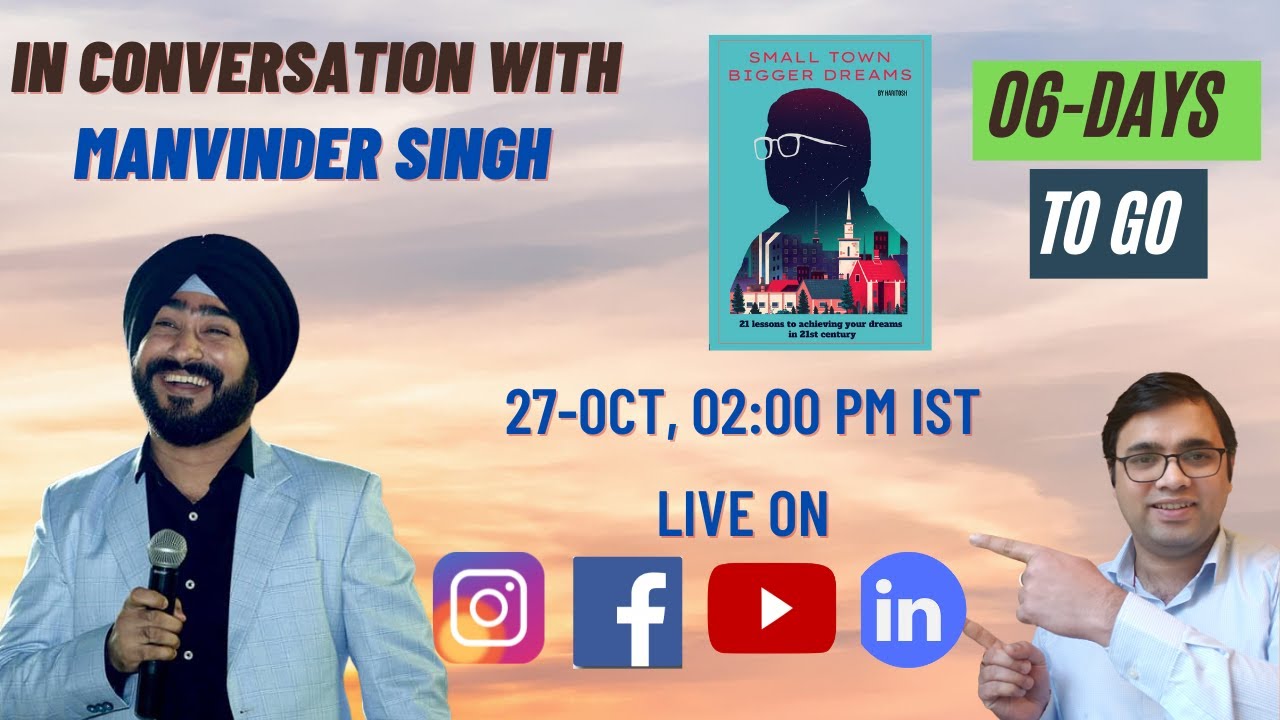
This content was created by Haritosh Srivastav. This content was uploaded by Haritosh Srivastav. This is a YouTube live conversation titled "6-Days to the 'Small Town Bigger Dreams' - Conversation with Manvinder Singh" (recorded/posted 2021-10-27). Host Haritosh Srivastav (author of Small Town Bigger Dreams) interviews longtime associate Manvinder Singh (entrepreneur behind Journey Jabardast and education initiative Beyond Siksha). The Day 15 session of a 21-day live challenge promotes the book launch (paperback on Nov 2) and covers topics including small-town beginnings, entrepreneurship, the impact of COVID, the importance of associations, communication skills and practical tips for personal and professional growth, ending with a call-to-action to order the book. The excerpt is an English conversational interview aimed at motivating and advising viewers.
Chapters
Hello and welcome to the next episode, which is day 15 of 21-day live challenge. And if you're not aware, I'm doing a 21-day live challenge leading to the launch of, yeah, the paperback edition of Small Town Bigger Dreams, which is getting launched on November 2nd. So I'm really, really excited, and I've been coming live on Facebook YouTube, LinkedIn, and occasionally on Instagram. And, uh, this week has been all about getting some guests. I've been talking a lot in last week, so I thought maybe it would be interesting to bring some people who has inspired me, helped me in journey, and you will also get to learn and they will share some nuggets of wisdom. So we had author Kanika Sharma, we had coach Akash Garg, and today I've got somebody who's really, really special. Somebody I've been associated for 22 years. Yeah, that's right. Somebody have been associated since 1999. Yeah, that does make me little old and from previous century, but that's all right. Uh, somebody I really, really admire, somebody I count in my top 5s if I have to say, and who's been an epitome. He's been part of travel and tourism industry for, if I'm not wrong, close to 18 years and worked on different at different levels. And couple of years back, he started his own venture, Journey Jabadas. He's also been associated in the education industry through his endeavor called Beyond Sikcha. So I'm really, really excited to have Manvinder Singh joining me. Manvinder is also from the small town, bigger dreams, uh, Jaunpur, small town. So I think it's very interesting to hear about his journey. So welcome, Manvinder. Welcome to this 21-day live challenge. I'm so excited.
Thank you so very much, Haritosh Srivastav, for your kind words and the great introduction. I'm more than excited to be here, and many congratulations for your book, which is so amazing. And of course, we're going to discuss about it as we move forward.
Absolutely, absolutely. So I'm going to give you a difficult task that I give to all my guests— summarize your journey in next few minutes for our audience. I know about all about your journey, but for the audience who's watching this, live or maybe afterwards, what has been your journey? How did you start and what you're doing nowadays?
The journey so far has been quite fulfilling. I mean, I would say that I have enjoyed throughout my journey. Of course, it had its own share of ups and downs, but it had immense amount of learning. And though through those learning, of course, it always helped me to move forward and that in the right direction. So I also come from the same town you come from, of course, as we know that. It's a small town, Jaipur. However, I also had the bigger dreams like you did, and it was not easy for us to reach to the level that we managed to reach. And I still remember when I was trying to convince my mom to allow me to go to Delhi to make my career, to go and have certain courses, and I was the most successful failure to do so. And that's when you came in and you somehow convinced her that I should be given a chance to go out and have my try. And that's how she somehow agreed, and the rest is the history. Of course, we started with a very small organization. The third day I got a job with the Vodafone, HUT at that time it was, back in 2004, I remember, which is now Vodafone. Then I worked with multiple companies in travel industries, and back in 2019 I started my own venture called Journey Jabardast. So it was, it has been so far a great amount of experience, great amount of learning, and yeah, it has been quite fulfilling, I must say.
Wow. I mean, yeah, I know all about it, but, but listening from somebody who's, who's talking about his own journey has got its own excitement. So thank you for sharing that. Now, uh, you also turned entrepreneurs couple of years back after being industry for 15 years. And you know, people say when you turn entrepreneur, it's a new journey, newborn, you become a newborn altogether. So what has that journey been for last couple of years?
See, it is always great to translate to what you want to do once you're an entrepreneur. Because when you work— I mean, no offense to anyone who works under anyone— but there are certain restrictions that you have. There are certain things which you're not allowed to do. Perhaps you need to seek permission if you really want to do something different, out of the box. There's some glass ceiling around which you cannot really break. But once you start, maybe if you want to do something different, you want to do some— you want to bring some new way, if you want to just kind of disrupt the industry for positive reasons, at least you have the liberty to do so. And I'm more than excited and more than happy to tell you that I have been able to do so. However, the only challenge that I came across is the moment I started back in 2019, 2020 came COVID, and that somehow rained the parade and that put us on the back seat for some time. But now since the market has opened up, things are getting better. So we are quite hopeful that we're going to make the difference that we are here for.
Awesome, awesome. Now, one of the things that I preach in my book is about the importance of having good association. So you need to be associated with, you know, people who are looking towards excellence and people who are doing great. That's when you get— you also become successful. You somehow get dragged into So what's your opinion about having good association?
It's, I would say, very imperative for you to make sure that you are around the right people. As someone very wise said, you are the average of 5 people you spend your time with. And I think you also have mentioned the same in your book, in the very first chapter, about your association. And I completely agree on it because the people who you spend time with, people who you rub shoulders with, I mean, that's, that's when you have the right impact. I mean, in case you are with the right people, of course, you get to learn a lot of things, you get to have the positive attitude, you see things through different lenses. However, if you are not in the right company, if you're not mindful about your association, and you kind of spend time with people who are not serious about their careers, about their business, about their life, sooner or later, you also get impacted and your performance, your I would say narrative gets impacted. So there's a reason it's really, very important for us to be associated with the right people. Like, I have always been associated with you, which has always helped me because I know, uh, you are somebody who brings positivity no matter how difficult the situation has been. So that's the reason I would always encourage everyone to make sure that you are with the right people if you really want to go ahead in career.
That, that's so, uh, beautifully articulated to say. Now, uh, I come from small town, you come from small town. We had our bigger dreams. And what do you think is different for somebody who's coming from a small town versus somebody who's already then there on, say, in an established city? What sort of challenges have you faced? If you have any, you know, stories or experience, I would love to hear that.
See, uh, the most important thing is that all is in their head. People think that it will be very difficult for you to go out there and compete with the people from the metropolitan cities, or somebody who have had, you know, convent education, English medium education, because you and I have studied in UP Board, the Hindi medium. So that was one perception or preconceived notion, or perhaps we could say imposter syndrome sometimes, that people usually come up with that, how are we going to compete with the metro cities boys, girls who have got all those facilities which we were completely deprived of. But what is more important is that you need to have the confidence. Of course, communication is something which plays a role, which is something you need to make sure that you have. Otherwise, no matter how good you are when it comes to express yourself, if you fail to, of course you'll not be able to compete. So, uh, I had my kind of— I was little underconfident. I was scared, how would I manage and go out and, uh, you know compete with people who are from the metro cities. But to be honest, people also have got the same expectations. I mean, they look at you, okay, fine, you're from a smaller town, perhaps you're not that competent, but you need to rise above those things. I mean, it's all about how well you perform. Let your performance speak more than your words. And most importantly, be confident, because there's nothing called smaller town, bigger town. Talent has a language that everybody understands. That's the universal language you need to speak in.
Wow, that, that's profound. Talent is the universal language, and it doesn't matter from which city, from which place you come from. That, that's so profound. Now, one thing that you alluded is about communication skills, and that's what I also mentioned in my book, one of the chapter about communication. And you do also a lot of work in Beyond Siksha for helping people, you know, communicate and articulate better. So if I have to ask you 2 or 3 things for anyone who's aspiring to be a better communicator, a better speaker, what, what are some of those 2-3 things that they can try on?
Uh, good question asked. Thank you so much, very much, Haritosh Srivastav, because one thing that has always worked for me right from the moment I started my career is the communication, the whole communication, because I always paid attention towards it. Even when I was in a small town like Jaipur, uh, people never took it seriously. People still don't take it seriously, but I strongly believe It is one of the best tools that you have that can really get you the success that you look for. It is something which separates sheep from the goat, I would say. So first thing is, it's very important for you to read. It's very important for you to listen to, because the more you listen to, the more you adapt and absorb. Don't try to go for something very difficult like reading a newspaper every day, because try to listen to something that you enjoy listening to. Don't try to go for something which you cannot stick for long. I mean, people usually go for a very tough newspaper and for 2-3 days out of passion they read, and then they simply keep it aside because it doesn't interest them any longer. So try to go for something that you enjoy. Because I have always been a cricket enthusiast. I always love listening about— listen to cricket commentary. So I used to make sure to listen to more and more cricket commentary so that I could learn words through it. I can practice that. And I never used Hindi commentary to listen to because I thought it is good for me to listen to the English one. Secondly, I had friends when I moved from Jaipur and I joined the hostel in Meerut for about 9 months. You are the reason for me to move out. So I chose my friends who could not even speak Hindi at all, from northeastern part of the country. And there was a guy who was again from the southern part of the country. Who did not know Hindi at all. And that gave me an opportunity to practice what I knew, and that really helped. So try to read a lot, try to speak no matter how much you know. It's absolutely all right to make mistakes because English happens to be the second or the third language to us. It's all right to make mistakes. Don't shy about it. And most importantly, listen to more and more. The more you listen, the more you learn. That's what I mean.
Okay, thank you. Those are some great tips. Now I do like to add a few things here because I'm also a proponent of, uh, no, being connected to your roots. And I love Hindi language. We love Hindi language. There's nothing wrong, nothing bad against Hindi. And, and those people who know me know how much I, I support Hindi. There's nothing wrong in knowing Hindi. Or, and there's like this again, the there's a big concept of like if you are Hindi speaking, you're not good enough. And, and one of the reasons people have that is like if you only know English, speak English, that doesn't make you any better than if you speak Hindi. Or if I say in Hindi, it's more about conveying your idea from you and, and sending it to someone who can accept. Language is always a medium. Hindi Hindi is a very good language. Similarly, English is again an international language, but if you want to be successful, and especially if you're looking at, you know, global career, it's also very important that you are able to articulate what you have inside. And, uh, it was very interesting, and I think I've never talked about it earlier. Uh, we are in UK and we went to for the admission of our daughter And what I liked about their education system, because they appreciated we are coming from a different background, our first language is different, and they stress that, that you communicate to your kid in your first language because that will not only strengthen her Hindi or first language, but that would also make her brain understand the other language and appreciate the English that we do here. So even in country where we— where the English is the first language, they appreciate you are coming from a different background and you stick to your roots, you stick to what language your first language is. And yeah, I, I would be telling a lie, but I see so many people sabotaging their own language just because they feel English is a better language. No language is better, it's, it's the people who use it, uh, for the communication and, and with whom you use. So if you're talking to somebody who's your native speaker native language like Hindi, I talk a lot. And if you're speaking on a global platform like this, talk in a language that globally people can understand. So that's the only reason we are doing it in English.
Absolutely. I quite agree with you because like I said, it's important for you to understand English because that's how you can communicate with people in a global platform. And most of the times at workplace, you need to communicate in English. But having said that, Hindi is equally important for you being in India because that is the language you connect people with, you know, you connect with the mass workforce within the country that you are in. You should always— I mean, what I strongly believe in, you should at least know two languages. And one language that is spoken, which is your mother tongue or the language that is spoken in your country widely, and one has to be English because that gives you the opportunity to go out to the world and talk to anyone in there, you know. With anyone because you cannot afford to learn every language on the earth. But of course, English is the language which is widely spoken, plus the language that your country speaks. So these two languages are very important for everyone to have. And more than the language to know, it's about how good you are to express yourself. No matter how much you know, if you fail to express yourself, that's where you lack in communication. So communication is all about the right expression, the right intonation, and the way you can articulate yourself.
Absolutely, absolutely. So language, like you said, language is a medium, but there are other aspects to communication which are equally important, and that's what we need to hone when we are trying to be better speaker. Now we are coming towards the end. I know you have limited time, I also need to go, uh, but what is your last message to anyone, whether it's from small town or whether it's somebody who's watching this from across the world? What is that one message that Manvinder wants to give to the audience today? Especially with respect to the whole context?
See, the very first thing is I believe that you should go ahead and read the book Small Town, Smaller Town and Bigger Dreams, because that particular book has got the lessons that's going to be life-changing, the game-changer lessons. The first one, like it says, be mindful of your association. That's a very, very important part. And we already touched upon that topic, that you need to make sure that you are around the right people, the positive people, people you can learn from, people who can guide you over how to go forward. And even if you're down, they should be there to uplift your spirit. So the second point is think ahead. Like Haritosh Srivastav has a second chapter, uh, that is think ahead. That means, uh, don't be reactive, be proactive. You need to make sure that, um, you have your calendars maintained, you have your weeks or months planned ahead, and that will always give you an opportunity to to manage your time well and to do things much ahead of your competition. They say that in case you want to be successful, start doing the work when the competition is sleeping. So that's what Haritosh Srivastav has to say with time. Think ahead. Another important thing is to have feedback. Take feedback very positively and convert those feedback to feed forward. I always say that because people who tend to ignore feedback would never grow.. So it's very important for you to continue to listen to the feedback. Even the worst critic is your best friend because they will help you understand what you're doing wrong, and accordingly you need to keep on moving. Fourth is never get settled. Never ever get settled that, okay, fine, I've had enough. Keep on moving, keep on competing with yourself because there's always room for betterment. Nobody gets on the pinnacle. Never think that I've reached the pinnacle, now there's nothing left for me. There's always somebody trying to reach there. So make sure that your learning has to be continuous. Make sure that you're self-improving continuously. At the same time, you need to make sure that in case I'm talking about being at workplace, always be a team player, at the same time an individual. You should know where you need to have your individual capabilities to pull things off. At the same time, you need to make sure that you're a team player. Delegate well, work well, understand people, don't be an autocrat, be the democrat, take everyone's opinion. And I think these are certain things which— and of course value time, because that's one thing which is more important than money or anything else. We as a country are getting time poor and money rich. So it's very important for us to value time. And if we put all these things in the right place, I think success is bound to happen.
Wow, wow. I asked for one, one message and you've given us a plethora of messages. And I'm pretty sure everybody would have got at least one message for them to carry forward to. And for example, for me, feedforward is something that we should all strive to do better, strive to get the feedback, take the hardest criticism, and make it in a way that it helps you grow, it helps you become better. So thank you so much, Manvinder, for joining. It was a pleasure and honor to have you in this live session.
Thank you so much, Haritosh Srivastav, and thank you so much for such a wonderful book. Most importantly, the language that you have used is pretty much communicating to the masses, and I would encourage and insist everyone, in case you have not ordered it, order it. Go through it. I'm sure you're going to enjoy it because it is the book which has a lot of learning lessons. And I know Haritosh Srivastav and his journey so far, and I know he will bring a lot on the table which can be a game changer to anyone and everyone.
Yeah, thank you so much. Thank you so much for those kind words, and thank you. I'm looking forward to collaborate more with you, and hopefully we'll go on Instagram if things go well.
Uh, most definitely.
Yeah. So that was Manvinder Singh, my dear friend, and helping me reach out to more people. So as I say every time, until next time, keep learning, keep growing, and keep going out of your comfort zone. And I'll be back tomorrow, hopefully with another interesting guest. And I tell it every day, but believe me, it's going to be another interesting guest, and you're going to love that conversation. So stay tuned. And until next time, stay blessed, stay safe, take care, and I'll see you tomorrow with 5 days to go for the launch of Small Town Bigger Dreams. Order your copy now.









