Daniel Magill's Secret to Confident Storytelling
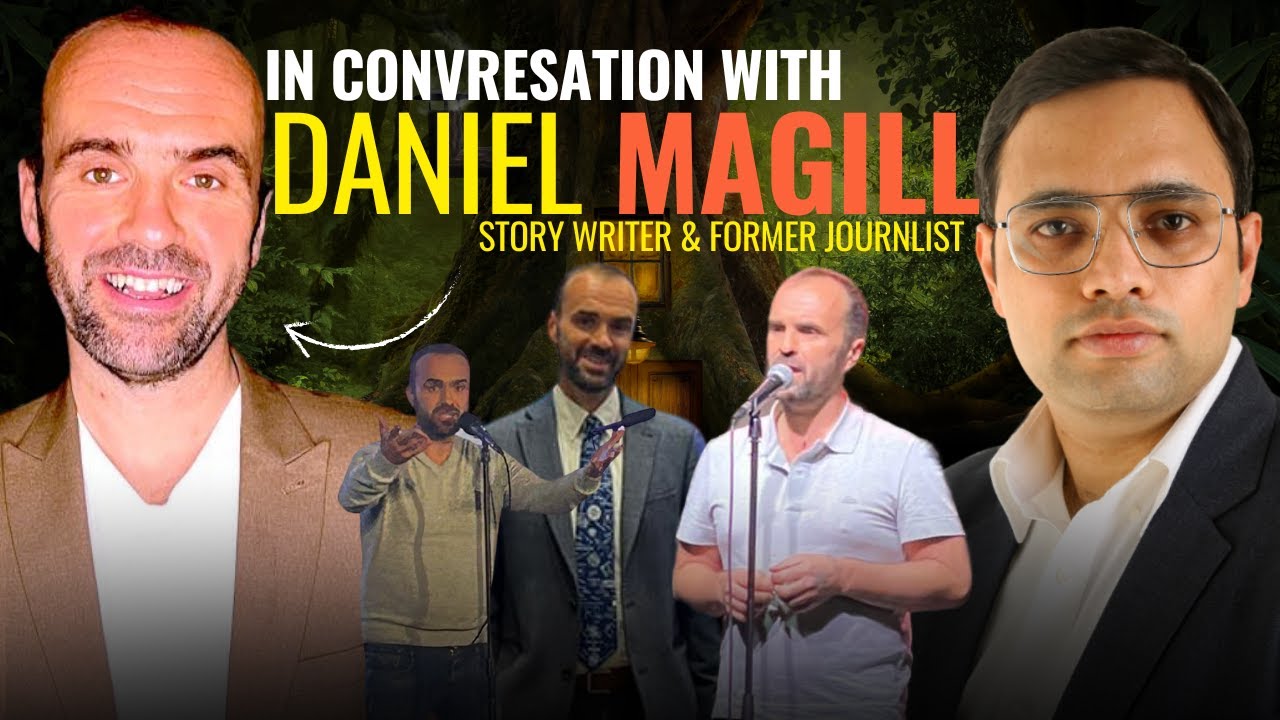
In this Confidence Storytelling Podcast episode, host (Speaker A) interviews Dan McGill (Speaker B), a former story writer, journalist, copywriter, and Toastmasters champion. Dan recounts his transition from writing stories on paper to performing them live after a chance visit to Toastmasters, highlighting how storytelling differs from story writing in terms of time constraints, detail, and punchiness. He shares practical copywriting insights, emphasizing the power of editing and the “kill your darlings” mindset, illustrated with a comparison of Apple’s 1997 website versus its modern, streamlined design. Dan describes his “Sculpt Your Story” workshop, using the Michelangelo marble metaphor to explain how to chip away unnecessary elements, condense language, and focus on essential events. For delivery, he stresses that the story’s substance and the speaker’s voice—pace, pauses, and tonal variation—outweigh stagecraft like gestures or eye contact. The conversation explores the role of humor in professional presentations, arguing that humor lightens heavy content and builds audience connection, with examples from Toastmasters contests and the Moth’s minimalist stage. Dan also outlines his current offerings: workshops for clubs, a free signed copy of his non‑selling book “Sculpt Your Story: Storytelling Success,” and ways listeners can contact him via LinkedIn and Facebook. Throughout, Dan provides actionable advice, vivid analogies, and personal anecdotes aimed at helping listeners craft and deliver compelling stories in both personal and business contexts.
Chapters
Hi everyone. I am so excited for this next guest who's coming on to the Confidence Storytelling Podcast. His name is Dan McGill. Dan is a former story writer and journalist, and I remember the first time we met was when Dan was preparing for appearing in the World Championship of Public Speaking, which happens in the USA, and I was so blown away by his humbleness. His ability to inspire the audience and tell great captivating stories. So in this podcast, you are going to learn a lot about his journey into public speaking and storytelling through things like Toastmasters, the monthly MOTS challenge that he takes. You're also going to learn a lot of how storytelling helps with copywriting, what you can do to sculpt your stories, and what is more important, story crafting or story delivering. This interview is filled with a lot of relatable stories, inspiring anecdotes, which I'm sure is going to help you in this journey. So let's not waste time. Let's get started. Thank you, Dan, for showing up, and I'm so excited for this podcast. How are you doing?
Very good. Thank you. Thank you for inviting me. Happy to be here. Really good.
I'm really, really inspired by your journey and seeing you for past couple of years. Uh, but I want to know the journey before that. So we know you have been a Toastmaster, won many awards and contests, etc. But what was Dan before joining Toastmasters?
Well, I, I think I was always, probably always been a story writer, and I was never a storyteller before joining Toastmasters. So, you know, at school growing up, I used to love writing stories. I used to love English and that kind of thing. And when I finished, I went, went to university and I got jobs in, in editing and writing and journalism and that kind of thing. It was always, it was always just written. And then eventually I moved into copywriting and user experience writing, which I still do at the moment. But it was all kind of writing and passing it over to people and, you know, being creative where you could, maybe bringing in stories where you could, but just the writing, just the writing. And then I always avoided any kind of, you know, public speaking, storytelling in public, anything like that. It just wasn't me at all. It terrified me, to be honest. And then, yeah, 5, 6 years ago, I went along to Toastmasters one night. It wasn't with any intention of speaking. I just, I was at a loose end one night and I saw it was on and I thought, I'll go and watch a few speeches. So I went along, saw a few brilliant speeches, ended up getting dragged into speaking, as we all do whenever anyone goes to Toastmasters, they end up speaking at some point. And I kind of enjoyed it. There was a bit of a buzz there, and I thought, actually, I don't know why I've been so kind of afraid of this for so long. It's, it's fun. So then the story writing became much more about storytelling. It's kind of a completely different avenue to go down and explore. And then when you then bring them both together, it's kind of even more powerful. So yeah, that's, that's been the journey before that's led into this one.
Amazing, amazing. And I know you do a lot of stuff outside Toastmasters as well. So you go to Morth, you do your workshop as well. And I wanted to first ask you a very interesting point that you also mentioned, that story writing is very different from storytelling. So if I have to ask you that, no, tell me, Dan, okay, what are the top 2 things I need to know which is different from story writing to storytelling? What would that be?
I think, I mean, even just story writing and storytelling are maybe not two things by themselves. They have elements within them. So, uh, story writing, it could be that you're writing a book, you're writing kind of quite a long piece of creative writing, and that gives you the chance to be very descriptive. You know that the person who's reading this is in for the long ride and they will enjoy all that, hopefully, if it's done well. So you've definitely got more time to kind of grab the reader and really bring them in with you. I think with storytelling, you generally have much less time. Nobody is going to really, unless it's kind of an audiobook that they might dip in and out of, if you're doing live performance storytelling or you're giving a story in a presentation at work, anything like that, then it's a much shorter thing. And you know, if you, if you start really going into long descriptions of things, an audience will quickly get tired. And, you know, they can't just close the book and put the bookmark in for an hour and come back to it. They have to listen to you. And so making things a bit more succinct, bit simpler, a bit kind of punchier and more powerful is really what you need to do with storytelling, I found. But yeah, even within writing, you know, so it might be a book and you'll have all this time. It might be a presentation at work and you just want to squeeze in a a short story that will kind of help emphasize a point. And, um, yeah, it's really every different type of story you tell in every situation will have subtle differences in probably the best way to tell it.
Absolutely, absolutely agree that. Yeah, we all think that, yeah, storytelling— and I, I see because I talk to a lot of people and they, they kind of intermingle that, yeah, story writing is the same as storytelling. It's is the same as you're telling kids a story to let them sleep. I mean, you don't certainly don't want your audience to sleep after you tell a story in a professional presentation. Awesome. So you are also a copywriter, and this is one thing that I wanted. I think I have had very few copywriters in the podcast yet, so I wanted to understand from the copywriting perspective, what do you think is very, very important when it comes to writing or crafting stories?
So I write mainly for businesses and quite corporate type stuff, and so there's not so much opportunity to put stories in there. But at the same time, every business is telling their own story. They have a reason, a purpose for doing it, and it will normally be to sell something, right? But there'll need to be some element of some story, whether it's their own story— and we're seeing more and more of that in movies with these big big companies like Nike and Gucci and so on releasing films to, you know, big, big, big kind of awarded, awarded films for, for telling their business stories. So there's, there's that side of it, but mostly it's kind of telling the story to the, to the customer, isn't it? To the potential customer, in that how, how will their story change by buying your product? So being aware of that is important. My main job is I'll be given, no matter which business I'm with, I'll normally be given kind of a truckload of information for a particular product or service and told to put that on the website. You know, if you did put that on the website, nobody would go near it because it would just be pages, pages, and pages. And, you know, people might read a book, but they're not going to read pages and pages on a website. So it's, it's, yeah, it's all about the editing process really. And I think with any story that you tell, the editing process, the cutting, cutting away rather than adding is the most important thing. And I often use an example in the workshops, but if you go, if you just Google Apple website 1997 and you look at the first version of the Apple website and there is just information everywhere, there's not really any images, just blocks of copy left, right and center. You wouldn't know what any of them meant. You wouldn't click on any of them because they don't really tell you why you would want to click on any of them. And then you compare it to the Apple website today and you log on, there's a huge image of whatever the latest iPhone is that they're selling and a button saying buy now and another button saying learn more. And that's it. That's it. And that's how they've kind of distilled their story from something that was about them. And, you know, we want to give you all this information. We want to throw it at you even though you don't need it. To this is why you're here. This is why we want you to be here. We want you to buy this. So we know what we want. We know what you want. And it's simple and clear and colorful and the contrast is stark between them. So yeah, I'd advise people to look at that difference and then Think about applying that to the stories. You know, if you're, if you might be in Toastmasters and you're giving speeches, you might be doing storytelling, but even in work presentations, have a think about whether your stories, your speeches, your presentations look like that old version of the Apple website with bits everywhere, or whether they're nice and crisp and clear and to the point.
And yeah, absolutely. Absolutely. I love that. And I can visualize that. Yeah, I've been to Many presentations, I shouldn't take any names, but people say, oh, come on, follow me on Facebook and also subscribe to my YouTube channel and go to my Instagram. And by the fourth, people say, okay, come on, stop it now, this is too much. But if somebody says, oh, if you want to know more, just go to my website and check it out, I think that is a clear distinction. So having a clear call to action, as we say, is very, very crucial, whether it's, yeah, story writing, copywriting, or storytelling as well.
Yeah.
And one thing you said which really resonated with me, and I want you to actually go a little bit deeper, is that, no, you said that you have to chop off your stories, and they say sometimes you have to kill your babies metaphorically, uh, to make a better story. So, so do you have any experience of, no, where you really had to struggle to, you know, get the stories out and then, you know, keep it revising and updating and upgrading.
Yeah, I think first of all, the example that I use in the workshops, which is not storywriting, but it feels kind of powerful to me. And the storytelling workshop I do is called Sculpt Your Story. Yeah, I talk a bit about Michelangelo and when he was sculpting the Statue of David, and he said that You know, David was in this big block of marble the entire time. His job was to uncover it, to find David within there. And I think that's the same with our stories. Every true personal authentic story we could tell is there within our brain. We've got it. The lump of marble that is us has that story within it. And really it's about chipping away and finding exactly what that story is. Yeah, in terms of experiences with that, lots, particularly at, you know, the Toastmasters contests or the Moth, where I'll spend a lot of time thinking about a story and thinking, okay, this is the way I want to tell it. And then I'll put it down on paper and, you know, I read it back and think, well, that's 15 minutes and I've got 5 minutes to tell it on the night. And at that point, I think there are two processes you can follow, and probably you should do both. The first one is to think about what is necessary to the story. In terms of events, you know, does the fact that this person said this, do you— does the audience need to know that? Can that go? It's just making sure that everything is kind of geared towards the story you're telling. There's nothing that goes off on a tangent, particularly if you're struggling for time, right? So thinking about what events you can take out, what sections you can say, I really like that section, but, but it's got it— I mean, it's a bit like if you've got a cluttered room in your house and you just throw everything in there because you can't bring yourself to get rid of any of it, and but if anyone ever went in there, they'd think you were a bit of a hoarder. And I think sometimes our stories can be like that. There are so many bits that we think, no, that's important, but, but really, is it? Can it come out and would the story be better? So taking out events is a big thing that I've found, but then also taking the words that we've written and condensing them, and, and that can have a huge impact because If you're saying something in 50 words that you could say in 5, not only are you wasting 45 words that could be used on something else, but actually those 5 words will probably come across to an audience so much more powerfully. So you kind of get a double benefit from just going through and really looking at every bit of language you're going to use. Just a silly example really that I use in the workshop is, you know, if someone someone started a story and said, let me tell you a story about a time a lady went into a haunted house. Well, that's, that's whatever, that's 15 words or so, I don't know. But if the person just came on the stage and said, lady went into a haunted house, it's just, there's just so much more something gripping about that at the start. We don't need to say let me tell you a story about, or I'm gonna tell you a story about, because you're doing it whether we like it or not. You're up there, you're doing So yeah, just, just, I mean, that's a small example, but there are so many areas where you, you see it maybe on LinkedIn posts these days and things like that, where people have used 3,000 words for a post when they could say it in 10. Yeah. And they're probably going to get more engagement from 10 a lot of the time. Sometimes they are really interesting. I'm not, I'm not, uh, I'm not judging them, but, but sometimes I think we could all benefit from from something we've written, just going through. And often we've said the same thing in there 6 times, and, you know, once would be fine.
Yes, yes, absolutely agree. I love that. Let me tell you a story. Once upon a time. And say, just, just tell once upon a time. Why do you need to tell, tell me a story? Or, or take that other— though I think this is where I find sometimes it is funny and risky as well, that, okay, you are going to love this joke. No, don't tell me because what if I don't love the joke, right? So you are actually increasing your risk by telling, setting the context. I mean, context setting is important, but not in this case. Just start with the story or start with the joke or humor, whatever it is. Now, um, I love that you gave us the process of, you know, how do you start off and how do you chop off some parts of it. Now when it comes to the delivery part of it, what are some of the things that you, uh, incorporate to make the deliveries, no, effective or make it wow.
Yeah, and another question I, I always ask in the workshop right at the very start is for people to have a think about a speaker that they admire anywhere in the world. You know, it could be a politician— unlikely it would be a politician— but it could be an entertainer, comedian, leader, whatever. Yes, you know, most of the time you'll get things like Obama and Oprah and people like that. And then I ask them to think about why they like that speaker. And the things that come back are always motivational, inspirational, the power of the voice comes back a lot, vulnerable, engaging, entertaining, funny, all those things. But what nobody has ever said in however many workshops I've done and however many times I've answered the question is, You know, they really like Obama because he uses the stage well, or Oprah has great eye contact and hand gestures when she speaks, or, you know, another person doesn't use notes. All these things that we do, we do particularly for anyone who's at Toastmasters, we focus on so much. Someone will give a speech at Toastmasters and then an evaluator will come up and say, oh, you could have used more of the stage and you could have had better eye contact. And I'm not saying these things aren't important, but we do lose focus sometimes of how important they are in relation to how a story makes your audience feel. That is, whether it's a story, a speech, a presentation at work, the response, the feeling that you get from the audience is way ahead of any of those other things. And I would prefer a storyteller who kind of looked at the ground the whole time it would be problematic. I mean, you'd struggle for connection, but I would prefer that if they had a great story to somebody who was dancing all over the stage and hands everywhere, but I was just bored by the story. So really focusing in terms of delivery, focusing on two things for me, I think. Firstly, the story itself— is it really entertaining? Is it really doing what you want it to do? And secondly, your voice. I think your voice is, is important as well. And absolutely.— the pace, the changes in pace, the pauses in the right place. I think that's— those two things are the real skills to work on, and the other things may be a little bit secondary. I know you mentioned the Moth, and the thing I love about the Moth storytelling, which monthly events that happen all over the world where people, anybody can go up and tell a story. But what I love about that is it's just a microphone in the middle of the stage and you can't move, you can't pick up the microphone and run around, or you can't bring props on stage with you. It's just your story and you're judged on that story at the end. And I like that. I think, yeah, kind of focuses on the most important things.
Absolutely. I love that. Yeah. I mean, if you don't have any substance on content, your delivery will actually elevate. If you're, if you're devoid of content, then it will show that you don't have any content more. So, and when you were telling that, you actually reminded me of a couple of things, and ironically both of them are related to Moth only. So first, I'm pretty sure you would have heard that Matthew Dicks, who is a great Moth StorySlam champion and so many times, and he always does that. He's always standing and he's not doing big flashy things and all, and most of the times he's also looking down, and people love his stories and he's written the story worthy, which I had the pleasure to interview him this podcast. I think few months back, and it was an amazing podcast, amazing interview. So even he says that, yeah, delivery is important but not the only important thing. And the second, which is actually a story, uh, I remember you were there in The Moth when the first time I went there. I didn't know anyone, and if you remember, there was this Asian lady who went there and was standing there, and she actually forgot her line. 3 or 4 times during this 5 minutes. And one other thing, reason I thought was she was trying to be too much flamboyant and too many words. But what was beautiful was that every time she forgot, after a few seconds somebody clapped somewhere in the audience and then everybody joined in. Not because she was doing great, because everybody wanted to support her. And that for me was beautiful because yeah, people do love who are there on stage because they visualize that if I was there on that stage, I probably would be doing worse than this. So why not support that? So yeah, Moth has been such a great experience for me, and I know you are a— what, what do you call, uh, addict? Moth addict. Yeah, so, um, moving on, um, Another accolade for you, you have been a District Humorous Champion couple of times, I think 2 or 3 times. What do you think is the importance of humor when it comes to, say, professional presentation? And what do you think funny stories do? Like, now, how do we incorporate storytelling when we are trying to be funny? I mean, the biggest thing people have, people like me also struggle, that how do I become more funny?
Yeah. So firstly on the, on the Toastmasters stuff and the contest. So, uh, 2 years ago, nearly now, 2022, I was really, really lucky in the contest and I won the International Speech Contest in District 91 here in the UK. And then there was a European round, which I got through as well. So I got to go and represent UK and Europe at the World Championships of Public Speaking in Nashville, which was lovely. But I was there with 27 other people who'd done the same thing from, you know, all around the world. And so I got to sit in the room and kind of watch 27 other speeches. And as you'd imagine, it's called the International Speech Contest. Every speech was big, motivational, inspirational, had real big message to go out and change the world, all these things. And they were all fantastic, like You could see why every one of them had got that far, apart from mine maybe, but then I did pay judges.
So, see your humor here. Okay.
But they, yeah, so they, they had all that. But the thing that, as you said, we have a humorous contest at Toastmasters, and the thing about all 27 of these speeches is I think every one of them would have won a humorous speech contest as well. They all had maybe 10 to 12 laughs in a, in a 5 to 7 10-minute speech that, you know, apparently is serious. Yeah, but they kept the audience laughing the whole time. And, and I think, I think it's really important if you're gonna go to a, a serious place, a dark place with an audience, they're gonna, they're gonna be happy to go with you, but you have to bring them out. You can't leave that mood of heaviness. And humor is the best way of doing that. It's the best way of moving from the dark to the light. It's the quickest way. It's the way you connect best with an audience. Shakespeare used to do it in his tragic plays. He'd have a scene where there'd be blood and guts and people dying everywhere and all that going on, and then his next scene would be two characters that had nothing to do with the main plot and they'd be just having a chat and it would be funny and it would just be a bit of light relief for, for an audience. So I think we need, we need humor. Now that, that dark place, you know, if it That would probably only apply if you were kind of maybe somewhere like The Moth or Toastmasters and you were telling a really serious speech, maybe about something dark that had happened to you, or, you know, a more general thing. But in work presentations, where, okay, you're not going to go to a dark place, you're going to maybe be explaining financial figures and things. Yeah. But it's quite a serious place, and in some ways it's a bit dark and boring and depressing. So yeah, I think same principles apply then. No one's saying turn it into a stand-up comedy routine, but find, find the light, find the humor in the, in the figures. Maybe find the humor in the slides if you're using slides. Just do something just to lighten it a little bit, I think is really important.
Love that, love that. Yeah, I love that analogy of taking them through the dark tunnel but also showing them there is light, and I'm taking you through there You're not going to be stuck and then left wanting, where am I and what I'm going to do afterwards? So awesome. Awesome. So then I think we are coming towards the end of this podcast and I loved every bit of it. So if somebody wants to connect with you or want to learn more from you, whether it's storytelling, humor, or any other kind of presentation, how can they reach out to you? And yeah, what are the kinds of things that you're doing right now to offer to them?
Well, we can put the links in, can't we, to LinkedIn and Facebook. I promise you won't find any 3,000-word posts from me on LinkedIn, so you should be fairly safe there. I'm doing the workshops if anyone— mostly doing them at Toastmasters clubs, but happy to do them anywhere. And, you know, basically I'm doing them voluntary. I just really enjoy doing them. So if anyone wants me to come to their club or whatever and and give the storytelling workshop, then, then, you know, I'd love to do that. Really enjoying that. I've got a kind of book that— don't worry, I'm not selling, it's not for sale— but it just goes with the workshop, and it's Sculpt Your Story: Storytelling Success. So that, that is the workshop, and everyone who comes will, will get a free one of them. Well, everyone who comes up on stage will get a free one of them, so, you know, any volunteers that come and tell a story. Anyone who doesn't come and tell a story will get a free signed copy, so, you know, Yeah, thank you, thank you.
Absolutely. I, I need to talk to my club leadership to get you invited. Yeah.
Yes, I'd love to. Yeah, I did have a nice, nice visit over to your club a couple of weeks.
Awesome, awesome. Thank you so much, Dan. It was such an honor and pleasure to have you, and looking forward to more such fun episodes in future as well.
Lovely. Thank you. Nice to be here. Thanks for inviting me. Thank you.









