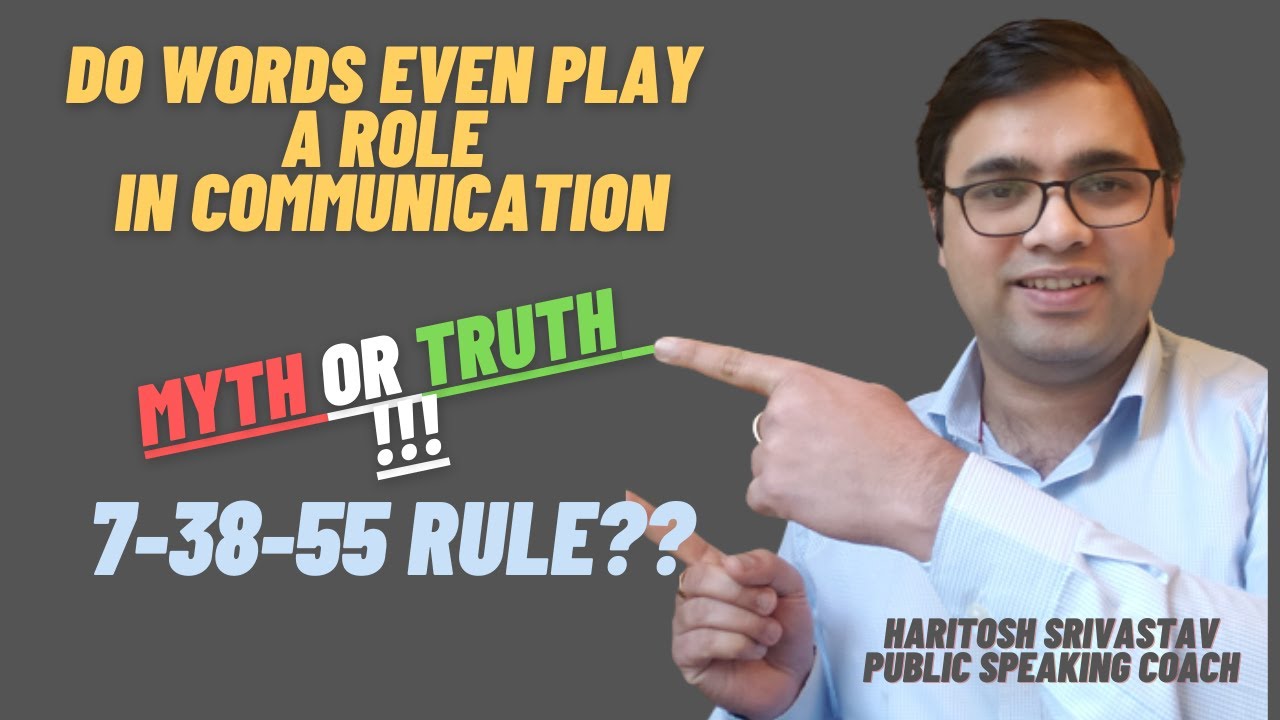
Public speaking coach Haritosh Srivastav debunks the 7-38-55 rule, which claims words account for only 7% of communication. The rule comes from Albert Mehrabian's 1967 experiment about feelings, not general content. Real effectiveness depends on congruency: alignment between why, what, and how you speak.
Chapters
Do words only play a minuscule role in communication? Do you also think only 7% of verbal communication is important for effective public speaking? Then you must watch this video to know the real truth. Hi everyone, my name is Haritosh Srivastav. I'm an IT project manager, bestseller author, certified mentor, and a public speaking coach. And in this video, I am going to talk about one of the biggest misconceptions of communication in public speaking. Now, we all would have heard that principle of 7-38-55, which blatantly states only 7% of what we say matters in our communication skills, while 38% is the tone of voice, etc., and 55% is the body language. Now, let me clear it right away. It is a myth. Yes, that's right, it is a myth. Now, it all comes from an experiment done in 1967 by two professors, Mehrabian and Ferris, to explain that the weight a listener places on the elements of communication only when a communication— when a speaker is talking about their feelings and attitudes. It has since been completely taken out of context and generalized for all sorts of communication. Come on, let's just think about it. If you are watching, for example, if you don't know Japanese language and if you're watching just a Japanese series, only by understanding their body language and tonality would you understand what they're saying? Would you have the perfect communication? Yes, you're right, it's not possible. As a matter of fact, Professor Albert Mehrabian himself has said on his website that, and I quote, please note that this and other equations regarding relative importance of verbal and non-verbal messages were derived from experiments dealing with communication of feelings and attitudes. For example, likes and dislikes. Unless a communicator is talking about their feelings or attitudes, these equations are not applicable. Yeah, I can see a lot of balloon bursting right now. So next time when somebody says that it's the only 7% verbal communication which is important for public speaking, You now are better informed. And this video is not to ridicule all the public, public speaking experts or anything. It's just to make you informed. Having said that, what I personally believe matters most is the congruency, where why you say, what you say, and how you say are in synchronization, are coherent. And this would make you a better public Speaker. Hope you found this information useful. How found this video useful? What are the other common myths people have about public speaking? Please mention it in the comment section. I love to know more about it. And also a quick announcement: we just started a Telegram group for all public speaking enthusiasts, and I would love for you to come and be a part of this vibrant community. I will be posting the link in the comment section, so Come and be a part of it. We will explore what more is important about public speaking, what else we can do, and what are the other myths out there in the, in the public domain. So until the next video, take care, stay blessed. I'll see you in the next one.