Don't Get Ready, STAY READY | Confident Storytelling Podcast with World Champion of Public Speaking
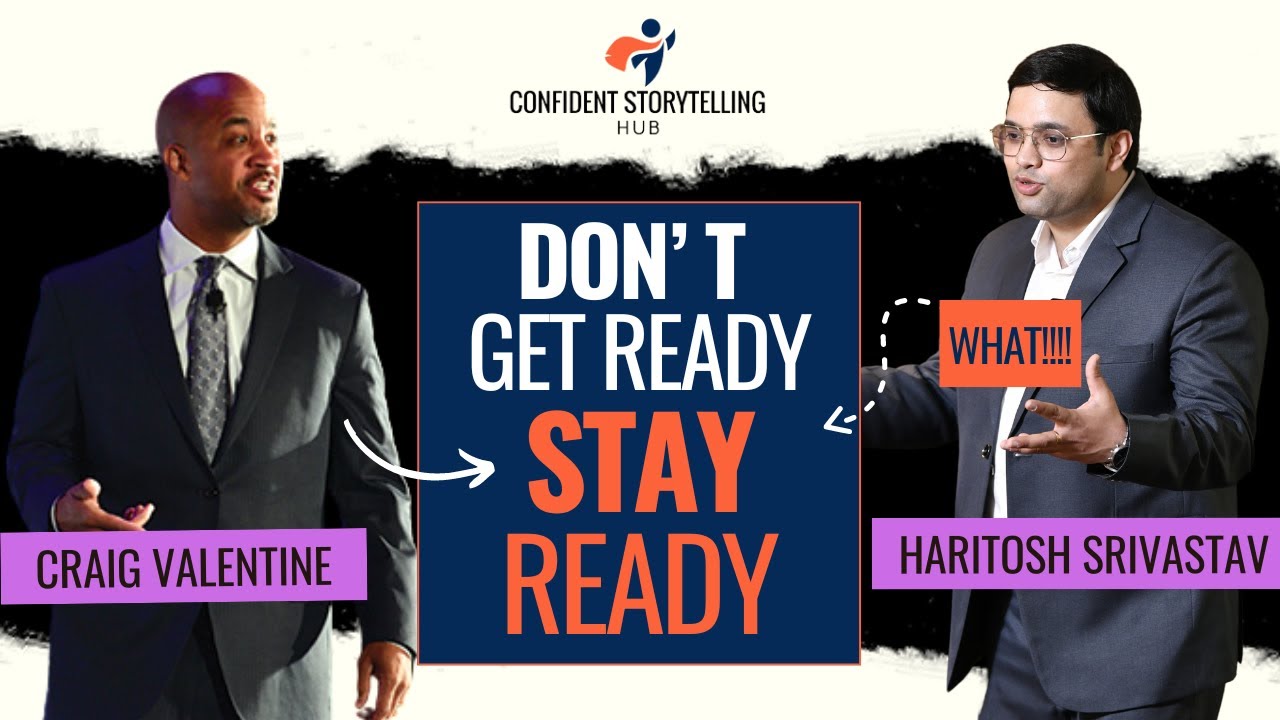
This content was created by Haritosh Srivastav. This content was uploaded by Haritosh Srivastav. This is a YouTube podcast episode titled "Don't Get Ready, STAY READY | Confident Storytelling Podcast with World Champion of Public Speaking" (created 2024-09-19T16:00:26Z). It is an interview-style conversation between host Haritosh Srivastav and guest Craig Valentine (1999 World Champion of Public Speaking). The episode covers Craig's personal journey into speaking and coaching, Toastmasters anecdotes, habits for speakers and coaches (story collection, listening, 30‑day story challenge), handling nerves (“don't fake out your nerves; stay ready”), the content vs. delivery debate, and selling through speaking (sell the result, not the product). Metadata: content_type=YOUTUBE; title as above; thumbnail provided in excerpt metadata.
Chapters
And then finally he said, Craig, okay, we're going to raise your salary to well above six figures. And I said, well, dreams are overrated. He looked me directly in the eyes and said, I don't care how much they try to compensate you, your dream is not for sale. So my advice for people nowadays is you can't fake out your nerves. You got to accept them. You got to employ them and make them work for you. I was— yeah, I was lonely in that car, just Just me and my payment. Most people will say something like this. Raise your hand if you'd like to receive 52 emails from me.
Hi there. Welcome to another episode of Confident Storytelling Podcast. And this episode is quite a special episode because I had the opportunity and privilege and honor to interview one of my speaking idols and my coach, Craig Valentine. So if you don't know, Craig Valentine is an MBA award-winning speaker and trainer who has traveled the world helping millions of people and hundreds of organizations reap the profitable reward that comes from presenting with impact and persuading with ease. As a motivational speaker, Craig has spoken in United States, Taiwan, Canada, Jamaica, Qatar, England, Bahamas, India, Hong Kong, China, and so on so forth. He is the 1999 World Champion of Public Speaking for Toastmasters International. He was awarded as the Salesperson of the Year 3 times. He is also an award-winning management trainer and recipient of Congressional Achievement Award. He has spoken in many corporates and world-class universities like NASA, MIT, HP, and so on so forth. He is the co-founder of World Class Speaking Program, which helps up-and-coming speakers and speech coaches turn their presentations and programs into huge profits. He is also the founder of Speak and Prosper Academy, which helps presenters transform their speech, transform their audience, and transform their bank accounts By becoming masterful speakers in high demand. In this episode, we covered a range of topics covering his journey, uh, how he got into coaching, what were the moment he felt that it is all worth it, to also talking about some of the big misconception people have, how you can be a better salesperson. And also we did a live experiment where He had to choose between whether you focus on content or you focus on delivery. This episode of about 30 minutes has the potential to really change your perspective towards speaking and storytelling. So let's get started. Let's welcome Craig. Thank you so much, Craig. How are you doing?
I'm doing great, coach. How are you?
I'm doing awesome. And I wanted to start by asking you the question which might have been asked to you several times, but I still want to know. We've already had your introduction and we talk about all the great things, but I want to know, how did it all start? Where this— where does this Craig Valentine, the Craig Valentine, What was the journey before that?
Well, you might know that when I was 10 years old, I was— I had a lisp that was so bad that a man referred to me as Daffy Duck.
Right.
And so for years and years, I was quiet. I didn't say anything. And then maybe 4 or 5 years after that, when I was about 14 or 15, I started forcing myself to, to work on my speech and my diction and so forth. And I always admired people who could speak well and could present well. And then eventually when I was about 27, 28, I joined Toastmasters International and I joined in March of 1998. I got what's called a Competent Toastmaster in March of 1999, and I won the world championship in August of 1999 in my, in my very first try. And Haritosh Srivastav, people come up to me all the time. They say, well, you, you don't even know what it feels like to lose a contest.
Right.
And I have to tell them I do. Because believe it or not, and this hopefully will give people some hope, I lost the humor speech contest at the club level.
Mm.
That's the lowest level you can lose. And I'll never forget, like, a seasoned Toastmaster named Alan Mish came up to me afterwards and he said, Craig, you can win the world championship of public speaking. And Haritosh Srivastav was like, what are you talking about? I just lost the humorous speech contest at the lowest level, the club level. What are you talking about? He said, I don't care. He said, the only thing wrong with your humorous speech was that it wasn't funny. But Alan Mish is the one who's responsible for talking me into going back and giving it one more shot in the international speech contest. And that's what I did. And it worked out. And I won the world championship and I've been speaking professionally. Well, I wouldn't say professionally. I've been speaking for the last 25 years. I've been speaking ever since.
Amazing.
That's how it started.
Amazing. And yes, I've heard this story from you many times. And every time when you share, it's like hope for so many of us around the world that yes, we can do that.
And you know what the great part about it, Haritosh Srivastav, is after I won the world championship, I ran into that father who called me Mr. H. I mean, I call him Mr. H. He called me Daffy Duck. I ran into him 2 months after I won the world championship, and he didn't even remember calling me Daffy Duck. Yeah. And so I had some fun with him, and I said, you know what, you don't even remember that? That's despicable. And he started laughing. I started laughing. And amazing. We just lost him a couple years ago. But, you know, I appreciated him because he was the one who made me face reality so that I can reform it. And I think that's what I try to do with people that I coach. Get them to face reality of where they are as a presenter so that they can take themselves to the next level.
Amazing, amazing. We all need sometimes those disguised angels in our life who can help us go into the path that we are meant to be. Awesome. So, so you won the world championship and then few years down the path, you also became the full-time professional speaker and trainer and coach. When was that moment of transformation? You said yes, I think I got it. I should now be speaking full time.
Oh, well, that was pretty interesting. Because you know the story, I was working for an internet company. And I wanted to leave because it was my goal to be a professional speaker. And my boss, the vice president said to me, you can't leave. And I said, what are you talking about? He said, we're gonna raise your salary. And he kept raising my salary up and up and up. And I think what happens with a lot of people, Haritosh Srivastav, is they let the good life get in the way of the best one. I had a good life. I had a good job. If they were ready to pay me a lot of money, keep in mind, this is like the year 2000, 1999, like 2000. And we let that good get in the way of the best. And my wife told me, don't let the good get in the way of the best. Your dream is not for sale. So I went back in there the next day. I looked the vice president in his eyes and I told him, I said, My wife said my dream is not for sale. But the bottom line is I left. I left. And here's some more hope. That very year, I spoke over 100, and I think it was 160 times.
Wow.
In 44 states and 5 countries.
Amazing.
Running my mouth ever since.
Amazing. Amazing. So let's talk about— you became a full-time speaker. As a speaker and trainer and coach, and as many people as I talk to who are at that level, they always have that one moment which feels like this is all worth it. This is what I have been preparing and I've been doing this. What was that moment for you when like, yes, this is what I was supposed to do?
So I'm in Cleveland, Ohio. I'm giving the commencement ceremony to the University of Phoenix. Okay, University of Phoenix is a little bit different because like the average graduate is like mid-30s, right? These are people who took a different route. And so there are probably 4,000 people in this orchestra hall. And before I got up to speak, as the people were coming in, the graduates were coming in, you could hear their children yelling out things like, "That's my mama!" or "That's my daddy!" And it just touched me in such a way. That Haritosh Srivastav, for the first time, I'll be honest, for the first time, I didn't think about myself at all when I took the stage. And I was just poured everything out into them. And I got up there. And it was the greatest engagement I've ever had. And then when I went and I sat down, I knew something was special about it. Because when everybody came up to get their degrees, almost all of them walked to the side and just came up and shook my hand and just came back and walked in. I was like, this is what it's all about. We took pictures afterwards, and it was— the kids came up to me. So it was just one of those transformational moments where I realized this is what speaking is really about. It's not about me. It's all about them. And it's even about their future and their kids as well. So that was one of those.
Amazing, amazing. And that's what you always teach. It's always What's in it for them, not for me, because audience comes first. Amazing.
Yeah, because if you really think about it, even way back in 1999 when I was going through the contest, every time I would win a contest, they would give me a trophy and they would give me pats on the back and attaboy, great job. But I remember there was always one guy who would come up to me and he would say, good job, are you going to win the next one? And I would always say to him, Look, man, can I just enjoy this one? He's like, yeah, but are you going to win the next one? And I even said to him back in 1999, my, my statement was, I don't know. I just want to touch lives. I just want to touch lives. Here's the interesting thing, Haritosh Srivastav. Every time I reached out my hand to touch a life, somebody put a trophy in it. But here's what I tell people. I never reached for the trophy. I always reached for the life. So the advice that I try to give people when they're in this business is just asking them a question, which is, what are you reaching for? Because if you really reach out there to touch lives, I think you'll be rewarded beyond what you ever imagined. So that's what it's about.
Awesome. Thank you so much. Now let's change gears. We talked a lot about your journey, your story, but let's talk about what you're expert at. You are the expert speaker, you are the expert trainer. So I want to know, what do you think is the biggest misconception when it comes to public speaking and storytelling and all the related fields? One misconception that you've seen over the years, but it still continues for a few decades.
I think it's like I thought when I first got into speaking that it was all about memorizing words. Yeah. And I was so nervous because I was like, if I miss a word, then I'm going to be done. What do I do? And I realized that it's not about memorizing your speech. It's about internalizing it. It's about understanding it idea for idea rather than word for word. So what I like to get people to do is find a way to tell your story. If you tell your story, then you're going to remember the point and they're going to remember the point. Give you a quick example. You know this, but 2 days after I won the world championship, I'm walking in the Chicago airport. My wife is on one side of me, and I'm carrying this gigantic crystal trophy, just walking through the Chicago airport, Chicago Midway Airport, not O'Hare, but Midway Airport. And people are looking at me like, well, who is that? And Haritosh Srivastav, you already know, I thought I heard a lady say, is that Denzel Washington? But this is when I realized my life would never be the same. This petite lady in a pink dress runs up to me in the middle of the airport and just starts reading the— I'm looking at the trophy right now. She starts reading the bottom of my trophy and she says, hmm, 1999 World Champion of Public Speaking.
Wow.
Say some things. I'm in the middle of the airport. I'm speechless. But that's when I realized no matter where I go in life, people are going to say, would you mind saying some things? So I came to the fundamental understanding about my life and really about any speaker's life, any presenter's life. I can no longer get ready to speak. I have to stay ready to speak. My motto is don't get ready, stay ready. And if you have a collection of your own stories, and you have a collection of what I call foundational phrases, you are always ready to speak. I don't know what questions you're going to ask me, Haritosh Srivastav, but I'm ready. Right? Because I got a story for pretty much probably any question you ask. You even talked about coaching. When you brought up coaching, it brought up a story for me. You know, here I am. I just won the World Championship of Public Speaking in 1999. I get a call from a guy who says, Craig, my name is Wade Randolph. I'd like you to coach me on my speech. I said, Wade, I'm just a speaker. I'm not a speech coach. I wouldn't even know where to start. He said, I'll pay you. I said, that's a good place to start. So I start coaching Wade. I have no idea what I'm doing. But for some reason, Wade keeps coming back. And the more he comes back, I keep finding out more ways to help him. And then all of a sudden, the word spread, hey, Craig Valentine is a coach. So I got more clients, I started finding out more ways to help them. But it wasn't until I had a conversation with my good friend Darren Lacroix, who's the 2001 World Champion of Public Speaking. He said, Craig, once you realize that you are actually also a speech coach, things are going to open up for you. And that's exactly what happened. So my advice for people nowadays is jump into what you fall into. Yeah, because there was a reason you fell. Jump into it. So when I actually jumped into speech coaching with my whole body and mind and spirit, man, I was able to touch more lives. So jump into what you fall into and tell your story.
Amazing, amazing. And, and you know, you, you would have heard this from hundreds of your fellow students, but you live in our heads. So every time, every time I'm speaking to somebody, he said, yeah, I need to get ready. I need to have a lot of content. And, and say, you know what my coach Craig says, don't get ready, stay ready. Say yes and then figure it out. And now I've got a new one as well. So thank you so much. This is such an honor to have you. And my major, this podcast is called Confident Storytelling Podcast. And you brought up the importance of storytelling.
Now, and you know what else, Haritosh Srivastav, is the reason why I might live in people's heads is not because there's something special about me. It's because I realized that good speakers speak to be remembered, great speakers speak to be repeated.
Repeated. Right.
And the way you get repeated is with those foundational phrases such as don't get ready, stay ready. Stay ready. The foundational phrases such as your dream is not for sale. The foundational phrases such as, uh, which Marshall Goldsmith later wrote a book about, what got you here won't get you there. You know, these are things that people are gonna remember, they're gonna repeat. And when they get to a certain fork in the road, they might take a different direction because of something that is repeating in their head. So that's an important part. Story point, foundational phrase. You can do that. You'll be beyond what most speakers ever do.
Absolutely. Absolutely. And that's what we have been following, following you. Once we learned and became Certified World Class Speaking Coach, we learned from you and that's what we teach our students as well. So my next question to you is about habits? Like, we all know that first we build our habits, then our habits build us. So somebody who's trying to become a coach, a trainer, and presenter, what are some of the habits that you want to say that they must have these habits to become what they want to become?
Well, it's different for each, but for a speaker, you have to have the habit of looking at life as a story. So what I would do is it's much easier now because we have phones, right? We have these phones. I have an app that's called Reflectly, Reflect-L-Y, and anytime I get an idea or a thought, I capture it, right? Because I think it was— what's the guy's name, uh, Ken Blanchard? It's one of those guys who said that an idea, when it comes into your mind, you have 37 seconds before it leaves, and if you don't capture it within 37 seconds, it's gone. And so I make sure that I capture my genius. That's a habit. You got to capture your genius. The things that come— now, 98% of what you capture might be garbage, but that 2% is gold. And so that has to be a habit. Another habit is, and I'm going to do this, I'm going to have a 30-day, 30-story challenge. Mm. And here's how it's going to go. You're going to have to tell a new story every day for 30 days. But here's the catch. The story you tell has to have happened to you within the last 48 hours.
Wow.
That's the way you can get— because that's how I think. I'm constantly collecting my stories. And if you do that, then that's something you can do as a presenter. As a coach, the real habit is about forcing yourself to listen more. When I'm coaching people, not on the podcast here, because this is different, but when I'm coaching somebody, I like to follow the 80/20 rule, where I'm spending 80% of the time listening, and 20% of the time asking and guiding. And if you can do that, then I think you can be a very successful coach because you're bringing the best out of them. And that, that's what we do as a habit for coaching.
Awesome. Thank you so much. And Totally agree to all of this. In fact, I also follow— I have so many apps, and I say to everyone, doesn't matter whether you are an app person. I have a copy that I keep, I call it story bank. So every time something is happening, I'm noting it down somewhere that I don't want to miss that part, the reflection. And I didn't know that study of 37 seconds, uh, but it is very important. So I'm sending it myself to WhatsApp or putting in some app But I don't want to miss that because yes, once that is gone, that is gone. You'll probably remember it after a couple of years, couple decades. I don't know when you will remember.
We think it's coming back. We think, oh, that thought will come back. No, it's gone. It's now in the ether. And now somebody else is getting rich and famous and touching lives off of your idea. You just never captured it. So I want to make sure that I capture everything.
Absolutely. And what you're talking about, I've read a book. I don't know whether you've read a book called The Magic by Elizabeth Gilbert. Which says that— who says that every idea has its own life and they come to you when they want to happen to you. But if you don't take action, it's going to go to somewhere else. And the point is, if you don't take action at that time, it's going to become someone else's idea. It gave you opportunity, you missed it, and it's gone.
That's exactly what I believe. Exactly.
Awesome. So now let's talk about a little controversial— not a big controversial, but There is a lot of people who solely focus on the content or script writing, and there is also a school who only focuses on the delivery. So if you have to choose between delivery and content, which side will you go into?
Oh, that's a great question. That's like somebody asked me one time, do you enjoy developing your speech more or delivering your speech more? And to be honest, I don't think I have an answer yet. Because while I'm developing it, I speak my way into speaking, right? So while I'm developing it, I'm also delivering it, but it's just nobody there yet. Right? It's not like I sit there and write down— I've never written down a speech in my life. Never written down a speech in my life. I speak my way into speaking. And so it's a little different for me, like, like, give me a topic, give me a topic right now, any type of topic.
Anxiety. Let's talk about that.
Okay, anxiety. So I remember being really anxious one time to sing at my best friend's wedding. He said, I want you to sing at my wedding. I said, okay. What do you think the first problem is when he asked me to sing at his wedding? Do you have any idea? What do you think the first problem is?
I can't sing.
Yeah, I can't sing. I'm a speaker, but I can't sing, right? But when we were kids, I could sing, but then my voice changed and I couldn't really sing very well. The second problem is I wasn't assertive enough to say no. So I had this anxiety, like the day was coming. Keep in mind, this is supposed to be his only wedding, right? So, so I get to the church, and all the groomsmen and the groom and me were in the back. And they're looking at me like, hey, Craig, are you nervous? And Haritosh Srivastav, I tried to fake out my nerves. I said, me? Come on, don't you know I played college basketball in front of 18,000 people? You think I'm nervous to speak in front of 200? Come on, I'm the kid, man. I can do this. And, and I was trying to fake out like I wasn't nervous. The music started playing, the microphone is in front of me, and I— Haritosh, it was the first time in my life my breath left me. I didn't know where my breath went or when it was coming back, but it was gone. Now let me ask you something, Haritosh. If you can't breathe, can you sing?
Not at all.
Not at all. And I know you think, well, I pulled it together and it was great. No, I was the worst wedding singer in the history of weddings. Again, keep in mind, this is supposed to be his only marriage, right? So I bring that up because if you fast forward a couple years, I have that same anxiety. But I had learned a new understanding. You can't fake out your nerves. You got to accept them. You got to employ them and make them work for you. So when we go to the 1999 World Champion a public speaking, World Championship of Public Speaking in Chicago, Illinois. There's 2,000 people out there. There's big jumbotrons on each side of the stage. So if there's anything in your nose, it's gonna be blown up like 1,000 times. Like you— and I'm the 9th speaker out of 9 speakers at the World Championship. You think I'm nervous? Absolutely. Did I try to fake out my nerves? No. In fact, I said, you know what? I'm nervous. Thank you, nerves, for being here. I know you're here to serve me. I went up on stage and I gave that speech better than I ever gave it in practice when I wasn't nervous. So one of my suggestions to people who have anxiety is, especially when it comes to being nervous to speak, don't fake out your nerves. Accept them. Accept your nerves and put them to work for you.
Wow.
So now, did I write anything down right there? No, but I spoke my way into speaking and that's the way you do it. Now, so to answer, go back and answer your question. I think I would rather deliver it because that's the moment where I'm touching the life.
I must say that that was one of the best table topics I have ever encountered. Yeah, I remembered some— once I went to a club and said, okay, your topic is 1952. I was like, okay, my father was born in 1950, so at that time my father was 2 years old, and, and that's it.
I didn't have any second sentence to say, so That was like, yeah, that's a hard one. That's a tough one. If you don't know anything about that year, it's like you got to relate it to another year. Right? 1952, that was 3 years before the Montgomery Bus Boycott. And you know, then you can go into that story. But yes, we speak our way into speaking.
Absolutely. Absolutely. Amazing. Thank you so much, Craig. My last question to you is, a lot of speaking also involves selling, where you need to either sell your ideas or you're trying to sell the product or services. So how can somebody approach selling through speaking?
It's very important to understand the most profitable concept, in my opinion, is to never sell a product or a service or an idea or even yourself. Always sell the result.
Yes.
And I put this video up on TikTok. It has over 3.3 million views now. And here, here's the essence of the video. Never sell a product, always sell the result. And I always give this story. Case in point, decades ago, I went to buy my first car ever in life. I went to the dealership, salesperson came up to me. He says, are you looking at that car? I said, yes, sir. He said, great. Let me tell you about it. This car has these types of brakes, this type of motor, this type of window. Now Haritosh Srivastav, what's he trying to sell me?
The car.
The car. I just said, never sell a product, always sell the result. So I said, thank you, but no thank you. I'm not interested. You know this, but I went to a different dealership, same day, different salesperson, same car. Now, in all honesty, Haritosh Srivastav, I think he might have understood where I was mentally and emotionally at that point in my life. You know, young and single and looking to mingle. Feel free to use that one. So he walks up to me, he says, are you looking at that car? I said, yes, sir. He said, hmm. Mm-hmm. You're gonna look good in that one. Mm-hmm. He said, yeah, man, you're gonna be flying down the road. The wind's gonna be blowing through your hair and the girls, let me tell you, the girls will be all over you. Haritosh Srivastav, you already know, but what do you think I did? What do you think I did?
I said, sign the check. Yeah.
I said, where do I sign? He made the sale not because he sold me the car, but he sold me the results. Yeah. And he lied. I always tell people I was, hey, I was lonely in that car. It's just, just me and my payment. What I tell people is never sell a product, never lie, but never sell a product or a service or an idea or change. Always sell the result. So when it comes to sales, it needs to be what's in it for them. All right. And one way you can do that is you can do it's, it's what I call a results generator. If I was to say, okay, you need to imagine yourself. You need to understand that imagination is the best nation in the world. What I can do is use the phrase, so that you can. Imagination. So that you can. Anything that follows that is going to be a good result. So that you can find yourself moving towards your goals and dreams and aspirations, even while you're asleep. So that you can feel the providence and serendipity at your back, pushing you, dare I say effortlessly, towards your dreams. So that one day you wake up in it. Right? So if you can just put what it is you want them to do, and then you say, so that you can, whatever follows that is gonna be a really good result. So never sell the products, always sell the result. And here's the other thing, Haritosh Srivastav, we want to put the result before the resource.
Yes.
I always ask my audience, I say, raise your hand if a year from now you'd like to be 3 times better than the presenter you are today. All hands go up. I say, great. Then for absolutely free, you can go to one of my websites, which is 52SpeakingTips.com. That's 52SpeakingTips.com. Every week for a year, you're going to get an audio lesson from me. And by the end of that year, you will be at least 3 times better than the presenter you are today. Now, if we were to just stop that and chop it up a little bit, I would ask my audience, okay, what was the result? They say 3 times better. What was the resource? They say the website. I said, which one did I mention first? Somebody always says free. Somebody always says free. But somebody also says the result. And that's the, that's the key. Never sell a product, always sell the result. Always put the result before the resource. And if you're in leadership, you want to state the result before the request. Absolutely do that, then you're really cooking with oil or cooking with grease, because most people do the other way around. Most people will say something like this: raise your hand if you'd like to receive 52 emails from me.
I already have 15,000.
I don't think that's going to work very well. But, you know, raise your hand if a year from now you'd like to be 3 times better than the presenter you are today. That's going to work.
Amazing. Thank you so much, Craig. And I can definitely vouch that it has certainly— I had got all the 52 speaking tips from you over the email, and each one of them is pure gold and diamond, to say. I've learned each from each one of them, so much so that, that I couldn't afford to become a Certified World Class Speaking Coach in 2022, but I made it as my resolution for 2023 that I am gonna go through the program. And it was all because all the 52, each and every tips that you mentioned was so valuable. So thank you so much. And anyone hearing or watching this, please go to 52speakingtips.com. It has got pure gold every single week coming up.
Awesome. Thank you.
Thank you so much, Craig. It was an honor and pleasure to have you. We already talked about 52SpeakingTips.com, but what are the other avenues for people to get in touch with you and learn from you?
Well, that's the front door. If you come in 52SpeakingTips.com, that's the front door. I'm on social media at @CraigValentineSpeaks. And so if you go on any of those social media sites, you can find me there. But I would come through the front door of 52 Speaking Tips because like you said, you're going to be getting a tip every week automatically. And it, I do feel like there's some gold in there. So thank you for that.
Thank you so much. So that was Craig Valentine, MBA, World Champion of Public Speaking, 1999. Thank you so much. And I'll see you in the next episode of Confident Storytelling Podcast.









