[Episode 7] Instagram Inspiration - Geeta Nain
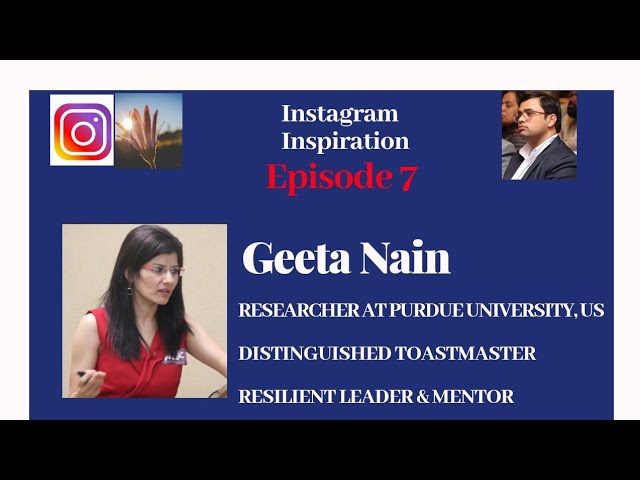
In this episode of the Instagram Inspiration series, host Haritosh Srivastav interviews Geeta Nain, a PhD candidate at Purdue University specializing in extreme weather modeling. Geeta shares a concise narrative of her life, beginning with her upbringing in a small northern Indian village, her pursuit of aeronautical engineering, a master’s in atmospheric sciences from IIT Kharagpur, corporate work modeling catastrophe events, and her current research on high‑impact weather. She reflects on two pivotal setbacks: rejection from the Indian Air Force due to eyesight and the emotional blow of losing external validation, describing how these experiences redirected her toward self‑love, meditation, and a science‑focused career. Geeta discusses her extracurricular engagements—six years in Toastmasters, presidency of the Indian Graduate Student Association at Purdue, reading, writing, dancing, yoga, and daily meditation—highlighting the importance of community and personal development. She offers concrete advice for young professionals: explore and understand oneself, maintain belief and self‑compassion, build authentic networks, adopt a teaching mindset, and give back to society. Regarding the COVID‑19 lockdown, she explains how the enforced isolation fostered deeper introspection, increased meditation, new hobbies, and reliance on virtual connections. Finally, she shares her view on dreams versus goals, emphasizing alignment between one’s work and personal aspirations, the agency to reshape reality, and the fulfillment that comes from living one’s dream. The episode concludes with a mutual appreciation of each other’s journeys and a call to help others in any form.
Chapters
Napoleon Hill said, when you are able to maintain your own highest standards of integrity regardless of what others may do, you are destined for greatness. Hello, good morning, good evening, good afternoon, everyone. Welcome to the next episode of Instagram Inspiration. Today I have a very special friend of mine, Geeta Nan. Welcome, Geeta. Welcome to the show.
Thank you so much, Haritosh Srivastav, for inviting me for this episode. I feel so privileged and honored to be here. Um, I still remember our first experiences, like, you know, uh, how we met. And when I look back that time and this time, um, I, I feel so proud on you, the way you are giving back to the society and community. So thank you so much for starting these videos and today inviting me as a guest.
Thank you so much. It's my honor and privilege to have you, and I'm pretty sure our viewers are gonna love the conversation that we are gonna have. So a little bit of background about how this, uh, goes is that now I will be asking a few questions, uh, more like a question master, and then you will give answer, and if we have any questions by audience, I'll ask towards the end of the session. So yeah, let's, let's start with me giving you a big task of summarizing your whole journey in probably couple of minutes. So how did you start and what all have you done? So give us a brief summary of that, please.
Okay, sure. Um, of course it's a big task. I'll start with my childhood. So I was born and brought up in a small village in northern India, and like everybody, after schooling, people want to go for engineering. So I also opted for engineering, aeronautical engineering. After that, I end up taking master's in atmospheric sciences from IIT Kharagpur, and then I went for a corporate experience. So it was basically, I learned how to how to model catastrophe events for managing the risks. So that was a beautiful experience. I specifically worked on hurricanes and thunderstorms. Now I am working in research for extreme events. So I'm doing my PhD from Purdue University in atmospheric sciences, and my main area of specialization is modeling high-impact weather because of extreme events. So of course the journey has been quite long, but when I look back, it's— there has been so many learnings and of course so many people who helped me and so many reasons why I'm here. So I cannot summarize, but yeah, this is what short— what you— I think.
Sure, thank you so much. I think this is enough for us to get started. And so let's go into a little more deeper part of it where I ask a few more questions about— no, we all know, we all like to boost our success, we all like to talk about success, but one thing that I do in my— this show is, you know, talk to people about their failures and their learning. So if you have to give two examples of failures, uh, what would those be and what were your learnings from those failures?
Okay, um, yeah, I would rather say learnings than failures because, uh, they have been in past and of course we learn a lot from our mistakes and rejections and problems, whatever happens. So for me, of course, there has been huge learning from all of those. I would first quote one example of my rejection. So like, we can categorize into different things. It's It's not just like failure, sometimes you call it rejection. It's failure. And, you know, so, um, uh, so I had a dream of becoming an Indian Air Force officer like my brother. So I took aeronautical engineering just because I wanted to be in, in Indian Air Force. But right after my bachelor's, when I applied, I did not get through it. And one of the prime reasons was that my eyesight was like was not appropriate. So, um, I tried hard, I did my best, but still I was not selected. So that was a kind of rejection, I would say. But the learning I got from this experience is that, uh, there are something like when you put your best efforts but still you are not able to get through it, then what do you do? You start exploring within yourselves, you start doing something which is already there. So, uh, I would say that every learning experience from this was like Every rejection is like a redirection for a new, for a new venture. And for me, it came out like that. I started figuring out that I am more like a science person than engineering, so I chose atmospheric sciences, then aeronautical engineering for my master's. And, um, that's how, like, I got interested in hurricanes and extreme events, and today I'm doing my PhD in that field. So that was a great experience. So Second, I would say, um, I would say like when people give up on, give up on you. It's like when you really like, love, or admire people, but still there are some, some challenges or situations or something happens, and then it's like people no more care for you. And I think that was a kind of I would say have been a breakthrough for my life because it's like when you think yourself as what people think about you and what people like imagine you, and then when they give up on— give up upon you, it's like— I'm sorry, it's like your whole image kind of shatters in your own mind. And so that's like, it brings a kind of true conflict in your life. Then you think that you no longer exist. So there has been something like that in my life too. And I would say that, and that, that kind of experience really helped me in bringing to what I am today, I would say, because after that I started this journey of self-love and I started doing meditation and I started going deeper inside me rather than being validated by other people. So I think everybody has to go through this, into this journey at some point of their life. I am blessed that I have got the chance of going through that journey in so early in my age. So yeah, I would say that was also a great experience and learning.
Great. Uh, I want to ask you, because I know you are involved in so many other things apart from, of course, doing a research on extreme weather. So you want to tell us about what are things you are involved apart from your research?
Sure. So, um, I am— I think I'm a people-oriented person. I love being, you know, surrounded with good people. And the reason I, I got to discover this part of myself is through— I would give the credit of to like Toastmasters, uh, because, um, it's like when I started my journey or my career, everything, there was nobody around me who was there to help me at each and every step. But I got a bunch of people in different aspects of my life, so I mean, I did not have like one mentor. I had a lot of people around me. So this made me realize the importance of being surrounded with people and having a good network of people. And that's why— and also like, um, so it's like when you feel something good from inside, just start doing it. Just start involving more people and just start feeling it. So That's why I'm so much interested in so many activities. First is, of course, Toastmasters. I have learned a lot. That has been like a part of my self-improvement. I have been part of Toastmasters for 6 years now. And second thing is like when I came to Purdue, so I had— I actually joined different communities who are there to help people when they need help or like support or just, you know, have a good learning experience in your schooling. So I have been part of Indian community here that's called IGRASP, Indian Graduate Student Association. So I was the president last year. And so in being part of this community, I get the chance of meeting a lot of people and help people, mentor them, and also learn from them. So this has been a great experience. Apart from this, I also like to read and write. And the reason is because I love to self— I love to introspect myself a lot. So writing and reading helps a lot. And also I'm kind of interested in physical activities like dancing and going out for exercise, doing yoga. I would say meditation is something I do every day and That is also kind of activities which helped me going through myself a deeper level. So yeah, there has been a couple of activities and there are more to come. Let's see.
Sure, sure. I think, yeah, you're just an inspiration in the number of things you are involved. I mean, sometimes I get bogged down with a couple of things that I'm involved and I seriously need some coaching on time management or priority management, as they say. Uh, but yeah, let's keep it for some other time.
So, um, yeah, sure.
Let's talk about, uh, why we do is that now we want to have some message for the young professionals over here who's gonna join the corporate probably pretty soon or start their career. So if you have to give 2 or 3 tips for any young professional regardless of their choice of career, what would that Sure.
Um, so I would say, uh, in early age, like in early stage of your career, uh, start exploring your options. Start knowing yourself better, what you really want. Because sometimes people think, okay, right after my education I'm just going to get this job, or I'm just going to do this what people, other people are doing. But I think that's a kind of wrong notion. We really have to understand ourselves, what are our options, what we really truly feel about doing. So introspection is the key. Never ever give up, no matter what. If it's a failure, you might learn something from it. If it's a rejection, it may redirect you somewhere else. So, uh, criticize yourself, but at the same time, love yourself. Like, forgive yourself and just move on from the things and just keep on doing. And just, just, just consider that there are something in your life which are going to take time. So if you're not like there yet, you will be there. Just believe in yourself no matter what. I think believing in yourself is seriously a key in my life. So I would say having a belief in yourself no matter what is seriously a wonderful thing to have. Second thing I would say, like I was mentioning, that you need to find a good networking of people around you. Because I, like I was mentioning, that I seriously did not have like one mentor in my life. I had a lot of people, and through people I got a kind of experience in my own things, like how to overcome with this challenge, how to like, how to, how to go to the next step. So because I have— I actually listen a lot of TEDx talks, and I'll, you know, um, listen this motivational speeches and all. So this, this inspired me a lot. So you should never feel alone in this journey. There are a lot of people who have gone through the same journey. So just find your people around you and be good with them, be authentic with them, and get a good guidance from them. And seriously move on, because there is a tendency of us, like, if we are stuck somewhere, either we stress out or we just give up. So there are two things we do, but that's not how you should react. It's like, just take a pause and see around you if there are people you can find, they have gone through the same journey, seek their guidance and then restart again. So that's how you do it. If you stress out on something like doing it the very first time, the very best, it's kind of stress we take on ourselves. Having good people and when you listen their stories is seriously, I would say, really help. Third thing I would say, of course, that will be very early to say in this age if you're talking about just for young professional, but I think if we make it a kind of habit, it's like do everything as if you are going to teach somebody. So that brings a kind of excellence in your work. It's like you're not just doing for financial benefits or for just like business or whatever, you are just doing it because you feel it from inside. So suppose like if you are supposed to teach something to somebody, how would you react and how would you do it? You do it in a different level, you do it in a different way, right? So I would say just have this, this point in your mind, like you are supposed to teach it to somebody or mentor or help or give back. When you have the tendency, you are automatically out there, like you are just, um, you know, taking it in a different level. These are the 3 things I would suggest. Uh, be authentic to yourself, believe in yourself, work upon yourself. Second, find a good network of people with whom you can share your problems. And third, you just think of giving back to the society.
Very nice. I think, yeah, I, I don't need to summarize that, I think, because you've already summarized. But I think these are very, very important points for any young professional or I would say any professional to say. It's not categorized only to young. Okay, uh, now, uh, let's talk about what's happening now. It's about the corona, COVID-19, uh, and we know what is happening now. So how are you coping up with COVID-19 and probably lockdown?
Sure, um, of course I understand it has been a challenging time because I was also like a people-oriented person. I love to meet people and it's like now everything is restricted. So of course I do have like video calls and talk to people, but I think this lockdown made me really spend more time with myself, um, like for self-reflection and to have a kind of plan for myself for like next couple of years. It's like when you are alone, like, I think it's a noise around us, um, most of the times, um, but this lockdown created a kind of silence in everybody's life. Now people are forced to think about themselves no matter what. So, um, I'm a positive person and I'm taking it really positive. Um, I get more time to do meditation and do self-inspection, I mean introspection in me, and I take care of myself. That is most important. I think I would suggest to everybody that don't get panic. It's, it's gonna— it's not going to be here for permanent basis. It will pass soon. We just have to take care of ourselves and just be connected with people through social media because I think this is, this is a kind of boon for us because in spite of having all of these things, we are still connected with people. Through, you know, social media. We have that kind of benefit. Um, so, um, just do that. And I also like started, um, doing— I mean, working on my own hobbies. Like, I get better in cooking and dancing and, you know, different activities. But I seriously feel like when I talk to my family, friends, and like, it's like they're getting bored, they don't know what to do. It's a kind of challenging situation, and It's like everybody don't take it in a similar manner, but I would suggest just, just take time for yourself. Um, try to do meditation if you can every day. Um, or just like be connected with people. Um, it will pass soon, and take it in a positive manner because it's with everybody.
Yeah, thank you so much. I think, yeah, connecting back to yourself, reflecting back, uh doing some sort of meditation. I started doing meditation couple of months just before corona, so I think I'm spending at least 10 minutes almost on daily basis too.
Oh wow, that's really nice.
Yeah, thank you. Yeah. And yeah, I think, yeah, I've got a lot of time now to go back to what I think I love— connecting to people, doing these new experiments that I'm doing now. Listening to a lot of podcasts and YouTube in a positive way. So I think, yeah, there are a lot of positive also, and we know what the situation is. So thank you so much. Uh, so yeah, before we finish, I think we had one question from audience earlier that, uh, what is your perspective about dreams versus A lot of people say, you know, focus on your goal, and a lot of people say focus on your dream. So what is your perspective that, no, in terms of general goal that we have versus the dreams we have, how should we manage both or prioritize one over other?
Sure. Um, I would say that We, I mean, it's like we take it in a different sense. Like we think, okay, dreams are different than reality. And in some people's life it is like that. But, and that's the point of confusion when we get, you know, these two different sides. Dream is something else and you are working on something else. That's like it's diverging you into different direction. So I would say just think through it and see, is it what you really want to do in your life, the kind of work you're doing? Because if it is diverging from your passion, from your interest, from your dream, maybe it's not the right thing to do. Maybe it's your, you know, the reality. And you know what is the great part? The great part is that you have the power to change it. If you think is your dreams are completely divergent from your reality, that means there is a need for you to work upon those. And there could be a different condition, you know, just think it from different perspectives, that whatever your dream is, you are living that dream and you're working on that. Then there is no longer two sides of you know, these things. It's like, you are here. I have been in that situation where I used to dream something else and I used to do something else, but that made me work upon myself. That bring— that brought a kind of change in me. And today, here I am, and I see that I'm actually living the dream of my life. This is what I really wanted to do. And trust me, friends, it really feels great. When you get to work on something which you really dream, then you are no longer working. It's— it becomes, you know, the joy in life. That's, that's what I would say.
Such an interesting, uh, perspective on that. So thank you so much, uh, Geeta, for joining us for this session. And I'm pretty sure whoever is gonna watch this episode is gonna learn a lot of things from this conversation.
So thank you once again, uh, and I'm gonna end this, uh, and I would like to add, seriously, I mean, yeah, yeah, I would like to add something. It's like, I seriously feel so inspired the way you are giving back to the society, because I think this, this is really important. We are not going to get like extraordinary people, like what you're really learning, what you are going through, is like through people people around you. And the kind of series you have started, like, you are just calling people who have been in your contact, and like, you were kind of influenced or inspired, or I was so inspired from you. So like, starting these kind of series is really inspirational. So I feel so proud that you started this, uh, and I seriously look forward to have a kind of great success in, in this, this series. Thank you so much.
Thank you, thank you so much, Foran. I think, yeah, you summarized well. I, I do not have any contacts with any rock star or any other stars. I wanted to have people who really truly inspired me, uh, in different walk— from different walks of life, but still connected, uh, the normal human being to say. And, and I think if we go back to that common people, we, we can learn a lot more than if we look at to the rock stars and other movie stars and other things. So we all hear, read, and learn more about them. But I think in our day-to-day life, we can learn a lot from people around us, and that they are the rock star in our life. I would say you are one of the rock stars in our life. I would say I might have to edit that.
No, no, seriously, I would say, you know, when I saw you, like, when we met first time, you were the VP Education at that time in Toastmasters. That was your first year. And you also happen to participate in international speech contest, and then you won at area level as well. So that was like, that time I saw you, and today I see you, like, it's like the huge jump you have taken in your life. And a lot of, I would say, like, seriously, a lot of progress might have been going through in this, this process. And so it's the attitude, like, you, you are going through. So that's very inspiring. And seriously, that's what make, you know, people, uh, great about what they are doing for other people.
So yeah, thank you so much.
Thank you so much for being what you are.
So I'm gonna end this episode now, uh, with, as I do it every time, that, no, please make sure that you help others. And when I say help, it's not always about money. It could be also about talking to someone for 5 minutes. It could also be feeding a pet. But help somebody, and we will get over this. This is not going to last forever. Make sure that, no, you keep learning, keep growing, and keep going out of your comfort zone. This is Haritosh Srivastav, and this is the episode 7 with Geeta Nan. I'll be back in the next episode to with another guest, another person who inspired me a lot in my life, and hope you'll love that. Thank you. Thanks, Geeta.









