How did he go from Kalpi to TCS | Inspirational Interview LinkedIn Expert Gaurav Gandhi (Part-1)
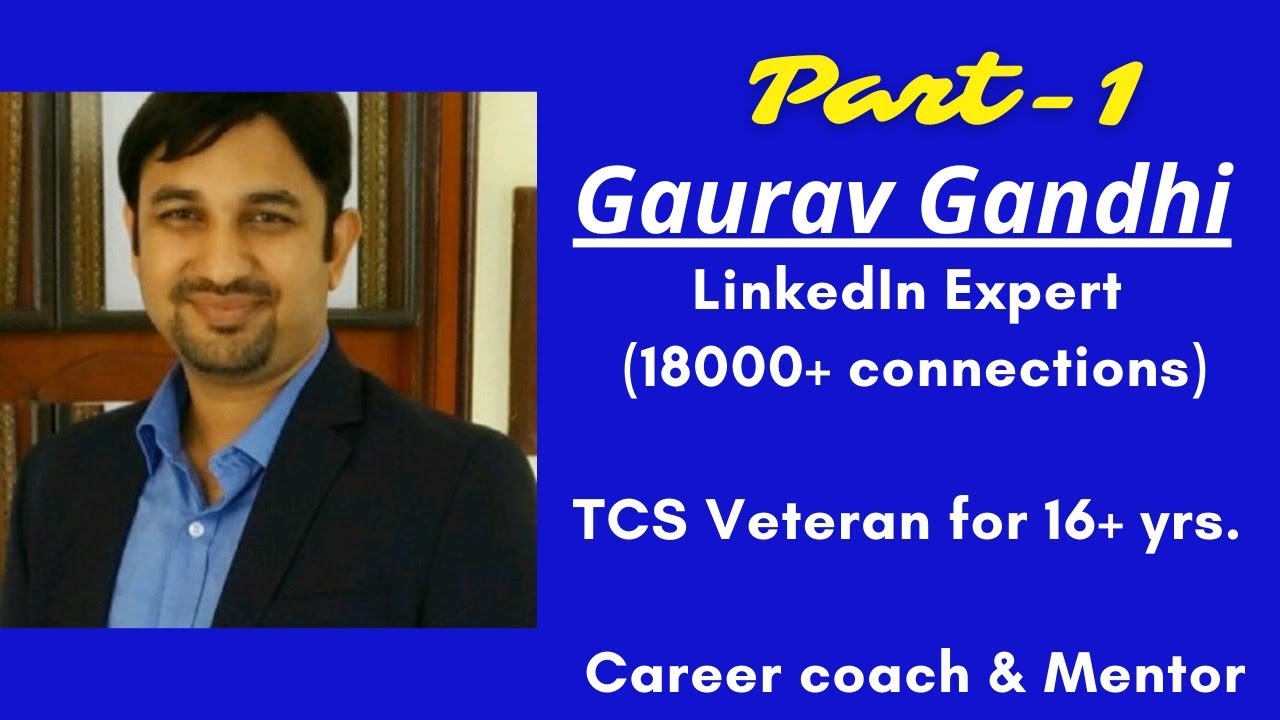
Gaurav Gandhi traveled 32 km daily as a child to school in Kalpi, joined TCS in 2004, and spent 16 years in roles from mainframe programmer to business analyst. A coma from infectious disease in 2009 and his mother's cancer diagnosis in 2016 shifted him toward education, leading him to deliver 100+ workshops reaching 50,000 engineering students across India.
Chapters
So I used to travel when I was 8 years old to 32 kilometers every day. I wanted to have an impact in education, especially higher education. That was the lowest point in my life. I was in coma for a month and I had more than 15 surgeries on me. How do you bridge the gap between industry and academy? What does industry need? That is where I also started reflecting what is important in life, whether what we are seeking, is it important in the larger context?
So good morning, afternoon, evening, people watching this interview. I am so excited and thrilled to have my next interviewee. He's someone with, if I may say, 16,000 to 18,000 connections on LinkedIn. He's someone who's got like million views on his post. He's been a TCS employee for close to, I think, above 15 years, played multiple roles. And I think before I take a lot of time of you, let me introduce my next guest, Gaurav Gandhi. Gaurav, welcome to the show.
Aaj hain, Haritosh Srivastav. Great to be here. I've been following you on LinkedIn. Great to see your commitment towards reading your YouTube channel, uh, through which you help a lot of youngsters gain new perspective through these interviews. I'm very excited to be here.
Thank you. Thank you. Same here. Uh, so let's start by asking you about your journey. I know you have a very varied journey and lot of interesting things that you have done. So would you like to give a short summary about that?
Sure. Haritosh Srivastav, my journey started in a small town from Uttar Pradesh. I was born in a small town near Kanpur, which is called Kalpi. It's a historical place. And some of my fond memories from there is we didn't have any English medium school in the town. And my parents, my grandfather was very focused on education. So I used to travel when I was 8 years old to 32 kilometers every day. To the next town to attend a school. And this, I used to go by state transport bus along with some of my friends who were also going to study. So that's where my journey started, uh, in a small town, educated, got into a boarding school at Standard 6th to 12th. I was there for 7 years in Jhansi, enjoyed the stint learned a lot of new things, both academic and extracurriculars, including a lot of sports like cricket, volleyball, football, hockey, and so on, which shaped my journey. And then I did my engineering, uh, in 2002— 2000 to 2004 in computer science from an institute in Indore, which is now a university. And then I got placed in TCS. In campus. And it has been now 16 years in TCS, a pretty exciting journey with multiple roles, multiple countries. That's in summary, you know, where my journey has been.
Thank you so much. That's really, really, uh, exciting journey. And yeah, 30, 32 kilometers, that's a commitment. So, but I'm glad that you took this commitment because that I think made you what you are now. So let's, uh, talk a little bit about your academic interface. So in your profile I was looking into, and you say that you are one of the faces that is the channel between industry and the institution. So you want to talk a bit about that?
Yes. So before that, I want to just put the context of my journey in TCS so that it can help us connect the dots. So when I got into TCS, the first 10 years I was working in a large account. I did multiple roles starting as a mainframe programmer to becoming a business analyst. I got exposure to visit Germany and Canada for a couple of years. I had large teams of around 30-35 people, you know, did all kinds of roles. And then at this juncture of having spent 10 years in multiple roles, I realized that after doing, you know, some self-introspection that I am good at some place where education is closer to my heart. I wanted to have an impact in education, especially higher education. The company which I work in is one of the biggest private employers in India. And also because I like coaching, mentoring, and dealing with young people. So I was finishing my executive program in management in parallel with my job from IIT Bombay with specialization in HR marketing, and during one of the campus drives, I went to a couple of institutes in Central India, MP. I did pre-placement talks, and I realized that these are kids which are our future, which is future of IT industry, future of our organization, future of our country. But they are lacking the guidance, especially in tier 2, tier 3 cities. And if I could get into a role where I could use my experience and make a difference in their lives, that would be great, both from a professional perspective also as a personal achievement. And hence I got into a role of academic interface program at— for India West, um, at TCS. And In the stint of 4 years which I was there, I conducted close to 100+ workshops, facilitated more than 500 sessions from students, maybe would have covered more than 50,000 engineering students across 100+ institutes. And this was basically towards how do you bridge the gap between industry and academia, what does industry need, and How can students, which are basically input to the industry, understand that requirement, fulfill the gap, you know, you know, basically upgrade their skills so that they are relevant and they are industry-ready? That's what I was doing from a student perspective. And similar kind of work I was doing for faculties through faculty development programs, interfaces. And the third phase, which was institute, I was contributing in form of board of studies helping institute upgrade their curriculum as per industry.
Wow, that's, that's really making a difference to all the youngsters. And I think, yeah, this is very important that we give back to the community, give back to the society, give back to the institution that we belonged once, and probably take it as a whole nation. So I'm really, really glad that you're doing such a great job of helping the next generation, because that is the future. So let me ask you, and I truly believe that behind success we have a lot of failures, we have a lot of learnings. And in my interview, I make sure that I ask my guests about their 1 to 2 failures and what were their learnings out of those failures. So would you mind telling that?
Thank you. Absolutely. And it's a great question, Haritosh Srivastav. In current world, A lot of us focus only on success. But as they say, our life is not a constant line, there are always ups and downs, and failures, and I'll also add setbacks, are the stepping stones, or I will call the raw material of success. Right. I've had multiple of them in my career journey. Starting from when I was in 12th, I was preparing. After a year, I was preparing for IIT, which is one of the top entrance exams in India. Most of the students who take science prepare for IIT. I cleared the, uh, the, the first leg, you know, uh, of the, uh, you know, of the process, but I couldn't clear the mains, and hence I couldn't get into an IIT. That was the first failure, I would say, from academic perspective. Second one was when I was also trying to get into a good management institute, say NIMHAN, while doing my job. I was close, I got a couple of calls, but I couldn't convert. These were two major failures. But now I realized that I was doing probably these because everyone else was. And when I did that self-reflection, and set myself reflecting, was it the right thing to do, or was it I was just following the herd? And I realized that that was not the case. I wanted to get into that because I wanted to get exposure to academic world, some great institutions, also great career journey, which I realized I had where I was. And I don't need to get into these institutes. This is only one of the ways to get success in life and not the only way. So that was my personal learning. I have a few setbacks also. If you're okay, I can share it here.
Sure, go ahead.
And two setbacks which I had and which is kind of life turning for me. In 2009, when I was probably 28 years of age, I was diagnosed with a rare kind of, you know, infectious disease. That was the lowest point in my life. I was in coma for a month. And I had more than 15 surgeries on me. This included loss of vital function like speaking and walking. And doctors said it was a miracle I survived. I was out of the entire professional life for more than 6 months. But with support of my organization, family, relatives, and well-wishers, I could overcome this challenge. And that is where I also started reflecting what is important in life, right? Whether what we are seeking is it important in the larger context. So this was one setback. Another one, which happened a few years back in 2016, my mother was diagnosed with an advanced stage of cancer. This was again one of the lowest phases of my life. I feel at least contemplated that I could spend, you know, last probably several months with her. In a peaceful way. But these were two setbacks which I had.
Thank you so much for sharing such private details. I think these are— I believe that we all see success as the tip of the iceberg, but there is a lot which is beside— no, beside the tip, which is inside the sea, and we do not see— we do not see our failures, we do not see our setbacks. And thank you so much for sharing that.









