How to be a good leader - Inspirational interview - Nora Hovee - toastmaster & #Mars society member
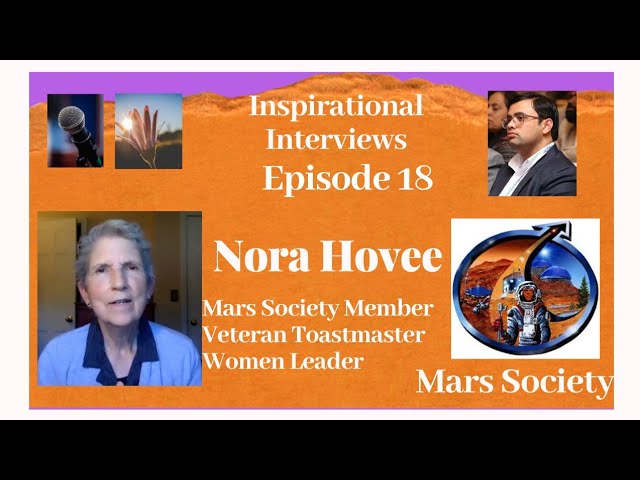
Nora Hovee, a Toastmaster since 2005 and Mars Society volunteer, talks about leading through delegation rather than micromanagement, and the underrated skill of followership. She discovered Toastmasters while homeschooling seven children and later spent five years launching Mars Society chapters worldwide after watching The Martian.
Chapters
It's kind of hard to turn us off. He said something that I could not say no to, and so tempting to micromanage. She said, "Well, could you stay on just a little longer helping?" People need to be encouraged on how to be a follower. So many of communicating is a permanent part of the new normal, whatever you— but if you ask the right questions of an older person, You'll be amazed. What, what should I be doing now to make the most of what opportunities I have? Such a valuable gift, a wonderful gift to give, hopefully, your children.
This is what Nora is slowly turning the table on me. Hi everyone, welcome to another episode of Inspirational Interviews. This episode 18 is about Nora Homi. Nora was the president of the Pioneer Club when I joined in 2017, and I had so much of learning from her. She is a born leader. As she says, leadership is in her DNA, as told by her mother, and you can feel that. She has a really good sense of humor and you'll find about his association with Mars Society. So over to the interview. I hope you'll have a good time. Good morning, afternoon, evening, people who are watching this video. Today I am so excited to have someone who was my first Toastmaster person I met when I was in Indianapolis, and I've learned so much from her, not only on the communication communication part, but also a lot in terms of the leadership. I'm pretty sure you're gonna enjoy this episode. So let me welcome Nora Hovi. Welcome, Nora, to this show, Inspirational Interviews.
Hi, Haritosh Srivastav. It's good to see you again.
Good to see you too. And yeah, I find this— there is a silver lining in this corona that we are still getting connected through Zoom and other calls. So thank you for agreeing to do this interview. So I'll tell you a bit about the format. This is more like a question-answer session, and I'll be talking— I'll be asking a few questions to you, and I'm sure you'll give some enlightening answers to those. It's going to be mostly about your journey and things related to those. So let's start with— and I want to know about Nora, what's your life journey like and what all kind of things you have done in the next few minutes.
Wow, that's like an icebreaker. Yeah, what brought— I joined in 2005. I Let's just talk about my experience with Toastmasters. I had become aware of the organization because I was looking for a speech class or a speech opportunity for our kids. We're homeschoolers, or we were. We have 7 kids and we homeschooled them all, mostly through kindergarten through high school. Obviously, speech class was important, whether it was required or not. So I called the library and talked to a reference librarian and explained what I was looking for. And she said, "Oh, well, you want Toastmasters." So I contacted whoever that was. I wish I could remember. And he explained that There was a program called the Youth Leadership Program. That was my introduction before I even went to a meeting. And of course, through the course of that opportunity, I found out about Toastmasters, and I kept putting it off thinking, you know, too busy, that sort of thing. And then the kids were getting old enough that I really could start doing things for myself, and my degree is in public speaking. I just like the whole genre of getting up and preparing a speech and getting feedback. So in 2005, a friend of mine said, "Norah, you keep talking about it, just do it." So my first club was Greater Greenwood, which I don't know if you've visited them or not, but it was Tom Doherty was like the first Toastmaster I remember interacting with. And I started going every week and found that I loved all of it. So fast forward to I think it was 2015-16 when the last kid moved out and we, Larry and I, had to— Larry's my husband— what to do with ourselves that we could do together. So I suggested, why don't you try Toastmasters? Now, if you know Larry, enough to know he's not the kind of guy that wants to get himself out there. He's the engineer. Well, he's an architect, but he's that mindset. That was the last thing he wanted to do. So he went because he loved me. But you know, he's a good example of somebody who was totally surprised. He just dreaded going, but the more he did, the friendship, the camaraderie, he discovered a part of himself that he never would have known if he hadn't tried. So as you know, he now does contests and has won at least a couple times. He is also the sort of person that will— do you need an impromptu speech? I'll do it. I won't do that. I mean, I can do impromptus for table topics, but he will do a 5-minute speech and carries it off. So that's where I am here because Toastmasters is something I really enjoy. I love the people. I love the program. I, you're the first to know, Haritosh Srivastav, I joined up for Pathways.
Awesome.
I'm going to finally, I have some reason, I'm, as you know, I'm a coach for Rolls-Royce and I discovered I'm not much help to them if I don't understand Pathways. So I decided I'm going to join If I can get through it and do all the computer stuff, then anybody can do it.
Thank you, Nora. A lot of our audience is going to be non-Toastmasters as well, so I want to little bit segue into about your background. And I mean, what were your studies like, and how did you meet Larry? Do you want to go into a little bit more about that?
Oh dear.
Go like this if I'm going too long.
Sure, I'll do that, yeah.
I think when we get to this age, when we're senior citizens, it's kind of hard to turn us off. Well, I will— I mean, Jerry Zimmerman, that's a good example.
Of course he's—
Yeah, he was my previous guest, so people will remember.
I promise, but feel free to go. Yeah, we need to— I mean, out of time. Okay, Larry and I are both from California. He was born in Los Angeles, I was born in Sacramento. He left the state for Oregon when he was 4. I didn't leave until I was 9, so I was there mostly in Los Angeles, and long enough to remember it. And I've been back several times with relatives. I'm really glad that I live in the Midwest. So for those who don't know what Indianapolis is, which is where I live, just think midway between Los Angeles and New York. It's called the Midwest. It's flat, boring. People say, "Indianapolis, what? Indiana, what?" But we really enjoy it. It's a very family-friendly sort of place. You've had your experience with it. To know that it's got enough city to it that, you know, you can have that flavor, but Downtown is very tiny compared to what you've probably— especially in London. So when I was 9, my dad grew up in Indianapolis. His folks were getting older, he was ready for a change, so we moved back and I thought I was moving to another world, or at least another country. I did not want to come. My mom didn't want to, because she was born and raised in Los Angeles. So for quite a long time, I was still getting used to being here. And fortunately, things worked out. I discovered I liked school, and that's— I got very involved with school. My father passed away when I was 17. So back then Social Security paid for kids to go to college. I don't know I would have gone otherwise. So I went to, it's called IUPUI, I-U-P-U-I, which is Indiana University Purdue University Indianapolis. And I got, like I said, a degree in public speaking, which I was going to use for a graduate degree, but life interrupted that career path. I wound up meeting Larry, and you know, that's, that's a story in itself. I'll just say when he first— we dated for a while, and I said, "You're getting too serious," and I broke it off. Yeah, so a month later he proposes to me. He said, "I think we should get married." And it's like, "But I just broke up with you!" And well, he said something that I could not say no to, and that was, "Nora, would you pray about it?" And when you put it that way, and just to make a long story short, Haritosh Srivastav Srivastav, I did. For 3 months, and at the end of the 3 months, I realized, yeah, we're good for each other. And yes, in 40— we're celebrating our 40th this year, and I tell you, congratulations. I, I am so fortunate to be married to Larry Hogue. We're, we're just really good for each other. We have 7 kids, 5 girls, 2 boys. After October, well, we have 6 and 1 in the oven. So we have 6 kids, grandchildren, and 1 will be born in October.
Oh, congratulations.
And when that's done, this doesn't make any sense to me, we have 5 girls, 2 boys, we will have 5 grandsons and— oh no, we'll have 6 grandsons. And one girl.
Interesting.
I don't know where they come from.
Okay.
So that's personal background. You said that I could mention Mars Society. Yep.
I'll be brief.
So one of our common interests is space. I wanted to be an astronaut when I was a kid. Like every kid wanted to be an astronaut. And then I found out that I better look for something else because I was not cut out to be an astronaut or anything scientific. But Larry, like I said, we had this common interest. In 2015, when The Martian came out with Matt Damon, we went. And then Larry, in that weekend, went 2 more times. To watch The Martian. He just loved it. Well, I thought at the end of the— I'm sorry, at the end of the movie there was this little note, a little sign that said, "If you want to know about Mars, go to this website," and it was the Mars Society. So I did. I went to their website and I thought, well, this is a good Christmas present. So I signed him up, and I must have— there was a place to put a note along with the membership, and I don't know what I said, but the next day one of the staff members contacted me and said, "We really enjoyed your note, and thank you for being interested in MARS, and would you be willing to talk to our executive director?" I thought, okay. So Lucinda, who is the executive director, is based in London, actually not far from you, in Oxfordshire.
Okay, yeah.
We wound up talking for 2 hours, and like kindred spirits finding each other, and it just so happened I had to do my high performance leadership project, and she had a need. I had a need to do this. I said, let me do this for you to help your organization. It's all volunteer. So she— we worked something out. It worked out perfectly. It was helping groups of people start chapters around the world. And at the end of that, she said, "Well, could you stay on just a little longer helping chapters get started?" I said, "Sure." I thought I would do it for a couple months. And then a year later, she said, "Nora, you're so good at this. You're so comfortable with it." It just "Hey, it's working out so well, would you just like to be a staff member?" And I thought, "Sure." So I've been doing that for about 5 years and it's the coolest, funnest job. I don't know, Toastmasters, Mars Society, I kind of go back and forth what I enjoy more. And no one should have this much fun, but there you go.
I do.
Thank you, Beth. So www. Marsociety.org if you want to have a cultural experience.
Awesome, awesome. That, that website would be on our YouTube video link whenever it publishes. Okay, thank you. That was great introduction about Mars. And I, I remember that when I came to Indianapolis in 2017, and after a few weeks I was like I was so much into Toastmasters, I was like, I need to find a local Toastmaster, I am missing something. And I remember that evening I drove to, on the main source bank on the back, and I, you were the first person I met on that. And yeah, it has been great association since then. I've learned so much from you. So thank you for your leadership and thank you for your mentorship.
You made it easy, Haritosh Srivastav. Like I said, I should be interviewing you because you accomplish more in 24 hours than— I mean, I think you wear people out who are around you watching you.
Do they?
No, no, don't put wrong expectations with people. One of the things that I really learned from you is about the leadership, and I want to ask my next question about the year that I joined. You were the president of the club, and next year you persuaded me to be president, so I was your successor. But what was your experience like leading a voluntary organization, and what were some of the learnings from that whole— I believe you were president for a couple of years of that club, so what was your experience like and what did you learn from that? Wow.
My mother says I was born leading people and I would try to organize my friends, so I think there is that DNA that has made it easier. If anything, probably the biggest challenge for being a leader is letting other people— delegating, letting them. You know, if they make mistakes, that's all right. If they don't do it the way you want to, I think you You know, you've had leadership roles. It's so tempting to micromanage.
Oh yeah.
I fight that constantly, even in the leadership roles that I have now. I would wish that everyone would try being a leader, even Larry, who, okay, his DNA is follower. Having known for so long, he is a much better follower and he enjoys doing that. But he's been thrown into situations where at the very least he saw how he could help followers, how he can help, you know, it's a two-way street. Remember, he's an architect and his boss and also best friend was an architect. I remember one thing he said that has stayed with me because he is a leader. He's a Marine. It's in his DNA. He said, "The best kind of followers are the ones who anticipate what I need before In fact, if they can figure it out before I do and introduce me to that, that is the absolute best situation. Which leads to, why aren't there programs in schools for followship? You know? Mm-hmm. Does that make sense?
Yeah, that does make sense.
We're working so hard at creating leaders, which is fine because that's important, but at the same time, people need to be encouraged on how to be a follower. So many just wait to be told to do something, and that really is a not a good follower if they have to be told what to do and taken by the hand and led down, or moving forward. So in answer to your question, I've learned to pull back and not be so much of a micromanager, be more of a delegator, and give people time to discover what they can do with whatever is set before them. And then Haritosh Srivastav, if someone can come up with one of those books of how to get a group to work together cohesively, they'll make a zillion dollars. If that's something you could work on.
Thank you. I love two parts of it. One is about the micromanagement part of it. But there is a reason it's called leader and not manager. Manager is more about when you are tracking the task, taking it to closure, which is also important. But leader is about when you are leading people, where you are enabling them to achieve success and do more things. The second thing, and which I think quite resonates with me, I have a favorite book book which is called— and I do have it here, and maybe when you get time you should read that— it's called The Leader Who Had No Title. A lot of us become leaders because we want to feel special, we want to get that title, I am the, I am the so-and-so. But I really like the fact that you are allowing others to work in that way. And when we move away from that entitlement my speech topic next year. But yeah, that when we move away from the sense of entitlement, that's when I think we become a true follower, and that actually makes us a true leader. So thank you for that. I think those are profound thoughts.
You alluded to inspiring the people that you're leading. That is a gift. It's an art. I don't know how one does that. Again, that's another book that if someone could condense that into, you know, a little book, they'd make a zillion dollars.
Sure.
I, again, back to your leadership, I love the fact that even when I was a leader, Many of the times you were ahead of me telling that, okay, Haritosh, you should be doing this, have you planned this? I mean, not many people do that, and that really shows the engagement that you had with the club and with the overall picture that at times, yeah, the leader or whoever is in charge may be missing. Are we taking out time to tell that, boss, you might be missing this? Have you thought about this? So I'm really deeply grateful for you, whether it's about that small things like keeping the bank keys, or whether it's about managing the overall meeting and how are we trying to get more guests or retain members. So many things I've learned, and I'm really grateful to you. Thank you so much.
You're welcome.
All right, uh, so next I want to talk about the elephant on the world, which is the COVID-19. So how has COVID-19 impacted your life?
Well, actually, I'm one of those people that I've really benefited from it. I was afraid of this venue of online meetings, so that when I was forced to do it More so with Mars Society, but I've since then, I'm now coach for the Nora Toastmasters Club, and I'm unofficial, I'm an advisor to the Cummins Corporate Club. And I've visited like you have. I just love this the power of virtual meetings. I really— maybe it's a stretch, but I really believe that this venue, this way of communicating, is a permanent part of the new normal, whatever that is. I don't see COVID going away for another year. I think 2021 is going to be a new version of 2020. But I've met more people. In fact, just this morning I met someone who— he was living in Los Angeles. He's here visiting his brother, but his company has him working remotely. He's not real eager to get back to LA. It's crowded, it's expensive, expensive. He's discovered the Midwest. Way less stress. And I think he's just one example of a whole big chunk of our population, especially those who don't have children. They might be married, but if they don't have that element that kind of complicates things. I can see people just living everywhere and working remotely, and I think businesses— my own daughter, she was working in an office for 4 months. Her company said, "You know, this is working out. Just stay home. We'll get you some more equipment. We're not renewing our lease for the office." space.
Yeah, true.
So that means there is a whole world of how to get the most out of this venue. I'm still learning. I'm trying to, you know, the breakout rooms. Have you discovered that part of Zoom?
Yeah, about it.
Of taking a big group and And just, well, you're gonna teach me how to put stars over my head.
Oh yeah.
Just like that. Yeah. Well, the bottom line is it has not really impacted us for ill. It's been good.
Yeah, that's good.
The more I talk to different different readers. And then before I find out the positives coming out of this whole COVID, I mean, we all know it's, it's bad, it's, it's not something anybody wants to have to any part of the world anywhere. But yeah, there are positives coming out of the world, and this interview is also part of it. Otherwise I would have been stuck here and you would have been, and we would have never been on a Zoom call. So thank you. And, and another thing I love about you is your enthusiasm to learn things, to explore things. This is really commendable. Okay, so we are coming towards the end of the session, and, and generally I ask people who I interview about 2 or 3 tips that you want to give to young professionals, students, or anyone who's going to start their career? What would be a few tips that you want to give them that can help them in betterment of their career and in life overall?
Well, your question brings to mind actually the advice I heard I think it was an interview or I— that's not important. But it stuck with me and impressed me. And since you're— are you 30 yet?
Oh, oh, I am well beyond mid-30s.
Oh, you're kidding.
No, I'm not. I'm serious. I'm 36.
Okay, well, You're still young to me. The advice that impressed me so much was especially for teenagers. So if there are any teenagers out there, you have an awesome opportunity to get help from people like me who don't come right out and say, "I want to help you." But if you ask the right questions of an older person, you'll be amazed. In fact, you'll get more than you bargained for. But older people, I think it's because we see the clock ticking, and we've gained some things that we want to pass on. So Haritosh Srivastav, I wouldn't hesitate at all. And I know you, to a degree, have used that in saying, "What should I be doing now to make the most of what opportunities I have?" Before you, if I could put— I was trying to think, what's one specific thing? Is keep a journal. Larry has been journaling for years, and I realized I sort of kind of journal. I go in bits and spurts, but I realize, my goodness, he has a chronology. He's got something that flows. And that's such a valuable gift, a wonderful gift to give, hopefully, your children. Your little girl is what, 4 or 5?
Yes, she'll turn 4 in September.
Okay.
If you can find a way to journal, or maybe you already are journaling.
Yes, you got it. Actually, I do have— I have started journaling So yeah, I've like almost finished this one journal.
So I've got like—
all right, all— I finished this much, I've already finished. And I've got like— and I've got another book like part 2 for this. So yeah, I've discovered that journaling, and I am very inquisitive about mental wellness, uh, things which can improve and get more productivity and I do read, listen, watch some things like that. And in many, many of those interviews or podcasts and others, they say to keep a journal. So, and there are different structures. I do not have any structured structure, if I may say. So I do not follow headlines and topics. But yeah, I like journaling. If I wake up on time, which is generally pretty early, I do generally.
Okay, well, may I ask you, what— dream a little.
Where—
what is it you're working towards, or do you know what you're working towards for, say, the next season of your life? What, what do you want to achieve?
That's a good question, and I— this is what Nora is slowly turning the table on me, but yeah. I do think a lot about what I want to do in life, and I'm like explorer, if I may say. I'm still exploring. I think I came to— I mean, I belong to a small city, and I still feel like I'm a small city boy. And whenever I go out of India, I get to places which is more like the small city, like Indianapolis, even in place where I'm living now. Basingstoke is not a big city. London is still an hour away from here, and I, I like that vibe. So my, uh, if you would have asked me this question about 5-10 years back, I would have said I want to be an IT architect or something. Nowadays I want to be more of a leader in the same company that I am, and maybe explore beyond. So with the help of Toastmasters and the other things that I'm trying, I'm trying to explore what else I can do apart from what I'm doing currently. And I'm very happy. I don't have any, of course, bad feelings. A lot of IT people have bad feelings that, shit, I am working in IT and all those. I don't have that. I like, I enjoy working in my IT company. I enjoy working for the company that I work and I enjoy connecting with people, the different walks of people, and I love Toastmasters. So I'm still trying to explore what is going to be. I do not plan too much because when you plan too much, chances of them failing is a little bit more. I do plan a bit, but sometimes going with the flow, I think, is a better option. I'm still exploring. I was thinking it this evening itself that, no, uh, I had a plan when I was doing my engineering that if I get a job, uh, in a company, it's fine, but if I don't get a job, I certainly want to do teaching. Uh, I haven't done teaching yet. Uh, I still used to coach people, uh, back then. I still like coaching people, but I've not done sort of formal teaching. So Maybe after 5 years or 10 years, if I get the chance, maybe, or maybe even, even before that, if I get a chance to go back and teach and educate people, that would be one thing I would love to do.
Well, you will of course let me know as these things start taking shape. You'll let me know the latest developments, right?
Sure, I would.
Alright, I'm going to watch you as long as I'm able to keep track of you and see where, where you go. If you went on to become International Director for Toastmasters, I would not be surprised at all.
Thank you so much. Currently, I do not have any such intention so far, but you know, Thank you, thank you so much for this interview, Nora. I had a lot of, lot of fun and a lot of learnings. Thank you, and yeah, take care of yourself. Okay, yeah, so for the audience, as I say every time, in these times, let's continue to help each other. And when I say help, it's not always about money. It's also about talking to someone for a few minutes. It's also about feeding a pet. So keep helping each other and we'll be out of this pretty soon. So let's keep learning, keep growing, and keep going out of our comfort zone. It was an honor and privilege to have Nora in my interview. And I will be back with another person who has inspired me to do better in life.
Take care.
Bye-bye.









