How to do Yogic Coffee Breathing - Instagram Inspiration - Episode 15 - Chella Kumar
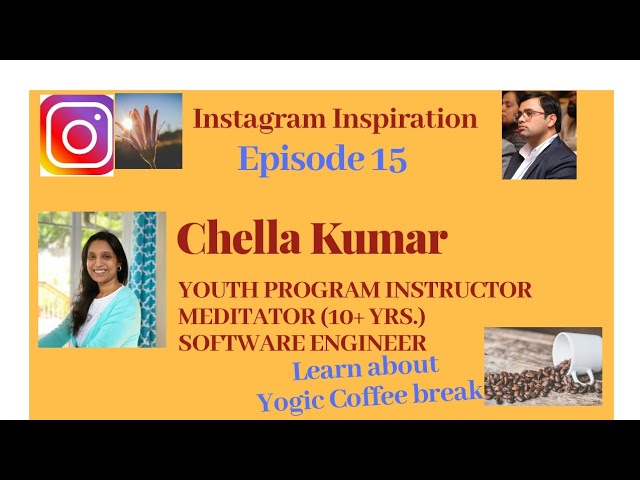
In this 2020 interview, host Haritosh Srivastav talks with Chella Kumar, a software engineer, longtime meditator, and Art of Living volunteer. Chella shares her personal journey from a small town in India to a software career in the United States, describing how she moved from a comfortable corporate life in Bangalore to the challenges of finding a job in the U.S. after marriage and motherhood. She explains how health‑conscious habits led her to discover the Art of Living’s Sudarshan Kriya breathing technique, which she credits with improving her immunity, reducing stress, and helping her navigate the COVID‑19 pandemic. The conversation covers her volunteer work, the supportive global Art of Living community, and her perspective on failure, resilience, and hope. Chella offers practical advice for young professionals—four pillars of energy: food, sleep, meditation, and breath—and demonstrates a short “yogic coffee” (bellows) breathing exercise designed to boost alertness. Contact details (email and Art of Living website) are provided for listeners who want to learn more.
Chapters
Hi everyone, this is episode 15 of Instagram Inspiration. I can't believe I made it to episode 15, and it's all because of the different guests who joined this episode, these episodes. My today's guest is Chella, who is a program youth instructor, a meditator for more than a decade and a software engineer. She and I started our professional journey together from Bangalore. I hope you like this video, and if you like, please click on the like button, comment, and share. And yeah, don't forget to subscribe to my channel. By the way, there are a few changes coming up from next episode. I'm not gonna ruin the secret. I'll keep you posted. Hope you'll enjoy this episode. When you can't go outside, go inside. Hello everyone, good morning, afternoon, evening, from wherever you are joining today. It is my privilege and honor to invite my dear friend Chela on this show. Uh, this is the episode 15. We took a small break and we are trying to change things a bit. Uh, so apologies if I cause any inconvenience, but I am pretty sure you'll have a good time. So welcome, Chella, to the show.
Thank you, Haritosh. Uh, yeah, it's very— I'm very happy to be here today. Thank you for giving me this opportunity, and congratulations and awesome job for whatever you've been doing, like 15 episodes. Episodes. I'm looking forward to many more from you and many inspiring stories from a lot of people. Thank you. It's a wonderful thing to do. I'm really looking forward to it.
Thank you so much. And it is the people and guests like you who come and grace this episode, so that helps me. It is a milestone. I never thought I'll complete 15 episodes. So yeah, I think I can give a pat to myself. Definitely. Okay, and it's so great to connect with you after I don't know how many years, probably 8, 9, 10 years or more than that. So I'll tell you a bit about the format. It's more about a question and answer session.
We'll—
okay, I'll be asking a few questions and then I'm pretty sure you'll have some witty, amusing answers. And if audience has any question, put it in the chat and we can see how we can answer that. So let me start by asking you about your journey. Would you like to summarize about your journey in next few minutes?
Oh yes. So right now, from where I am, from where I was— so I was brought up in a family of 5 kids in India. I grew up, did my studies, and as like any other kid, I also, uh, I did well in studies most, and I got into a good college. And after, right after my college, I got placed in a very good company in Bangalore. So I think that's where I started living alone away from family. And I think, yeah, I made a lot of friends there in Bangalore, meeting people from different states and cities all over the country. Because till then it was all my hometown till I started working. So it was only Tamil Nadu from where I came from. So I didn't have much exposure outside my state. So that was a beautiful experience to come out of. And that was one of my things I wanted to come out beyond my own. That's because, um, that's when you learn more, when you start coming out of your comfort zone. That is when you will make an effort to come out of your comfort zone. So yeah, that's what I said. Then I— and things fell in place, like, so I got good job.
I went—
I was working and I made a lot of friends. And then I got married after a few years and my husband was in the US, so I moved to the US in 2011. And I've been here the last— it's almost, I think it's for us also, it's going to be 10 years now. Uh, yes. And yeah, I've been a software engineer for 5+ years. I just took a break after my kids were like 4, and I thought maybe it's time for me to spend more time with them. And in the meantime, I've been doing a lot of volunteering work with the Art of Living organization and also at my children's school. So I find volunteering is It gives me more— I love doing it. It gives me like the flexibility as well as like something that it does more freedom, I feel, compared to the job where you have to do this, that, and it's very time constrained. So this is more easy and it's like something that I love to do. Volunteering has always been a part of my life. I think even when I worked with Mindtree in Bangalore, so there we used to go every second week to the Mother Teresa Institute.
TSA trips.
Yes. Yeah, yeah. So, so that's not— I think that's something that was naturally inclined with me, serving others and helping. And, and that's how you also grow, seeing others. And like, it's like every journey is the stepping stone for us.
True.
Thank you.
I think—
and now here I am in Seattle, to quickly finish off, uh, my two kids, uh, and a lovely, caring, beautiful husband supporting me in my journey. Yes, that's where we are.
Awesome. Thank you so much for sharing that. And I'm gonna come back to what you did after you came to US, but I just wanted to piggyback on— we both joined Mindtree, Bangalore, same company, on the same batch, same time. And I did learn a number of things from you. And one of the things that I still feel that you have is your compassion. Now, whenever somebody meets Chella and and talk to her, that compassion flows out of it. So, and, and you haven't changed, so that's one thing that has kept. So, and, uh, yeah, I remember those TSA— I think it was called TSA, Technology for Social Action trips that they used to do every second Saturday. It was, I think, a beautiful concept, and I've talked in a few of my speeches about that. And volunteering, I do different type of volunteering now with the Toastmasters, but I love doing volunteering. So let's move on to the next segment, which is, uh, I know you have been doing a lot of work on the meditation, Art of Living, uh, things like that. I want to know more about that. I've never done anything. I've heard a lot about Art of Living, uh, honestly I haven't done anything. I do a bit of meditation, 5-10 minutes probably. Few times in a week, but I want to know more about that and how you came across that and, and what has your journey been in that, in that particular field.
Yeah, so, um, as you said, as I was started living on my own, I was always a person who was very health conscious. Like, if, like, I won't drink, uh, these Coca-Cola and everything, or like, I know like a healthy lifestyle is very important for your body. If your body is something That's— it's like only if you have a, like, a wall, you can have a picture. So your body is like the wall. So if you don't take care of the body— and then I stumbled upon, when I was having a few sinus or migraine issues, and then I stumbled upon a person who introduced me to this, the Art of Living Foundation and Sudarshan Kriya, which is a breathing technique that helps you eliminate toxins and also helps you to relax and rejuvenate. I said, why not? I mean, I was going open. I was trying a lot of new things as I was like on my own. That was the phase of the life that I started learning music that I hadn't learned in 25 years, 26 years. So a lot of new things I was venturing on, and this is one thing that I just jumped upon and I just went for it without thinking much. And yeah, and I think that was after feeling that 20 minutes of calmness and feeling very some relaxed and rejuvenated after that thing, or something was an experience for me which I've never done. Like, other than sleep, I don't think I had any kind of relax or, uh, that I would rest for so long. And that I was like, a breath can do this much? Okay. So then I kept on practicing it. I was on and off for sometimes because it's like a practice that you add to your life for sure. But, uh, the experience was also there. Once you like— it's like, uh, you never Sometimes the very first time you taste the flavor of ice cream that you like, then you never go back. You always remember the first flavor. Okay, chocolate ice cream, yes, it's my favorite. Something like that, right? Yeah, and then when I moved to the US, so I was doing it, I was just doing, I was participating in it. The volunteering work started when I moved to the US. So the presence of Art of Living and my husband was also had done the programs, and he was also very much volunteering with the organization. And the community support was something that I would say bigger support. So I had a big AOL group who supported me like an extended family. Till now, that many of them who I've been associated with, they're now like our family. So, and anywhere you go, it's like, I'm from AOL, just like I need a house to stay for 2 days, it's like they'll give you. It's like they're so— it's like everybody's so connected. So even if I go to New York, I'm from there, it's like, you know, that you have an extended family. Like if I go to a different city in India, you have a cousin, you just know, you know, have to stay there instead of a hotel. So it's like, uh, the family and the connections that I loved more than that. And, uh, yeah. So giving like 20 minutes of your— so you always, if you need to take a big leap in your life, a rest is always required. So this 20-minute meditation that I learned, I feel that is very important in our day-to-day life. And now we live in a very competitive world. We can't like sit and relax like our— I think, I mean, they also didn't relax, our old, old grandparents and everything. They did a lot in the field or like whatever they worked hard, but there was a different kind of comp— they didn't work in like this competitive, overloaded information world. But we live in this internet information and then it's a competitive, you have to— so it's, it's, uh, you can't escape it, whatever career or professional you are in. So if you take that few minutes to rest the mind, it's like it adds more quality to the— your way of life and the quality of the work and your relationships with all the people. So that's what I observed by doing these— all these practices.
That's amazing. So what I noted down is the importance of trying out things. I mean, you would like to experiment. I mean, you want to be within your value system, but within that value system, you want to experiment and see what works for you. And, and then, yeah, one beautiful line was that you have to take risk before you take the big leap in life. So amazing. And yeah, I, I do meditation, not a big meditator or something. I try to do a few minutes and I definitely feel the difference. So it's being helpful for me on personal basis as well. So, uh, let's move on to the next question. And that is one of my favorite questions, which I ask every guest. And that is about, uh, everybody likes to talk about success. I mean, I would rather say boast about success. I've achieved this, I have this title, this and that. But what I'm more interested is to go deep and understand the failures. What are challenges they've gone through? What are the one or two big failures that they had in their life and what did they learn from that and how did they overcome? So Please tell us about your one or two failures or learnings.
Yes, definitely. So as you said, I mean, my— for me, life till I got into a job, I didn't really face a struggle. I was doing good at studies. I got placed in two companies. I choose which one I wanted to go. I had so many choices. But as after I moved to the US and I was wanting to get a job, it was not the same as in India. So it's like I was recently married, got into a new relationship, and then I had my twin girls also. So I mean, at a personal level also, there was so much happening. And also I've been in a new country where I don't know many people, right? And the way of getting a job here in the US is different from the way— for me, it was like it just fell in my place, like, because I got good grades in the college, the campus came, recruited me, like, you go here. So I didn't really know what I was like doing an interview or going for an interview. Was, or like, so like, for that was like a 9— it took me 9 months to get into that routine. I did experience a lot of failures. It's like put me down for sure. I was like, sometimes you have left and seen— I've been the topper in high school, got 2 placements, and like I was had to question myself what is happening. Uh, so it's like every time you fall, it's like, uh, it was not easy the very first 2 times, I would say, because I didn't expect this, it would be that hard to get a job in the US. Initially, I was like, I was doubting my own strengths, like being able to get 2 placements, and now like I can't even get— clear an interview or get an interview. So it took me 1 or 2, but every time you have to step up, right? Every time you fall down, you get up. So, and then it— and then it's like you learn. And I think luckily the meditation practice that I had, so I kind of knew what— where I have to go and relax my mind. So I— that really helped in this, uh, journey. And then I— it took me 9 months to get my first job in the US, and then I started working. So that was, uh, I think a very good learning for me as well. Like, things take time sometimes, but you don't lose hope.
Yeah, I mean, that's, that's beautiful. I mean, yeah, hope is everything. If you lose hope, you lost everything. And yeah, I can feel that, yeah, whenever you shift from one country or one place to another— in fact, I, I have had many shifts between city, state, and then nations as well. And every time you shift, there is some sort of uncomfort, and, and you feel like, no, I'm lost, I don't know what to do. But then you slowly figure it out, and that's the beauty out of it, that when you figure it out, you— it makes you feel good. So the key is not to lose hope and, and think that it's just the grinding that we're going through. Thank you so much. Okay, so let's move on to the next question, which is the elephant in the world. I'd say people used to say elephant in the room, now I say elephant over the world. Now, uh, the COVID— I, I mean, I was watching the news and I The Bachchan family has also got COVID-19 now, almost the whole family. So how are you dealing with COVID-19? There's a lot of negativity, pessimism going on. How are you managing? You have, you have twin girls, you have your work, and do you do a lot of community work, art of living? And also, how are you managing all this?
So actually, to be very, very frank, There was not a panic even from day one I was hearing all this. I don't know why. I mean, there was awareness that I have to take care, I have to come— the kids were told what to do, how to be safe, and taking precautions, wearing masks, washing your hands as much as you can, whatever. I was following the World Health Organization, everything, but there was not even, uh, 1% of panic from me. I was like, uh We just need to take care, help, watch our food. Food is actually the main thing in everybody's life. So it's like the right amount for the right quality of food and also the right food that is good and healthy and it improves your immunity system, like having turmeric with a pinch of pepper. Uh, so I, as we were already living that kind of a lifestyle, maybe I was not panicked and I said, I know all these breathing techniques that I've been doing the Sudarshan Kriya, that increases your immunity and it also eliminates the toxins from your body. So I was— that was also a special mask that I was like very— I was wearing, I would say, because every day, like, it was— now it's like I should never miss. This is the situation in life. That's where— so more than ever that I ever failed, felt very grateful, and I was happy that I knew all these techniques, life skills meditation and breathing is during this time, I would say, because that didn't shock me even a bit. I'm like, yeah, we have to take a lot of being aware. See, when you are panicking, you're gonna— you're not gonna respond, you're gonna react like, what is gonna happen? But when you are alert, when you are not at a calm state, you're being more alert and aware and you respond to the situation. So this is not something in our condition, it has happened You have to stay home, you have to stay safe, yes. But if you have to go out, you wear your masks, maintain social distancing, do the best. And it's more of like, for all of us right now, it's like it's taken us more inside. We have like, we prioritize things. It's not like every time we run to the grocery store, it's like only if we need it. We like very, um, treating Mother Earth like with so much care right now, I think.
Like being very essential. There are a lot of silver linings coming out of it. And I do hope that it continues to be like that. And you would have heard the news of pollution level going down. Yeah, a lot of crowded places getting a little breathing now, to say. Maybe they are going through this art of living now.
Actually, to add to that, um, as you were saying, I was doing a lot of company. So actually I've been doing more now because all our workshops, everything has been online. So in that way I'm also busy. So am I like I really don't have time to think of like what is happening with the COVID situation, like what is the negative things. I— that is what I would also say because I've been teaching the kids, the teens, I've been organizing workshops for adults. So I think that way also I'm keeping myself busy in a good way.
Nice.
So you're not very worried. See, anything, any body thing is like— any stress is like it starts with a small worry for you. So if you're not worried about the negative, that will not easily affect you. It's like being on the positive side as much as you can.
Awesome. I think I'm loving this conversation. And the few things that I noted is, is it's about awareness over having that panic, because when you're aware, you actually respond. When you're panicked, most of the times you will react. And it's always response over react. So, and then it's a, it's a, it's a beautiful time to actually give back to society, give back and contribute to the place. From where you came and from where you are now. So I love the fact that you're doing a lot of these workshops and helping people out, learning and then making people also learn things. So I think you're doing a great job. Thank you for that.
Thank you.
Yeah, my, my, my schedule has also been a little bit different rather than going to office. Yeah, I'm attending 5 to 6 different Zoom meetings over the weeks. And most of them are Toastmasters apart from this Instagram session. But that was also a brainchild because when you can't go out, you go inside and you come up with different ideas. And this was my idea to spread some sort of positivity, to interview people. And our selfish reason is to learn from best of the people and learn so much and then probably spread positivity.
Yeah, all right, definitely. This lockdown has really brought a lot of creativity in everybody. To kind of like—
that's true. Yeah. And yeah, anyone watching, yeah, please go to my YouTube channel. That's my— that's me doing my paid— own paid promotion. Okay, uh, I'm coming towards the next question, which is about young professional. A couple of questions. One is that, no, how can meditation or some program like Art could be useful for them. And then another broader question I have is how— what are the top 2-3 things that they can apply to be more successful in their career, in their life, in their relationships?
Yeah, so to answer this, it's like very— there are like 4 sources of energy in our life for a human life to sustain, at least 4. So one of them is food, the next is sleep, the next is meditation, and the fourth is the breath. There are four sources of energies that we say it's like very essential for you. You need to have the right food, the right amount, and at the right time. The quality of the food also affects your body. So if you eat junk food, the state of your mind is not going to be— you're going to be sleepy, lazy after that. But if you eat fresh and wholesome foods your, you're gonna also feel the energy from the food. This is very important. And also the quality of sleep, at least 7 to 8 hours of sleep for you to see. If you're not sleeping for 2 days, the next day you're not gonna have the energy, you're gonna be fully irritated. So that also affects your state of mind, the quality of your life. So that is also very important. And fourth, third is having that meditative, calm state of mind. That— how do we achieve that? As I said, your rest is really— if you need to rest. So if the body doesn't rest, you can't work the next few— the morning, you won't be fully recharged, physical body. That's why the sleep is very— but for our mind, which has thoughts and thinking all 24 hours, the mind even doesn't sleep. Even in the sleep, you have dreams. So what are we doing to give that mind rest is the meditation. And how can you go into meditation is using your breath. As you— as I, as I was talking yesterday with you, breath is something which has always been with us the moment we were born till the end of our life. Like, our life is between the breath in and the breath out. So because breath is something— can I say, like, can you breathe fast? We don't have time in the evening, or we have a lot of time in the evening. Let's breathe breathe a little lower, we'll pass our breath for some time. No, right?
Keep the breath for the evening. Yeah, so let's go for the breath walk.
Yes, so breath is something which is always with us. So bringing our attention to the breath and using the breath and doing some breathing exercises helps you to relax and rejuvenate and go into that deep state of rest that what I call as meditation. So meditation doesn't need to be somebody has to guide you. You can sit and keep your eyes closed and bringing attention to the breath. And that's what the Art of Living Foundation has made it very easy using those programs, the Happiness Program, where we teach them the Sudarshan Kriya technique, which helps people to go into meditation. And there's a lot of benefits people have been experiencing.
Awesome, thank you so much. So what I, what I found out is you said about food Sleep, meditation, and breathing. Beautiful. You have one word for 4 tips. Okay, um, I normally don't do this on this show, uh, but today I'm gonna do this. I'm gonna ask you to, uh, give us one exercise or demonstration of 2-3 minutes how we can be more self-conscious or how we can practice more yoga. I'm sorry, I I didn't ask you before, but if you—
Oh, definitely I can do that. We can maybe learn a small, uh, quick, uh, breathing technique. Okay, so this is called the power breath.
Okay.
Or you can call it the bellows breath.
Okay.
So sometimes like in the afternoon, like, uh, like what do we drink, coffee or tea? It's like to feel that little instant energy, right? In the afternoon, or if you're working like after 2, 3, you kind of like feel a little sleepy or drowsy. Okay, now I need to get my coffee or cappuccino, whatever you like, or your masala tea to boost up your energy. So this is something like anytime you feel I need to boost, I feel a little lazy, or I need to boost up my energy, and anywhere, wherever you are. So let me just show you and then, uh, I can just demonstrate so it's easier.
Sure.
So it's like you have— you sit straight, keeping your spine straight, and you have a loose fist next to your shoulders.
Okay.
And you can keep your eyes closed if you wish, or you can keep it open. The more it's closed, it's like you have your deep— you're not distracted much by things outside you. So when you breathe in, your hands goes up and your palms open. I'm not able to show. Hopefully I can see. Yeah, it's like this. Palm open.
Okay.
And when you breathe out, your palms come back into a fist, back to your shoulders.
Okay.
Yeah, yeah.
Okay, it's like you're pulling something out of your chest.
Yes, like gravity is pulling you down. And you're breathing in and out through your nostril, not through the mouth. So it's like, it's like a breath in and a forceful breath out. Through the nose. So it's like you're sniffing out. It's even good if you have congested nose.
Yeah, yeah, a lot of people have, and yeah, let's not talk about it.
So we can just do maybe 10 rounds now to just give you an experience.
Sure.
So loose fist next to the shoulders, keeping your spine straight, having a smile on the face. Let's take a breath in, let go, begin.
In, out. Breathe in, out. Breathe in, out. Breathe in, out. In, out. In, out. In, out.
Do one more time. And relax your hands on your thighs. Keep the eyes closed. Observe the sensations in your body, breath, and mind. Let's do a couple of more rounds. Loose fists next to your shoulders, keeping your spine straight, having a smile on the face. Let's take a normal breath in.
Join if they want to.
Yes, definitely. And breathe in.
In, out, in, out, in, out, in, out, in, out.
And relax the hands on your thighs. Observe the sensations in your body, breath, and the mind. When you're ready, you can open your eyes. How do you feel?
I feel amazing. Yeah, thank you so much.
Definitely. So we even call this a yogic coffee breath.
Yogic coffee breath. Wow, that's gonna be the highlight of my video. Yeah, I, I mean, if you can see, I had coffee, which is actually a juice, but yeah, this coffee is— Thank you so much. So, uh, last thing, how— if somebody wants to connect with you, how can they connect?
Oh, uh, you can definitely share my email ID. It's chella.kumar@gmail.com. Yeah, at artofliving.org. So yes, happy to help anybody who's interested or come join us. It's just an experience. You have to— millions of us are meditating, I think, around the world. It's— Art of Living is present in 156 countries. So just come, why not? This is— it's like, this is what I say when people like, see, you can't go into the war field and learn to fight. So that is not going to be much fruitful. It's like you can take risk in life, definitely, uh, in times you need to, because life is not always the same. Like our current situation is— was an uncertainty for everybody. We never knew this would happen this long term. But if you are trained, it's like swimming. If you know swimming, life is an ocean, it's easy to cross. You can still live life without knowing swimming, but if you know it, it's easier. So that is what I say, learning these breathing and meditation techniques is a life skill. So whenever it's like, and you don't need to wait somebody to like, if there is any uncertainty, you feel don't well, or like you're confused or you don't have that clarity of mind, or you're in a panic, you have this life skill, go do your breathing. And they just say, it's like a strong mind can carry a weak body. Wow. Even if your body is weak, but it's not like it's— so that's what I will say. It's your mind. It's the willpower and the mind, which is very important. To come up in life every time you're stuck or like you fail.
Thank you so much, Ella. That was an amazing episode. And yeah, we did try new things and hopefully people will appreciate. So I'm gonna end this episode and I'm gonna end like I do every time, that in these situations let's help each other. And when I say help It's not always about money. It's also about talking to someone. It's also about feeding a pet. It's also about meditating. So let's, let's continue to grow. I will be back hopefully pretty soon. So until next time, let's keep learning, keep growing, and keep going out of our comfort zone. This is Haritosh Srivastav, and this was my episode 15 of Instagram Inspiration with Chela. I will be back with episode 16 and hopefully somebody equally interesting. Thank you so much and wish you all a very great day and great week ahead. Thank you.
Thank you, Haritosh Srivastav. I wish you do many, many more. Keep rocking. This is very inspiring for many people like me and hope you reach Many, many people.









