If You Want to Tell People Who You Are, This is the Place | Mona Lisa's Story
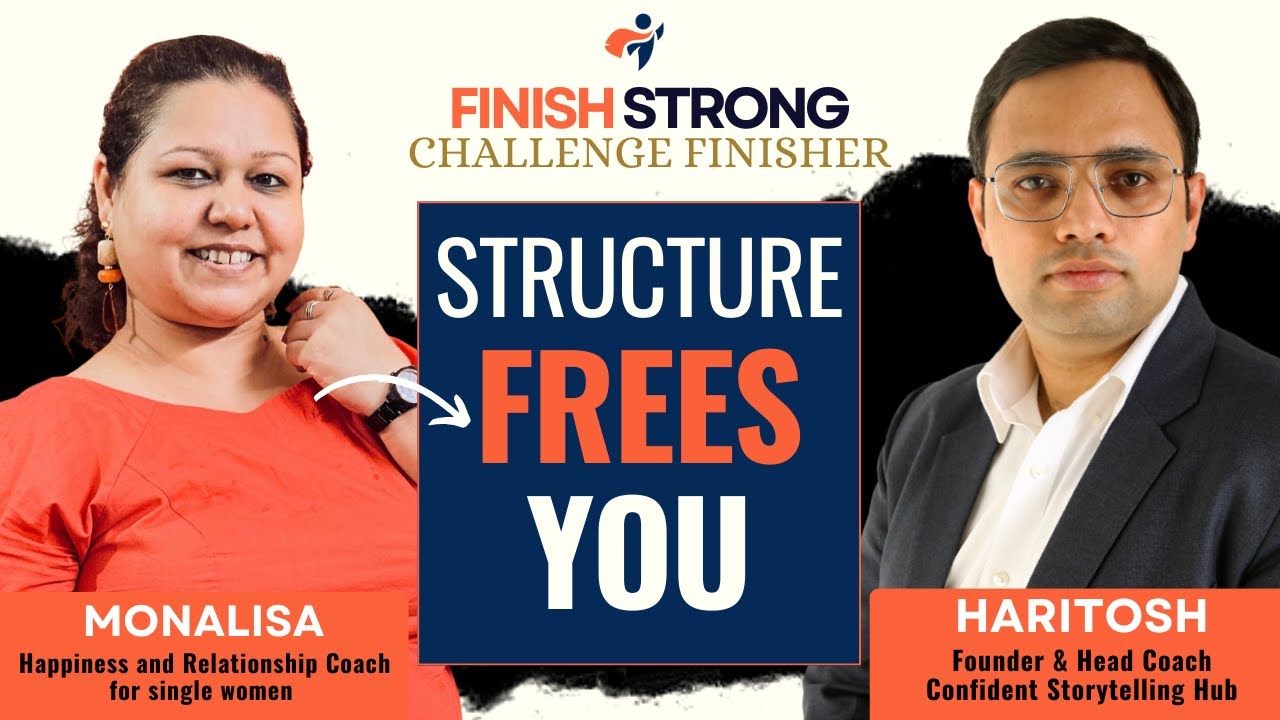
In this interview, host Haritosh Srivastav (Speaker B) speaks with Monalisa Singh, a happiness and relationship coach for single women, about her experience completing the Confidence Storytelling Hub’s "Finish Strong" challenge. Monalisa explains how she discovered her coaching niche, was introduced to the Hub through her mentor Beena Srivastav, and was drawn to storytelling as a tool for influence. She shares three core learnings from the challenge: storytelling is an art, a speaker holds power to influence, and one should not underestimate one’s own story. Her favorite task involved the "5 Cs" framework (Content, Conflict, Care, Change, Carry Out), which she sees as the essence of any story. Monalisa describes her evolution from impromptu, extemporaneous storytelling to a more structured approach, noting the importance of voice variation and feedback. She highlights that each live session and feedback moment served as an "aha" breakthrough, deepening her self‑awareness and confidence. The outcomes she cites include greater readiness to experiment with storytelling, a deeper understanding of self‑awareness, and the ability to influence others through authentic narratives. Finally, she recommends the Confidence Storytelling Hub to anyone seeking to tell their story confidently, emphasizing its role in personal growth and impact.
Chapters
If I am a speaker, I have a power to influence people, thousands of people. The importance is how I am narrating a story. What is my point of view in that? At the end of finishing, I was wondering, I asked the question and now I know the answer, that how people are doing it. But then I realized that, I mean, there is no good or bad or a high-level story or something like that. It is how we are saying, how confident we are feeling, and everyone has their own stories. I will say every live session had an aha moment because I'll say to the people that if you want to tell people who you are, then this is the place for you. Everyone is actually telling a story. As a coach, we are telling a story. Movie is a story. All the dramas and And when family get together, we love to hear the stories from our elders or some amazing experiences. So this is—
Hey everyone, I am back, back with a bang with another finisher interview. So if you're not aware, in our Community Confidence Storytelling Hub, we do these monthly challenges. And for the members who finish or complete this challenge for the very first time, I love to interview them personally to know about their journey, to know about what kind of breakthroughs they received, and so on and so forth. So we have another interviewee. Her name is Monalisa Singh. So Let's invite Monalisa for the interview. Hi Monalisa, welcome! How are you doing?
Hi Haritosh, I'm good. Thank you for, for this, uh, opportunity. Thank you so much.
Thank you to you for completing the challenge, participating. So that's why you are here. So let's start with knowing about you. So tell us about yourself, uh, in probably a minute or two.
Yeah, okay. So I'm a happiness and a relationship coach for single women. And when I decided that I want to be a coach, I was looking for a niche. And the very thing which I was as a person, as Mona Lisa, was looking for, I made a niche out of that. That is the happiness. So my journey has started with this. It has started in 2023, end of 2023, and these 2 years have been like a journey to find myself. You know, every incident happening, every training happening, every client I'm talking to, it is something, somewhere, one door has opened for me to understand, keeping myself more, you know, come closing to myself. So it's a beautiful journey going on. With that, I will say, you know, about myself being as a coach and as the person, they are actually now getting together. So that is— yeah, so that is about me now.
Love that happiness, coach. And I think we all need more happiness. Okay. So tell us a bit about your journey with Confidence Storytelling Hub. When did you join? Why did you join? And how long have you been part of it?
As you know, my amazing mentor, Beena Srivastav, so I got introduced through her to you. You came as a guest lecturer in our community, and I had a great experience on that day and never thought that storytelling could be, you know, learning it as an art of saying our mind. So that I found really found it interesting. And moreover, I want to add something over here that I was actually thinking I wanted to address people. I thought that I can do that. So I wanted to learn about it. At very time when I was thinking how I should start this or how I should reach people other than Instagram, I came to know about Toastmasters. Yes. I haven't heard it before. And so I was planning to go there as a guest and see what is going on. And at the very time you came as a guest lecturer. So I thought that maybe a way to address people to be on the stage someday. So I think my way will start from you. So that is how I, I found it attractive, and I found that yes, there is a way going somewhere through you, so I should join.
Very nice, very nice. Thank you so much, and thank you for being part of the community. So let's talk about this Finish Strong Challenge. I know you joined earlier, uh, but in this month, which we're talking about December of 2025, you took that place that, okay, I'm going to complete the challenge, I'm going to be part of this challenge and complete that. So I want to know about your experience and what were your top learnings out of this challenge.
So I want to tell you something. On the first day, if you remember, uh, when there was a graduation day and for the other group, other finishers, yeah, and the day of the introduction, I joined So I asked you one question that, uh, do you give any, uh, I mean, tools how people are actually telling the story from a smallest part to— I mean, how they are doing that? That was the question in my mind on the first day. With completion of the challenges you have given in every 2 days and give us— given us a topic, at the end of finishing, I was wondering the I asked the question and now I know the answer, that how people are doing it. So those challenges have actually given so many versatile, I mean, style of telling a story. So I really liked it. I mean, this finisher challenge, at the end, I was thinking that from where I should get my story on this, on this, and how I'm going to say this. But at the end, I realized that I can do this. I mean, giving a framework and do it accordingly is challenging, but it is actually beautiful to do. So I like— that's how I became the finisher of the challenge.
Absolutely, you became finisher. That's why we are doing this interview. Awesome. So which one was— so we had 15 different or individual tasks. Which was your favorite task?
First thing I learned is narrating a story is— can be art. Oh yes, I didn't know that. Although my dadaji used to— I mean, we have grown up by listening his stories. He has particular characters and lots of different stories he used to add. So we grow up by listening that, but it's an art of storytelling. And then now when I think That stories are— I mean, everyone is actually telling a story. As a coach, we are telling a story. Movie is a story, all the dramas. And when family get together, we love to hear the stories from our elders or some amazing experiences. So this is— I mean, that's a realization that narrating a story is an art. And second thing is Speaker has a power. I mean, I, if I am a speaker, I have a power to influence people, thousands of people. The importance is how I am narrating a story, what is my point of view in that. So that's amazing thing to know that, I mean, I am carrying a power and people are ready to listen to me, so I can use that. And for the third part is what you gave me the feedback. Don't underestimate your story. I was— when you gave me the feedback, I was wondering and I was thinking again and again, I mean, at what part that he got the idea that I am actually underestimating. Maybe a difference of confidence, maybe how I ended it. So I was thinking about it, but then I realized that, I mean, there is no good or bad or a high-level story or something like that. It is how we are saying, how confident we are feeling, and everyone has their own stories. So there is no— don't judge your story before telling it.
Absolutely. I totally love that. I love all the 3 learnings that you mentioned. And yes, I always say that, no, uh, storytelling is everywhere in day-to-day conversation, in boardroom, sales room, everywhere. Ultimately, we are telling stories. We all are storytellers. Yeah, some of us are little better, but all of us are default storytellers. And yes, also in terms of the power, like in Spider-Man, it says, right, with great power comes great responsibility. You have great power and it's your responsibility also to tell better stories, to tell authentic stories. And third one, yes, I do remember, because I realized that every time you were telling the story, you said, oh, this is— this doesn't matter, it's a very small story. Usually when that happens, it means that people are sort of undermining their own journey, their own story. And, and as a coach, it's my job to let them know it doesn't matter what your story is. It actually matters whatever you're telling. So, so if you undermine your story, of course audience is going to undermine. So first job of us, responsibility of a narrator or storyteller, is to ensure that he or she is not undermining his or her own story.
Love that.
So now I'm going to ask you the second question, and I'll combine next two questions. One is, what is your— what was your favorite task? Because we had 15 different tasks. And also I want to know about the journey. This is a fun question. How much time did it take for you to create the first video, and how much time it took for you to create the last video? What was the time duration that it took?
So my favorite, uh, the theme was for the 5 Cs, for, uh, content, content, conflict, care, Change and Carry Out message. I mean, it has the crux of all type of stories. Every story must have this. Yes. I felt while, while we narrated different stories for different topics with different framework, but this is the core. I felt that. So I loved that, that one. And about the timing, you said, you know, I, I don't know if I'll say a problem, or that is my conditioning, or I, when, you know, I love to do extempore. I mean, I don't want to write it before, and then, yes, I love to do it. Like on that morning.
On the spot, yeah.
But when I started like this, but then I realized that coming into a structure, because coming into a structure, sometimes I feel that I'm stuck, or I've been tied into something and I cannot— the independence, the freedom, I was not feeling at that time. But then gradually I felt that structuring what I want to say or reach to people is important. Because otherwise, sometimes it feels casual. Sometimes, not always extempore is good, you know, it should have right message, it should conclude properly. So then I started, so earlier I used to do it directly. Then I started writing it, the points. Yeah. And it took— then, then it took a longer time to deliver. And I tried to make some differences. Although what I used to do when I started hearing my voice, after recording, I found it that I am restricting while saying it, you know. Um, like, uh, like it should remain in this room, other people should not listen. So I was saying in that manner.
I understand.
Yeah, so there was a difference. I mean, when you gave me the feedback, I will, I will come back to the feedbacks also. So those, that feedback about the variation, to make a different variation in the voices, is so important. That I'm only, my voice was coming from here. Only from here. It should come from here or from stomach.
Absolutely, 100%.
Like, like people sing. Yes, how they sing. So there is a difference, and people can make out that if they are singing from a throat or from stomach or from only from a jaw. So that was— I was observing while I was seeing my video, how I'm saying, how is my expression going. So, uh, I mean, I will not say it has improved so much, but I now I know where to improve.
Absolutely. And it's a journey. It's, it's not a journey. And I love that you— I love your honesty. And, and when I ask this question, I don't expect every answer to be that, okay, it used to take so many hours and now it is taking so less hours. It's also about knowing and reflecting on your journey. You are part of the community, you know, every time There is something I ask people to reflect on that, and I love the reflection that you're bringing, that going from being completely on the spot impromptu storyteller to becoming more structured. Because one of my mentor, Darren Nakrawai, says that the structure doesn't freeze you, it frees you. So if you know where you're going, what is the structure, it can actually liberate you. And you know this is how you're going to do., and within that you will have a lot of liberty. But if you don't even know where you are going and from where you are going, then you don't know where you will end up. So I love that reflection, and I love that.
Awesome.
Now let's talk about the next point, which is about the breakthrough moment. I know you covered a little bit about it earlier as well, but I want to hear from you, what was your main aha or breakthrough moment of this year?
I will say every live session had an aha moment because what you introduced about the feedbacks.
Yes.
Every feedback is an aha moment for me. Because when we narrate, when we say something, we had something in mind. But how other people are actually listening it in that way, that is a totally different thing. After, I mean, every feedback make me— I mean, I become so happy receiving the feedback. It was giving me different perspectives of different view because someday I'm going to address many people. So I need to keep in mind what message I'm going to give to them. So those feedback, every feedback is a moment for me. I must say all feedbacks are important, so important. And taking a feedback, it's also a learning.
Taking— I mean, so both giving and receiving feedback is an art. So I remember, I think when we started doing this and one person was giving feedback and the person who was receiving the feedback started defending, and I asked her, please stop. When somebody is giving feedback, you should just keep your mouth shut, just open your ear, just hear, because you're not here to to defend yourself. You're here to take feedback. Of course, not every feedback you need to apply as well. That's why you choose which one you want to do. But if somebody is giving you feedback, which is very precious thing, then you should just acknowledge that and take it. Even if you don't agree, that's a separate issue, right? And that is why in this month we took a lot of— and I, and you know, I force people to give constructive feedback because if you only keep on giving all the good feedback that it was very nice, it was very good, it's not helpful for the speaker. And as a community, we want to ensure that if somebody is giving feedback, they are giving valuable feedback, or I say, as I say, wholesome feedback, which has both good things but also things to work upon. So love that, love your realization, sir.
I mean, every, every, uh, live session was amazing. I, although I missed two of them last time, but because of different reasons, personal reason, but I watched uh, the videos. And, uh, I mean, it was really— I had aha moment at that time also. And, uh, I mean, other people's journey also teaches us how they are coming up. So it's amazing.
I mean, absolutely, when you learn from others, that's where, like, you don't have to make the same mistake. You can actually take your journey to others. So that's why I always also say that It's not only important to become a storyteller, you also need to be a story listener. You are listening to without any bias, without engagement. If you are able to listen to other stories, you can learn a lot out of that. Yeah, awesome. So my next question to you, next question to you is about the outcome or the impact. Of course we want to do something, we go through the journey, but what is most important is the outcome. So what, if I may ask you, what has been the major outcome or impact of completing this challenge? What would you say?
Every topic I am getting a story from my life. So I was thinking that I am saying too much about my life, you know. Uh, I was feeling that should I do this, but I was getting examples from— for those topics I was getting from my life only. So I was not thinking in the other ways, or as told earlier that using metaphors or taking stories from Jataka tales or from Panchatantra or somewhere, you know, many examples are there. But I was using that, so I was thinking that, am I saying too much about myself to the people who don't know me? But then I, I thought that, uh, I'm learning. It's a learning state, so I will not judge myself on this. And moreover, as a coach, when we tell our stories, our perspective, and from where we have gotten up, that influences, that inspires people, because this person has also come out from this. So that is one thing I learned, that saying my stories from my life doesn't matter. Am I giving the right message to them? Am I being too emotional to something that I have done. Am I saying that with ego, or I'm saying as a story to people to understand and take an idea from there? So that is one thing I learned, that it's okay to do that. But, uh, in the coming time, definitely going to, uh, take different experiments that I thought of. The second thing I thought that Speaking one thing in a different way is, is again, it's difficult. You know, it's not an easy task to do. Telling story is not an easy task to do. So, but doing that under given tools makes your understanding better. And with the every story, you are actually, you are taking a milestone. Ahead. So that is what, uh, I mean, I have learned from this. Or I think the outcome is that, uh, I'm ready to experiment on telling the story. Definitely.
And you shouldn't stop this journey. I love that. I mean, what you said earlier also, I think the answer to the question, am I telling my story a lot? The answer is no. Because if I may say that knowledge is limited but it's your story that brings the different focus, different light, different perspective to the same knowledge, right? If you say that, okay, all of us have journey, all of us have gone through that, it's okay, it's very generic. Or maybe you tell a story which people may have already heard, nothing wrong in that. But when you tell your story, it's said that nobody can tell your story better than you. Yeah, because you are the one who has lived that journey, right? So So that's why it's very— and this shouldn't come as an ego, it should come as a service. That why, the why of why you are telling the story to this audience at this particular time, at this particular place, is very, very important. And then when the why is clear, then as they say in Simon Sinek, that when the why is clear, then how and what happens automatically. But why has to be there. So if you are a coach, the why should be that how Which story should I tell that will impact my client in the way that I want them to be impacted? And for that, if your story is the best one, then why not?
Yeah, awesome.
So now we are on to the second last question, which is, what is your message for anyone who's been part of the group or otherwise who wants to go on this journey of, you know, building confidence and learning and telling stories? What is your message for them?
Uh, I'll say to the people that if you want to tell people who you are, then this is the place for you. Uh, it's not easy to say our mind, but everybody wants to do that. Everybody wants people to listen to them. Then this is the place. The Confident Storytelling Hub is the place where we can say our mind without judgment, without, you know, any fear or any conditioning. We can say that. And people who really want to, you know, review their life, if they want to review their life and understand their life in, in the form of story, then this is the place for them. That is what I have taken it like that. So, and with confidence, and with confidence, that is the most important.
I love that. And yes, as I say, confidence is not something that most of us are born with. We earn our confidence by taking massive action, by taking action. And one of the things that we do is doing these kind of challenges, because the more you tell stories, the more you get better. There's no other way around that, okay? There's no pill, there's no injection that you can get, and, and overnight you'll become a great storyteller. Every great storyteller in the world goes through the process of trying out, failing, learning, getting feedback, and then building brick by brick, as they say. Because another coach of mine says that, no, if you want to build a masterpiece You need to master the pieces.
Wow, this is so beautiful.
Yes, it is. Yeah, awesome. So my last question, question to you, which sort of you kindly answered, but I'm gonna ask it. Would you recommend people to join Confidence Storytelling Hub and why?
Um, I would say I have recommended already to many people that I am doing this, I am part of this community. I will recommend because it's a skill to develop. People think that this is the course should be done to, uh, develop, to earn something, or, you know, for a different, very pressurized, uh, reason. But, uh, joining Confident Storytelling Hub is It is to know yourself and then make other people influenced by your journey. This is for that. This is for that.
I think I've said that in earlier interviews as well, that one term which keeps coming back, the more interviews I do, the more that term keeps coming back, is the term called self-awareness. And I think maybe you will agree to that, that no, self-awareness and then self-acceptance, and that leads to self-love. And only when you love yourself, that's when you can start loving others or adding value to others. So absolutely, we are on the right track with that. And this interview is again in alignment with all the previous interviews that we have done, that it is the same theme that is coming over and over again.
That's right.
So thank you so much, Mona Lisa. Uh, you really— I have seen your journey. I have seen how you were a little uncomfortable at the start and how you were not sure how to proceed. Going from there to be able to create multiple videos in a day and complete the Finisher is something that needs to be recognized. So congratulations once again on being a Finisher, and I'm looking forward to you becoming the Hall of Fame, where you will complete 3 challenges and we'll be having a celebration and all. So thank you so much and wishing you all the best.
Thank you so much, Haritosh Srivastav, for this opportunity. It's a beautiful experience I'm having right now, and I I'm love to recommend this to other people because everybody wants this. Let me tell you, storytelling, everybody wants that. So thank you so much for this.
Thank you, Mona Lisa.
Have a beautiful day. Thanks.
You too. So that was Mona Lisa Singh, our latest finisher of the December's Finish Strong Challenge. If you are somebody who wants to learn about yourself If you are somebody who wants to express about yourself in the form of the most important and most engaging skill, that is storytelling, consider joining Confidence Storytelling Hub. And this is my honor and privilege to keep interviewing the achievers of this community. So I'll keep doing that. I'll be sharing more and more interviews as we proceed. But until next time, as I say every time, keep learning, Keep growing, and most importantly, keep going out of your comfort zone. Story power to you.









