In Conversation with Author Sherry
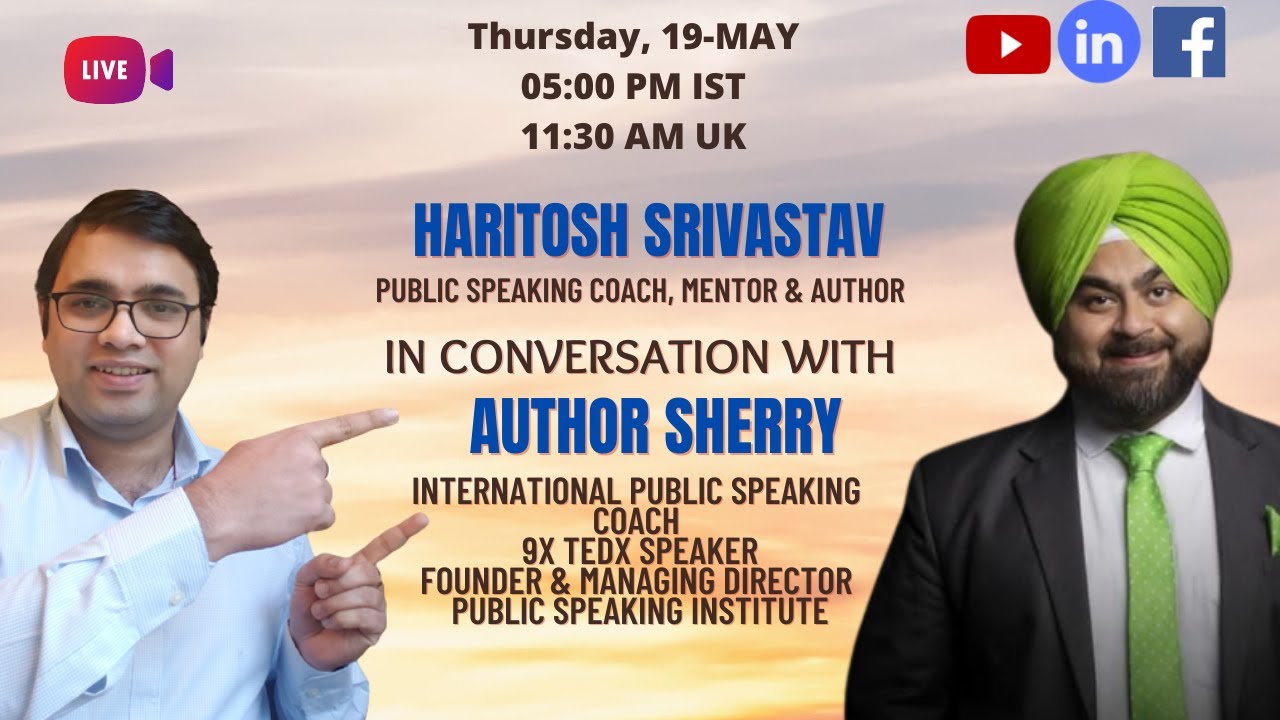
In this YouTube interview hosted by public speaking coach Haritosh Srivastav, international public speaking expert Author Sherry shares her personal transformation from a panic‑induced stage blackout to becoming a nine‑time TEDx speaker, founder of the Public Speaking Institute, and advocate for creating one million public speakers by 2030. She recounts her early crisis, subsequent milestones—including meetings with Prime Minister Modi and a vision for India’s first public speaking university—while highlighting her mission to train over 30,000 speakers. The conversation explores common myths about public speaking (age, language, introversion), practical steps for rapid skill improvement (regular speeches, coaching, video practice), the role of a coach, strategies for monetizing speaking (branding, marketing, visibility), storytelling techniques that make personal narratives powerful, and the importance of dressing to mirror audience demographics. Sherry also provides contact channels (website, LinkedIn, YouTube) and ends with a parting message emphasizing authentic, human connection on stage.
Chapters
Happy Thursday everyone! My name is Haritosh Srivastav. I'm a public speaking coach, certified mentor, and author of the book Small Town Bigger Dreams. But it's not about me today because I'm so excited to have our special guest today. A guest who is an international public speaking coach, a mentor who has mentored more than 30,000 public speakers, founder and managing director of Public Speaking Institute, on a mission to create 1 million public speakers by 2030. Founder and CEO of MS Talks, a public speaking platform which has given more than 40,000 public speakers across the world. Global conference speaker, 9 times international TEDx speaker, multiple times Joe Stock speaker, and author of multiple bestseller books. I'm talking about none other than Author Sari, I'm so, so excited to have you. Author Sari, welcome to this show. Thank you so much for joining.
Thank you, thank you. It's my privilege, Haritosh Srivastav. Thanks for having me.
Lovely, lovely. So amazing. So, Author Sari, I have learned a little bit about— I've read a little bit about your journey, but it would be amazing to hear from you what is your journey, from where do you come, and how this all public speaking and the revolution that you're trying to bring up came into the picture?
Well, I would like to phrase it as, uh, from panic attack to stage attack, uh, because, uh, it's been, uh, 15 years of magnificent experience into public speaking. I remember for the very first time when I was on the stage, I was about to receive and get felicitated from an exceptional award for achievers where I was in top 3 in my entire organization, and my country head was supposed to give me that award. My girlfriend was along with me And that very moment when my name was about to be called, 300 people sitting in a full-packed capacity auditorium, people enjoying snacks, drinks, music. And the moment I reached on the stage, the country had felicitated me. I was feeling on cloud nine. And my girlfriend, I remember backstage, told me that, Sherry, you have to share how you did this. And you have to share this experience with everybody. I said, yeah, Jasmine, I will definitely share this, and I'm so excited about it. But the moment I walked towards the dais when my country had invited me to share a few words, that very moment, Haritosh Srivastav, something happened to me, and there was a complete blackout. I could not understand what is happening with me. My heart started pounding, my legs started shaking, my hands started trembling, I had sweat on my forehead., and I could not sense what's going on. I mean, it was just insane. And within a few seconds, I decided that somehow I have to get off the stage. I escaped that situation. And later on, when this was over, I analyzed that this was one of the worst days of my life. And I promised myself, Haritosh Srivastav, that this day will never ever come in my life again because I'm going to learn the art of public speaking. But that day I had never realized and never knew that the journey is going to be this much here, where now I have trained over 2 lakh individuals and I have created 30,000 public speakers. I have a mission to create 1 million public speakers. I'm working on creating India's first public speaking university. 2 weeks back, I met Prime Minister Modi at PM House. I was invited as a corporate delegate. I also met the Cabinet Minister, Mr. Hadeep Singh Puri, where I shared my idea about Public Speaking University. And last week, I, at an SOCHAM conference where I was panelist and keynote speaker, I also happened to meet the UDC chairman, Mr. Jagdish, and I shared the idea of how skill building is now creating the path wave and how India can become the skill capital of the world. And he was so mesmerized about the idea about public speaking being promoted in such a way, because all these people and educationists, they have understood the effective and the most important skill. So I told him, I'll tell you how I pitched him this idea. I said, there are two ideas, there are two technical skills, or there are two important skills in an individual's life which will change the way for our nation. And he said, what are those two skills? I said, one is information technology because you are from IIT, and second is communication.
Absolutely, can't agree more.
And he said, you are bang on, you're hitting the target. I said, now I want you to support me and take this idea to next level. We are in touch, we are working on it. The idea is in progress. I am a person in progress. But the journey has never been so easy for me. I had been on TEDx for 9 times. That's a very rare achievement in India. Somebody is speaking for the 9th TEDx talk. I'm giving my 10th TEDx talk next month only. I've been on Joe Stock for 4 times. And the way you have introduced me, you know, all these things which I have done, I think it's never about the sprint, it's about the marathon. And when you have your mission, vision, vocation, and profession all clear, creating a sweet spot, then something happens for you. And then you create that tide, that, that energy. And then that energy helps you to reach anywhere you want. And that is what has happened with me.
Absolutely love that, love that whole aura that you're bringing. So, so amazing. And we're already seeing some great comments on social media. So just a reminder for people, we will have a segment where you can actually post your questions. So if you have any burning question that you really want to ask, please put it in the chat, and if we have time towards the end, we will take it up. Now, other said, let's talk about— because communication and public speaking, something that I believe everybody, and I, I say in my trainings that even if you are a scientist you're working alone in silo and you get that $1 million idea or the biggest invention, you still need those communication skills to portray and project to the world, because then only they will understand the gravity and importance of that. So if I ask you, and, and there is a lot of myths around public speaking as well, that you need to be the this one, you need to do that. So if I have to ask you, what do you think are the top 3 myths when it comes to public speaking? What would that be?
Okay, top 3 myths. So let me start by saying that there's a huge misconception about public speaking, because what happens is people feel that public speaking is just about talking to anybody from the stage. Well, that's not the way it happens. You need to have good flow, you need to have the right enunciation, pronunciation, stage command, facial expression, body language. Your vocal coordination, voice modulation, your alignment to your content. And besides that, the 3 top myths which I keep on hearing from a lot of people is that number 1, people feel that if you have not done public speaking in childhood, then it will be very difficult for you to do it in adulthood. That's absolutely wrong. It's a complete myth. All I have to say is that just like any other skill, it is a learnable skill. Rather, it's an art and science. So just get onto it, invest some time, and I promise you, you will be able to learn the skill. And not only learn, you can be on the command and you can really do effective public speaking by investing some good time, efforts, and energy. The second thing, the second myth which I notice usually with a lot of people is that they feel that they don't know English speaking and they feel that they cannot do public speaking. I want to tell you that if you cannot do English speaking, you can still do public speaking if you know Hindi, if you know Malayalam, if you know Gujarati, if you know Kannada, if you know Oriya, if you know Punjabi. My dear friend, public speaking is a skill and English is just a language. Do not mix the two. The third myth which I notice, which is again very common, is people start feeling that if I am an introvert, I cannot do public speaking. Well, I want to tell you that it doesn't matter whether you are an introvert, it doesn't matter whether you're an extrovert. All of you can do public speaking irrespective of omnivore, introvert, extrovert. It's just a matter of how you focus. I have seen a lot of people who have decided to share their ideas, even if they are introvert, they are good public speakers. Now, one important thing which I want to highlight here is that if you have an idea, if you have an innovation, if you have a product, if you have a service, but you do not know how to express it, My dear friend, whatever you have created, it's of no use because you do not know how to express it.
Absolutely.
And that is one of the major challenges with people. If you know how to do innovation, if you know how to work on an idea and execute it, but you do not know how to explain it in the right diction, that's a big challenge. And it will not allow you to grow in your corporate ladder, in your corporate career or business career. So you got to understand that just like any other skill, it's a learnable skill. And you have to diffuse all the myths. And from today, if you're watching me right now, from today, start learning public speaking.
Brilliant. Amazing, amazing. I love that answer. You don't have to be a born speaker. You don't have to have that perfect personality and extrovert. I do not know if anybody is a pure extrovert or pure introvert because I believe everybody is somewhere on the scale and most of them are like me, at times completely extrovert and other time completely cocooned to be an introvert. And I love that you have to know about communication. So now if somebody has that intention, because that's very important to learn about public speaking, what are some of the 2-3 steps that they can start taking now or today itself so that they become, you know, 1x, 2x, 3x better speaker by end of the year?
Okay, see, the first suggestion would be that start understanding how the skill works, how you can present your ideas. So learn about how to deliver your ideas, start talking to students, start talking to colleges, start giving at least 10 to 30 speeches. So one of the best books which I have read by Brian Tracy, written by Brian Tracy itself, is Speak to Win, where he also mentioned that if you really want to start your journey as a public speaker, you have to do at least 300 speeches. But I'm giving you another formula— remove one zero, just give 30 speeches, and you will create your flow, you will create your ideology, you will create your own style of talking. You'll find your authentic voice. That's very important. The second suggestion which I would like to give you is that if you have lesser time and the journey is long and you do not know how to do it and you don't want to waste time, hire a coach. And seriously, that's one of the best suggestions I can give you through this interview. Do not waste your time if you feel that it's just not getting over there, hire a coach. The coach knows where to take you on the journey because he knows— he's the one who knows the way, goes the way, and he can show you the way. Show you the way. The third suggestion is, if you are somebody who wants to DIY, then I would strongly recommend get into the videos because the best way you can start from your home, you can start creating videos. Even if you fumble, Even if you are not looking perfect, doesn't matter. What matters is you appear every day, you perform every day, and you create every day.
Lovely, lovely. I love how impromptu you are able to bring that. And you actually took one of my questions, and maybe we can expand on that because I was alluding to next question is what is the importance of having a coach? And probably you already mentioned that, so I'll probably change that question to the next question is A lot of people, not everybody, but a lot of people also aspire to monetize their public speaking skills. They want to earn something out of that. And how can they get started on monetizing? Because there's so much of buzz around monetizing, but nobody actually knows how to get started on that. So what would you suggest?
I think the best answer to this question is that go and watch my channel, type Haritosh Srivastav on YouTube, and I have given 4 or 5 high-quality content videos to answer this question. But since I'm here in the interview, I would like to share that if you want to start earning through public speaking, I think you should first become a public speaker. First, you qualify the criteria of becoming a public speaker and letting the world know that they can hire you. The second step is, just like any other product which is marketable, which is saleable, Brandable. You got to do your branding. Branding is an extremely important part of public speaking. And third, as I always say, marketing is the religion of sales. So in public speaking, your own marketing is a religion which should help you to bring gigs and paid gigs to you. So start appearing, start creating your content, become a content creator. And see, one of the best journeys which I can share with you, I mean, I can share my example. There was a time when I was not being paid for any public speaking, but now I do get very handsome money. But this has— I mean, the kind of journey which I had during the period of time, it was not so easy. It took me some time. So it will take some time for sure. Just like any other career, you're spending your time. See, one of the misconceptions, Haritosh Srivastav, is that people start feeling that it is just talking, nothing else. My dear friend, it is not talking. It's about the research. It's about the content. It's about the authenticity. It's about how you shift that emotion, how you change the situation in the room, how you give the solution of a problem created, demanded, and raised by the organization. I think if you understand all these parameters, it is very easy for you to start working on your career of public speaking. And don't forget, you have to start working on yourself, and visibility will in turn get you credibility, and credibility gets in turn the profitability.
Love that. Visibility leads to credibility, which in turn leads to profitability. I love that answer. And, and really, I think there's a lot of value. And do go out to Author Series channel, subscribe to that, and get— there's a lot of great content out there. And one other thing that I have learned over the year is, apart from having a coach, which is a must, is getting to interview such amazing people, because When you interview people like Arthur Serri and other people that I've interviewed, you get so much of wisdom, so much of knowledge, which really takes you ahead in the game. So this is what I'm doing right now. It's a selfish reason. All right, so, uh, we— I had prepared a few questions, and I would say I had outsourced this question. I'm an IT guy, so I should use the word outsource because I had asked people, if you get a chance to ask a question to Arthur Serri, What would that question be? So I've got 2 questions so far, and in the meanwhile, anybody who's watching live, if they have questions, they can put it in the comment. But first question is coming from Taiba, and he said— and she says that one of the aspects about public speaking is the storytelling, and in that also there is another aspect of personal storytelling. So what do you think are some of the tips and tricks that we can use to master sharing powerful personal stories?
Okay, see, uh, I think, uh, one of the things which you need to understand about storytelling is that storytelling is the only trump card you have when you are on the stage. Because once in every 3 million people, according to a recent study by Harvard, once in every 3 million people, you will find they have a similar thumb impression like you. So this is the only unique identity in the human body and in the biological structure of a human being which has been treated as unique. But now, according to this study, if we go by this study, that means there's nothing unique. So the only one thing which gets left which is unique about you is your story.
Hmm.
And that story will differentiate you on every platform. People usually ask me this question, that whatever I want to say, it is already been shared. Whatever I want to convey, it has already been conveyed. Whatever content I have created, it has already been delivered. Then what will I say? I say, you are absolutely right, but you forgot to say something. There was no one like you earlier. There was no one like you before on the stage. And what I mean to say is that your story has to be conveyed. And that's the power of personal story. Facts tell and stories sell. We have already noted in business storytelling or brand storytelling. But if you talk about personal storytelling, well, it is very important to highlight the characters, the plotting, how you introduce the emotions, how you create a call to action from the entire story, and how you connect the entire story with the presentation. So there are different elements which you need to understand, absorb, and use it while you're doing storytelling. And these basic elements set the tone. So when you introduce all these elements into your story, your story does not become good, it becomes powerful. And when it becomes powerful, it creates impact. If somebody listening to you can shift their emotion, can move from one thought pattern to another thought pattern, I think you have done a great work on the stage by sharing your story. And let me tell you, stories will always make you win from the stage.
Lovely, amazing answer. I couldn't agree more. Stories, yeah, facts tell, stories sell. And having a concrete call to action, having a power opening, having a smooth transition— loves it. So the next question, which is a tricky one, and I'm pretty sure we can tackle it in multiple ways. So I'm really curious to know your take on that. And this question is coming from Santos, and the question is, what is the significance of dressing when it comes to public speaking?
Yeah, I think that's a very good question. So you need to understand whatever culture and demography you're part of. If you are Punjab and if you are a Hindu, it doesn't mean that you have to wear a turban necessarily to deliver a talk. Let me put it straight away. But you got to create some resemblance when people start watching you. You know, they should feel comfortable. I remember when I had a visit at PM House, I've never seen Prime Minister of our country wearing a turban live in front of me. But he did that to make sure that all the Sikh delegates over there should feel comfortable and he delivered his speech of 20 minutes in front of us with that turban. Now, why was he wearing turban? The answer is very simple. He was just trying to mirror. In communication, when you mirror your audience, when you make them comfortable, when you look like them, you do not look like a unique person. I think you win the game. Because if you look different, then audience will start thinking, I got to be very different because this is a very next level, probably. But if you become one of them, you become a part of them, it's very easy for you to engage them. And the ultimate objective— see, we all have religion, and engagement is the religion in public speaking. So the answer to your question is wear whatever resembles, makes your audience comfortable, and suits the theme and the demography which you are in. I think that's the way of deciding the appropriate dress.
I hope, Santosh, you got the answer. I, I, I must confess, I changed the question to make it little generic. Its exact question was that, uh, in the Gen Z generation, should we be wearing coat or we should, we should be going with t-shirt? So I took that creative liberty. But definitely, I think you will also say that if you're talking to Gen Z in an environment which is much relaxed, we should rather go with the t-shirt versus going all suited, booted.
Yeah.
All right. So we have covered audience questions as well. Now I want to ask you, if somebody wants to connect with Author Sherry, who doesn't know already, how can they reach out to you? What are the different platforms? What are the different avenues that they can connect with you?
Sure. Well, if you want to hire me for your organization, you can type into my website, www.authorscherry.com. If you want to follow me, my work, you can type Haritosh Srivastav on LinkedIn. You'll find my profile, just click on the follow button and you will start getting updates. I'm very active on social media. And if you want to watch my research-based free videos, you can subscribe to my YouTube channel. Every week we upload 2 videos, every Wednesday and every Saturday. So there's regular content flow over there from last few years, and, uh, you will definitely enjoy and learn so much.
Thank you so much, Haritosh Srivastav. So here is this last question for you. If you have to give one parting message to people who are watching this live or who will watch it later, what would that be?
Well, you're not talking to robots on the stage, you're talking to human beings. So your ultimate objective in public speaking is to create human connection. Be a human, talk like a human, speak your heart, be authentic, understand the power of vulnerability, and speak with your heart. And that is what will help you create that bond and connect with the audience. And ultimately, you will end up landing the human connection.
Thank you so much, ladies and gentlemen. That was Arthur Sary. I loved every bit of information, every bit of knowledge and wisdom you provided. So stay tuned, we'll have more such interviews. And if you have any comment, if you felt like something, please do post it in the comment section. So thank you so much, have a great rest of the day, take care.









