In Conversation with Nausheen I. Chen
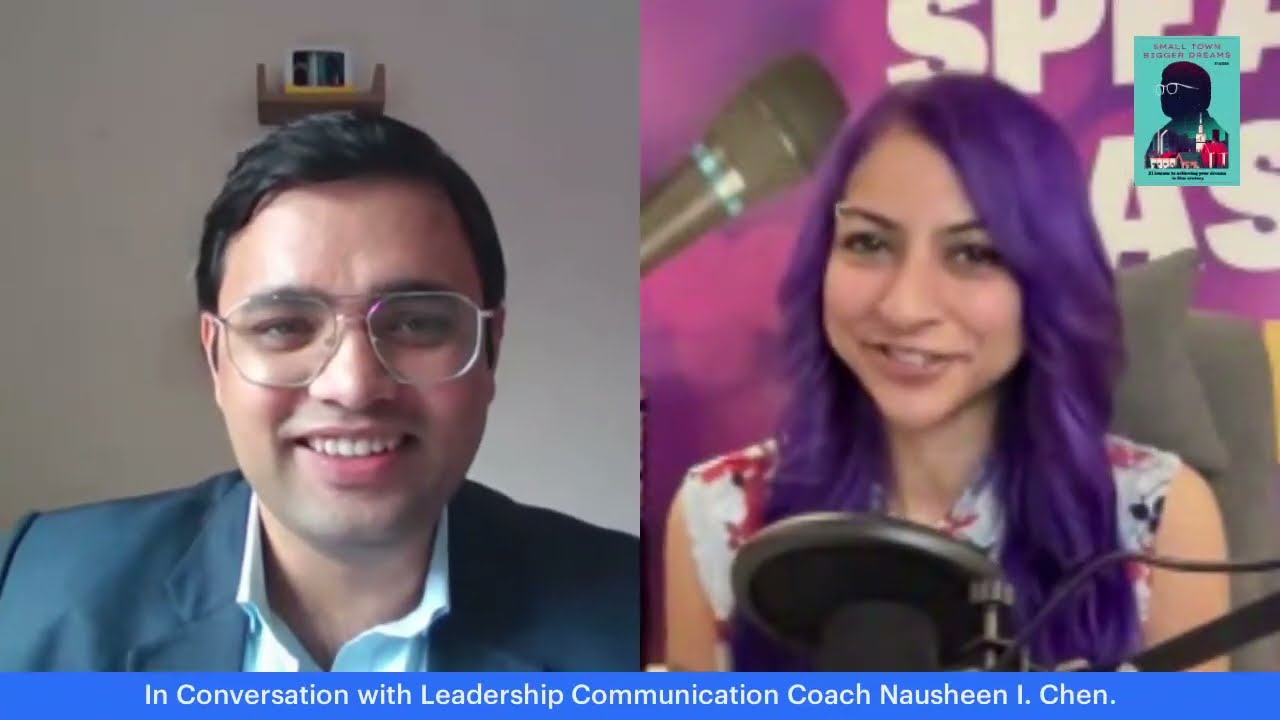
In this interview, public‑speaking coach Haritosh Srivastav talks with Nausheen I. Chen, a French‑Pakistani leadership‑communication coach, former Procter & Gamble marketer, filmmaker, and solopreneur based in China. Nausheen shares her unconventional career trajectory—starting in corporate marketing, moving into improv, theater, stand‑up, and a filmmaking startup that she bootstrapped to a million dollars. She explains why the letter “I” in her name is a tribute to her late father and a core part of her personal brand. The conversation explores how improv’s focus on presence and trust, filmmaking’s directing and script‑writing skills, and entrepreneurship’s mindset shape her public‑speaking coaching methodology. Nausheen recounts a major early failure in a corporate video project, highlighting the need for client involvement and clear visual expectations. She tells an amusing coaching story about turning a camera‑shy CEO into a confident keynote speaker. The dialogue delves into storytelling fundamentals—relatability, structure, and emotion—and offers practical advice for impromptu speaking: energy, controlled pacing/pauses, and extensive practice (including improv). She recommends building a “story bank” through daily journaling, studying story structures, and reading books such as The Big Bang Storybook and Storyworthy. Nausheen debunks the myth that public‑speaking is only about external techniques, emphasizing internal mindset work. She shares an unusual rehearsal method using a prompting partner instead of a script. Finally, she reflects on personal growth (learning to say no) and delivers a concise message to young professionals: start speaking publicly to gain confidence and legitimacy. Contact details are provided (LinkedIn).
Chapters
Hi everyone, welcome to In Conversation with Haritosh. So my name is Haritosh Srivastav. If you do not know, I'm a public speaking coach, certified mentor, and author of the amazing bestseller Small Town Bigger Dreams. And once in a month, I try to get in touch with some amazing people across the world and persuade them to come here in this interview and talk about their life journey, the subject, the expertise on, and a many lot of learnings. So if you are joining us live, feel free to put in the chat from where you are joining. And if you have question for our special guest today, also put in. If time permitted, we'll try to take up a few questions as well. So our today's guest, guest is very special. It took me some time to get her time. Uh, but I'm so glad we are doing it. Her name is Nausheen Aichen. She's a French Pakistani leadership communication coach, a two-time TEDx speaker, corporate trainer. She's currently based in China. She has more than 5 years of marketing training communication experience and at Fortune 50 giant like Procter Gamble and more than a decade of communication coaching experience for all across the world. She is also a founder of many startups and she's coached many of the C-suite people, CEOs, CTOs, etc. And she's also been interviewed on, I think, featured on BBC, Forbes, TEDx, Bloomberg, Business Insider, so on and so forth. If I just continue giving her introduction, it's going to be taking another 10 minutes or so. So cutting to the chase, let's welcome Nausheen Aijin. Nausheen, it is so amazing to have you here. Joining us right from another part of the world.
Hi, Haritosh Srivastav. Thank you so much for having me, and thank you for that very, very kind introduction. I, I have to correct two small things. I'm only the founder of one startup because now I'm a solopreneur, so I don't count it as a startup. So I'm the founder of one startup, uh, that was my filmmaking startup that I bootstrapped to a million dollars in China, and As for BBC, Forbes, and TechCrunch, my clients, the clients that I have coached, have been featured there. Not me. Maybe one day. So I have one. Let's hope. But I wanted to set the record straight that it was— but I wanted to feature my clients onto those platforms and, you know, help them be the shining stars on those platforms.
Awesome, awesome. I'm so grateful for you to come over here. So let's jump right into the interview. Uh, we want to know— we've seen your profile and all those things, but I want to know some interesting things about Nausheen. Where do you come from? What do you stand for? What is your introduction? Not so conventional.
So, you know that annoying kid who always stood up at family reunions and recited the most boring poem? So I was that annoying kid. I have always loved being on stage, speaking to people in public, and I just took a very, very long time realizing that this is what I was meant to do for a living, doing it myself and then helping others be better at it. So I took the long way there. So my first stop in my professional life was at Procter Gamble, like you pointed out. I was there for 5 years. I was in marketing and PR. But while I was doing those things as my day job, I also became one of the youngest trainers over there. And I trained in communication and public speaking skills. Sorry, I trained in communication and presentation skills. Public speaking wasn't that big a thing there, but presentations were. And after that, again, took several twists and turns, ended up doing improv. Theater, stand-up, and made my way to filmmaking, which was completely unplanned. Ended up going to media studies school in New York and then came to China and started my filmmaking startup. Just— it was just my husband and me in the beginning, and we took on all kinds of projects, some of them for peanuts, some of them for free. And eventually, over the next For 6 years, we built a filmmaking business. I was the scriptwriter and director, and we took on commercial projects for Chinese clients. Except in 2021, I realized I love some parts of this. I love being in control. I love being able to work with my actors. I loved working with people to get them to perform better on camera. But I didn't like some of the other parts. I didn't feel like I was a filmmaker at heart. So in 2021, I started really digging deep. I started trying to figure out what it is that I really wanted to do. And public speaking, speaking on camera, and helping people do that, helping people gain the right skill set to speak well, those things kind of jumped out at me. Actually, it wasn't even me, it was my husband. He was like, "Nausheen, you know you love doing this, right? Because you've taken every single opportunity possible to speak on every stage ever since he knew— he's known me ever since, you know, I've, you know, been a young adult." And he was like, "Why aren't you trying to figure out how to do this for a living? This is what you love doing." So I took the man's advice. He's way more wise than me. So I thought, Okay, let me try it. I have been very scared of it because it's not easy making a career out of public speaking and coaching people on public speaking, but here I am giving it my best shot.
Awesome, awesome. That's so amazing, amazing. Really amazing journey and full of roller coaster as I can see. So my next question to you is gonna be, yeah, let's, let's talk about something personal. And I did ask permission for the recording. So when I shared the poster about that, I'm going to actually share that poster for everyone here. One other thing that Nausheen pointed out, which is a letter I in her name, which was very intriguing to say the least, that you said this letter I has a lot of importance for you. So I want to know what exactly is that I stands for and why you are so passionate about this. Letter I?
Oh, I stand for Ishtiaq. That's my dad's name. My dad died when I was 10, so it's one of the last links that I have to his name. And I was an only adopted child, so no one else in the entire world can carry on the name other than me. So I retained the name officially on all my official documents as the full name, and on LinkedIn and in terms of my personal branding, I shortened it because I realized Nausheen is a difficult name, especially for people that aren't from South Asia. And Chen is— well, Chen is easy, but Isha Iyak is also difficult. So I thought I'll make people's lives easy and shorten it to the I. But that's— I don't want to shorten it any further. And I especially felt it when for my first TEDx Talk, for example, they just got rid of the I. So if you look me up on the TEDx website, you'll see Noshin Chen. And I was just like, why? There is one letter, why didn't you let it be? And people often shorten my name because I guess they don't— of course they don't know the significance. But for me, the I makes a huge difference.
Awesome, thank you so much for sharing that. That indeed is a very touching and nice way of contributing, if I may say so. So really, really appreciate sharing such an intimate thing. And yeah, I understand. I teach one of the things in public speaking, it's very, very important to know the other person's name. And this is after I came out of my home country, is that, no, not to offend anyone in my country, but no, sometimes we don't pay as much attention to the name and detail of the name of the person. But when I came out of the country, and I remember once I misspelled one of my client's name, and I got an immediate email from manager that please correct that. And that's where I understood the importance of knowing that, okay, name, somebody's name holds so much value, and sometimes we take it for granted. So thank you for sharing that. Now let's go a little bit in a different direction. So from improv to filmmaking to scriptwriter to public speaking coach and communication coach. What do you think has been the common between all of those, apart from— yes, you have been there. What do you think you took it? Because I, I believe that every time we do something, we take something out of that and apply into next venture. So what has been— if I, I'll probably talk to you about the subject and you take What did you take? For example, what did you take from improv that you still use in your public speaking opportunities?
Oh, so much. Improv is one of those arts and skills that I encourage everyone to try, even people that never want to be on stage, because improv teaches you to think on your feet. It teaches you to trust your team members because you're up there on a stage performing something live without a script. And you're not there alone. It's not like stand-up comedy where you're just doing it by yourself. You have a team of people that you need to trust, and everything is happening in real time. The scene is unfolding and being written and acted out at the same time, and it requires a huge amount of trust. It requires a huge amount of creativity. It requires a huge amount of just being present. And that is the one thing that I take with me and bring it to the stage, bring it to all my appearances on camera. And I teach to my clients the art of being 1,000% present, literally getting all the other thoughts and things that you're worried about out of your head and being all there for your audience. And then your audience will feel it. They will know this person's here with me. They're all there. They're completely present. And the kind of energy that you can bring when you're completely present is amazing.
Awesome. Amazing. I totally agree. I haven't done a lot of improv, but whenever I got the chance to get my hands dirty, as they say, with improv, I absolutely loved it. So I always did it for the fun that it brings up, apart from all the creativity. Uh, what has filmmaking taught you in terms of public speaking communication?
So from my filmmaking, the most important thing, the most attractive thing, the thing that I loved doing was directing. I loved being there and I loved working with my actors or working with the CEOs that were giving keynotes for the first time. I loved working with on-screen talent to get their best performance out. And I remember in New York when I first started as a student, I was doing a student film and working with some of these great indie actors. And one of the actors told me very early on, "Nausheen, you are an actor's director." I didn't even know what that meant at the time, but later I realized that different directors have different parts of the craft that they really lean towards. There are some, there are some directors that love editing, or they love working with the edit, and they're always there in the editing room, and they're really in on the post-production process. There are directors that love working with the camera people, that love working with the director of photography, and they're all about camera angles and what can we bring, how can we make it like more action-packed, or how can we make it more effective. And I liked doing those things, but the part I loved was working with my actors. So that, of course, is a very direct connection with me working with people that I'm coaching, because I have the same objective to get their best performance out of them for their camera, for the stage, for whatever event or podcast or interview they're speaking at.
Awesome. And the last one is, you said you were scriptwriter and entrepreneur, what has that left you with when it comes to public speaking?
The, the scriptwriting and the entrepreneurship were both part of filmmaking. So scriptwriting, definitely that, you know, goes into helping my clients with their content. So my approach is very delivery-focused, but that said, sometimes you cannot separate the content from the delivery, and you I probably shouldn't because the content has— the content can then direct the delivery, and then the delivery has to be tied back to what the content is. So I let my clients come up with their own content, but then I work with them on refining it. I work with them in shaping them and shaping whatever they want to say into a narrative. So that's where the scriptwriting experience comes in, and the entrepreneurship experience definitely ties into what is now my second entrepreneurial venture. And I never thought I would be an entrepreneur. Like, that was not something I thought about. It was not something anyone in my family ever did. You know, my mom was a teacher, my dad was a government servant. So we— everyone was always all about, you know, work, work in a company, work in an office. It was never entrepreneurialism, was not in, you know, even my extended family. Everyone worked in an office kind of setting or at a school. So it's all still very new to me. So definitely everything that I learned as an entrepreneur when I was doing filmmaking, my filmmaking startup work, I'm taking that and trying to apply it to the coaching business. And it's, it's an adventure.
Awesome, awesome. Thank you so much for sharing that. Now, Nashi, in my next question, which I asked to almost all the guests. I believe we all flaunt a lot. We all flaunt, oh, I've done this, I've done that, I've achieved this, I've been on to the stage. But one of the things we, I believe, as a society need to talk more about is the word F or the failure. So let me ask you, tell us one or two of your major failures, and more importantly, what have been your learnings out of that?
Yeah, when I was doing my filmmaking work, one of the earlier projects I would say that was a failure, and it was a huge wake-up call for me. So we had a client, and they got us on board to create these corporate films for them. And it was probably our very, very first big project. It was a, you know, a big company, and the project, the scope of the project was great. We were supposed to make, I think, 3 or 4 different No, we were supposed to make 7 different videos for them. So it was big. We were super excited and we really, really tried to work a lot in the pre-production stage. So in the pre-production of a commercial, you start with the concept, just an idea. And once the client approves the concept, you move on to the scripting stage where you create a whole script. And then you move on to the storyboarding stage where you flesh out the script and you turn it into visual scenes. And my approach was I wanted to involve the client at every single step. So at every step, we would go and make a nice presentation to the client. I would show them all these visuals, reference video, tell them this is what we want to do, and they would just say, "Yeah, that's great. Good job. Yeah." So I thought that I was doing everything that was, you know, by the book. I thought I was, you know, getting all their approvals. I thought everything was going super smooth because they kept liking everything. They kept saying yes. We shot the whole commercial. We shot 7 more videos. It was 1 big commercial and 7 shorter videos. And then when we showed them the edit, we showed them the first version, they were just so disappointed. They just said, wow, what is this? Is this what you did? And I was like, you were there. We got your approval on every single step. What happened? Later I realized they couldn't even explain this to me, but they could not visualize it the way I could, because my job was to see the commercial in my head before we filmed it. But that wasn't their job. And that was my fault. When the client just keeps saying, yes, good job, go ahead, great job, do it, it means they're not actually thinking, they're not considering what it will be. They feel like they are trusting you to go do your work. But they're not doing the work themselves. They're not, you know, thinking about it enough and in enough detail to give you feedback on what they think they will like or they think they will not like. And they only know they don't like it once they see the result, and then it's too late. We already spent the money. We spent the budget in, in shooting the commercial. We can't shoot it again. So thankfully, this client— this client was very, very nice. They still paid us, and they saw that we were really trying our best because we tried for weeks in the post-production process to get it to a point that they liked. But at some point they just gave up and they said, it's fine, we can finish the project, it will ever be something that we really like. And I took home that hard lesson that, now Sheena, it's your job to get the client on the same page. It's not the client's job to visualize it and give you this great feedback that you think will help you. So if the client is not doing their job in taking an equal part in the process, then it's your job, or as the coach now, it would be me as the coach, to make sure that the client does their work, or to point it out early, to point out the red flags early, to say that, look, I think that this is not going to succeed, it's not going to go well, and put in the work. Because neither the coach nor the film director is a magician. No one can just wave a wand in the air and create the perfect commercial or create the perfect public speaker. It cannot happen like that. So that's one of the things I learned from, and it was definitely one of my, my big early failures as a filmmaker.
Wow, amazing. I mean, I, I could only imagine what a big failure had been, but more importantly, what the great lesson that you learned, that yeah, you have to keep them involved. You have to put them into task and they have to give the feedback. And I think this is a very common scenario, whether you're working in a service industry, whether you are working in a product industry, whether you're working for public speaking, anywhere, you have to make sure that they are also doing the work and you are being accountable and they are being accountable to you. Awesome. Amazing. So Noshin, you have coached and mentored a number of different sort of clients. So tell us one story of, I won't say weird, but an amusing experience you had while coaching someone.
An amusing experience. I would say that one of the more memorable experiences that I had was when I was coaching a CEO to do his very first keynote speech for his product launch. And This almost didn't happen. I think that's why it was memorable, because from the beginning, he did not want to be on camera. He was very shy. He was very introverted. And he thought that people that are on camera are like these flashy, loud people that are always being very larger than life and look at this, this and that. And he said, I'm not going to do that. And that's not me. And I'm not going to do that. But at the same time, his team told me that he has a great origin story. His origin story was that he was, he was observing his mom doing household chores, and he created a product to help her. And that's a beautiful story. And he based his entire startup on the fact that he wanted to solve a problem for his mom. And I said, this is a great story. We need to tell the story, and he needs to tell the story. No one else should tell the story except for him. So we talked to him, we tried to— we basically gently convinced him that you should be in the video, you should be the one telling the story, and I will coach you to be present on camera, to give that talk, give that, you know, deliver that story in your own way. I will not force you to be someone you're not. I will not ask you to mimic someone that you don't want to. It has to be you. It has to be your personality. So you can still be introverted, you can still be quiet, but you can be confident, you can be bold, you can be clear and effective in how you're speaking without being like, oh, this is not what I'm gonna say, and this is me, and buy my product. So thankfully he got convinced and we— I worked with him for about 4 or 5 weeks before the product launch shoot. And on the day of the shoot, we, you know, had a lot of things on standby. We had scripts kind of printed out and like showed so that he could read them, he could remember what to say, but he had done his homework as well. He memorized everything, which was great, made our job much easier. And then we, we filmed the whole thing, and when he saw it, he was really happy. He understood that it wasn't the perfect performance. It wasn't that overnight he was going to become Steve Jobs, but he was still himself, and he saw himself in the story. And that was the best thing. That was exactly what I wanted. And I think then he continued to do more camera appearances, and he didn't feel as intimidated by the idea of being on camera and talking about his story. So I really enjoyed working with him.
Awesome, thank you. This was really amusing to say. Uh, I, I can— I could feel the spark in your eyes when you say that he continued to do so and he's now that— not that camera shy, and he's able to share. We have got a question in the chat. I'm going to take it in a minute. But before that, I want to ask you two questions. First one is— and both are coming from the responses— one is about what do you feel if you want to become a good storyteller? Do you want to— do you— will you be extrovert? Will you be an introvert? What is that? Because I know there are a lot of misconceptions and I want to hear from you. I have my own opinion that do you need to be an extrovert to become a good or great storyteller?
Oh, absolutely not. Absolutely not. There are amazing public speakers that are introverts and there are a lot of extroverts that think they are good storytellers, but they just love the sound of their voice. So The personality type does not determine whether you are a good public speaker or not. The energy that you bring to the stage, the vibe, the confidence, the way that you can be clear, precise in your message, all of those things count. The only difference here is that an extrovert who understands how to be a good public speaker might find it easier to bring energy onto the stage. And for an introvert who doesn't generally like social situations, they might need to make a little bit of an extra effort in being turned on. And afterwards, an introvert might need more time to recover. So there are a lot of great introverted public speakers that after they get off stage, they just need to be alone. They're not going to go out for drinks afterwards. They might not stick around to network. They might just want to go home and be by themselves and, you know, get basically recover, recover their energy from all the energy that they spent on that stage. And differences for extroverts, speaking on stage actually gives them more energy. So every single time I come home after an event, I am so charged up. I'm so wired up. And my husband always looks at me and says, why can't you stop talking? You've been talking at this event. You just came. What's wrong with you? Aren't you tired? He's an introvert. So I tell him, yeah, yeah, I'm tired. But like, my brain is on fire. I have to talk to you. I have to tell you what happened. I have to do like, tell you all these things that are just happening in my brain.
So that's the difference. Amazing. I consider myself as ambivert because I change based on the scenarios. If it is a little bit familiar, even if it is like 10% familiar, I will be completely like an extrovert going out. But if you meet me for the very first time, you're like, he seems to be quite a shy guy, he doesn't talk. And I tell people, okay, very first time you meet, you'll feel like this guy is very shy guy. But after a couple of times, your opinion will completely change. He can't keep his mouth shut. And that is when I feel like I am in my territory. I'm, I'm in that— cross that line and I'm in that zone. Yeah, that— yeah, I can't stop talking. So amazing, amazing. So my next question, which is related to again the same answer that you provided, is about storytelling. So what do you consider, uh, are probably 3 major factors or 3 major components of captivating story?
Ah, so just the story itself?
Yep.
So a captivating story is something that is instantly relatable. It has an element of the audience saying, oh wow, I know this feeling, or whoa, that can happen to me, or that has happened to me. So instant relatable, relatability for your audience. For me, that would be the first factor. The second factor is of course structure, so it following a specific structure. I actually have a story coach who is like a thousand times better of a storyteller than me. Uh, look him up. I would recommend everyone to look him up. His name is Dan Manning, and this, this man is a genius. I love the way he tells stories. So he has taught me a lot about storytelling, and he says every single story is a story of transformation. If there is no change that happens in the story, it's not a story. There has to be a change that happens. So that's following a structure. So whatever idea you have in your mind and you want to turn it into a story, you have to figure out what is the structure that the story falls into. Of course, you can see, you know, all Marvel films, for example, follow a specific story structure. They have the hero's journey. You know, the hero has a mission, and then the hero gets the first— he always loses the first— yeah, then the hero loses the first battle, and then he comes back like more charged than ever, and then he wins. So it's the hero's journey that they follow, which is one story structure. There are many other ways. And then the third thing, of course, emotion. Every story should evoke an emotion, whether it's happiness, fear, whether it's sadness, you know, excitement. If the story is not evoking an emotion, it's not going to be powerful. It's just going to be a series of events happened that you might forget about tomorrow. But if it really makes you feel something, then you're going to remember it for a very, very long time, and you're going to want to tell it to other people as well. Because, you know, the real power of stories is that we want to tell them to other people. And so many of the story traditions, you know, from Africa, so many of the story traditions are things that precede books. It wasn't that these things were written down, they were just passed on to from generation to generation because they were so powerful and you felt almost compelled to pass it on as a story. So that is really, for me, the— if you can evoke them, then it's making itself last longer, itself more life.
Awesome, awesome. So relatability, structure, and emotion. Lovely. All right, so I'm gonna move to the question that we have, and for anyone who's watching, if you have any question for Nausheen, please put it in the chat. We do have one question, uh, from Ratan, and the question is, what do you think are the 3 most important, 3 key things? So if somebody is saying impromptu, participating in impromptu contest, or in general for impromptu speaking, what do you think are the 3 most important things, uh, that people should consider?
The very first thing is your energy, like how turned on you actually are. And this is something a lot of people that aren't experienced with speaking wrong, you know, they're— they just don't bring enough animation, or they somehow think that being energetic is just having this, yeah, this is me. I'm gonna say this now, do you like it? But bringing energy is just amplifying your own personality and making it— giving it that oomph factor, really turning on the charm, making the connection with the audience, being more energetic than you would be if you were just having a Zoom conversation. Okay, great, good job. Being on, and if you can be really on and in the moment and present, then you're really going to be setting yourself up for success. So that's the first thing. The second thing is being able to control, control your pacing, being able to control your voice. Some of it is just being able to pause. And I think because he, he said doing something that will set you apart from the other contestants. So speaking impromptu means that your adrenaline is going, you know, you're excited, you want to speak fast, you want to really get everything out, you want to make sure you keep talking. But if you take a pause, if you can really control the speed at which you're going, you're going to really make so much more of an impact. So the second thing would be pauses. And the third thing is something that you should do before you start speaking impromptu, which is get lots and lots and lots of practice speaking either impromptu way or speaking script, or like I said, go out and just learn how to do some improv, because the way— like, you not really go out there and speak impromptu and expect to be impressive. Some people have a lot of experience and expertise to share, but they kept talking about their field of expertise anytime. But that doesn't mean they're being impactful speakers, it just means Anyone can talk, but you're talking in that way. And to really be able to be impactful, you need to have enough practice, enough, you know, build enough rep before you go on the stage and do an impromptu speech so that you already have all the tools. And it's just about choosing the right tool from your toolkit and making that impromptu speech happen.
Awesome, awesome. So bringing in right amount of energy, having control, also having pauses, and insane amount of practice— that are the 3 critical factors we want to stand out when it comes to impromptu speaking. So thank you. I hope, Rithin, you got your answer. Uh, we've got couple more questions in the chat. Yeah, so, and both the questions are related, so I'm gonna show it both of them together. So the question is How do you get started with storytelling here and ask, and the other part of question is any, uh, starter book to get started with storytelling? So what's your take on that?
So when you ask, um, how do you get started with storytelling, I'm assuming that to learn about the art of storytelling and integrate it into whatever you're doing. So That would be the best way to think of the next presentation that you need to make and think of how can I integrate a story connected to my work or connected to the presentation into the presentation. Maybe use it as a starter, use it in the middle, maybe use it at the end. So how to get started, there are a couple of things you can do. And again, I do want to stress that these are things that I have learned. Myself, and there are people specifically who are specializing in storytelling. So things learned from them, uh, Francisco Mefouz is a great storyteller, and he's, you know, one of my friends and mentors as well. And he gave me this idea of always having a story. He teaches all his clients that too, that keep a journal with you just write down one story from the day every single day, and by the end of the month you're gonna have 30 to choose from. Every single day is not gonna be a winner. You're not gonna have this amazing train journey where you meet someone inspirational and you end up going to their house for brunch and you meet the star the next early that's not gonna be, but it could happen one day. It's something interesting could happen one day, you need to forget, or you might not even think it's interesting much later. So if you keep it where you simply just document every day without judgment, without trying to evaluate, oh, this isn't that great, why am I writing? Just write it and take one story on that day, one incident. It doesn't even need story. It could just be, I got a package from a mailman and half of it was closed but half of it was open and it looked like Haritosh Srivastav had torn it. I don't know why, but everything inside was fine. That could be one story. And 15 days later something else happens and you're like, oh, I can connect this with this, or I can get this analogy of, you know how Sometimes you don't have a full idea, you have half baked. It's like you get a package of report but half of it or something, I don't know, you know. So you can, it would really help you. So that's the very first step in creating the stories. And the second step is great when you sit down, really understand what the content for your next presentation, your next video, your next interview will be. Try to think of the stories that you've been collecting and which can be relevant. And of course, the third thing is you have to study the story structures. This is the part that people, including myself, are very reluctant to do. We think that it's fake somehow. If I put my story in a story structure, it will no longer be my story. Or, oh, I like telling my story in a raw, real way. I don't want to put it into this format. It actually is just like any other art form where you have to learn the rules in order to break them. So understand like what the story structure is, why it's there, how does it work, and what ideas you have can be— how can they be spot into the story structure. And you just have to Google it, just Google story structures, find so many. There are 5 or 7 that are very commonly used, and we already talked about one, which was the hero's journey, which is one of the most popular ones. So you find these structures very easily online. Just have to do that part, figuring out which story fits into.
Awesome, awesome. And, um, yeah, second part of the question: any starter book to get started with storytelling? You have any recommendation?
There's so many. I don't know if I can recommend just one. I think I have one right here. This one's got a lot of love, this book. It's called The Big Bang Storybook by Alice Miller. So this one is not necessarily for personal stories, it's more specifically for stories for— I don't know how to say story, a specific book for personal stories. That's a really good book that you should read and, you know, get the gist of and understand how to tell very powerful stories for agency, for your business, for your, um, you know, for your startup, for your, for your boss. Maybe you're, you know, in the communications department and you want to rethink how you're going to tell the story of your business. So that's a very solid book for that purpose.
Awesome. I'll probably add on to that. I think one of the books I really love about storytelling is a book called Storyworthy by Matthew Dicks. He's a so many times Story Moth winner. I think they have this contest in US, and he's written this book Storyworthy, and it's an amazing book. And similar to that concept of having the book, having the story, personal stories, He also talks about something called Homework for Life, which he says the same thing, that at the end of the day, you have a journal, you note down the stories, that things that happen to you, and over the period of time, it becomes such an amazing collection. I want to give a shout out to one of my friend and mentee, Claire. She also came and we worked together and she started working on her story bank. At this point of time, I'm not updated, but she has collected— I mean, you will be amazed to know she has collected 300 of her own stories. And that was so amazing that she chose 121 stories out of that and created a book called One to One, which is all about her collection of stories. Uh, so, so when you start collecting this story every single day, and, and if not every day, every alternate day, every week, and compile somewhere the magic happens. And like, I've got so many stories, I— tell me how much time I have and I can tell the story, uh, accordingly. So that's what happens.
That's brilliant. Yeah, yeah, I think I, I saw, um, the TEDx talk that this guy— or the TED Talk that this person did, because I remember seeing this in one of his talks, the same concept. Yeah, yeah, building your story bank. Awesome.
So next, uh, I want to do a, you know, fastest— what, I don't remember the term, but I'm going to ask you a quick question and I would request you to give quick answers, maybe a few words or maybe a couple of lines at most. Uh, yeah, not, not, not too difficult. Uh, number 1, uh, who's your favorite speaker?
Oh, this is so difficult. I love so many speakers. I don't know if I can give you a specific answer, but I love, I love bringing up Shah Rukh Khan for, for all my Indian and Pakistani audiences because have you seen his TED Talk?
Amazing.
You have, right?
I have.
It's— yeah. Oh my God, I, I have, I have not seen a more charismatic speaker. I mean, I was just glued to the screen. I was just like, oh my God, like every single word he says is just dripping with charisma. So he's awesome.
All right, this is for the very first time on the record we are talking about any Bollywood celebrity in this interview, but I don't mind. All right, uh, one myth when it comes to, uh, public speaking.
Oh, there's so many.
I know, you have to choose the best one.
One myth is that you should focus on how to stand or focus on how to project your voice. All these mannerisms have become the norm. So people always ask, oh, how can I get over stage fright? Give me 3 ways or 5 ways. When actually, the truth is that good public speakers need to do a lot of work on the inside. So if you have stage fright, if you have the imposter syndrome, if you're not feeling like you're completely yourself on stage, no amount of external mannerisms is going to solve that in the long term. So much of public speaking is internal work. So much of that coaching is internal work. So this is something I really disagree with when I see these public speaking courses that are all about, you learn 5 ways to stand and learn 3 ways of gesturing. Yeah, you can learn those things. But what about what's going on in your own head?
Got it. I think I heard a quote which I completely resonate is, skill set without mindset leads to upset. So of course, skill set is required, but you need to have mindset first. Otherwise, it might lead to upset.
That's a cool one. I'm gonna write that down. That's cool.
So one unusual way Nausheen practices her talks. Hmm.
So little known secret, little known fact, um, is that I didn't do a lot of practicing for my talks right up till the point I did my TEDx. I would say till the point I did my TEDx, I might have done like, I don't know, 80, 90, 100 different talks and workshops and training things, and I had almost never rehearsed for them because I don't know, maybe it's just I just love doing that much and I never felt that kind of nervous energy to, to rehearse for them. But TEDx was the very first time, so it was all new to me. I had to look up like, what is the best way to rehearse? How do I do it? What, what? So The unusual thing that I've been doing since then is practicing with my husband, and specifically for talks that need to be— need to hit certain points where I can't be 100% improvised. Because you asked me to improvise, I don't need to rehearse. I need to rehearse the art of improvisation, right? But the actual content I can just deliver in an impromptu way. But if I know that I have to hit I need to hit certain points in this talk, and I, especially if I don't have slides, a lot of the times your slides become like your support. If I don't have slides and I know I need to hit certain points, then what I do is I take my notes and I give them to my husband, and I start delivering the talk as if I would on the stage, and I tell him, just prompt me. And this is from the theater world, where you have actors who go when they are rehearsing, they have someone who's prompting them. So they don't need to go around rehearsing with the script in their hand. They remember whatever they can remember.. And when they get stuck, they can just point to the person who's prompting them and say, "Line," or, "Can you tell me what, what to say next?" So that's the, the way that I use, and I— it's really worked for, for scripted stuff. It's really, really worked because I've realized if I rehearse with the script in front of me, I'm gonna keep looking at it. So I need it to be away from me so I'm not looking at it and relying on my memory. But it's at that stage where I haven't reached the whole thing yet, so I need someone there who can prompt me.
All right, uh, we said this section is going to be short. It seems to be quite long. But last question, uh, and feel free to say no to as well. One thing you would change about yourself?
Oh my God, there's so many things. One thing I would change about myself, um, probably that I don't say no often enough, and it links back to my people-pleasing tendencies. So a lot of people like me say we are recovering people pleasers, where we've grown up thinking that we need to please everyone around us, even if it's at the cost of your own well-being. And I've done that a lot, and I've always external validation most of my life. Only recently did I start to break away from that and say my own validation is enough. I don't need someone else to approve of what I'm doing. In fact, more people disapprove of what I'm doing at certain points, and I'm okay with it. But at the same time, you know, being able to say no, it makes you feel very strange if you've been a people pleaser. So learning how to say no more often, knowing when to say no, those are things that I would change.
Awesome. That was an amazing answer for all of us to learn about something. Yeah, saying no to things that we shouldn't be doing is an art and we all need to work on that. All right, so that section is over. So now this is the, I would say, ultimate question for you. I know you've been here for quite long now. It went on more than what we planned for. But anyways, uh, what is your message or advice to anyone who's watching this live or maybe will watch the recording? Uh, especially most of the audience of this particular show is young people who are just getting into corporate or getting into entrepreneurship. What is your one message for them?
Start speaking in public, even if you never want to be a public speaker, even if it doesn't appeal to you. If you can learn to tell your story on a public stage, even if it's a small stage, even if it's doing short videos and putting them up on TikTok talking about your own life, the moment you can step outside of your comfort zone, the moment that you formulate your story and tell it to someone else, you will feel this immense sense of confidence and legitimacy. And that's priceless. Because till your thoughts and your stories are in your head, you're actually doing the world a disservice by not sharing them. So it's a win-win. All you need to do is just find a platform that suits you. And again, it can just be making a podcast, it can be doing a talk at your high school, you know, going back for career day or something. But make yourself, push yourself out of your comfort zone and try just once or twice telling your story in public and you will understand the immense positive effect it will have on so many different aspects of your life.
Awesome. That was amazing. So thank you so much, Nausheen. I know you are busy. And yeah, it took us some time to get here. But really, really truly appreciate, grateful for you being here. Uh, tell the audience how and who can connect with you and how do you help them.
So I work with either entrepreneurs or coaches that want to build their personal brand and create more on-camera content or do their TEDx talk, basically build their brand through speaking. And I also work with corporate executives that want to gain more visibility in their companies by doing more presentations, by being able to speak better and with more impact. So the way to contact me is through LinkedIn. I live on LinkedIn. I'm always there and I'm always posting. I post every single day, so you can connect with me there. I'm the only Nausheen I. Chen, so if you just look for me, you should be able to find me, and I would love to connect with you.
Awesome, thank you so much, Nausheen. It was absolute honor you shared a lot of personal details, a lot of insight from the various industry that you come from, a lot of your own approach to things, which is really, really valuable. So thank you once again for being part of this. So really appreciate and wishing you all the best. I will be tagging you and putting it everywhere so people should be able to reach out to you. Go and check out, she's actually putting some amazing content on, on the LinkedIn every day. So I really appreciate you for that. And that's all for this conversation of In Conversation With. Uh, next month again I'll be bringing another guest speaker. So until next time, as I say every time, keep learning, keep growing, and keep going out of your comfort zone. This is your host, Coach Haritosh Srivastav. I'm gonna see you next month. Take care and have a good holiday.









