Instagram Inspiration Episode 10 - Adele Borders
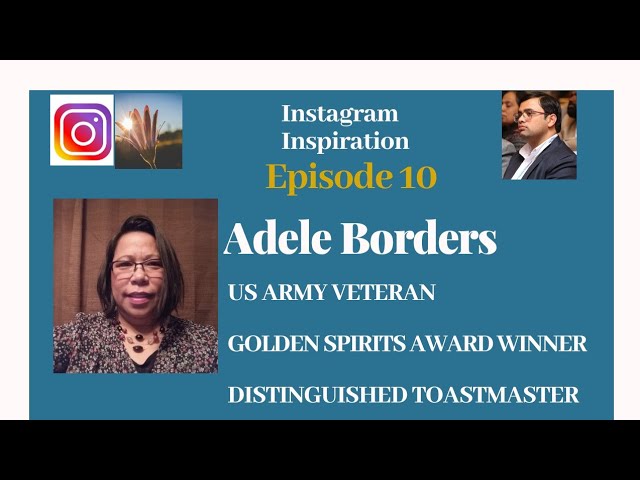
Adele Borders, a Filipino immigrant and Department of Defense employee, joined Toastmasters in 2016 to overcome her fear of public speaking after a painful early experience. She led a District 11 project visiting 20 clubs in 2020 to promote a new education program, and credits Toastmasters' supportive culture with her growth.
Chapters
'Real leadership involves breaking through the limits of your mind so the highest of— so you can step into the highest of your spirit.' This is a quote by Robin Sharma in the book The Leader with No Title. Today I feel so entitled to have with me another leader who I've learned so much, who who has been my fellow Pathways guide in Toastmasters District 11, and, and we have done so much of work together and learned so, so much. So I thought this is a good opportunity for me to have an interview with Adelia B. Potters, or Adele as we call it. So hey, hi Adele, good to have you.
Hi Haritosh, it's always good to see you, it's always good to to talk to you, my friend. I'm so excited when you invited me. I said, how can I say no to my friend Haritosh Srivastav? And we've always collaborated since when, uh, 2018, 2019. Yeah, those were good times.
Yeah, thank you. And I think it's my honor and privilege to have you in this show. So let me tell you a bit about the format. So this is more like a question and answer session. I'll be asking you a few questions, and in between, if the audience have any questions, they can post it in the comments, and we'll take some questions if there are any towards the end of the show. So let me, let me ask you, uh, to tell a brief journey about yourself.
I've been everywhere. As you can tell, I'm of Asian descent. I'm from the Philippines, and I migrated to the USA, and I became a US citizen in 1999. That influenced my desire to join the Army because how do I give back to the country that has adopted me And so I joined the military, and I tell you, that was the scariest thing that I have ever, ever done, getting trained to hold a rifle and with the mentality to kill the enemy. And then the second thing, the hardest thing that I have ever done is public speaking. Can you believe it? And so in 2016, I joined Toastmasters. I have— I'm married. I have 3 children, a boy and 2 girls. I've been married for 21 years. Can you believe it? Yes. I grew up in a big family. There's 6 of us, so I have 5 siblings and my mom and my dad and relatives that are— my dad has 9 surviving siblings, 9 of them, and each one had at least 5, 6 children. So I grew up in a big— we call it a big clan. So that's the family that I grew up in. And then when I came here in America, it's a culture shock because here family planning, it's like 2 children And the ideal is have a boy and a girl. So I was single when I moved here, and in my mentality, I said, okay, I'm gonna adapt the American way of life. I'm only gonna have 2 children, a boy and a girl, instead of 6 or 12 like my family, my cousins, and my uncles and aunts in the Philippines. So here I am, I only have 3 kids. That's enough, I think.
That's interesting how you portrayed it. And yeah, I mean, yeah, I can say, yeah, up till last generation it was a case back in my family as well. So yeah, my, my parents have like 4 siblings, so this was the case. So I hope, yeah, people are learning. Okay, so how did you, uh How did you come across Toastmasters?
It was actually an advice from a boss of mine. As you probably know, I work for Department of Defense. It's another branch called DFAS, Defense Finance and Accounting Service.
It's—
we call it the payroll for the government, for the federal government. And when I was working in the budget office, we do brief higher executives and managers and leaders in our company. And whenever we have a briefing, my boss noticed that I don't really volunteer to— I'm going to brief. I won't volunteer. But if it's mandatory and it's required that every one of us budget analysts would brief, I can do the briefing. So my boss, his name is Sean, and he said, Adele, so on our performance evaluation, we do an annual performance, he put down, you have to, you know, kind of like the feedback that we give in Toastmasters, the evaluation, you have to have grow and go points. So he has a lot of glow points, and then he has to have a grow point for me. And he said, I want you to start volunteering. And he goes, how come you never volunteer? But I know you can do the job. And I said, Shawn, I'm nervous in front of people. And he goes, oh, so your weakness is public speaking. I said, yes. I said, that's why I never volunteer. But if I have to do it, I said, I will do it. And so he said, well, there is a Toastmasters here at DFAS. I want you to join. And our annual performance evaluation is around May timeframe. So he said, I want you to join. That was in May. June, he followed up and he said, have you joined Toastmasters? I said, no, I'm scared. He goes, I want you to join. Come July, He followed up again and he said, "Adelle, have you joined?" I said, "No, I haven't." And I said, "Sean is not going to get off my back until I join." I said, finally in August. So it took me May, June, July, August, 4 months later I joined and he was so happy. He said, "Oh, okay. So you joined. How was your experience?" I told him, "I should have listened to you in May." I love it. I said, I am going to join because I just, I went and visited. So I said, next meeting, next week, I am going to join. And he says, good, that is good news. And the rest is history. I fell in love with the club August 2016.
Yeah, I think your journey is quite similar to mine, to say. I also joined about June, July 2016, almost the same time as you. And yeah, I was— I also joined because, yeah, there was a manager, so-called manager, you know, then who was behind me and other project leads that joined. And for me, it was more this thing that he wanted my team members to also join. I said, I'm not gonna recommend something to somebody unless I try it myself. So then I joined it myself, and then, then I recommended it to my team, and, and yeah, this is history. It's been close to 4 years. Yeah, it's 4 years actually. Yeah, this is the main, so it's 4 years now. So great. I mean, it— I didn't know it, there are so many similarities between our journey. Um, so, uh, the next thing that I want to talk about is, and, uh, is, uh, in this show we don't like to talk too much about the Successes. I like to talk to people about their failures and, and their learning. So do you want to talk about a couple of your failures in life and what did you learn from those?
Actually, the, the reason why I was scared in speaking in public was because of an incident that happened at my— when I first came to America. My first job, or one of the jobs that I have early on, was in accounts receivable. And as such, I have to handle aged receivables that are more than 300— more than a year old. And so I got good at it. I said, I have a knack at convincing people to pay their accounts that had been written off. And as— and there's a tier that we had to go through in our team, and I was reaching the top tier where you get bonus and good recognition, and you got prizes. And said, I want to achieve that. So I've been calling people, doing skip tracing, finding people and making them pay and a monthly, even though it's small, I was successful in making them pay their accounts, reopen already written-off account. And I was getting recognized. And I think it got to my head because I'm going to reach the top and I'm going to do this. And I said, I'm going to do it within a month. You know, you make plans without even thinking, this is what I'm going to do. So one time, I— this is a deadbeat call. This is an account that my boss said, if you can resurrect this account, you know, my hat's off to you. I said, I'll do it, you know, very proud. Well, that taught me a lesson because that was the hardest account. And this guy, when I was calling him, he already He already know how to deal with collections. So when I was talking to him, I was convincing him, hey, sir, just make a minimum payment, this and that, monthly, and it would clear your account, blah, blah, blah. And he got mad and he yelled at me. And in the end, he told me— this is what affected my life— he said, why don't you speak English? And he hang up on me. That crushed my whole world. I said, "Oh my goodness, I couldn't get through to people because I couldn't speak English." And it just got me and got me. And so even though I know in my head, if I put my mind into something and if I want to be successful, it's up to me to work. To work hard, get that ambition. But that one lousy word of criticism got me. So my advice is don't take it personally, because whatever others think of you or say something about you, it's their opinion. And sometimes they do that because they wanted to get out of their trouble and they use you, they use your circumstances to get them out of trouble. So he got out of that, that customer got out of that situation, got away from me by criticizing me. And I took that to heart that I am not good at public speaking because I am not good in English. I cannot speak English well. So over the years, that was my weakness, that thing that got me. Well, how did Toastmasters help me with that? With the environment that Toastmasters has. And that's why I, when you invited me, I thought maybe I can talk about the symbiotic relationship between the Toastmasters community. And when I search about the symbiotic relationship, Some of them have 3 elements of symbiotic relationships. I've had 4, some said 5, and the most that I have found is 6 because I added herbivorism or something like that that deals with plants. Well, the most common ones in the symbiotic relationship is the mutualism, where 2 or more interacting species benefit from each other. And that's one thing about Toastmasters, because we benefit from each other. It's not parasitism, parasites, where only one benefits from the parent host. And then there's also a healthy kind of competition relationship where, you know, the speech competitions that we do, that is good. It's not harming anybody, but one person benefits, you know, the winner. So in, in Toastmasters, we have those relationships. And so it reminded me of that, the mutualism in Toastmasters is what everyone should really work on and take advantage of this, kind of like what we're doing right now, collaboration. And when we first met, I remember when we first met because we were Pathways Guide. I remember at that time I was working on my advanced communication because remember once you finish the Competent Communicator, the CC, you do advanced manual and I think one of them is to be part of a panel or hosting a panel. So that's when I first met you. I invited you to be part of the panel.
I remember you were taking on questions and yeah. And was it—
Yeah, and so I took advantage of that symbiotic relationship, the mutualism, where, hey, what is our mutual something in common? And Pathways, we were Pathways. I invited a couple of my friends to talk about Pathways. I think that's when we hit it off, we collaborated, and then yeah, the rest is history. So My advice to new Toastmasters is find somebody, you know, everybody would say, oh, have a mentor. Yes, that, that is wonderful. Also find people of like, like mindset as you are, and then build on that and collaborate on that.
Thank you. You, uh, say covered so many things in such a small time frame. I mean, kudos to you. First of all, you, you talked about such, uh, close things of your heart. I mean, I know failures or such type of criticisms are really close to heart, and it takes really guts to actually talk to someone else. So thank you for that. And then you also talked about the mutualism and the Toastmasters, and I talk enough about Toastmasters, but I like, I like the fact that you talked about the mutualism. This whole series of, you know, 10— this is the 10th episode that I'm doing. I can say, you know, I get all the mutual friends, Toastmasters and non-Toastmasters, who are mutual friends or colleagues or mentors who really helped me. I think that that term is really, really, really a powerful term, and thank you for introducing that term. So my next question to you is I know you are doing an interesting project where you, you are visiting different clubs across, across the globe. So how has your experience been so far?
Actually, it's not— Holly is the one that's doing the project across the globe. Mine is just within District 11, and I titled my project 20 in 20. What it is, is I visit 20 clubs in 2020. So I gave myself from January to December this year. This is pre-COVID incident, so I started this job, this, this project in January, and I kind of got a blessing from our district trio, Lou, Jean, and Holly. And I said, I told them about the project, and I said I kind of want to be like an ambassador for District 11, visiting clubs and giving them a message. And what message do you, TRIO, have to tell to the District 11 clubs that I'm going to visit? And I said, I don't have any club in particular. What I'm going to do is, as my time permits, and if they are safe, for instance, I am off on a Wednesday, which clubs are open on Wednesday? So, so I said, I No favorite club or whatever, and I don't have a club lined up. This is based on my schedule. And so they said unanimously, they said Pathways, because at that time in January, Pathways adoption in District 11 is only 69%. And guess what? Legacy system is going to be gone June 30th. Yeah, in a month. 30 days. So I said, okay, so whenever I visit the clubs, that's the message that I'm going to tell the clubs that I visit, that if they can adopt and enroll in Pathways, that would be great. So that was my project, to bring the message of it's about time, open your eyes, Legacy is leaving, Pathways is here, let's embrace it whether we like it or not.. And when you enroll in Pathways, you get free PATH. Everybody gets a free PATH, so you take advantage of it, and it kind of increased our adoption rate. So, so far, last time, and then I would post it in District 11. I see on the website. Yes, on Facebook page so that people can benefit, and my goal is to borrow best practices, observe the best practices, and kind of give it out to everybody and say, hey, club number one is doing this, and that it really makes their, their meeting so alive. And then club number two right here is doing this. For instance, the very first club that I visited, they are on Meetup. And they had like so many guests. And I would say half of the guests they have, like, because it was an open house, they had like 20 visitors. And about half of those visitors, about 10 or 11, when they asked to introduce themselves and how did you hear about this club, they said, oh, I saw your advertisement in Meetup. And so I said, Oh wow, Meetup actually brings guests. You know, it's an announcement out there inviting the community to visit the club, and it worked for that club. So that was the goal of my project, to borrow best practices, announce it to District 11, and hopefully the clubs that are, I should say, struggling clubs can borrow from The Thriving Clubs. So the project that is global, visit global clubs, that's Holly. Mine is locally, just within District 11.
I mean, with the Zoom in the picture, you can actually make it global.
Yes, I know. And actually, I was getting in trouble because in March I said, oh, I only visited like 5 clubs. At that time, and I said, it has to be 2 clubs a month so that I can finish within December. But I said, it's gonna get impossible. But then here comes COVID. So I think sometimes I blame myself for the COVID because I think God is giving me a chance to finish my project in 2020. So if you want somebody to blame on the COVID and the lockdown, Quarantine, that's me.
You're not alone in that. Yeah, we all have our dirty hands in that. Okay, so yeah, since you already touched upon COVID-19, uh, my next question is, how are you dealing with COVID-19 now that you introduced COVID-19 to the world? How are you dealing with it?
It depends on, on day-to-day basis. Like 3 weeks ago, I said, my goodness, I cannot be a homeschooler. I thought I'm a good teacher. You know, I thought I'm a good teacher, but I'm not. I don't have the patience. My hat's off, kudos to all the teachers who can teach, because especially elementary kids, which I have one junior high and then two elementary, they're going to move to middle school. Next school year, but whoo, it is tough to be a homeschooler. And that's one of the, on my top, top 3 that I hated about the COVID because because of that, oh, it's impossible. And then the second thing that I didn't like is I'm busier than ever because now that Zoom is here and Skype, WhatsApp and so many other modes to communicate and reach out to people, you get so many invites that it's like every hour you got something going on. And there's so many wonderful things. Like yesterday, I think I missed your global meeting because we were doing something for Boy Scouts and Yeah, and it was outside, it was outdoors, and I couldn't really join because I was like, I'm gonna join, maybe listen in. It's impossible because it's in cemetery. I don't know if they even have Wi-Fi. We were pulling up the flags for the veterans. It's like, how can you have so many fun?
I posted the recording in the District 11 website as well, so I mean, District 11 Facebook as well, so You might want to look whenever you have time.
No obligation.
All right.
So, um, the thing about it though, one good thing about COVID that I really, really like is my kids are here at home. And because before, oh, I want to play with my friend, I want to play with my friend, I felt neglected and I felt like, oh, now they have friends and they want to spend time with their friends. Now they're here, they can't play with their friends. So they hang out with us, especially my teenager. Before he's like, nope, I don't have anything to do with my parents. Now it's like, Mom, Dad, let's do this.
So that's one good thing about COVID All right, I think we are coming towards the end of this session, and I want to ask an important question before we conclude is Uh, if one of the, one of the motive of this Instagram session is also to inspire especially the young professional, so if you have to give a couple of advices to them so that they can excel in their career, in their, in their pursuit, what would those be?
3 things that I always tell myself Number 1, which I covered earlier, don't take things personally. Don't take things personally, even if it's attacking you, even if it's a compliment. If you don't think you deserve the compliment, but people are giving it to you, don't take it personally because that's their opinion. That's their opinion. Or if it's a negative thing that they say about you, don't take it personally because you know yourself and it's your core value. So don't take things personally. That's my number one. Number two, keep the main things the main thing. I heard it from somebody, it's from my pastor, and they say—
It's a quote from Stephen Covey, I think. The main thing is to keep the main thing the main thing.
Keep the main thing the main thing. Yes. So what is your priority? What is it that you're chasing? What is it that you want? And keep that your main thing. Don't have so many other things that convolutes it. So keep the main thing, the main thing, the main focus. And then the other one is we are here to serve. Even the Lord Jesus. I'm Christian and I give credit to God. I give credit to my Lord and Savior Jesus. And him, he did the ultimate service, the ultimate sacrifice, that he gave his life for us. So I would say that for number one, always serve others. Put others before yourself. You know, there's a saying that says, "Do unto others what you want others to do unto you." If you adhere to that, always think of others before yourself, and with the intention of of I am going to serve, whether it's a young person, whether it's a friend of yours, whether it's your family. Put that in mind. Others first. Serve.
Thank you. Thank you so much. I can't thank you enough for coming to this session. I know you had to do a lot of things and you had a lot of communication, but thank you so much. It was an honor privileged to have you. And, and with the last point that you say, sir, that is where I generally end my episode by saying that, no, let us help each other in this. And when I say help, it's not always about money. It's also about talking to someone 5 minutes. It's also about feeding a pet. So let's help each other. We'll be out of this pretty soon. Keep learning, keep growing, and keep going out of our comfort zone. Yes, thank you so much, Adelle.
It's my honor, Haritosh Srivastav. Thank you.









