Instagram Inspiration Episode 12 - Dipender Singh
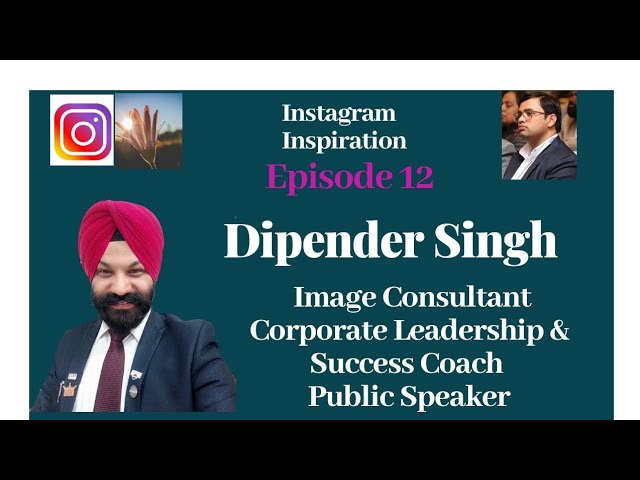
In this 44‑minute interview hosted by Haritosh Srivastav, Dipender Singh shares his life story and professional evolution. He begins with a humble upbringing in an Indian army family, describing how his parents prioritized education despite financial hardship. After earning a B.Tech in Information Technology from Dehradun Institute of Technology, he spent 12 years working for major IT firms (HCL, EXL, IBM, Accenture). Recognizing the growing importance of communication skills, especially amid economic uncertainty and the COVID‑19 pandemic, he left his corporate job in 2019 to become a full‑time communications coach and image consultant. He recounts early failures—most notably repeated rejections in campus interviews—and how introspection helped him improve and secure a position at HCL. A pivotal moment came when he joined Toastmasters in 2014, which he credits with a 180‑degree personal transformation, enabling his current coaching career. Leveraging this experience, he founded the venture Zai Si Varto, offering a 66‑module "Public Speaker and Communication Master" program and a public‑speaking curriculum for children, aiming to generate jobs and empower individuals. The conversation also touches on the COVID‑19 crisis, where he emphasizes social distancing, cleanliness, and calls for national recognition of healthcare workers as gallantry award recipients. Finally, he offers advice to young professionals: protect one’s dream, work relentlessly hard, and allocate a portion of earnings to a social cause, a principle inspired by his Sikh faith. The interview closes with mutual gratitude, encouragement to help others, and a reminder to step out of comfort zones.
Chapters
You have the power to be every day, and that is an amazing responsibility. That is a quote from Brian Tracy. Today I'm so happy to have an amazing personality who's gonna enthrall wisdom with his common sense of humor. Thank you so much for joining. My honor and pleasure.
Hey, thank you so much, Haritosh. It's an equal honor and a pleasure to have been able to come over this show. I've seen your show a couple of times, especially with the guest that were known to me. And I guess you're doing a fantastic job, uh, with creating content which would help, uh, and which will help a lot of people in the future. So thanks so much for having me on this, this—
Thank you.
So today is—
today is— now it's gonna be a— it's gonna be a— and each of them of Haritosh Srivastav and a lot of things to learn. Yes, yes. So I'll tell you a bit about, this will be more of a question answer thing, so think of it as topic. I'll be asking a few questions to you and you can give, you can answer to that. To that, if any audience, any audience question, they can put it in your comment box and towards the end, towards the end, you can take a few questions.
Wonderful, awesome.
So, uh, so, uh, start with your journey. You want to talk about your journey in 2-3 minutes?
Sure, sure. Thank you so much for giving me this opportunity to talk about my journey. There's not a lot of forums that where you get the opportunity to log, talk about what you've been through, what has been your journey so far in, in life. Right, Haritosh Srivastav, I would say that I actually come from a very humble background. My father— I was born into an army family, and my father was a non-commissioned officer in the Indian Army, and he was retired before I was born. And because of education, because of his education, he did not land up in a very good job or an opportunity after he retired, and he ended up selling eggs at one point of time, and by the time I was born, he was, uh, flowing an autorickshaw in my hometown. So there was, there was some one time at, uh, in my position when we do not used to have two square of meals. And in those time, that, that is when the time when I was born into this family. I am the youngest of the three siblings, and I've seen my father trying to make his ends meet, to make his family ends meet. However, what I've liked about, uh, the guts and the grits of my parents is that they've never given up. Even with that meager income, they have been able to bestow us with the best of the education. If you would go ahead and search in Google about Brightlands School in Dehradun, it's one of the best academic schools that one can find, a day boarding school that one can find. In the entire, in the entire India. And he and they ensured that if even if they had to give up everything in life, they would never compromise on our education. Today both my sisters are educationalists. One is a teacher in one of the best schools in Patna. The other one is, is a home tutor in Hyderabad, and she's given up her teaching career because of her growing children, but she still is in the education field. And that is where the entire inspiration of my life is being driven. I think that if you may give up everything, but what you should not give up is hope.
Right.
And when that Hope is with you even if you don't have anything in life. Correct, correct. You only have hope in your life, there is nothing in this world that can stop you from achieving whatever that you aspire for. So, so that is— that has been the journey. And everything else after this, be it my education, be it my college, be it my be it my life, be it my studies, be it my marriage, it is all due to the results of the hardships that my parents have gone through. And after that, that is all material. If I go on to talk about what has happened after that, that is all bragging. What, what has happened before that, that is what draws inspiration in my life.
I mean, I am really, really— I got to hear, and we all are, we all are fighting that fight to make us what we are. That should be the last day for 2024, given 2025 is 25th. So thank you so much, thank you so much for inviting. I mean, I'm not, you know, don't believe in bragging. But let's talk about your higher education and professional experiences, etc.
So Haritosh Srivastav, I graduated from Dehradun Institute of Technology and I have a bachelor's degree in technology in the information degree stream, information technology stream. Right after my graduation, I was very clear in my mind that I will not go for further studies. The simple reason was that because of the financial background that I came from, I knew that there is a lot of dearth of money in the family and I would not be able to put that financial burden on my parents. So from there, I've worked for about 12 years in the IT industry. I've worked for brands like HCL, EXL, IBM, Accenture. And I have two stints with HCL, and recent stint was till September. And since then, since September 2019, I have given up my IT job, and now I am a full-time communications coach. I'm an image consultant, and right now I am helping professionals around the world in achieving their goals, within their careers. A lot of people, what is not being realized is that you might have the best of the technical skills, the best of the functional skills, you might have the best of the domain knowledge, but with the advent of the economic depression that we are probably coming into due to the advent of coronavirus. A lot of promotions or a lot of success in careers, whether it's business or job, will go to people who are able to express ideas, who are able to impress their audience with ideas. And that is where communication and self-image plays a bigger role, right? So if you're putting all your money into one basket and you are trying to, uh, get a lot of technical knowledge, but you're not investing any of that in— into your self-image, then there would be a time where you'll find yourself a lot behind the crowd which is moving forward. And with that, I have resolved to work with people who have this frame of mind and helping them to achieve, uh, big, uh, bigger goals and bigger targets with them.
Awesome, awesome. Uh, thank you so much. I'm part of your Facebook page and I see a lot of, lot of, lot of useful content and I was able to find this one. And he said that one of the most promising, promising, the leader among the communication educators and the ability to communicate with the—
you are working hard.
Thank you. Okay, uh, so my next segment, I ask about encounter of people with failure. People which most of us have encountered some of failures that I've encountered and what, what have been my learnings.
Oh, wonderful, wonderful. Uh, thank you for asking, asking that. That's a very interesting question, Haritosh Srivastav. I guess, uh, you know, we, we all know this famous saying, and it's a very clichéd saying, that you you know, your failures are your stepping stones to success. So I, I believe there have not been too many failures in life, but whatever one, two failures that I have encountered have taught me a lot. The first that I think from the top of my mind is the campus interview that I sat for.. And, uh, I saw a lot of people in, in, in my batch getting placed, but I was not getting placed. There was some God's plan, I don't know what. A lot of my friends got placed into, uh, organizations like Accenture, IBM, NIIT, and I was continuously flunking a lot of interviews, not even getting through first round of analytical and logical reasoning interviews. But what I found is that, you know, the failure should not get to your mind, right? If you let the failure get to your mind, I guess that's equal to a suicide.
That got—
then there can— there cannot be a bigger mistake that you can create in life. Now from there, what I did was I tried to understand my shortcomings, why I was not getting placed, uh, what did it— what did it take for them to get placed, right? And what I found was that there are— there are some qualities that I lack. And I started working on those qualities. I, for the first year, I worked in a call center after graduating, and within that year I worked on a lot of technical stuff, I worked on a lot of soft skills, I worked on a lot of other aspects of, you know, being hireable. And I sat for the interview again on an off-campus with HCL, and that is where I got placed. So I could have— there could have been two roads that I could have taken. The first road was I could have sulked, I could have probably blamed my destiny about it. On the other hand, I chose to work on the shortcomings, and there is this— that is where this— the learning is that you cannot put every blame about your failures on the destiny. Be, right? If something is going wrong in your life, right, rather than looking outside, look within. And a lot of solutions will be found if you just, just try to look within. And it would not take a lot of time. It would also not take a lot of efforts looking within, because the best counselor that you can have is your own self. That is who— that is where you can find your best counselor. And the only way that things can come out of it is when you listen to that best counselor, right? So, so that is what I've learned from my failures, is— and there have been others, but this— the technique is the same. You do not blame your destiny. You look within and you'll find a lot of answers.
I love that. You're not looking out, you're looking at the mirror to find out more about yourself and then also find out how you can craft your resources and make the best out of it.
That's right.
Thank you for that. Thank you. Okay, okay, so how did you become a Toastmaster?
How did I end up being a Toastmaster? And then it's a very interesting story behind it. Now let me give you a background of how I was attracted to Toastmasters, and then I'll tell you how I ended up in Toastmasters. So this was the year 1999, and we, the Sikhs around the world, we were celebrating the tricentenary year of the formation of formation of the Khalsa Panth, actually the, the clan that we belong to. And because it was such a huge occasion within my faith, I— and I was a growing teenager then, so I was inspired and motivated by my mother to attend or participate in a competition, a speech competition, where we had been given a particular topic. We had to prepare on it, and we had to then go and speak about it, uh, again, but probably if I remember it correctly, it was a 2 to 3 minute speech. Uh, now my parents helped me construct the entire speech because they had the facts, they had gone through the scriptures, they had the facts, they knew what would impress, uh, the audience and the judges, and they gave me the content and they gave me how to put I put that account across and I practiced a lot. One week before the, before the entire participating event, I practiced it in, in probably in front of everybody— my siblings, my friends, my parents, my dog, my plants, everything. And when it came to that day, I still remember I walked up to the podium And I greeted, you know, the common greetings that we have in our faith. Vai Guru Ji Ka Khalsa, Vai Guru Ji Ki Fateh. And that was the only thing I could muster out. And I froze in front of 200 pair of eyes. I froze because I had everything in my mind, but what happened was, is the magnitude of the event took over. And all I could do was repeat the greeting and come back. And that was a huge disappointment for me. I, I believe it was a huge disappointment for my parents as well, but it was a huge disappointment for me personally because I was, I was not able to live up to the expectation of my parents or to the expectation of my community. Since then, this was this lingering failure in my mind that, you know, what has happened. And I, I kept thinking about it, you know, as I said earlier, I kept looking within. And 15 years hence, I got a mail. I was working with IBM. I got a mail from the HR about something known as Toastmasters. Now, whenever you hear, and this again is a very clichéd thought, whenever you hear about Toastmasters, the first thing that comes to mind, because you are from the, from Indian community and from Indian culture, toast stands for a toasted bread in our, in our community. And I thought it is, it has something to do with the cookery and cooking and And I have a passion for cooking, to let you know. And I thought I would like to probably attend it. I went in there and it was totally different. And probably, you know, we say it in Hindi, "Duptekho tinke ka sahara." This is what I was looking for the last 15 years. And I got it. You know, as Toastmaster, once somebody comes as a guest, the VP membership is after your life. The VP membership have to come after my life. My, with my credit card after the meeting, outside the door of the meeting, meeting room, and running after the president to sign me up. I was— there was nobody to have— there was nobody who had to follow us. Up with me on being a Toastmaster. So this was, this was my start to Toastmasters. This was something that I was looking for 15 years, and Toastmasters has been a revelation, and it has been a totally transforming experience for me. If I today am working as a communication coach and an image consultant, the entire credit goes to Toastmasters. If I had not been in Toastmasters, I would I would certainly have been sitting behind a desk doing probably a coding or a service maintenance job. That would— or probably I would have been elevated to a manager or a senior manager level. But Toastmasters has totally transformed me. Whosoever who is looking into this feed or would be looking after once this feed is made available, let me tell you, Toastmasters can transform you. Transform your life 180 degrees, because it has done for me.
And now that you said that, I don't have to say that I would like to even doing that in simple language.
But this is what it is. I, I do it. It is a way of life. It is certainly a way of life because it teaches you so many things, some things that are explicitly mentioned when you join Toastmasters that you will become a communication communicator and a leader, right? But what they don't tell you is that you will become a totally transformed person. And that is something that I bargained out of Toastmasters. I, I knew I will become— because it was a 93-year-old organization when I joined, and I knew I will become a good communicator, I will become a good leader. But I did not know at that time. Had I known at that time that I will become a totally transformed personality, I think I would have, you know, put in more money to join Toastmasters. So that is, that's exactly it. It is a transforming experience.
Thank you so much. Okay, so now that we talked about your journey, your failure, and how did you come across Postmasters, how did this idea of being an entrepreneur come to you?
I was expecting that question, Haritosh Srivastav, because these are the questions that you are fired with once you choose to become an entrepreneur. Success is probably which will follow you after you put in those efforts. But once you choose to give up your high-paying job and you want to get into struggle of becoming an entrepreneur, you are followed with these questions. And I'm thankful to you that you've also asked this question to me, because through this answer, I think I'll be able to inspire and motivate a lot of people. Growing up, I had this idea in my mind that I am somebody who likes to work in an independent environment. And I was always told that in Hindi that naukari le nese bada naukari denewada. And this has stuck to my mind, you know. A person who gives a job is better than who takes the job. And that— this has stuck in my mind as I was growing up, right? My destiny was that I was, I was to be employed for 12 years, but within those 12 years also, this idea always stuck in my mind, and I always wanted to be a job generator. Rather than a job chaser. Even when I was, even when I was an employee in 2014, when I joined Toastmasters, quickly after joining Toastmasters, I started doing trainings on the side. I worked on the weekends giving a lot of trainings, and through that, over the last 6 years, I have generated a lot of market presence. So the idea is to generate jobs and through my entrepreneurial journey generate opportunity for people to get into a stream where they actually get transformed. Now my organization, Zai Si Varto, is working on transforming people. If you look at our main headline. It says Transforming Lives for Success, right? And right now we have, because it's a humble start, we have 2 programs running in the entire organization. One is something known as a Public Speaker and a Communication Master, which has 66 modules in it. And if somebody chooses to go through that 66 modules. It takes you through an entire transformation journey where it works on your public speaking, it works on your communication skills, it works on your leadership skills, it works on your self-image, it works on even at a granular level of how you look in front of people, right? Not only what you think a lot of. And the third— and the second program that we are learning, we are running is public speaking for kids. And my strong belief is that I encountered Toastmasters when I was 32, and now you could have guessed my age as well. So I encountered, encountered Toastmasters when I was 32, and if I would have been lucky in 1999 Right, I would have been a totally different personality. I could have probably achieved more than what I have achieved in my life. So our thought and our, uh, goal over here is to start kids at a very ripe age so that once they achieve an employability age, you know, they are masters of their trade. They are filled with confidence and they have a beautiful self-image about themselves. So these are the two programs that are running towards the betterment of people who want to strive and strive hard in their life. So that is the life, that is the idea behind the Entrepreneur are the A, to generate opportunities, and B is to generate jobs.
Nice, nice. I've stuck part of—
I think part of a new group that you run.
Some of the—
I was really impressed with some of the presentation.
Wow, somebody, somebody would ever, somebody would ever meet something that 20 years, 20 years— but anyways, anyways, Let's take that to current times. We all know the elephant in the room. You must have expected it. Let me ask, how are you dealing with it?
You know, you've addressed probably the biggest elephant ever in the room. And absolutely, and everybody in this world right now is, is dealing with, uh, with this, uh, pandemic. And, uh, you know, I would, I would say that, uh, the way that I am or my family is dealing, we are following the very basic principles. And there are only two basic principles of dealing with this pandemic. A is social distancing and B is cleanliness. Those are the only two solutions or guiding principles behind dealing with COVID right? Now, the Indian government may have lifted, uh, the, the lockdown there are scenarios where a lot of countries, governments, and economies have lifted lockdown. However, let me tell you, the corona is here to stay. Yeah, it is here to stay until, until a vaccine is found for this, right? So let's— a lot of intellectuals around us, you know, they are They are saying that, uh, you know, let's live with Corona. Let's do that, but let's live with Corona with the principle which will safeguard not only you but safeguard your dear ones as well. And it is very important. So social distancing and cleanliness is the only solution right now, right? And any person, doctors, paramedics, or anybody who is dealing at ground, at grassroots level with this pandemic will tell you these two principles. So that's the only way that we are dealing, and that is the only way that the entire world should deal with this. Totally agree.
And I think, and I think, I think we need to give a grand salute to all the sacrificing their time and putting their lives on risk. It is an incredible, incredible move to mankind.
Haritosh Srivastav, I would like to probably express a feeling over here.
Yep, sure.
Being from an army background, I've, I've seen this, this culture in my, in my family. My grand— both, both set of my granddads were in the Indian Army. My father was in the Indian Army. My uncle was in the Indian Air Force. And I've seen this culture, and this culture says that there has to be military honors for people who fight an enemy. And there are military honors both in peace as well as in war. So the highest gallantry award in peace is Ashoka Chakra. The highest gallantry award in— at time of war is the Param Vir Chakra, right? Uh, and both of these are given to people who show, uh, uncalculated bravery in the face of facing the enemy, right? Right now, our healthcare professionals are facing the enemy, right? You know, that enemy is not loaded with guns, that enemy is not loaded with tanks, and it is in such a stealth mode that you can't even see that enemy. Correct, correct, right? And I would like, through this platform, I would like to address, or I would like to request the Government of India to bestow upon Ashoka Chakras to all those people who have either died or fighting— died fighting this coronavirus, or they are braving against this coronavirus as paramedic forces. Yeah, because they deserve it.
They deserve—
because they are, they are, they are literally fighting war as an army man would, because they are putting their lives on the line to safeguard the lives of, uh, the people of the nation, the people of the nation. And that is where we should thank them with, with these gallantry awards, these military gallantry awards. They deserve it.
Yeah, I, I totally, I totally, I, I already pointed out this has never epidemic and they are the one, they are the one who are dealing with it on the forefront of— I want to congratulate them for their hard work. Like, the mortality rate is so low. I mean, number of people dying across the world if you see. So it's all their heartwork, diligence, dedication.
They truly deserve it. They truly deserve it that they not only deserve They not only deserve monetary awards, they also deserve these gallantry awards because they, they are showing that gallant behavior right now in the face of this unseen enemy.
Okay, so I think I'm going towards the end of going towards the end of the episode, and, and I'm gonna ask you, I'm gonna ask you Some tips for any young professional who are gonna probably join a corporate or have their own entrepreneur. So what would be, what would be any tips that you want to give it to them?
Uh, there would be a hybrid, hybrid, uh, suggestion that I would, or tips that I would like to give both these I mean, these, these suggestions come out from both my experience as an IT professional working 9 to 6 and also as an entrepreneur working— there is no time limit.
Yeah.
And my first tip to any such person, whether they want to become an employee or a professional, or they want to become— my first tip is put your undivided focus on your dream. Put your undivided focus on your dream because your dream is something that is your personal thing, right? And if there is anybody in this world that can rob you from your dream is you. There is no Maika Lal in this world. There is no Maika Lal in this world who can rob you from your dream if you— if it is well protected. So protect your dream because you will— you are the only person who can drive you towards your dream. Your mentor in your life will be a catalyst, right? But he cannot take you to that particular dream. Only you can fulfill it. So put your undivided focus on you. The second thing is never compromise on hard work. Now this could be a cliche— this could sound a very clichéd opinion, but there is no substitute to hard work.
Agree.
There is no substitute to hard work. Now, uh, fire me for, for, uh, for calling a lion a lion. You can do that. But then if there is no substitute to hard work, there is no substitute. Just, just put in, put in whatever it takes, whatever it takes. People who make excuses will never make money in their life, and people who make money in their life never make excuses.
Nice.
So hard work. And the third thing, the most important thing— dream is good, hard work is good, but without a social cause in your life— let me repeat that— without a social cause in your life, If because of you 10 people are not well off, then probably your coming into this world has, has, has no meaning. Now it's my opinion, it's my opinion, and I am, I am fine with people differentiating with this opinion. You know, that, that's, that I respect that, right? But if in, in your lifespan and 10 people are not, are not well off because you lived in this life, then, then your life has no meaning. So have a social cause. What will you do after you, you have a dream and you have made money with your hard work? What will you do? You know, will you sponsor somebody's education? Will you marry somebody, you know, marry off somebody who does not have money to marry? Or will you take care of somebody who's in an old age house? What will you do with that money? Is your money only good enough to buy cars and swanky homes? No. So if you read the the Sikh scriptures, and I'm, I am, I'm not taking this opportunity to promote my faith over here, but this is something that I've learned from my faith. Whatever you earn, whatever you earn, you do not own the 10% of it. That 10% is for social cause, right? You are only owner of the 90% that you've earned. You know, after taxes. Before taxes, it's all government. But those 10%, so if you earn ₹100, you only own ₹90. ₹10 is always taken out for a social cause, right? If you have ever gone to a gurdwara, right, you would have seen those donation boxes, right? Now those donation boxes in literal Punjabi translation means— it is known as Golak, and in, in little— there is a, there is a saying in, in our faith, and the literal translation from Punjabi is that those donation box are the mouth of the poor. You feed those people, uh, through, through your donations. So have a social course, right? And let me tell you, with these 3 inputs, if any young professional is listening to me, if you work with these 3 principles, plus a lot of principles— these are, there are related principles— you will work with, with them. I tell you, when you go to sleep at night, you will have the most fulfilling sleep. Most Because, you know, you are still chasing your dream because nobody has the guts to rob you from it because you have that kind of an attitude. And second is you're working hard because after you worked hard, then tired, and then you go off to sleep, I tell you what kind of sleep is that. And you've worked for somebody's life. You know, when you close your eyes with those blessings in your life, even I cannot tell you, I'm having goosebumps right now when I'm talking about this. So these are my suggestions to all the budding professionals and entrepreneurs out there.
Thank you so much, Haritosh Srivastav. And I truly respect you. And so are examples. Thank you so much. I think since we are coming towards the end of the session, we have been talking about 44 minutes, but it didn't—
I didn't even realize that it was 44 minutes. The time went off so fast. Thank you so much.
I'm pretty sure whenever, whenever after this, he's gonna pick up something. You are a shining example of how you can turn your dream into something powerful and then make it successful. And, and most importantly, thank you. Thank you.
Thank you so much. It's, it's an absolute pleasure to to have been invited onto this platform. It has given me the opportunity to look into my shortcomings because I still strive to be an amazing speaker. I still strive to be an inspirational speaker, and you've given me that opportunity to work towards being one because this is a practicing ground for me as well. So thank you so much for for giving me this opportunity. And you're doing a wonderful job, uh, taking out so many differentiating opinions to a lot of people around, around the world. So God bless you, man. You, you are already doing a social cause without even putting, putting in a penny, right?
So that's amazing.
That is amazing.
Yeah, so I'm gonna end as I do every time. In these trying times, let's help each other. And when I say help, I say help. It's not always about me, it's also about talking to someone for 5 minutes. It's also helping, helping.
Let's all help each other.
We'll all be out pretty soon. And let's keep learning, keep growing.
And most importantly, keep going out of comfort zone.
This is Haritosh Srivastav. Don't get heart beat up. It's interesting. And I will be back next week. Another personality. Sad that you are sad. Thank you.
Thank you.









