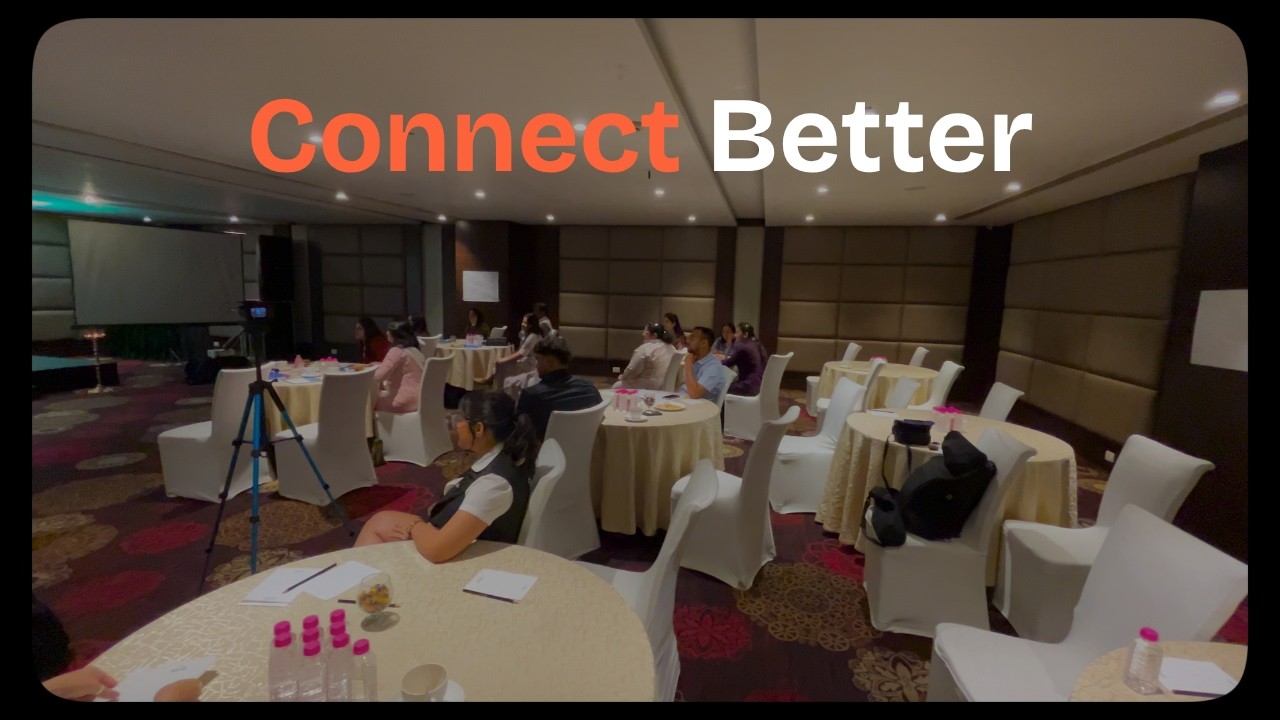
In this solo presentation, the speaker shares practical networking advice drawn from personal experience, focusing on why most people fail at networking and how to correct those habits. He outlines common pitfalls—such as pitching too early, over‑complicating one’s offer, being self‑centered, and treating interactions as purely transactional—and then presents a set of actionable “dos”: clarify what you sell, who you serve, and where you operate; replace pitches with concise stories; ask clarifying follow‑up questions; prioritize building genuine, long‑term connections over immediate deals; and pay close attention to non‑verbal communication (posture, eye contact, personal space, handshake, etc.). The speaker illustrates each point with anecdotes from a recent networking event, emphasizing that people remember authentic conversations more than salesy pitches. He concludes by urging viewers to apply these principles, comment their takeaways, and subscribe for more growth‑focused content.
Chapters
Most people, when they go to networking, they get this wrong. I know you must be thinking, what is it that he's going to talk about? So don't worry, I'm not going to share with you a lot of tips and tricks. I'm going to share something which are part of my experiences. So I see most people who are attending a networking event, they actually fail at how they want to show up. Even though people are attending events, meeting new people, exchanging number, but what happens afterwards? Nothing. So I'll show you exactly what to do, more importantly what not to do, and how you can communicate in a way that people will actually remember you. Would you be interested in that? Very recently I was in a networking event and within first 20 to 30 minutes I met at least 5 people. Out of those 5 people, 3 pitched to me immediately. One of them gave me his visiting card without any context. And with only one person, I had a real conversation. Guess who I remembered the next day? Well, no point for guessing. It's the person with whom I had a real conversation because he was not trying to impress me. He was not trying to sell something to me, but he was trying to understand me, and that's when I felt the connection. When you think about networking, it is not about collecting a lot of business cards and contacts. It's not about bombarding people with your pitches, and it's also not about talking about yourself endlessly. Have you met any such people who are so full of themselves that within first few minutes you're like, whoa, I don't want to talk to that person. He seems to be so full of himself, but he or she doesn't have an ear, an appetite to listen to me. So what networking is really about, it's about building connection. It's about creating clarity and it's about communicating your value through your stories. So in this video, we are going to learn all of that. Let's just start with some of the don'ts, right? So you already know what needs to be done, but what people don't know is what they don't know, right? If you do not get the last sentence, let me say that again. Most people don't know what they don't know, and that's why they end up where they end up. So I'm going to help you here with some of the don'ts that you shouldn't be doing when you are a networking vet. Number 1, the biggest no-no is do not start selling within first 30 seconds because in the world, even though we are at networking, nobody likes to be sold. Everyone wants to buy. The last thing that you want to turn off people with is immediately pitching your services, your products. Mistake number 2 that you shouldn't do is overcomplicate your things. I am a transformational coach who blends the NLP and this and that, creating the— who's interested in that? No one's remember. So you want to make sure that you are simplifying what you offer, what you produce. And mistake number 3, this comes from a lot of knowledge that Stephen Covey gave, that he said that be interested in people and not interesting, which means that follow the ratio of 1:2. You know that ratio? You have how many mouth and how many ears? Yes, you have 1 mouth and 2 ears, and use it in that ratio. So you should listen twice to what you speak. So be open to listening, be an active listener. This will really help you get connection. So don't be so full of yourself. And number 4, and that is from the mindset perspective, don't be transactional. I'm not saying that don't do business, right? But there are some people who are all about transaction. Have you made the payment? Have you delivered the services? Nobody wants to connect further with them. Of course, if you have a necessity commodity you need to buy, You are not— we're not talking here about any particular necessity or any particular commodity. We're talking about business networking. So here you need to go away from transaction to connection. Now let's talk about the powerful dos. So number 1 is have clarity. Don't overcomplicate things. Be clear of what do you sell, Where do you sell? Who is it that you serve? Because if you're not clear, your audience is definitely not clear. Number 2, use stories instead of pitching. So instead of saying that we do amazing work, you say that last month we worked with a real estate client who wanted to build their brand online and we helped them, we helped them brainstorm, we helped them create, we helped them post on all social media. This is a story and everybody is okay with the story, not with a pitch. Number 3, very important question, very important skill is asking better question, right? When somebody says that, okay, I do this, make sure that you ask them a follow-up question. Okay. So let's say somebody says that I'm a digital marketer and you can say, okay, are you specialized in a particular area in digital marketing? Somebody say that I am an artist. So you can say, okay, are you a pencil artist or are you a painter? When you ask those clarifying questions, follow-up question, people feel that this person in front is interested in them. And that's where the connection start to happen. And this is where the fourth do come, which is focus on connection, not only on conversation, which means that the focus is not to get a deal done and as soon as possible. The focus is how I can build a connection, a relationship that can be longstanding and that can be beneficial and value-adding for both the parties. Now, the last thing that I want to talk about is the communication layer. What most people miss when it comes to these networking events is it is largely driven by how you communicate, and that is why it is very important that you focus on your communication, the way you are standing, the way you are making eye contact, the way you are taking the space. Are you getting too close or too far? The way you do the handshake, the way you listen to others. All of these small nuances play a big role in whether you're going to build new connections and make it profitable, build a business, or not. So I hope in this video you learned something about what turns people off, so the don'ts, the dos when you go to a social networking platform, and how your communication plays a pivotal role in your journey. So write down in the comment section what were your major takeaway from this video. And for more such tips, don't forget to subscribe to this channel and press on that bell icon so that whenever there's a new video, you are not missing out on that. See you in the next one. And as I say every time, until next time, keep learning, keep growing, and keep going out of your comfort zone. Story power to you.