@OnlineStudy4u A small-towner in Bangalore | Pratik Shrivastava [Interview Part 2]
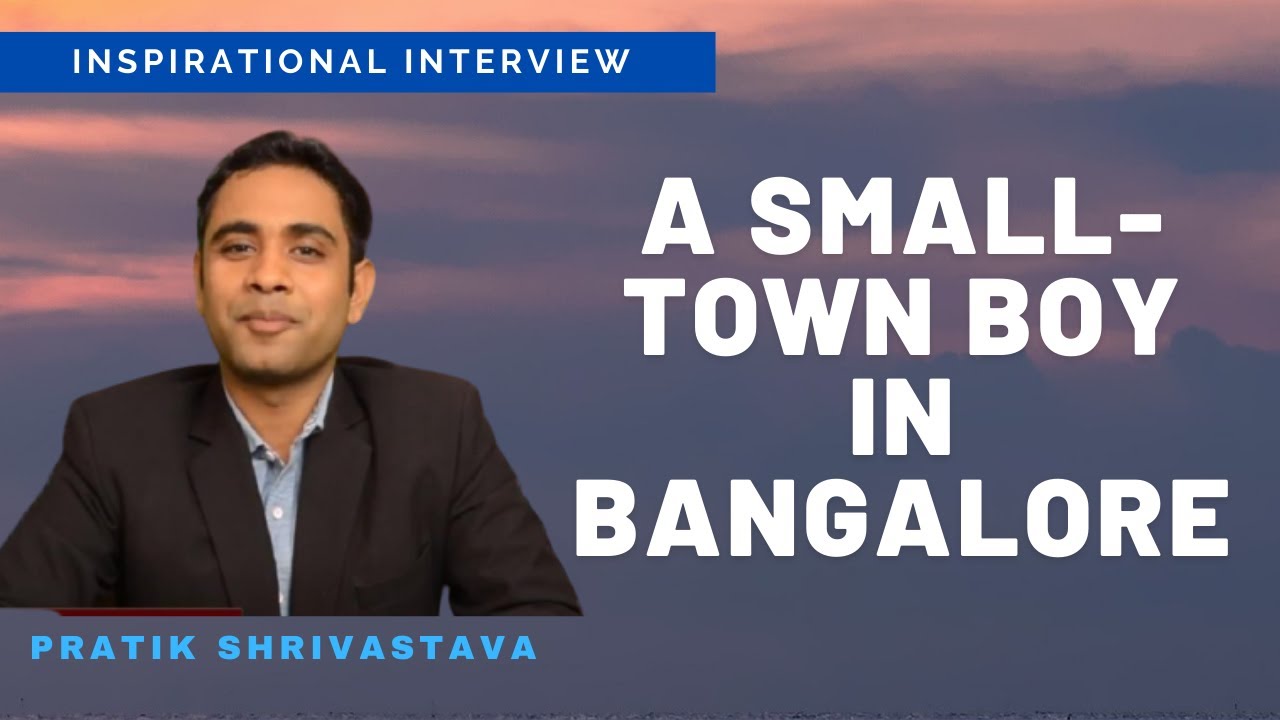
In this interview, Pratik Shrivastava recounts his journey from a remote village in Bihar to Bangalore, describing the intense physical and linguistic challenges he faced, including long daily bike rides, a lack of English proficiency, and social ridicule that bordered on discrimination. He explains how he overcame these obstacles by self‑studying English through YouTube videos, practicing speaking to himself in the mirror, and reading novels, eventually gaining confidence to converse with foreign clients. Pratik shares his philosophy that English should not be a career barrier and emphasizes the importance of self‑reflection and perseverance. He then offers practical advice for final‑year students and aspiring entrepreneurs: identify a passion, pursue it alongside a job that supports family needs, and leverage digital skills (e.g., freelancing, web development) to monetize that passion. The interview concludes with a promotion of his YouTube channel “Online Study 4 U” and contact email onlinestudyu@gmail.com for viewers seeking guidance.
Chapters
I will not work with the same intensity where I will work for 16 hours for my passion. Please do not think about how you speak, what you speak, just speak. So English should not be a barrier to your career. You should talk to yourself, you should understand your problem. So what is your problem? And you should rectify your problem by yourself. My journey is like I was always feeling demotivated, depressed. But one thing, you know, I learned from all those things that you have to fight. Whenever I was talking in English, I was trying. People will laugh at you. I was completely zero in English. I used to go by cycle some 13 kilometers, 3 times in a day, from a village to Bangalore, a metro city.
Awesome, awesome. That's an amazing story. Now it has become a story, but I can feel you that it must have been really, really painful. But I'm glad that, no, you kept to your values. You kept to that, no, this is the confidence and this is the respect that I deserve. And, and you didn't compromise. So great job. And, and I think that is the reason you are so successful now. So let's move on to another aspect. And I know, because I know you personally, that you are also from a small town, as am I. And you also made a career decision to move to a larger city. I think this is probably the first time I'm asking this question in the interview is, have you ever faced any sort of prejudice, to say, or sort of discrimination in terms of like, okay, you are from a small town or from UP or Bihar and you probably do not know or do not know English. Do you feel, do you ever felt, as they say, imposter syndrome, that no, you do not belong here? And how did you overcome that if you ever felt that?
So I think the people from, you know, a small town either from Bihar or UP, so almost 90% people would have faced this problem. But I think I had faced more problem. So as I'm from Bihar, a small town, small village actually, not even town. So that is a small village. And I still remember, so, you know, I used to go by cycle some 13 kilometers 3 times in a day. So that in for one class, 13 kilometers, and then come back. Then again one for maths, one for chemistry. So different subjects. So total, you know, 13 into 3, that, you know, 39 into 2. So almost 60-70 kilometers we used to travel for the classes. So till 12th, I did my education from— studied from Bihar, and then directly I moved to Bangalore. So it was a drastic change. I mean, from a village to Bangalore, a metro city. So yeah, when I came to Bangalore, I was not able to understand anything. So neither the traffic rule and English, I was completely zero in English. So whatever I'm able to speak today, so not even 1%, 1% of that. So I was like, you know, if I have to frame a sentence, I have to think 5 minutes, 2 minutes, 3 minutes, If I will speak, it will be right or wrong. So that kind of situation I had, and I got admission in, you know, in a college, Indian college in Bangalore, which is like, their Hindi itself is not there. So in colleges of Bangalore, Hindi is like very, very less, even you can say 1 or 2% of that. So definitely, now I have to, you know, if I have to talk, I have to talk in Hindi. I cannot talk in English because, and whenever I was talking in English, I was trying People will laugh at you. See, it's, you know, the reality of life. Whenever you'll try something, people will start pulling you. So whenever I was trying, even with the bad English or wrong English, the people started laughing. So that was also, you know, even I had an interview with, you know, Joe Stocks, and there I had discussed that. So that was really a very, very bad moment. I just wanted to leave Bangalore. So it's not even, you know, one month also, and I somehow I wanted to leave Bangalore because because of— so I will not say discrimination, but yes, I will definitely say so. This is a human mentality most of the places. So if you want to learn something, people will, you know, start laughing at you and they will, you know, keep pulling you back so that, you know, you do not grow, something like that. So that time also I started crying. So, you know, my journey, most of my journey is like I was always feeling demotivated, depressed. But one thing, you know, I learned from all those things that you have to fight. See, nobody will come and tell, okay, you please sit, I will teach you English. So that time I cried. I mean, for one year, I will say one year, almost like every time, like I was kind of demotivated. How should I talk to someone? And forget about, you know, the girls and all, I was not even seeing them. Because if I will, you know, I have to talk to any— I have to talk in English. So if I, you know, go and ask something, I have to talk in English. So that kind of like, you know, the complexity you will feel. And even from Bangalore guys also, I was not able to talk. And then I thought like, what should be our next step? So fine, now I cried, I am not understanding the things, and I am feeling very much difficulty. Then what is next? If I'll keep crying, then either I should go back home or If you want to do something, then you have to fight and you have to continue with that. Then I started, you know, watching videos, YouTube videos, and I know I started learning by myself. I started talking to myself. So before that, I had never talked to myself. What I am, I was not knowing. So I was only, you know, interested in friends, families. But that time I realized you should talk to yourself, you should understand your problem. So what is your problem? And you should rectify your problem by yourself. You find the way. So nobody will come and tell, okay, you do this and then you will improve, because people will think if he improves, then it will be a problem for— he will grow. So that, that will be always there. So then I started, you know, reading some novels and Chetan Bhagat. Now also my English is not very good, so I will not say, you know, I am very good, but yes, I can manage. And with that only, now also I am managing and I have my family members of, as I said, 100K subscribers. So they like that kind of, you know, uh, in that way itself. But that time it was a very worse situations. So I went through like YouTube videos and then I started talking to myself in front of the mirror. I am going, I am eating, I have to eat, I have to talk. And then slowly, slowly, yes, but I fought. So with every situation I have cried at the same time and I have fought at the same time. And now, yes, I can talk, uh, you know, to people. So we also have in office our foreign clients and all. So yes, I talk to them. So yes, but that struggle will be always there, not only for me, for every student, those who are coming. So in, uh, you know, most of my YouTube videos, I will mention, um, that one line: please do not think about how you speak, what you speak. Just speak. So English should not be a barrier to your career. So once you get the confidence, all your, uh, this barrier should go away. So that will be a moment, yes. So it was a very bad moment. I still, when I recall, I feel like I should leave Bangalore, but now Bangalore has given me so much, so I really respect.
Yeah, and in no way we are disrespecting Bangalore. I've also been there for 3 and a half years, and it's It's a beautiful city. So the purpose of this interview is not to malign Bangalore in any way. The purpose is to showcase that now everybody has their own struggle.
Any, yeah, any metro cities, we will definitely face this problem. But yes, so Bangalore has given me so much. Now, you know, my house is in Bangalore, and I'm completely settled here.
Awesome.
Yes.
So what I loved is that now there is one quote you might have heard is that now feel the fear and do it anyway. You felt that, okay, you are, you are being maligned, you are being discriminated, if I may say, or no, you are not able to perform to your potential. But then you made the plan, how can I improve? How, how can I make it better? How, what is my strategy to make it grow? So thank you so much. Congratulations. The fact that you are giving this interview in English should be a milestone for you and for everyone who's coming from such cities. So not only It's not only about me or you, it's about all those people who come and have such kind of some small thing in their mind.
So true.
All right, so we are coming towards the end of this particular interview, uh, and one last thing that I want to ask is that, now you already gave too many, uh, tips and guidance, but if there is a person who's either in their final year of studies or looking towards entrepreneurial journey or starting a job, What are the top 2-3 tips that you want to give them that will help them, you know, better their career?
Okay, see, uh, the first thing what I realized is, so there are two parts of life. One is we have to earn and we have to feed our family, and one to pursue your passion. And the third aspect is going with both. So if you are in, you know, final semester, uh, And first you select what is your passion. So first you find out what is your passion, where you can do better. I see, I can, you know, uh, tell you. So if somebody will ask me to work, you know, for 8 to 9 hours in a different work, I will not work with the same intensity where I will work for 16 hours for my passion. So that makes a difference. And trust me, that passion One day it will convert in a profession and you'll never even imagine that how much, you know, you are earning from there. So if you take the example of all singers, actors, so those who have, you know, created the platform for themselves. So if you're in final year, then you find out your passion and along with that you start whatever job you get. So suppose if you get in a job in a software or maybe in marketing, So you start a job if you really need that, and along with that you work on your passion. So many people are there who are very much interested in singing, so you, you keep that as well. If you're in dancing, keep that also as a passion, and you get some job so that you can also pursue your passion. Because, you know, behind going your passion, you should also see, so if you come back, then what is there for you? So you should always have a backup of the things, uh, which should be there in your mind. And, uh, yes, definitely. So in the growing era of technology, so if you— if the final year students are passionate into technology, then it's a boon for them, uh, because we have like digital marketing, we have website development. So all those things are, you know, if you work as a freelancer also, you can definitely earn a lot. So these are the— yeah, so yeah, awesome.
Thank you, Pradeek, that was lovely, uh, hearing from you. So how can somebody reach out to you? Would you like to give the details of your channel, website, etc.?
Yeah, so, uh, my channel name is Online Study 4 U. So I, I hope I had mentioned in the beginning as well. So, uh, we have, uh, you know, on YouTube channel, uh, we have our official, uh, email ID. And, uh, so email, uh, I, I only handle, so the calls and WhatsApp my team handles, but definitely I will be always available to look at the queries which comes to the email and I always interact with them. So it is onlinestudyu@gmail.com. So if anyone wants, you know, any suggestions, or if you want to, you know, give some suggestions to improve myself, or if you want any suggestion to, you know, improve yourself, so definitely We can connect anytime over the email. So it is onlinestudyu@gmail.com. And we have a YouTube channel, Online Study for You.
Yeah, thank you so much, Pratik. I'll also put that in the description so that people can get that. So thank you so much. It was an honor and privilege. And your journey is a beautiful journey. With that, we can learn a lot from— no, for all of us, we can learn a lot. So thank you so much. Thank you so much for being part of this show. So until next time, keep learning, keep growing, and keep going out of your comfort zone. This is Haritosh Srivastav, and I'll be back with another episode of Inspirational Interviews. Thank you so much.









