Pioneer Demo Meeting - 24 Mar 2020
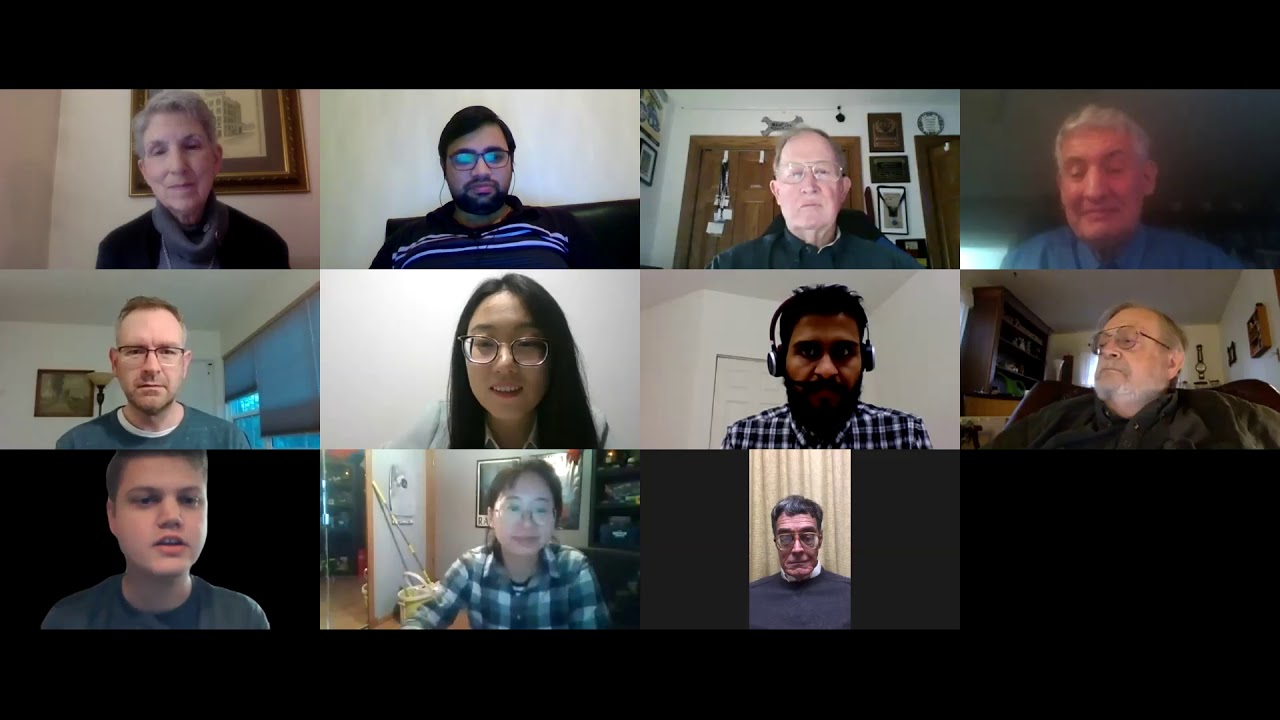
The video records a full Toastmasters demo meeting held online on March 24, 2020, organized by the Pioneer 17 Club (Indianapolis). The meeting opens with the club president outlining the club’s mission and the need to move to a virtual format because of the COVID‑19 epidemic. Each standard Toastmasters role is introduced and explained: Word Master/Grammarian (Haritosh Srivastav) presents the word of the day “epidemic” and tracks filler words; Timer (Shui) demonstrates an innovative visual timing system using green/yellow/red cues for speakers; Toastmaster of the day (Nora Hoey) leads the agenda. The prepared speaker (Mark Walton) delivers a 5‑minute talk titled “Some Things Have Changed, Will We?” offering concrete advice for effective online presentations – lighting, background, attire, camera eye‑contact, vocal variety, and gestures. Table Topics Master (Cameron) poses two impromptu questions about the biggest benefit of virtual meetings and how preparation differs online; speakers Larry and Travis respond with practical observations and personal preparation routines. Evaluators (Jerry Zimmerman, Anna, Tom) provide feedback on speech structure, use of the word of the day, filler counts, timing, and overall meeting flow. The meeting concludes with reports, a general evaluation, and a closing by the president. Throughout, the content emphasizes how traditional Toastmasters tools can be adapted to a remote environment, highlighting both challenges (loss of physical movement) and opportunities (enhanced vocal variety, technical skill development).
Chapters
Welcome, fellow Toastmasters. Welcome to the demo meeting of the online session of our Toastmasters. I'll start off with the meeting with our club mission. We provide a supportive and a positive learning experience in which members are empowered to develop communication and leadership skills, resulting in a greater self-confidence and personal growth. This— we have a preset agenda where we'll be going over each of the roles. And the first role that we have today is the Word Master. The Word Master for tonight is Haritosh Srivastav. Haritosh, can you please explain your duties?
Thank you, Mr. President. It's an honor and privilege to be the Word Master Grammarian for this demo meeting. So as a grammarian, I am gonna focus on good uses and not so good uses of English language. Also, as a grammarian, I am supposed to give a word of the day. So since the theme of the meeting is related to coronavirus, I thought this would be an interesting word. The word is epidemic, which means a widespread occurrence of an infectious disease in a community at a particular time. You can use it like, World Health Organization has confirmed coronavirus as a global epidemic. I would encourage you all to use this word of the day. Also, I'll be keeping a check of all the fillers like, um, so and other. These words are not supposed to be used and it's not sign of an effective speaker. So I'll present my report towards the end of the meeting when called for. Over to Mr. President.
Thank you, Haritosh Srivastav, for sharing your duties. Due to this epidemic that we are forced into of not having face-to-face meetings That's the reason we are having an online demo meeting to utilize what all opportunities that we can pertain with. At least we can go ahead with our Toastmasters meeting without having to attend the face-to-face. This— moving on to the next role. The next role is timer. Timer for tonight is Shui. Shui, could you please explain your duties? Shui, you're on mute.
Yes, Toastmaster. I realize online meeting during the coronavirus epidemic is going to be another epidemic. It's going to be a new trending for people to meet online. Tonight I'm going to introduce the tool for online meeting time controlling. We have one speaker, He's going to give a 4 to 5 minute speech, so I'm going to share my screen. For 4 minutes, I'll have green light for him. 4 and 30 seconds, yellow. 5 minutes and over 5 minutes, will be red. I will only show the time card when the timing limit— time close to the limits. So you won't see the time card all the time during the speech. For Table Topic speakers, 1 minute is green, 1.5 minutes yellow, 2 and more than 2 minutes will be red. Each speaker will have 30 seconds to wrap up their speech. Thank you, Toastmaster.
Thank you, Shui, for coming up with an innovative way of timing the speeches. With this, let's move on to our meeting, and the Toastmaster for tonight is Nora Hoey. Nora, over to you.
Welcome, fellow Toastmasters. Are you ready to do this? Are you excited? Yes, that's what we're all about. We're going to have fun while we do this. In fact, we're going to have an epidemic of fun, I think, as we move through this new opportunity for all of us. Our prepared speaker for tonight is Mark Walton. He will speak with us about online meetings. He'll discuss some of the things he has learned and some of the things that he wants to learn yet. The title of his speech: Some Things Have Changed, Will We? Please welcome Mark Walton.
Thank you, Madam Toastmaster and fellow Toastmasters. It's good to be here, or there, wherever we happen to be tonight. I'm going to state the obvious. This epidemic has changed the world, and we Toastmasters are finding ourselves changed as well. Let's be very specific about what we have done in the past. We all know this is true. We have helped our members to overcome their fear of public speaking, and we've helped them to become very, very good at it. Those are tremendous accomplishments. That's what has built and maintained Toastmasters. But guess what? There's no more public speaking for the foreseeable future. We can't even guess how many months it will be before we can resume face-to-face meetings and before other sections of the culture and the economy and the nation will begin face-to-face opportunities for speaking. So what do we do in the interim as Toastmaster clubs? How do we retain our value as a Toastmasters club to our members? What are we going to offer them if we can't offer them confidence in public speaking? What? Well, to my mind, The answer is we can help them to become effective at online meetings. Help them to become an important part of the meeting, to engage their audience, and not be just another little icon in the corner of the screen. Because there's a lot of icons in this world, folks. I don't want to be one of them, and I suspect you don't either. And if that's all we become, it will be all that we were. We don't want to go there. What are some of the things we could do? I have a short list of some things that I have learned. There are others too. Look at the light. Is the light hitting you in the face, or is it coming from behind you? Look at your image in the screen. If you look like somebody who was caught on the surveillance camera in a liquor store holdup, you need to change your lighting and probably stay away from that liquor store from now on too. You want the light to shine down on your face as equally as possible. The rest of the light, you do not want it glaring in the screen. That's pretty obvious. You'll see a lot of difference as you experiment with your screen and with your image. How about your clothing? Look, I've got on a sweater, shirt with a collar, huh, huh? Pretty impressive for me who usually runs around in a sweatshirt. Now what you cannot see is I'm wearing fluffy bunny slippers, but that's okay. They're not in the screen. But what you can see should be dressed for business. Makes sense? So checks and stripes with a multicolored background is going to look strange. Think about business attire. And of course the background. Most of us here tonight have got pretty good backgrounds. I've got a fairly neutral background. We all know how to apply online backgrounds, and I'll not fiddle with that right now, but make sure that you present everything you can in your little portion of the world to be as professional as possible so that when your icon pops up as the speaker, you are an attractive speaker. What have we— what else can we do? Well, it's obvious that we have lost, for the most part, many of the Toastmaster tools that we have used in the past. Most of us cannot move around freely, use movement through the audience. A lot of gestures are going to be lost if we don't have full-body cameras. But what we do have is vocal variety. We can use different vocal variety as often as we like. We can use facial gestures. We can get our hands up around our face. Oh my, I wonder what he was thinking. Strange. There are many things that we can still do. Probably one of the most important is to remember to look at the camera. I have seen too many of us look at the ceiling even during an online impromptu meeting. You know what else we can do? Well, I will tell you that I do not because I'm new to this, but I'm hoping that you may have some information that I do not, and that you'll share it with us. This is how we have always learned as Toastmasters, and this is how we should in the future. So we've got to keep on learning, we've got to keep on being of value, and if we don't, you know what's going to happen? I'll let you fill that in, Madam Toastmaster.
Thank you, Mark. We are now ready for Table Topics, and filling that role tonight is Cameron. Come on in, Cameron, wherever you are, because I don't see you.
Thank you, Madam Toastmaster. Good evening, fellow Toastmasters. Tonight we have a pair of Table Topic questions. To get us through this epidemic that we're going through and to just give us a little demo on how we would do this. Tonight's meeting is virtual meetings. That's our meeting theme. And the first question I would like to ask for Larry is, what is the biggest benefit to having a meeting in a virtual setting?
Larry.
Well, I have written down several different benefits to having a virtual meeting. Mr. Table Topics Master, fellow Toastmasters, and any guests, one of the opportunities is that we can work really hard on our facial expressions. That's what's showing up most of all in these virtual meetings. Our style. Is really important, or frown, or being surprised. It, it can be anything. And our vocal variety, as Mark was talking about, we can speak very softly, or we can speak loud, or we can, we can pause. And we can also use gestures. And as Mark was talking about, we can use our hands in the screen with our face, and we can be expansive with our gestures. We also need to learn the technical aspects of working with Zoom, and the timing, the limitations, awards, voting, all of that has to be taken into account. As Mark said, we need to think about lighting and background and extraneous sounds. And there will be other reasons for the remote connectivity besides the virus. Guests like Haritosh Srivastav from India and other clubs learning how to do the things that we're doing and recording meetings for later viewing and being communicators and leaders, whatever our limitations. We started out with letters when we couldn't meet each other, and then postcards, and then telegrams, and then the telephone, and teleconferencing, and now we're to Zoom, and that's a great advance. But one of these days, I think we'll even have virtual hugs and handshakes. That's my hope. So, Mr. Topics Master.
Thank you so much, Larry, for describing the types of benefits that we'll be having, the things that we're going to need to work on, and referencing to Mark's speech on all the different types of advantages that we can take and work on that we can bring into our face-to-face meetings. Later on in the future. My next question will be for Travis. Travis, could you tell us how you prepare differently in a virtual meeting versus preparing for a face-to-face meeting?
Thank you, Mr. Table Topics Master and Toastmasters.
I—
let's see, how do I prepare differently for an online Toastmasters meeting versus an in-person meeting? Uh, the first step was wiping away the tears because My escape from this well-carpeted prison that I'm sitting in is Toastmasters on Thursday night. It really is my escape, my ability to actually be around people. The next thing I do is stand at the top of my stairs over here and yell in a very loud, clear voice, "Hey, everyone in this house, take the decibel level down about 50." notches because I'm going to meet with my friends in Toastmasters in my office for the best hour and a half of my life, expressing myself and improving my speaking abilities. Next, I look at— actually, I tone down my phone here. Thank you. And I look at the lights, as Mark just mentioned. I make sure that I'm well lit. The lamp back here is not lit. I have a couple blinds back here for some ambient light. That helps a little bit. Next, I test my equipment. I make sure that my camera and my speaker and my microphone all work before I log in, and I make sure that I log into the Zoom session as early as possible. It's important that the organizer and the Toastmaster can hear me and I can hear them, that we can see each other. And then the next thing is blocking. This screen is what everyone sees. Is there anything behind me that is distracting? If I actually move my screen down, you're going to see junk on my desk. Junk on the guest bed behind me, and I clear everything out. Then the last thing I try to do is experiment with the frame. Can I stand up and you actually see me and hear me? I don't know. Give me a thumbs up. Anybody? Can you still hear me? Awesome. Maybe we can try doing this instead of sitting down and feeling less framed in by this chair and the desk. Maybe that's the way to do it. And that's how I prepare for the meeting. Thank you, Table Topics Master and Toastmasters.
Thank you so much, Travis, for that answer and describing your whole process, from yelling at everybody in the house to bring the decibels down, all the way to the computer settings and the framing that you're doing to prepare yourself for, as best as possible, for this virtual meeting. And now I will return the meeting to our Toastmaster.
Thank you, Cameron. Let's give Cameron a hand for taking that responsibility. We are now ready for the evaluation part of our demo meeting, and to get us started, Jerry Zimmerman is going to evaluate our Table Topics speakers.
Jerry. Thank you, thank you, Nora. Appreciate the transitioning over to me for topics evaluations. We had two interesting speakers tonight. Actually, everyone did much better than I had expected, only in the sense that I expected them to be good, but I did not expect them to be quite this good. What I really liked were the gestures from both individuals. Larry, I thought you were excellent with your facial expressions and with your modeling of pitch, pace, and pause with the voice. That is something that it came across, and particularly the facial expressions showed that That is something we really are capable of doing. I was going to catch you for not greeting the audience, but you did slip that in, so very good. I caught a few, only about 3 ums and ahs at the beginning, and I know the Word Master will comment on that, but I think that's a problem that in a new setting, in a new situation, all of us are prone to. Prone to do that. So I appreciate, I think you did a good job and you were a good model for the points you were making. Likewise with Travis. You began with a nice greeting, worked in very smoothly. You too modeled the gestures. I like the one where you talked about this is the box that we're speaking in. I thought that was very effective. You also made good points about things that we can do for preparing, and you had some good humor in there. You too, I caught a couple of ums and ahs, but again, like Larry, mostly at the beginning, where I think under new settings, new circumstances, we're all going to have to watch that very closely. So you two both modeled a good Table Topics presentation. Over to you again, Nora. Oh, I'm giving this to Anna. So Anna, you're up.
Thank you, Jerry, for the evaluation. This is Anna. I'm going to evaluate Mark's speech. Here, I want to share in this screen. I made a mind mapping, and then really quick, I have 5 points. First one, Mark, you are doing great in your structure. Even though it's a very short speech, you have the very clear background introduction in the beginning, you have 3 sections in the middle, and you have a strong closing which reminded everybody in Toastmasters we are all keep on learning. I really, really like that concept for your speech today. Thank you for doing that. And you have your great body language as always you do. Even your limit is small screen, like this, you still using this gesture. Let us remember how small screen is, how your eye contact is, how everything is going on. So great job, Mark, for that. And thank you for using the word of the day, and you are very good at using that every single time. And also the eye contact, like I always said, you are good at eye contact. Keep staring at the camera like you are speaking to the people. The last part is suggestion. It's not for you, but it's also more about some thought I have. Like Trevor said in his Hippotopic section, if you can backward a little bit and give me a bigger gesture like you always did, I think that will be awesome. Sometimes we can also do the dancing club in the Zoom, you know. If that can be happen, more gesture for sure can be happen. And also this one screen is also a try on myself to showing us to use a different technology to pop into our meetings. So this is where Zoom gave us possibility to make that happen. So overall, thank you, Mark, very much for your sharing to put everything interesting and knowledgeable in a short speech. Very good speech. Thank you. Now I will give back the lectern back to Nora, our Toastmaster.
Thank you, Anna. I like that little tool. You'll have to tell us more about that resource. We are now ready for reports, and our first one is from Haritosh Srivastav.
Thank you.
I thought I had unmuted myself. Did everyone hear that?
Okay.
Thanks, Nora. So I'm here to present my Wordmaster Grammarian report. I am so happy to see that the word of the day epidemic was used by Rohit, twice by Shui, one time by Mark, and one by Cameron. If I miss someone, I'm sorry. There were a few fillers, starting with myself. I had two ahs. Larry had one ah and two ums. Travis had one ah and two and abrupt. And then Anna had two ahs I could not find in other speakers. In terms of not so good uses, so there were times where a sentence was started with 'I' and then it was abruptly completed. So maybe we can work on that. Now, my favorite part, the good words. So there were a number of good words used today: tremendous, opportunities, retain value, effective, icon, professional. Then there were a few alliteration: smiled, frowned, and surprised. Pitch, pace, and pause. Another couple of words: ambient lights and mind mapping. So that's it. Good job, everyone. And back to Toastmaster of the Day.
Thank you, Haritosh Srivastav. We are now ready for the timer's report, and that is Shui.
Thank you, Nora.
We have one speaker tonight. Mark, I'm not sure if you are timing yourself because you are right on 5 minutes and 30 seconds. Good time control. We have two Table Topics speakers. They're all in time limits. I think Larry speaks right on 2 minutes and 2 seconds. Travis speaks 2 minutes and 18 seconds. They're all qualified for the best Table Topics speaker if we held a vote.
Thank you, Shui. We are now ready for our general evaluator's report. Take it away, Tom.
Thank you, Miss Toastmaster Nora. So many things went well tonight, ladies and gentlemen. I am rather impressed. Nora, let's start with you. You booked us for 15 minutes early in preparation to make sure we all look good, and I think that is by far the best thing that you could have done for all of us. You made us look good and sound good before we even started our meeting. You did well with that, and you kept us muted throughout the meeting. We only had one or two incidents of somebody not remembering to unmute. So, Nora, thanks for controlling us very well this evening. For our evaluators, let's start with Jerry. Well done, Jerry. As always, you do offer a very well-balanced and easy-to-understand evaluation. Everybody has something they could go home with. I appreciate that. "Era, wow, I was impressed with that innovative tool you wrote up. That's a mind mapping tool. Don't tell me you can't teach an old dog new tricks because I learned something from you tonight. That was good to use as a tool, but what about your evaluation itself?" Again, well-balanced. You had something for the person to grow on and you gave them some things that they could do well, go home and feel good about themselves tonight. Thanks so much for that. Timer? Shwee! I love that online tool. You're going to have to show me how to use that for some other conference meetings we have scheduled soon. And you brought up the timing card right at the right point, a few seconds to let the speaker know what was going on, and then you had it turned off without any problems. Thanks so much for that. For all of us, I would like to comment on the hands-to-the-face things I see going on throughout the meeting. Yeah, Anna was doing some of that, and I was doing some of this, and I saw Cameron go like this. Those are being watched, people. People see you. At a face-to-face meeting, you can kind of turn your head and they won't see you with your wiping your eyes, but on camera, you You have to be careful. Altogether, I'm very pleased with how this has turned out. This has been a good online meeting, and we have something to teach other clubs, I'm sure. Thank you, Nora, and back to you.
Thank you, Tom. I, at this point, I'm going to make sure Well, actually, I really don't have any more comments. It's time to turn the meeting over to our President, Rokit.
Thanks a lot, Nora, for being the Toastmaster and having a smooth meeting for tonight. Let's have a big round of applause, the silence applause for Nora. Okay, this puts an end to our session. I would like to thank everyone from our Pioneer 17 Club from Indianapolis. To make up this meeting a very successful one. And that's it. The meeting is adjourned for tonight. See you next week. Thank you. Bye-bye.









