Story Spark Day 20 - Add Hook To Your Story
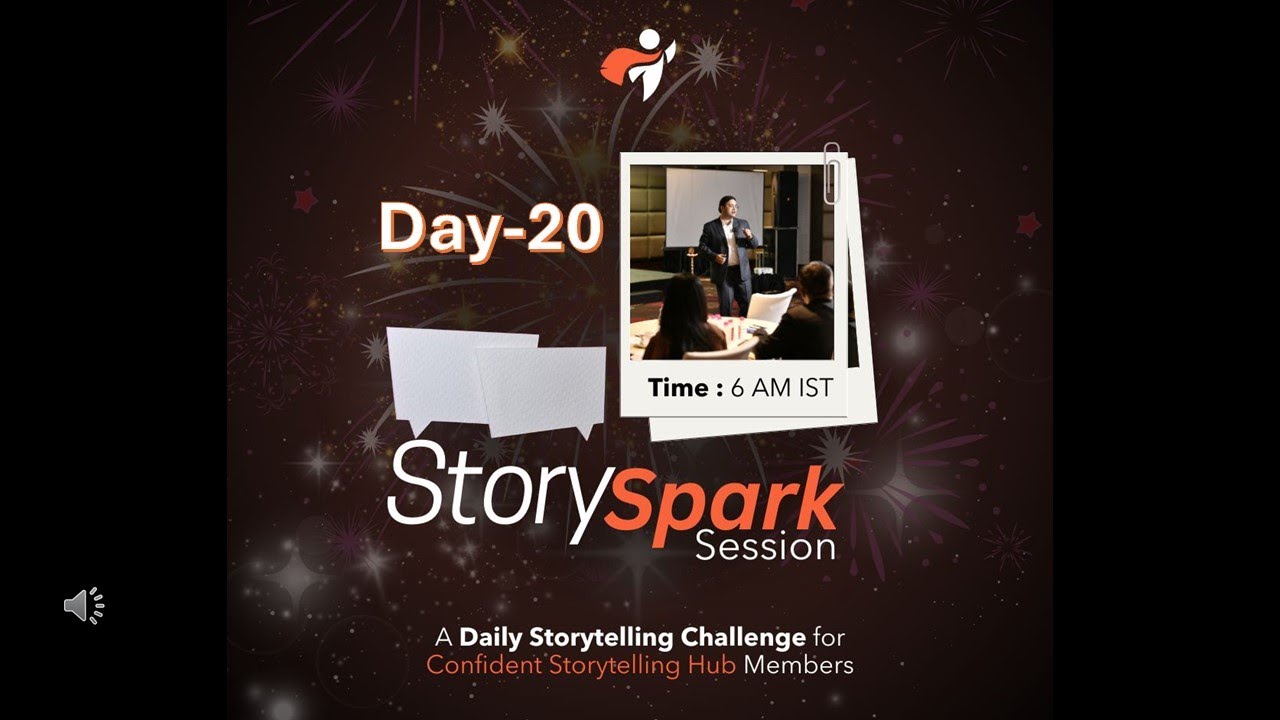
Haritosh Srivastav teaches five types of story hooks: rhetorical questions, quotes, conflict, startling facts, and imagine statements. Participants pick a quote and build a personal story around it. He emphasizes that a strong opening and closing make up 80% of a presentation's impact.
Chapters
Awesome! Welcome everyone to day 19 of StorySpark session. Is it day 19 or day 20? I just have to check. I think it's probably day 20. So welcome to day 20 of StorySpark session, and as you know, we have officially entered to the week 4 of Storython, which means that we are talking about the various elements. So Today's story Spark session is all about hooks. So who remember hooks from yesterday's session? What exactly is a hook? Venkat?
Hook is Audience, uh, make or make— makes audience curious or interesting. Yes, to start to understand.
Absolutely, something that catches attention of your audience, right? Uh, so in today's session, we're just gonna go and revise what are the hooks, and then we'll do a small exercise. So first is Just a quick reminder of types of hook. You have things like rhetorical question, which is more like question you already know the answer, but it is for creating the effect. Like, "Isn't this an amazing day?" That's a rhetorical question. The second one is quotes, where you quote something which is relevant for your story. Third one is where you take them right to the conflict, right to the big problem. The fourth is where you have a starting fact or statistics that is mind-boggling for anyone. And the fifth one is the imagine statement that you put. Now I just got a few examples of specifically quotes, and I thought this will be a good exercise today. So I got few quotes. For example, "You miss 100% of the shots you don't take." You can dream it, you can do it. Now here is the exercise for today. I want you to think about one of your story, right? And I don't want you to think about anyone's story, your story, and see which out of these quotes can you use in your story. Okay, so I want you to think about that. And think about which out of this quote can you do. So what we're gonna do is I'll give you couple of minutes to think about and you pick and choose one of these quote and then once we go through the exercise I want you to give a summary of the story that you are going to use with this particular quote. We are doing the other way around, typically people choose story and then choose the hook. We are choosing hook first and then you're gonna complete the story But the thing is, it has to be from your own life. So, okay, so I'm gonna have 2 minutes. So just pick one of those quotes, the 5 quotes, and then think about your story. All right, everybody clear? Awesome. So let's do it. Will last 15 seconds. All right, time's up. So Let's go around the room and see which hook did you use and what will be the story that you tell. So let's start with Venkat.
Yes, it's our choice that show what we truly are, far more than our abilities. So in all the meetings I faced that I, uh, concentrate on my body language and how to represent and how to present. But I, in the middle, I struck in many times because I'm, I'm, I'm not, I'm true. It's, it is, I am always thinking about others' point of view, how they think and how they think about my body language, my words. So then I, I realized that our true things are connecting others, not external makeup. Nice.
Awesome, great job. Story power to you. Everybody write SPTY in the chat. And let's go to Dr. Alka. So out of these quotes, which one will you take and what is the story?
So I have taken the 'If you can dream it, you can do it.' Yes, my life, my life has been all about that only. So very early in my life, when I ran away from my house, it was about dreaming to have a good life and dreaming to have something comfortable in my life.
Yes.
And not to live a toxic life with my mother-in-law. I just dreamt that I want to have a peaceful life. And that was the reason I left from there. And I put the wish in the cosmos, in the universe, that I want this. And one day somebody came and I was 3 months pregnant, and one day somebody came and told me that we are building a home in Vashi in New Bombay. Would you like to be a part of it? So I said yes, and that was my wish answered. That was the beginning of— so the first step, you know, that the last one which you have put, taking the first step, laosu, laosu. Or anything, you have to take the first step. That was my first step. The first step is to put the wish to the cosmos.
Yeah, the journey of a thousand miles starts with a single step. Yep, yep, awesome, great, great job. And everybody write story power to you, SPTY. All right, Rajesh ji, were you able to find a quote and the story?
Uh, yes. So the code for the, for the story is that, okay, out of this we need to achieve, uh, so, so the exercise was to take one of the codes and then add your story to it.
Have you done this?
Oh, I, I made my own thought. Okay, you can share your own code as well.
Yeah, go ahead.
Ah, you see, you know, from this also I can just show the screen, screen Sure, I'll show that. Okay, uh, this is, if you can dream it, you can do it. This is the quote I would like to add, uh, for my story. I always, uh, think of becoming as a, uh, as a trainer. And it was never— I was not into that field, but it was again like it was always there into my mind, in my thoughts. And I keep thinking how I can go into it, what exactly I can do for it. And, uh, I was not getting way, but somehow I just realized that some or the other way, I was always connected with this particular profile. And because it was my dream, and finally I decided to quit and come into training field. So that's the reason, like, I can say, if you can dream, you can do it.
Awesome. Thank you for sharing story. Power to you as well. Everybody write S-P-T-Y. To Rajesh Ji. And personally, I chose the fifth one, the journey of a thousand miles begins with a single step. 5 years back when I started the content creation journey, I had basically no idea what I am doing, and I was creating anything and everything. I went on YouTube, I did a lot of Instagram, and if you ask me why, why you are doing, I had no idea. But now looking back, I can connect the dots. I can see that was the training period for me. That was the bold move that I was taking so that I am getting ready for what I am doing today. So a journey of a thousand miles begins with a single step. Awesome. So this was the exercise for today of thinking about not starting your story with a vague thing, but having a hook. And specifically the quotes, that adds a lot of gravity to what you say. So let's go around and share how did this exercise made you look at your own story. Let's start with Venkat.
Yes, Haritosh Srivastav, I need to practice and implement. That is, I understand. And yesterday I read one book, and in that also It's mentioned, do not read too much book and research inside and create own content. So I have to create, uh, my own, uh, story with content. Yes, that is code. So I would practice and implement.
Correct. So just learning is not enough. Awesome, thank you so much. Yes, Dr. Alka.
So what Venkat is telling is— which book is it, Venkat? It is true, it is absolutely true.
4-Hour Week.
4-Hour Workweek.
4-Hour Week. Who's the author?
It's a very good— it's by Tim Ferriss, if I'm not—
yes, I think.
Okay, okay. So So what actually Haritosh Srivastav is doing is that only, Venkat. If you realize what he's doing, he is asking us to go to examples from our own life and asking us to give the quotes. Every day he's asking, what was that moment in your life which was a turning point in your life? What was that moment in your life where you change your perspective? What was that moment in your life? So these are all the ways he's making us go into our subconscious mind and to dig out the stories from inside. I think it's a very good exercise if we listen to what Haritosh Srivastav is saying properly, and if you can file the stories in our, in our story bank properly, whatever out of this, this exercise, it would be a great thing. So what I'm learning is to go to the subconscious mind and take out the stories which have helped us to grow in our life. It could be a small incident, but it is something which is worth noting it down, and it can be used anywhere in our, in our keynotes or in our training programs.
Absolutely, absolutely. Thank you for sharing that, Dr. Alka. Yes, Rajesh, what was your key moment for this? Yeah, feelings.
Okay, so, uh, after this, what I could learn is that everything is there in, uh, in you. The only thing is you don't realize your own potential. You need someone who can just push you. And who can just shake you. Yes, you can, you have everything, you just need to realize it.
Absolutely.
That is the learning for me.
Awesome, thank you for sharing that. And this week, as I said, we are getting into technicalities, and one of the technicalities we discussed today is the hook, because This is the way you start your story, and the way you start and the way you end covers 80% of your success. Even if you have little bit of weak points in between, if you have a power start and a power close, audience is going to remember. So what I want you to take away from this exercise is think about whenever you are presenting, sharing story, or addressing audience, don't be monotonous. Don't just say, "Thank you, good to have me, blah blah blah, it's a great weather." Start with a powerful hook, which for a speech itself is a good story, and for a story, a good hook is a quote, or it could be a startling statement, a figure, getting them right to the main or core of the story. So that way you will have the audience attention with you. Tomorrow we'll do the next exercise where we are going to talk about identifying characters in the story. So this is, as you can see, the overall theme I planned for the whole 3 months is for you to go through the theory, and these are the practical implementation, the StorySpark session. So thank you so much for joining. Tomorrow we'll have the next one, and, and as I say, until next time. Keep learning, keep growing, and keep going out of your comfort zone. See you tomorrow at 6 AM.
Thank you.
See you.
Thank you. Thank you. Have a good day.
Have a great day. Thank you.
Have a wonderful day, everyone. Thank you.
Thank you.









