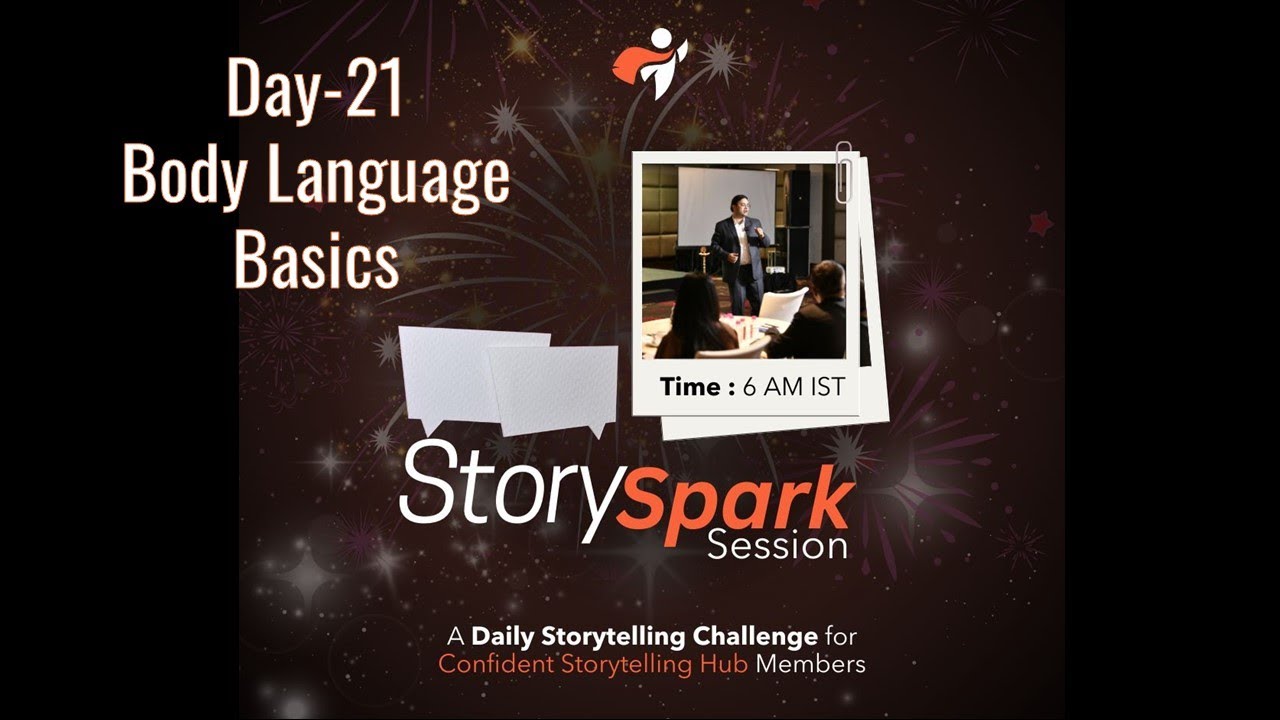
In this virtual coaching session, the facilitator introduces the delivery phase of storytelling by focusing on body language. Five core elements are outlined: facial expressions, hand gestures, posture, eye contact, and stage movement (adapted for a camera‑based environment). Participants are asked to journal a personal story within two minutes and then deliver it on camera while the facilitator observes the five elements, especially stage movement. Dr. Alka shares a personal narrative about leaving her job to become a more present mother, demonstrating the use of facial expression and gestures. The facilitator provides feedback, noting effective facial cues and hand gestures but warning against repetitive gestures, and explains how posture, distance between feet, and purposeful stage movement convey confidence and stability. The session concludes with three affirmations designed to embed confident, clear, and engaging physical presence in future storytelling. The tone is instructional, supportive, and encouraging, with practical, actionable tips for on‑camera storytelling.
Chapters
Okay, so welcome to day 21 of StorySpark session, and with this, today we are moving towards the delivery aspect of storytelling. So we have covered mindset, story collection, Story creation. Now we are talking about the delivery aspect. So the today's session is all about body language basics. As they say, roughly about half of our communication is non-verbal, which is through our body language. So if you want to be an effective speaker, you want to focus on our body language as well. And there are many aspects when it comes to body language, but the key key aspect is— are, sorry— facial expressions, your gestures that you make through your hand, your posture, how you are standing, how you are moving, your eye contact with the audience, and the stage movement. So these are the 5 key elements that we do. Facial expression shows whether you— what you are saying is congruent with what you are showing. Gestures, make, make a paint, make, make it a painting, the picture in your audience's mind. Posture shows how much your confidence and what you are going to do. Eye contact, again, eye is a window to the soul, so people love when you're able to make eye contact and able to speak confidently. And last one is, are you using your stage for the maximum potential?
Venture.
So what we are going to do is we are going to again, once again, journal one of the story, and you will have probably 2 minutes. You can take any existing story or new story, and then we are going to do the story delivery, and, and we are going to look into whether all these 5 aspects are covered, and specifically the stage movement, because it's a virtual thing. So it will be about how are using your camera presence, not actual stage because we don't have live cameras running over there. So let's do the journaling for 2 minutes, write down your story, and then we'll practice.
Okay.
Awesome. So time's up. Are you ready with your story, Dr. Alka? Are you ready?
Yeah, I'll just say the same story what I have in my mind. Sure, yeah, you have to just do the eye contact with the camera. And should I stand or what should I do?
I'm not— it's okay, you can sit and deliver as well.
Okay. My dad, he always sang lullabies to me as a little girl. I have a box of stories in my head when my dad sang those beautiful lullabies and he told me the stories at night. But when I became a mother, I wasn't spending enough time with my children. And I want to take you back to a time in my life when I had become a Cruella mom, and I was only running and running and running after my work. And one day I fell down and I broke my ankle. The pain of the ankle was not so much as the pain that was there inside of me, which made me feel so inadequate, so poor. And so, and so I felt very weak. And it was in that moment that I realized that I have to give up my job, and I resigned my job. And then what happened was like magic when I gave up my job, although it was very difficult because the pain was so much, because I had to pay my installment of my house with one installment. It was a very, very big and very difficult decision to leave my job. But I did that, and after that, my life completely changed. And what happened after that is history. I started spending more time with my children. I was playing with my children. I was doing all kinds of activities with my children. And my mindset changed, and there was so much of oxytocin coming into me, those chemicals coming into me. And with that, I got a very new purpose in my life, and the purpose was to become the best mom in the whole world. And that, my friends, did the whole change. And the purpose comes into our life The how becomes very, very easy. And then I changed my life. And I want to tell you all today that if you can find the purpose in your life, if you can reach out to the people in your life who can help you, and if you can be playful in your life— not playing with the children, but playful mindset— you can achieve whatever you want to achieve. And you can become adaptable. And you can— adaptability is a key to become— making you unstoppable. Thank you so much. I don't know how many minutes I took. I was just trying to do some gestures and something.
I understood. Great job. Uh, so yeah, you had some good hand gestures and your facial expression was also pretty good. I, I like that, you know, it was showing pain when you had pain, and it was also showing your eyes lit up when you had happiness. Of course, some of the gestures were repetitive, uh, so You might want to think about how I differentiate one gesture for another, because it cannot be the same gesture for everything, then it becomes distracting gesture as well. But yes, it's much better than not having any gestures at all. So great job and story power to you. Now, how did you feel? Yes, you want to say something?
So the thing is that when you make us do this exercise, You're not just telling a story, you're concentrating. So I was concentrating on facial expression, eye contact, and gestures, and I forgot the other two. What are the other two? The five things.
Yeah, stage movement and then your posture.
And your posture, so how you stand in front of the people, you're bending down like this, or how your posture is.
Yes, your stage— are you putting your hands in your pocket? Are you having cross-legged or standing still? What is the distance between your feet? And then, and stage movement is, are you just walking like a pendulum one stage, or you are just frozen at one place, not moving at all, or you're moving with purpose?
Yeah, I think that's very important. Yeah, I, I want to ask you, when we come in the center of the stage, we give our central message, and when we tell the story, we go to the side, and then we come back in the center, and then we give Yeah, so there are many ways you use the stage.
Of course, the central place of the stage is where your central message should come from, but then you can use story— use stage for, say, different stories at different parts. You can use it as a timeline as well, that this was past, this is present, this is future. So there are many ways to use. You can also use it for different emotions, that this is where I talk about all the happy, positive emotion, this is where I talk about all the negative dark emotions. So that also is there. So depending on the context and story, you can use that.
So if you stand cross-legged, and what should be the distance between the two feet?
Uh, distance is, uh, as this thing should be not too close because then you tend to become this wobbly. And if it is too far also, that shows that you're not balanced. So general distance is the distance between your shoulder. So that you can stand there easily and you don't have to— you don't feel like you're moving unnecessarily and it is stable.
Yeah, the stability should be—
stability is very important.
It comes with confidence when you are talking about your subject and when you are going to say something.
Absolutely, absolutely. Awesome. So now let's go to the last part of the session, which is affirmations. So I've got 3 affirmations again related to today's topic. So let's start with first one: my body speaks with confidence, clarity, and connection.
My body speaks with confidence, clarity, and connection.
Number 2: I tell powerful stories not just with words, but with every movement I take.
I mean, I tell powerful stories not just with words, but with every movement that I make. Yeah.
And the last one for today is: My presence can capture attention. I am a storyteller who is seen and felt.
Okay, my presence can capture the attention of the audience. I am a storyteller who is seen and who is felt.
Yeah, awesome. Story power to you. So that was day 21 of StorySpark session. We'll continue tomorrow with day 22 with focus more on delivery aspects. So I'll see you tomorrow. Take care, have a fabulous day ahead.
This affirmation will put in the group, no, because I could not copy them.
Okay, I'll put that in the group. Yeah, thank you, take care, bye.